A noise complaint on a 45RFE is one of the easier jobs to get wrong and one of the most expensive. The customer says "the transmission is whining" or "it clunks," and half the time the noise is coming from the axle, the transfer case, a driveshaft slip yoke, or a heat shield. The other half it really is the transmission, and then the question becomes which of the pump, a gearset, a thrust bearing, the park gear or an accumulator is making it. Each of those has a signature, and you can find most of them with the truck still on the ground.
This is the way I sort 45RFE noises: what the unit is doing mechanically in each range, how to tie a noise to engine speed, output speed or a specific gear, and the known RFE noise faults that are documented well enough to trust.
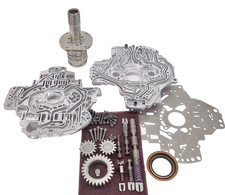


Know what is turning in each range
Most noise diagnosis on this unit comes down to one fact: you have to know which parts are spinning, and which are spinning against each other, in the range where the noise happens. Per Chrysler's RFE service description, the geartrain uses three planetary gearsets, three input clutches (underdrive, overdrive, reverse), three holding clutches (2C, 4C, low/reverse), five hydraulic accumulators and a dual-stage pump. The 45RFE ratios are 3.00:1 first, 1.67:1 second, an alternate 1.50:1 "second prime" used for high-speed kickdowns, 1.00:1 third, 0.75:1 fourth, and 3.00:1 reverse.
The clutch application chart from Chrysler's road test procedure is the tool that matters here:
| Range | Applied elements | What it means for noise |
|---|---|---|
| Park / Neutral | Low/reverse clutch | Geartrain mostly idle. Noise here with engine running is pump, converter or flexplate. |
| Reverse | Reverse clutch + low/reverse | Gearsets loaded backward. Gear whine often loudest here. |
| 1st | Underdrive + low/reverse (below 150 rpm output) + overrunning clutch | Highest gearset load. Overrunning clutch ratchets on coast. |
| 2nd | Underdrive + 2C | Planetaries under reduction. |
| 2nd prime | Underdrive + 4C | Different gearset path from regular 2nd. |
| 3rd | Underdrive + overdrive | Direct drive, 1.00:1. Gearsets lock and turn as one. |
| 4th | Overdrive + 4C | Overdrive ratio, gearsets turning again. |
The row to remember is third. With the underdrive and overdrive clutches both applied, the planetaries turn as a solid unit, so the gears are not meshing under relative motion. A gear or planetary whine that is present in first, second and fourth but drops out completely in third is almost certainly inside the geartrain. A noise that does not change at all when the unit goes into third is probably not a gearset.
Step one: is it engine speed, road speed, or gear?
Before any parts come off, Chrysler's road test procedure says to check the fluid level and shift cable adjustment and resolve any diagnostic trouble codes. Do that first. Then classify the noise with three simple tests.
Test 1: Park, engine speed only
With the truck in park, bring the engine up slowly to 2,000 rpm and back down. Then do the same in neutral. If the whine is there and climbs with engine rpm, it is following something turned by the engine: the pump (driven by the converter hub), the converter itself, or engine accessories. Pull the serpentine belt for a minute to rule out an alternator, idler or power steering pump. If the whine stays with the belt off and the fluid is full, you are looking at the pump or converter.
Test 2: Coast in neutral, road speed only
On a safe road, get to the speed where the noise happens and slip the shifter to neutral with the engine at idle. If the noise stays exactly the same while engine rpm drops, it is following output speed. That points at the output shaft and park gear area, the transfer case on 4x4 units, the driveshaft, or the axle. A loaded gear whine usually fades in neutral; a bearing or axle noise usually does not.
Test 3: Gear-by-gear on the scan tool
Hook up a scan tool and watch the current gear, input speed, output speed and engine speed PIDs while you drive. Note exactly which gear the noise is in and whether it changes the instant a shift completes. On a 45RFE you can hold second with the shifter in "2," which lets you separate second from second prime and from third.
Whine that follows engine speed: pump and pickup
The RFE pump is gear-type and turns at engine speed any time the engine is running, so its whine rises and falls with the tach. Two things make it loud: the pump is sucking air, or the pump gears and pocket are worn.
Air first. A low fluid level or a pickup filter that is not sealing will cause the pump to cavitate. You get a whine that is worse on hard stops, sharp turns and steep grades, often with foamy fluid and line pressure codes. Check the level with the fluid hot using the procedure for that vehicle, top up with ATF+4 only, and if the noise is still there, drop the pan and look at the pickup filter neck seal. A rolled or torn O-ring on the filter will make even a new pump howl.
Then the pump itself. If the level and filter are right and the whine is still tracking engine rpm, the pump gears, pump body face or converter hub bushing are the suspects. A pump that has eaten debris from a failed clutch pack usually shows other symptoms first: delayed engagement, P0868 low line pressure, and slipping when hot. Our 45RFE pump failure guide covers the line pressure scan data and the bench checks in detail.
A converter can also make a whine or a growl at engine speed, usually from its internal thrust bearings. The difference is subtle from the driver's seat. With a mechanic's stethoscope on the bell housing versus the case near the pan, the converter noise is usually loudest up front.
Whine or growl in certain gears: planetaries and thrust bearings
When the noise is gear-specific and goes away in third, the problem is in the geartrain. The two common sources are gear mesh wear on the planetary pinions and failing thrust bearings between the rotating members. A whine is usually gear mesh. A growl or rough grinding that changes with load is usually a bearing.
The RFE uses a lot of thrust bearings, and they take a beating when the unit has been run low on fluid or overheated. Sonnax's SBK-C17 bearing kit for the 45RFE and 545RFE (1999 and later) lists bearing noise and bearing failure as the symptoms, and the kit maps out twelve bearing positions, including:
- Input support to input drum, and underdrive hub to input drum
- Underdrive hub to overdrive hub, and overdrive hub to reverse hub
- Reaction annulus to reaction sun gear
- Reaction sun gear to reaction carrier / reverse sun gear
- Reaction carrier / reverse sun gear to reverse carrier
- Input sun gear to reverse annulus / input carrier
- Reverse hub to the center 2C/4C support, and 2C/4C support to reaction annulus
One detail that catches rebuilders out: Sonnax notes the bearing between the reverse carrier and the input sun gear is a 1999 to early-2004 part, and late-2004 and later units use a .204 in. thick bearing in that location. Mixing the early and late bearing changes end play and can create the same noise you were trying to fix. Measure input and output shaft end play on teardown and again on reassembly, and match the bearing to the build date.
On the bench, inspect each planetary carrier for pinion end play, blued or pitted pinion gears and worn pinion washers. Any carrier that has been run hot enough to discolor the pinions gets replaced, not cleaned.
Ping or metallic noise in and out of Park
This is a documented 45/545RFE complaint and it sounds a lot worse than it is. The vehicle makes a "ping" or metallic ringing noise when the shifter goes into or out of Park, and it seems to come from the tail housing area. As reported by Underhood Service, the cause is wear on the output shaft spline or the park gear that lets the park gear move on the shaft and ring like a bell.
The confirmation test is simple once the tail housing is off: strike the park gear with a metal object. If it rings with the same sound the customer hears, you have it. The published fix is to center-punch (peen) the spline area to create an interference fit that holds the park gear tight on the shaft. The bulletin's warning is worth repeating: do not over-peen the spline, or the park gear will be very difficult to remove the next time the unit is apart.
Clunks: coastdown, garage shifts and Drive to Neutral
Coastdown clunk
A clunk felt as the truck coasts down to a stop is often an accumulator problem. The RFE uses accumulators to cushion each clutch apply, and when the accumulator piston or its bore wears, the downshift lands harder than it should. Sonnax's vacuum test guide for the 45RFE through 68RFE family lists "coastdown clunk" as one of the symptoms addressed by its accumulator piston and sleeve kits, alongside slide shifts, high CVIs and 1-2 shudder. If your 45RFE also shows high clutch volume index values on the scan tool, check the accumulator pistons, seals and bores before you suspect hard parts.
Do not skip the driveline on a coastdown clunk. Grab the driveshaft and rotate it by hand to feel how much lash there is between the transmission output and the axle. Loose U-joints, a dry slip yoke, worn differential gears and worn transfer case chains all clunk on throttle transitions and get blamed on the transmission.
Harsh or audible Drive to Neutral
On some 2011 and 2012 Dodge and Jeep vehicles with RFE transmissions, Chrysler addressed a harsh or audible shift from Drive to Neutral, most noticeable with everything at full operating temperature. According to the Underhood Service summary of TSB 21-010-12, when neutral is selected the drive circuit pressure drops suddenly and jolts the driveline. The fix was a revised valve body spacer plate, 52120004AB, with a restricted exhaust path that slows the release. The plate part number is stamped on the plate and can be read with only the pan off. The same write-up points out that the 2010-and-later grey-connector solenoid design changed the spacer, and those parts do not fit earlier units with white or black connector solenoids. Confirm the bulletin applies to your vehicle before ordering anything.
Buzz or tick from the solenoid pack
Early RFE solenoid packs could be noisy. Sonnax's RFE universal valve body write-up notes that Chrysler changed the solenoid pack in 2004 to reduce operational noise by switching to internal solenoids, the design identified by the white connector. The original design used a black connector. The later design was retrofitted back to earlier units. On an early 45RFE with a black-connector pack and a buzzing or ticking noise that comes from the pan area and changes with shifts or lockup, the solenoid pack is worth a look. Check it against the vehicle's valve body before swapping it, because the connector generations are not all interchangeable.
Preventing the noise from coming back
- Keep the level right. Low fluid is the leading cause of pump whine and cooked thrust bearings.
- Replace every thrust bearing that shows roughness or discoloration during a rebuild, and match the late-2004 .204 in. bearing where it applies.
- Flush the cooler and lines after any failure that left debris in the pan. Debris that comes back through the lube circuit takes out new bearings fast.
RFE Accumulator Piston Kit (1999-up) at CoreTransmissionParts
Bonded accumulator pistons for the RFE family, the usual fix when worn accumulators are behind a coastdown clunk. Confirm fitment for your unit before ordering. For bearings, pump parts and the rest of the RFE hardware, browse the full collection.
View the piston kit → RFE family parts45RFE pumps, accumulator kits, filter kits, solenoid packs, planetary parts and overhaul kits — shipped from the USA.
Shop 45RFE parts →FAQ
Why does my 45RFE whine when I accelerate?
If the whine rises with engine rpm in every range, including park, it is usually the pump sucking air from low fluid or a bad pickup seal, or a worn pump or converter. If the whine only shows up in certain gears and disappears in third, which is 1.00:1 direct drive, the noise is coming from the planetary gears or thrust bearings.
What causes a 45RFE to clunk when slowing down?
Worn accumulator pistons or bores are a common transmission cause, and Sonnax lists coastdown clunk among the symptoms its RFE accumulator piston and sleeve kits address. Driveline lash from U-joints, a dry slip yoke, the transfer case or the axle causes the same complaint, so check the driveline before pulling the transmission.
Why does my 45RFE make a ping when shifting into Park?
A metallic ping going into or out of Park on 45RFE and 545RFE units usually comes from wear on the output shaft spline or park gear, which lets the park gear ring like a bell. With the tail housing off, striking the park gear confirms it, and the published repair is to peen the spline area for an interference fit without over-peening.
Can low transmission fluid make a 45RFE noisy?
Yes. Low fluid or a leaking pickup filter seal lets the pump draw air, which causes a whine that tracks engine speed and gets worse on stops, turns and grades. Running low also overheats the thrust bearings, which later turns into a growl in specific gears. Check the level hot with ATF+4 before any other diagnosis.
Sources
- Chrysler — 545RFE Description (2007 Jeep Commander service information). The RFE geartrain layout: three planetary gearsets, three input and three holding clutches, five hydraulic accumulators, a dual-stage pump, and the gear ratios including 2nd prime for high-speed 4-2 kickdowns. Chrysler RFE description
- Chrysler — Road Testing and RFE Clutch Application Chart. Checking fluid level, cable adjustment and codes before a road test; the clutch elements applied in each range, including underdrive plus overdrive in third and low/reverse on only below 150 rpm output speed in first. Chrysler road testing
- Sonnax — Bearing Kit SBK-C17 (45RFE, 545RFE, 1999 and later). Bearing noise and bearing failure as the symptoms; the twelve bearing locations; the late-2004 and later .204 in. bearing at the reverse carrier to input sun gear position. sonnax.com
- Sonnax — Chrysler 45RFE, 545RFE, 65RFE, 66RFE, 68RFE Vacuum Test Guide. Coastdown clunk, slide shifts, high CVIs and 1-2 shudder listed against the accumulator piston and sleeve kits. sonnax.com
- Sonnax — "RFE Transmission Universal Valve Bodies: One SKU Does It All." The black, white (2004) and grey (2010) solenoid pack connector generations, and the 2004 change to internal solenoids made to reduce operational noise. sonnax.com
- Underhood Service / Vehicle Service Pros — "A Couple of Late-Model RFE Concerns." The 45/545RFE Park ping from a worn output shaft spline or park gear, the strike test and the peen repair with its over-peen warning; TSB 21-010-12 for a harsh or audible Drive to Neutral shift on 2011-2012 RFE vehicles and spacer plate 52120004AB. vehicleservicepros.com