A 45RFE with a pump problem rarely walks in with a note that says "pump." It shows up as a Ram that sits in the driveway for thirty seconds before it will take reverse, a Durango that has to be revved to 1,500 rpm just to creep, a Liberty that whines louder the faster the engine turns, or a truck that throws P0868 every time it gets hot. Some of those are pumps. Plenty are not, and a pump is too much labor to install on a guess.
This is how the 45RFE pump does its job, what wears out inside it, which faults outside the pump look exactly like pump failure, and the order I check things in before I pull the unit.
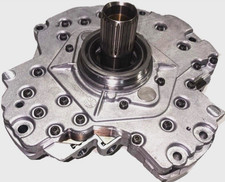
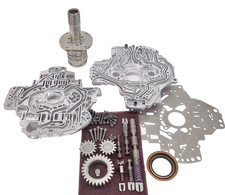

What the 45RFE pump actually does
The pump sits behind the converter at the front of the case and is driven by the converter hub, so it turns at engine speed whenever the engine runs. It is a gear-type pump. Sonnax's remanufacturing spec checks pump gear to body face clearance on every build, and that clearance is one of the first things that goes. The pump draws fluid from the pan through the pickup filter and pushes it out as main line pressure.
The RFE pump is more than a pump, and that is why it causes so many different complaints. The pump body and cover carry a full set of valves:
- Pressure regulator (PR) valve: sets main line pressure.
- TCC regulator valve and TCC switch valve: meter and route converter clutch apply and release oil.
- TC limit valve: limits the oil feeding the converter.
- TCC accumulator: cushions the converter clutch apply.
Line pressure on this family is electronically controlled in closed loop. Per GEARS Magazine's ATRA write-up on RFE pressure codes, the TCM controls line pressure through a variable force solenoid in the solenoid pack by changing its duty cycle. About 5% duty cycle (solenoid off) gives maximum pressure and about 65% gives minimum. That solenoid feeds the end land of the pressure regulator valve, and a line pressure sensor on the outside of the case reports actual pressure back to the TCM. The TCM compares the two and adjusts. When the pump cannot deliver what the TCM asks for, the TCM sees it right away, and that is your best diagnostic window.
Symptoms of a failing 45RFE pump
Pump failure shows up in two groups. In the first, the pump cannot make volume or pressure. In the second, the valves inside the pump leak and the converter clutch misbehaves.
Low volume or pressure
- Delayed engagement or no movement, Worn pumps usually get worse as the fluid heats up, because hot oil leaks past worn clearances more easily. A delay that shows up only on the first start of the day is often something else (see the drainback TSB below).
- Has to be revved to move. The truck creeps only when engine speed comes up, because a worn or leaking pump can only reach the pressure needed to apply a clutch at higher rpm.
- Slipping under load, flares between gears, and line pressure codes, mainly P0868.
- Whine or growl that tracks engine rpm and not road speed, in every range including park. That points at the pump gears or a pickup that is sucking air.
Pump valve wear
- Converter clutch slip, shudder, or no lockup, with TCC slip codes.
- High cruising rpm and lost fuel mileage.
- A converter that overheats or fails early.
Sonnax's symptom list for worn 45RFE/545RFE pumps covers both groups: low pressure, damaged pump gears, pressure regulation codes, TCC slip, and TCC codes. Sonnax says low pump pressure usually comes from wear in the pressure regulator valve or from damaged pump gears, and TCC slip codes come from wear in the TCC regulator or TCC switch valve.
Reading the codes and the scan data
The pressure codes on this family are specific, and they tell you which part of the circuit to suspect. From the GEARS Magazine article:
| DTC | Meaning | Set condition |
|---|---|---|
| P0868 | Line pressure low | Actual pressure more than 10 psi below desired, monitored in forward gears |
| P0869 | Line pressure high | Actual above the highest desired value for the gear with duty cycle at or near max |
| P0933 | Pressure sensor range/performance | Actual more than 25 psi above desired but below the gear's highest pressure |
| P0934 | Sensor circuit low | Sensor signal at or below 0.35 V for 0.18 s |
| P0935 | Sensor circuit high | Sensor signal at or above 4.75 V for 0.18 s |
P0934 and P0935 are electrical. They mean the sensor signal is outside its normal 0.35 to 4.75 V window, and they are not a pump fault. P0868 is the code a weak pump sets, but a sensor that reads low can set it too. That is why you compare the PIDs instead of trusting the code.
GEARS published known-good scan data from a 2007 Ram 5.7L with a 545RFE, which shares the 45RFE's pump and pressure control design. Use it as your baseline:
| Condition | Desired line pressure | Actual line pressure | PCS duty cycle |
|---|---|---|---|
| Park/Neutral, idle | 125 psi | 129 psi | 19% |
| Drive, stopped, idle | 60 psi | 63 psi | 28% |
| Drive, 3rd gear, ~1,240 output rpm | 120 psi | 120 psi | 20% |
On a healthy unit, desired and actual pressure stay within a few psi of each other, and pressure solenoid voltage closely matches sensor voltage. On a tired pump, watch two things. First, does actual pressure fall behind desired as the fluid gets hot? Second, does the TCM drive the pressure control solenoid toward its low duty cycle (maximum pressure) and still fail to reach target? If the solenoid is asking for everything and the pressure is not there, that is a volume or leakage problem: the pump, the PR valve, or a leak downstream. If actual pressure reads strangely low but the truck drives firmly with no slip, suspect the sensor or its connector.
GEARS points to one common failure point outside the pump: the solder and crimp joints at the line pressure sensor terminal pins. Give the connector a gentle tug while watching the PID. If the reading jumps, you have found your fault without opening the case.
Rule these out before you blame the pump
Fluid level and the pickup
Low fluid is the cheapest pump failure there is. A pickup that pulls air acts like a dead pump: whine, foamy fluid, low pressure under hard cornering or braking, and pressure codes. Check the level hot, using the correct procedure for the vehicle, and inspect the pickup filter seal. A torn or rolled O-ring at the filter neck will make the pump suck air no matter how good the pump is.
Delayed engagement after sitting overnight: TSB 21-016-05
This one fools a lot of people into buying a pump. Chrysler TSB 21-016-05 covers 45RFE and 545RFE units (sales codes DG4 and DGQ) with an initial delayed engagement after the truck has been parked for a long time, usually overnight. The first shift into drive or reverse feels like a delay or a slip, then the truck drives normally all day. Per the bulletin as reprinted by Underhood Service, the cause is a suspect cooler return filter, part number 04799662AB. The "AB" level filter can let fluid drain back out of the torque converter while the engine is off, so the first engagement waits while the converter refills.
The complaint often starts after a service where the cooler return filter was replaced. The repair is a 04799662 cooler return filter at a suffix level other than AB. The bulletin lists applications from the 1999-2004 Grand Cherokee and 2000-2004 Dakota through the 2003-2006 Ram, 2002-2006 Liberty, 2004-2006 Durango and 2006 Commander. Before you suspect the pump on a "slow to engage in the morning" complaint, check which cooler return filter is installed.
Valve body and solenoid pack
The pressure control solenoid lives in the solenoid pack, and the pack has a filter screen of its own. A sticking pressure control solenoid, or a pack that is not making good contact, can set P0868 on a perfectly good pump. If scan data shows the TCM commanding pressure and the solenoid voltage does not follow, the problem is in the pack or the wiring, not the pump.
What fails inside the pump
Once the outside causes are cleared and the unit is on the bench, these are the failures to look for.
Pump gears and body face. Scoring on the gear pockets and the body face opens up clearance, and volume drops. Debris from a failed clutch pack, or a converter coming apart, will score a pump in short order. A pump that has been through a debris event needs to be replaced along with a cooler flush. Do not reuse it.
PR valve and bore wear. The pressure regulator valve oscillates constantly and wears its bore. Line pressure then exhausts past the worn lands, and the TCM cannot make up for it no matter what duty cycle it commands. Sonnax builds its remanufactured RFE pumps with a drop-in or oversized lube-regulated PR valve for this reason, and vacuum tests every valve train. Any bore that fails spec is reamed and fitted with an oversized valve.
TCC regulator, switch and limit valve wear. These are the lockup complaints that get blamed on the converter. If you have a TCC slip code and pressure codes together, the pump is a stronger suspect than the converter.
The spacer plate screws on early pumps. ATSG's Pete Luban documented a case in Transmission Digest (July 2010) where a shop opened brand-new 45/545RFE pumps and found no screws holding the spacer plate to the pump body. Gregg Nader at Sonnax identified those screw locations as being in a main line pressure passage. On the earlier pump design, a loose or missing screw lets main line pressure dump out through the hole, dropping pressure enough that the truck creeps only at high rpm or will not move. On the redesigned pump, those holes are cast shut, so no screws are needed. When you rebuild an early pump, confirm every spacer plate screw is present and torqued. When you swap in a later pump, do not panic over the empty holes.
Casting changes. Sonnax notes its remanufactured pumps account for the lube circuit and casting changes in ATSG bulletin 13-08, so match the replacement pump to the unit.
Bench inspection checklist
Sonnax's own remanufacturing process is a good checklist for anyone rebuilding an RFE pump in-house:
- Check the pump body, cover and separator plate for flatness.
- Measure pump gear to body face clearance.
- Inspect the stator support bushings, the seal ring grooves and the sealing rings. Replace the rings every time.
- Vacuum test the PR, TCC regulator, TCC switch and TC limit valve trains. Ream and oversize any that fail.
- Install a new front seal and check the converter hub for scoring or wear before it goes back in.
- On early pumps, confirm every spacer plate screw is present and tight.
For a shop that does not want to ream bores, a remanufactured pump makes sense. Sonnax lists the CHR150-PS for 45RFE and 545RFE assemblies with a front seal, and the CHR151-P for 545RFE, 65RFE and 66RFE assemblies without one. GEARS Magazine describes both as no-ream repairs, tested at assembly for hydraulic repair, pump gear operation and stator shaft installation.
Doing the job right: fluid, filters and refill
Pump work on a 45RFE is a transmission-out job, so do everything that protects the new pump while you are in there. Flush the cooler and lines, replace the pickup filter and the cooler return filter (check the part level against TSB 21-016-05), and refill with ATF+4 (Mopar MS-9602). Chrysler's fluid capacity sheet lists a 45RFE/545RFE service fill of 5.2 L on 4x2 and 6.2 L on 4x4, and an overhaul fill of roughly 14 to 16 L. Set the final level hot, using the procedure for the vehicle.
Make sure the converter is fully seated into the pump drive before you bolt the transmission to the engine. A converter that is not fully engaged with the pump will break the pump gear as soon as the bolts pull it forward.
After the install, road test with the scan tool connected and confirm desired and actual line pressure track together, as in the reference table above.
Prevention
- Keep the level right with ATF+4 only. Many 45RFE trucks came without a dipstick tube, so low fluid goes unnoticed for years.
- Service the cooler return filter along with the pan filter, at the correct part level.
- Act on the first P0868 or TCC slip code. A worn valve bore cooks the converter clutch long before the pump quits.
Sonnax Lube Regulated Pressure Regulator Valve 44912-17K at CoreTransmissionParts
If the pump body and gears are good but the PR valve bore is worn, this Sonnax valve fits the RFE family, 45RFE included, and replaces the OE regulator. For pumps, filters and the rest of the RFE hardware, browse the full collection.
View the PR valve → RFE family parts45RFE and 545RFE pumps, filter kits, valve bodies, solenoid packs and overhaul kits — shipped from the USA.
Shop 45RFE parts →FAQ
What are the first signs of a bad 45RFE pump?
The early signs are delayed engagement into drive or reverse, a truck that has to be revved before it will creep, and a whine that rises with engine rpm in every range. Many trucks also set P0868 for low line pressure or TCC slip codes, because the pump carries the pressure regulator and converter clutch valves.
Can a 45RFE pump be replaced without removing the transmission?
No. The pump sits at the front of the case behind the torque converter, so the transmission has to come out of the truck. Because the job is that big, flush the cooler, replace the pickup and cooler return filters, and inspect the converter hub while it is apart.
Why does my 45RFE take a few seconds to engage only in the morning?
That pattern often comes from converter drainback, not the pump. Chrysler TSB 21-016-05 ties delayed engagement after sitting overnight to cooler return filter 04799662AB, which can let fluid drain out of the converter, and the fix is a 04799662 filter at a suffix level other than AB.
What line pressure should a 45RFE show on a scan tool?
Known-good RFE data published by GEARS Magazine shows about 125 psi desired in park or neutral at idle, about 60 psi in drive at a stop, and about 120 psi in third gear, with actual pressure within a few psi of desired. A pump problem shows up as actual pressure falling behind desired, especially as the fluid gets hot.
Is the 545RFE pump the same as the 45RFE pump?
The two units share the same pump design family, and Sonnax lists one remanufactured pump, CHR150-PS, for both 45RFE and 545RFE assemblies with a front seal. Pump castings and the lube circuit changed over the years, so match the replacement to the transmission you are working on.
Sources
- Sonnax — Remanufactured Pump CHR150-PS (45RFE, 545RFE). The 45/545RFE pump wear symptoms (low pressure, damaged pump gears, pressure regulation codes, TCC slip and codes); low pressure attributed to PR valve wear or damaged gears; TCC slip attributed to TCC regulator or switch valve wear; the remanufacturing checklist (flatness, gear-to-face clearance, stator bushings, ring grooves, vacuum testing of valve trains, lube-regulated PR valve, TC limit valve); and the reference to ATSG bulletin 13-08. sonnax.com
- Transmission Digest — "45/545RFE Pump Mystery Solved," Pete Luban, ATSG (July 2010). The 45/545RFE being known for pump issues; spacer plate screws located in a main line pressure passage; a loose or missing screw on the earlier pump dumping line pressure so the truck creeps only at high rpm or will not move; the screw holes cast shut on the redesigned pump. transmissiondigest.com
- GEARS Magazine (ATRA) — "Diagnosing Pressure Trouble Codes," David Chalker (August 2017). RFE line pressure control by a variable force solenoid at about 5% (max pressure) to 65% (min pressure) duty cycle; the P0868, P0869, P0933, P0934 and P0935 set conditions; the 0.35 to 4.75 V sensor window; known-good 2007 Ram 545RFE scan data; and the sensor connector solder and crimp joint failure. gearsmagazine.com
- Underhood Service — "Tech Tip: Solving Transmission Delayed Shift Condition on Dodge Durango" (Chrysler TSB 21-016-05). 45RFE/545RFE (DG4/DGQ) delayed engagement after the vehicle sits for a long period; the suspect cooler return filter 04799662AB allowing converter drainback; the repair with a 04799662 filter at a level other than AB; and the list of applicable vehicles. underhoodservice.com
- GEARS Magazine (ATRA) — "Sonnax Chrysler RFE Remanufactured Pumps" (May 2026). CHR150-PS for 45/545RFE with front seal and CHR151-P for 545/65/66RFE without; no-ream repair; assembly testing of hydraulic repair, pump gear operation and stator shaft installation. gearsmagazine.com
- Chrysler / Ram Body Builder Guide — Fluid Capacities sheet. 45RFE and 545RFE service fill of 5.2 L on 4x2 and 6.2 L on 4x4, and overhaul fill of 14 to 16 L. rambodybuilder.com