The "3-4 clutch" is a GM name, and a 46RE does not have one. On the Chrysler RE family the 3-4 shift does not happen in the main case at all. It happens in the overdrive unit bolted to the back of the case, where two clutches trade jobs: the overdrive clutch applies and the overdrive direct clutch releases. When a gas V8 Ram, Dakota, Durango or Ram Van flares on the 3-4, slips in fourth on the highway, or throws a flashing check engine light with P1740, one of those packs or the pressure feeding it is almost always the reason.
The 46RE is the gas-engine member of the family, and that matters on the bench. It carries the gasoline overdrive clutch stack with its three-snap-ring trap, and the 2000-2001 trucks have a known boost valve orifice problem that starves the overdrive clutch of the pressure boost it is supposed to get in fourth. This guide covers how fourth gear is made, the electrical checks that come first, the pressure and air tests that prove a mechanical slip, and what to replace. Rebuild details come from the ATSG 46RE/47RE/48RE manual. Hydraulic and bulletin details come from Sonnax, ATRA's GEARS magazine and Transmission Digest. Sources are listed at the end.

How the 46RE Makes Fourth Gear
Per the ATSG manual, first through third come from the main case: front and rear clutches, kickdown and low/reverse bands, and the low roller clutch driving a TorqueFlite-style geartrain. Fourth comes from the overdrive unit behind it, which holds an overdrive clutch, an overdrive direct clutch, an overrun roller clutch and a single planetary gearset. Fourth is 0.69:1.
- First through third (1:1 through the overdrive). The overdrive direct clutch locks the overdrive sun gear to the planetary carrier so the unit turns as one. It is not applied hydraulically. A single large spring clamps it, and ATSG puts that spring force at roughly 830 lb. On coast, the overrun roller clutch freewheels, so the spring-applied direct clutch is also what gives you engine braking.
- Fourth (0.69:1). The PCM energizes the overdrive solenoid, oil strokes the 3-4 shift valve, and the overdrive piston applies the overdrive clutch, holding the sun gear to the case. The same piston travel pushes against the 830 lb spring and releases the direct clutch.
So a "3-4 clutch" complaint on a 46RE can be either pack. The overdrive clutch has to beat the spring and then hold torque in fourth. The direct clutch has to hold first through third, plus reverse and coast loads, on spring force alone.
Control is mostly hydraulic. Dave Skora's October 2006 GEARS article describes the 42-47RE as basically hydraulically controlled, with a duty-cycled governor solenoid moving the 1-2 and 2-3 shift valves. ATSG adds that the 3-4 upshift is not governor-controlled at all. The overdrive solenoid makes it, and that solenoid has no other job.
Symptoms, Sorted by Which Pack Is Failing
Overdrive clutch (problem shows in fourth)
- Flare on the 3-4 shift: rpm drops, then climbs back before fourth takes hold.
- Rpm creep in fourth under load at a steady throttle, worst on grades or with the converter locked.
- A soft, late 3-4 that gets worse as the fluid warms up.
- Dark, burnt-smelling fluid and friction material in the pan while first through third still shift normally.
Overdrive direct clutch (problem shows everywhere except fourth)
- Slipping or no reverse.
- Little or no engine braking in manual 2 or manual 1.
- A slip or flare that seems to follow the overdrive unit in the lower gears rather than one specific shift.
TransGo describes the direct clutch failure plainly: faded overdrive direct springs lead to slip in reverse, burnt overdrive direct plates, and reduced or no coast braking in manual 2nd or 1st. On a high-mileage gas truck that has towed a camper for years, that spring is tired whether or not anyone has looked at it.
If the truck simply will not go into fourth and you never feel an rpm drop, start with our 46RE won't shift into overdrive guide. A burnt overdrive clutch usually gives you a partial shift and a flare. A dead circuit gives you nothing.
Rule Out the Electrical Side First
- Overdrive switch. ATSG notes the switch must be in the normal (ON) position for the PCM to energize the overdrive solenoid. If the O/D OFF lamp is lit, the truck is doing what it was told.
- Fluid temperature. Above 260F (127C) ATSG says the PCM forces a 4-3 downshift and applies the converter clutch on the third-gear schedule. Chrysler's 1998 Ram service manual (pp. 21-212/213) gives the same 260F trigger, lets fourth back in once fluid falls to 230F, blocks the 3-4 upshift above 250F, and holds out overdrive and lockup entirely below 50F. A 46RE that "falls out of overdrive" pulling a trailer in July may be protecting itself. See 46RE overheating prevention.
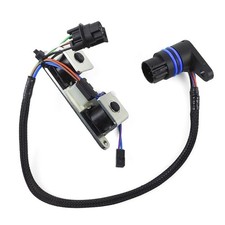
- Solenoid and harness. The overdrive and TCC solenoids are part of the internal harness and case connector assembly. ATSG gives 25-40 ohms for each. Measure at the case connector, then again at the PCM, to catch a chafed external harness.
- Codes. A solenoid circuit code is electrical. A "no rpm drop at 3-4 shift" or P1740 type fault means the shift was commanded and the ratio did not change the way the PCM expected. That points back at hydraulics or the clutch.
The 2000-2001 P1740 Problem: The Boost Valve Orifice
This one is specific to the trucks this unit lives in. Transmission Digest's January 2005 Tech/Talk summarizes it: some 2000-01 Dodge Ram Vans, Dakota and Ram pickups, and Durangos with 46RE/47RE transmissions may show a flashing check engine light from P1740, a torque converter clutch or overdrive solenoid performance fault.
The cause is a reducing-pressure exhaust orifice in the boost valve cover plate that is too small. That delays the pressure increase the transmission needs when the converter clutch applies. The fix in the bulletin is to remove the plate and open that orifice to 0.069 in., or install the revised Chrysler boost valve cover plate, part number 04617012, which comes with the orifice already enlarged.
Why does that matter for the overdrive clutch? Sonnax explains the circuit in its article on RE-family hydraulics. Starting around 1996, Dodge added a boost valve train next to the pressure regulator. In third with TCC on, or in fourth, TCC apply or overdrive apply oil moves the boost valve and exhausts one of the regulator's four reducing areas. That raises line pressure about 10-15 psi to give the converter clutch and the overdrive clutch more clamping force. If the boost is late or weak, the overdrive clutch applies on base pressure. The truck sets codes, the overdrive clutch slips at the apply, and in time it burns.
If you are rebuilding a 2000-2001 46RE for a burnt overdrive clutch, check the cover plate before the valve body goes back on. Putting new frictions behind the same small orifice is how a rebuild comes back.
Prove It: Scan Tool, Pressure and Air
Watch the ratio change
Log engine rpm (or turbine speed, if your tool shows it) against output speed through a light-throttle 3-4 shift with the converter unlocked. At 0.69:1, rpm should fall about 30 percent and stay there. If it drops and then climbs back, or creeps up at a fixed throttle, the overdrive clutch is slipping. If nothing changes while the PCM shows fourth commanded, go back to the electrical checks.
Check line pressure in fourth
The overdrive clutch is fed by line pressure, so low line pressure makes a good pack slip. GEARS gives a shortcut on these units: the PCM normally turns the governor solenoid off at about 40 mph, so above that speed the governor circuit sees line pressure and the governor pressure sensor is effectively reading it. Watch "governor actual" on the scan tool in third and then fourth, and confirm it with a gauge on the governor tap. You should see the boost rise in fourth. GEARS also notes that more than 105 psi governor actual in third or fourth at wide-open throttle points to excessive line pressure or a bad transducer.
Low pressure with a clean valve body has another known 46RE cause. Transmission Digest's October 2005 issue covers recurring P1740 or P0740 before or after overhaul, traced to a pump body to pump stator mating surface that is not flat. That leak costs line pressure and converter apply pressure. TD's fix is to have the stator face machined flat. Check it on a surface plate during any rebuild where those codes were part of the complaint.
Air check the overdrive circuits
With the valve body off, ATSG's case passage chart shows two overdrive feeds on the 46RE: overdrive clutch pre-fill and overdrive clutch apply. Use low, regulated air. A healthy overdrive clutch applies with a solid thump and holds with only a light leak at the sealing rings. A loud hiss from the back of the case, or air that blows straight through, means a damaged piston seal, a worn piston retainer bore, or a support that is not sealing to the case. If the pack applies cleanly and the truck still slips in fourth, the frictions are done.
Before the valve body comes off, put a gauge on it. The factory hydraulic pressure test for the overdrive clutch is Test Six in the 1998 Ram service manual, and the same manual's "No 3-4 Upshift" chart (pp. 21-230/231) lists fifteen causes, from the overdrive switch and solenoid to a leaking overdrive piston. Work that chart top to bottom and you will rarely tear down an overdrive that did not need it.
On the Bench: Gas-Unit Details That Bite
Overdrive clutch stack-up
ATSG lists two overdrive clutch builds. Gas units like the 46RE use 5 frictions and 5 steels with a flat backing plate. Diesel 47RE/48RE units use 6 and 6 with a stepped plate. Count what comes out, and read the build tag before ordering. ATSG says the part number and build date are on a bar code label on the left side of the case and are also etched into the pan rail. If a 46RE has a stepped plate in it, someone has been in there before you.
The three-snap-ring trap
The gasoline overdrive pack uses three different snap rings: a wire-type retaining ring, a waved ring and a flat ring, with the waved and flat rings sharing one groove at the backing plate. ATSG calls putting them in the wrong place a very common mis-assembly error. The diesel pack does not have the waved ring, which is why the mistake shows up mostly on gas units. A swapped ring changes clutch clearance and apply feel, and a 46RE that flares on the 3-4 right after a rebuild should make you think about this first. Lay the rings out in order as they come off.
Overdrive direct clutch and the 830 lb spring
To reach the direct clutch you have to compress that spring. ATSG specifies compressor tool 6227-1 or an equivalent and a press with at least 5-6 in. of travel and an adjustable bed, with the output shaft flange, not the bearing, resting on the press plates. Release it slowly. A screwdriver and a vise are how people get hurt here.
The overdrive direct stack changed across the RE family's production years, and ATSG lists more than one stack-up. Count frictions and steels as they come out and match the kit to what you found and the build date. Then replace the spring. TransGo's TFOD-SP high-temp spring is a direct replacement for OEM 4461027 and fits RE-family overdrives from 1988 on. New plates behind a faded spring will burn again.
Selectives on reassembly
ATSG calls out two selectives before the overdrive goes back on the case: the intermediate shaft spacer and the number 10 thrust plate, measured with Chrysler tool 6312 through the sun gear. The spline alignment tool (C-6227-2, or a modified intermediate shaft) has to stay in the overdrive planetary and roller clutch until installation. Skip it and the overdrive will not go onto the case without coming apart again.
The Fix, and Keeping It Fixed
- Overdrive clutch burnt: new 5/5 frictions and steels, new piston seals, snap rings in the right grooves, piston retainer inspected, selectives set. On 2000-2001 trucks, check the boost valve cover plate orifice.
- Direct clutch slipping: new direct pack and a new spring. Inspect the clutch hub and sun gear splines.
- Both burnt with debris in the pan: treat it as a full overhaul. Flush the cooler and lines or the debris goes straight into the new parts. See 46RE rebuild cost for what drives the bill.
Prevention comes down to fluid, heat and pressure:
- Fluid. ATSG states the 46RE, 47RE and 48RE require ATF+4. Do not top off with a generic multi-vehicle fluid. Fill specs are in our 46RE fluid type and capacity guide.
- Heat. A gas 46RE towing near its limit needs a real cooler and a temperature gauge. Use O/D OFF on long grades so the overdrive is not cycling in and out.
- Pressure. Keep the correct valve body on the unit. Sonnax warns that a 46/47RE valve body swapped onto a 48RE can seem fine at first and then come back with a burnt converter clutch or overdrive clutch. The 48RE uses a different regulator curve and TCC feed.
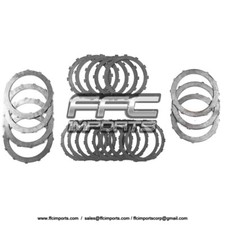
RE-Family Friction Clutch Kit, 1988-2002 (Raybestos)
Raybestos friction set for 1988-2002 RE-family units, including the 46RE, for when the overdrive or direct frictions are what burned. Sold by CoreTransmissionParts.
View the friction kit →Shop RE-family overdrive parts →
Frequently Asked Questions
Which clutch does the 3-4 shift on a 46RE?
The overdrive clutch in the overdrive unit at the back of the case. On the 3-4 shift the overdrive piston applies the overdrive clutch and pushes against the roughly 830 lb spring that holds the overdrive direct clutch on in first through third. The front and rear clutches in the main case do not change state on the 3-4 shift.
What causes P1740 on a 2000-2001 46RE truck?
Transmission Digest traces a flashing check engine light with P1740 on some 2000-01 Ram Vans, Dakotas, Ram pickups and Durangos to a reducing-pressure exhaust orifice in the boost valve cover plate that is too small. That delays the line pressure boost the converter clutch and overdrive clutch need. The fix is to open the orifice to 0.069 in. or install Chrysler boost valve cover plate 04617012.
Why does my 46RE slip only in 4th gear?
Slip that shows up only in fourth, or as a flare on the 3-4 shift, points at the overdrive clutch or the pressure feeding it. Common causes are burnt overdrive frictions, a leaking overdrive piston seal or retainer, low line pressure, a late boost valve, or snap rings swapped at the backing plate after a rebuild.
Can I fix 46RE overdrive slip without pulling the transmission?
Only if the cause is electrical or in the valve body: the overdrive switch, the overdrive solenoid or internal harness, low fluid, or the boost valve cover plate. If the overdrive frictions are burnt, the overdrive unit has to come apart, which means pulling the transmission and setting the selective spacer and thrust plate on reassembly.
Sources
- ATSG (Automatic Transmission Service Group) — 46RE, 47RE, 48RE Technical Service Manual. Backs the overdrive unit layout and clutch roles, the 0.69:1 fourth ratio, overdrive solenoid control of the 3-4 shift, the overdrive switch and 260F forced 4-3 logic, the 25-40 ohm solenoid spec, the overdrive pre-fill and apply passages, the 5/5 gas and 6/6 diesel overdrive packs, the wire/waved/flat snap ring mis-assembly warning, the roughly 830 lb direct spring and tool 6227-1, the tool 6312 selectives, the build tag location, and the ATF+4 requirement. (Print reference.)
- Chrysler — 1998 Dodge Ram Truck Service Manual, Group 21 (46RE/47RE), archived copy. Backs the overdrive and converter clutch temperature logic (no overdrive or lockup below 50F, forced 4-3 above 260F, fourth restored at 230F, no 3-4 upshift above 250F, pp. 21-212/213), hydraulic pressure Test Six for the overdrive clutch, and the 15-cause "No 3-4 Upshift" diagnosis chart (pp. 21-230/231). archive.org
- ATRA GEARS Magazine — Dave Skora, 42-47RE electronic governor, Part 2 (October 2006). Backs the mostly hydraulic shift control, the governor solenoid turning off at about 40 mph so governor actual reads line pressure above that speed, and the 105 psi WOT limit in third and fourth. gearsmagazine.com (PDF)
- Sonnax — "Dodge 48RE Hydraulic Features Revealed." Backs the boost valve train added around 1996, the 10-15 psi line pressure rise in fourth (and third with TCC on) for overdrive and converter clutch clamping force, and the burnt-clutch risk of a 46/47RE valve body on a 48RE. sonnax.com
- Transmission Digest — Tech/Talk, January 2005 Issue (Chrysler 46RE/47RE: DTC P1740). Backs the flashing check engine light with P1740 on 2000-01 Ram Vans, Dakota and Ram pickups and Durangos, the undersized reducing-pressure exhaust orifice in the boost valve cover plate, the 0.069 in. fix, and Chrysler cover plate 04617012. transmissiondigest.com
- Transmission Digest — Tech/Talk, October 2005 Issue (Chrysler 46RE recurring P1740/P0740). Backs the pump body to pump stator mating surface that is not flat, the resulting loss of line pressure and converter apply pressure, and machining the stator face flat as the fix. transmissiondigest.com
- TransGo — TFOD-SP Overdrive Spring. Backs the faded overdrive direct spring failure and its symptoms (slip in reverse, burnt overdrive direct plates, reduced or no coast braking in manual 2nd or 1st), replacement of OEM 4461027, and fitment on RE-family overdrives from 1988 on. transgo.com
Shop 46RE rebuild kits, friction modules, internal harnesses, valve bodies and hard parts, shipped fast from the USA.
Shop 46RE parts →