A 46RE that slips is telling you one of two things: an apply element is worn out, or it is not getting enough oil to hold. The trick is figuring out which element, and whether the oil supply is the real problem, before you spend a dime. This unit makes that easier than most, because it is a hydraulically controlled A518 at heart. The PCM runs the governor pressure solenoid, the overdrive solenoid and the converter clutch, but line pressure itself is set by the pump, the pressure regulator valve and the throttle valve cable. Most slips on a 46RE are fluid, linkage, pressure or clutch problems. Very few are computer problems.
Chrysler's own service manual lays out the method, and I still use it on every 46RE that comes in with a slip complaint. First road test it and use the clutch and band application chart to isolate the slipping element. Then pressure test it to find out why. The manual is blunt on this point: unless the fault is obvious, such as no drive in first, do not pull the transmission apart until you have done the hydraulic and air pressure tests.
The short version: Check fluid level and condition first. Then check TV cable and shift linkage adjustment. Road test and match the slip to the application chart: every forward gear points to the rear clutch, D1 but not manual 1 points to the overrunning clutch, third plus reverse points to the front clutch, fourth only points to the overdrive clutch. Confirm with a pressure test (145-175 / 230-280 psi in reverse at the rear servo port). Then fix the cause, not the symptom.

Step 1: Fluid Level and Condition
Chrysler's diagnosis chart for "slips in forward drive ranges" lists low fluid level as cause number one and fluid foaming as number two (Chrysler 46RE diagnosis chart). Low fluid lets the pump pick up air, line pressure drops, and the rear clutch goes first because it is applied in every forward gear. Foaming does the same thing from the opposite direction. The chart says to check for high oil level, a bad pump gasket or seals, dirt between the pump halves and loose pump bolts.
Check the level the factory way: hot (around 180 F), engine idling, in Neutral, parking brake set, on level ground. Then smell and look at it. Burnt, dark fluid with friction material on the dipstick means a clutch has already been slipping long enough to cook. A top-off will not bring that back. The 46RE takes ATF+4 (MS-9602). Transmission Digest has documented what happens with the wrong fluid on these units: they may shift and lock up fine at first, then apply progressively worse until they fail, and the failure gets blamed on something else. If somebody put a generic multi-vehicle ATF in it, drain it and refill with ATF+4 before you condemn anything.
Step 2: TV Cable and Shift Linkage
Items three and four on the same chart are throttle linkage misadjusted and gearshift linkage misadjusted. On a 46RE the throttle valve cable is not just a shift-timing adjustment. It controls throttle pressure, which boosts line pressure as you open the throttle. A cable that is too loose gives you low line pressure under load, early soft shifts, and clutches that slip when the truck is working hardest. A shift cable that does not put the manual valve squarely in its detent can partly open a circuit and bleed apply oil.
ATRA's RE valve body write-up describes the tell for a worn throttle valve bore. You cannot dial the cable in. Loosen it slightly and the truck is in third at 25 mph with no kickdown. Tighten it slightly and the 1-2 hangs out. If you see that, the cable is not the problem. The bore is leaking throttle oil, and that is a valve body repair.
Step 3: Find the Slipping Element with the Application Chart
This is the most useful page in the 46RE manual. Every gear uses a specific combination of clutches and bands. If you find which gears slip and which do not, you can work out which element is at fault (Chrysler clutch and band application chart).
| Range / gear | Elements applied (main case) | Overdrive unit |
|---|---|---|
| Reverse | Front clutch, rear band | Direct clutch, OD overrunning clutch |
| Drive - first | Rear clutch, overrunning clutch | Direct clutch, OD overrunning clutch |
| Drive - second | Rear clutch, front (kickdown) band | Direct clutch, OD overrunning clutch |
| Drive - third | Front clutch, rear clutch | Direct clutch, OD overrunning clutch |
| Drive - fourth | Front clutch, rear clutch | Overdrive clutch |
| Manual first | Rear clutch, rear band, overrunning clutch | Direct clutch, OD overrunning clutch |
Chrysler's worked examples, which I have confirmed on real trucks more times than I can count:
- Slips in any two forward gears: the rear clutch is slipping. It is the only element applied in every forward range.
- Slips in first in D and 2, but not in manual 1: the transmission overrunning clutch is not holding. In manual 1 the rear band holds the carrier and hides the bad roller clutch.
- Slips in third: either the front or rear clutch. If it also slips in reverse, it is the front clutch. If reverse is fine, it is the rear clutch.
- Slips on the 3-4 shift or only in fourth: the overdrive clutch.
- Lost reverse and lost engine braking in manual second: the overdrive direct clutch has failed.
- Flare on the 1-2 or slip in second only: the front band or its servo. It is the only element added for second.
The manual adds a caveat: the road test tells you which unit is slipping, but not why. Practically any condition can be caused by leaking hydraulic circuits or sticking valves. That is what the pressure test is for.
Step 4: Pressure Test It
Chrysler's pressure test uses two gauges. Gauge C-3292 (100 psi) goes on the accumulator, governor and front servo ports. Gauge C-3293-SP (300 psi) goes on the rear servo and overdrive ports, where pressure exceeds 100 psi. Line pressure is read at the accumulator port on the right side of the case, and the front servo port is just behind the filler tube. The key numbers from the manual (Chrysler 46RE hydraulic pressure test):
| Test | Condition | Spec |
|---|---|---|
| Reverse, rear servo port (300 psi gauge) | 1600 rpm, throttle lever fully forward | 145-175 psi |
| Reverse, rear servo port | Throttle lever moved gradually rearward | Rising to 230-280 psi |
| Fourth gear, overdrive clutch port | Closed throttle, just after the 3-4 shift | 68-72 psi |
| Fourth gear, overdrive clutch port | 1/2 to 3/4 throttle | 90-120 psi (about 130 psi at WOT) |
| Governor pressure | D range, idle, wheels held | 3 psi max; rises about 1 psi per mph |
How to read it. Low in every range means the common supply is weak: a worn pump, a clogged filter, a stuck or worn pressure regulator, or a leaking valve body. Good in some ranges and low in one means that circuit is leaking, such as worn seal rings, a cut piston seal, or a leaking servo. Pressure that will not rise as you pull the throttle lever back points at the throttle valve circuit. If the numbers are good and the unit still slips, the frictions themselves are worn out. Follow up with an air test of each clutch and servo to find the leak. A piston that applies with a solid thump is sealing. One that hisses and barely moves is where your oil is going.
Step 5: Band Adjustment
Chrysler's chart lists misadjusted front and rear bands as a noise cause. A band that has worn past its adjustment is also the usual reason for a second-gear-only flare. The front (kickdown) band adjuster is on the left side of the case above the manual and throttle valve levers. The factory procedure (Chrysler 46RE band adjustment) is to back the locknut off 3-5 turns and make sure the screw turns freely. Then tighten the screw to 72 in-lb, back it off 2-7/8 turns, hold it, and torque the locknut to 30 ft-lb. If you have to use adapter C-3705 to reach the screw, the torque drops to 47-50 in-lb. Everybody forgets that detail and over-tightens the band.
The rear band is adjusted inside the pan and its spec varies by year, so pull it from the manual for the exact truck. If a band is already at the end of its adjustment, adjusting it is not a fix. The band or its strut is worn out and the unit is coming apart.
Step 6: Valve Body Causes of Low Pressure
ATRA calls the RE valve body the nerve center of these units, since there are no hydraulic control circuits outside it. The RE family was also built without valve body gaskets, so flatness is the only seal. Two bores cause most slip complaints:
- Line pressure plug and sleeve. ATRA calls this one easily overlooked. Wear produces delayed engagement, reverse slip, poor converter and cooler charge, a soft or slipping TCC apply, and unstable line pressure. Pull and inspect it on every valve body job.
- Pressure regulator valve. Sonnax says the OE valve's restrictive design can cause engagement delays. Its steel lube-regulated replacement, 22771A-02K, is listed for delayed engagement, PR buzz, converter drain-back, lube failures and converter bushing failure. It works best paired with manual valve 22771-09. Sonnax's install note also says to remove the cooler line drain-back valve to prevent converter slippage and hydraulic noise.
If the valve body has several worn bores, Sonnax's Sure Cure kit SC-46-47RHE-OS seals the main line, converter clutch, throttle and lube circuits in one package, with oversized valves that need the matching reamers. Whatever route you take, flat sand the valve body surfaces on glass. On a gasketless valve body, flatness is what seals the circuits.
Step 7: When It Is the Hard Parts
If the fluid is right, the linkage is right, and pressure is in spec but the chart still points at an element, it is coming out. Chrysler's chart lists worn rear clutch plates, leaking clutch seals, leaking servos, leaking seal rings and a worn overrunning clutch as the internal causes of a forward slip. Two failures on this family are worth knowing before you order parts:
- Cracked forward (rear) clutch retainer. Transmission Digest reports that the cast OE retainer (52854149AA) commonly fails from cracks and wear, especially behind extra power or towing. A cracked retainer bleeds apply oil and gives you exactly the "slips in every forward gear" symptom. The Sonnax replacement, 22554-HD, is machined from 4140 steel.
- Overrunning clutch. If it slips in D1 but not manual 1, the roller clutch in the main case is done. It is a known wear item on high-mileage and towing units.
Converter slip that is really a cooler problem
Not every slip is a clutch. If the complaint is a flare or rpm creep at highway speed under load, with a P0740/P1740 converter clutch code, check cooler flow before you condemn hard parts. Sonnax's 46-47RH/RE cooler and converter flow article lists TCC slip at high torque, delayed engagement, slow converter fill and excessive stall among the symptoms of a restricted cooler circuit, and calls cooler restriction the most common issue on this family. Its quick check is to bypass the cooler circuit temporarily and retest. The number to beat comes from Sonnax's 22771A-01 instructions: with the return line disconnected at the rear of the case, flow must be at least 1 quart in 20 seconds (0.8 gpm) in Drive at idle, and a meter should show 0.7-0.9 gpm at idle and a rapid rise to 2.1-2.2 gpm when the TCC applies. Our 46RE cooler line guide walks through the full test.
Replace frictions, steels, seals and the filter as a set, flush or replace the cooler, and set clutch clearances to spec. The factory window on the rear clutch is tight (0.025-0.036 in.), and a rear clutch outside it will flare right after the rebuild (Chrysler 46RE specifications).
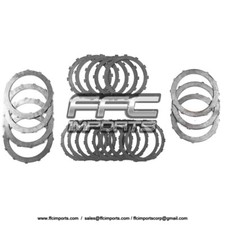
Rebuilding it? Raybestos friction clutch kit for 1988-2002 A518/46RE-family units
If the chart points to worn clutches, this is the friction set to rebuild with. It covers the 88-02 A518 family that includes the 46RE. CoreTransmissionParts stocks it with the rest of the RE-family hard parts.
View the clutch kit →Or browse the full RE-family parts collection.
Need parts for this job? Master rebuild kits, clutch modules, pumps, valve bodies, bands and governor solenoid kits for the 46RE are all in one place. Shop 46RE parts →
FAQ
Can low fluid make a 46RE slip?
Yes. Low fluid level is the first cause on Chrysler's diagnosis chart for slipping in the forward ranges, and foaming from an overfill is the second. The pump pulls air, line pressure drops, and the rear clutch slips first because it is applied in every forward gear. Check the level hot, in Neutral, on level ground before you do anything else.
Will a band adjustment fix a slipping 46RE?
Only if the band is the slipping element. The front (kickdown) band holds second gear, so a flare on the 1-2 shift or a slip in second only points at it. The factory front band adjustment is 72 in-lb, back off 2-7/8 turns, and lock the nut at 30 ft-lb. If the slip is in every forward gear, it is the rear clutch or low line pressure, and no band adjustment will cure it.
What should line pressure be on a 46RE?
Chrysler's reverse test at the rear servo port, with the engine at 1600 rpm, calls for 145-175 psi with the throttle lever fully forward, rising to 230-280 psi as the lever is moved rearward. In fourth gear at the overdrive clutch port it should read 68-72 psi at closed throttle and 90-120 psi at half to three-quarter throttle, up to about 130 psi at wide open.
Why does my 46RE slip in third gear and reverse?
Third gear uses the front and rear clutches together, and reverse uses the front clutch with the rear band. The one element common to both is the front clutch, so a slip in third and reverse is a front clutch problem: worn frictions, a leaking piston seal, or lost apply oil through worn seal rings.
Can a bad governor pressure solenoid cause slipping?
It usually causes shift-timing complaints rather than a true slip - no upshift, early or late shifts, or hunting. Governor pressure should be no more than 3 psi stopped at idle and rise about 1 psi per mph. If governor pressure is correct and the engine still flares in gear, the problem is a clutch, band or line pressure, not the governor.
Sources
- Chrysler - 2001 Dodge Ram Truck (BR/BE) Service Manual, 46RE Road Testing and Clutch and Band Application Chart (page 21-487). Backs the element-by-gear chart, the slip-isolation logic (two forward gears = rear clutch, D1 not manual 1 = overrunning clutch, third plus reverse = front clutch, fourth only = overdrive clutch, direct clutch failure = no reverse and no overrun braking in 2), the instruction not to disassemble before hydraulic and air pressure tests, and the gauge and test-port locations. The ManualsLib scan previously cited for this page no longer resolves (403, bot-blocked as of October 2026); cited here as the factory manual by page number pending a working public mirror.
- Chrysler - 2001 Dodge Ram Truck Service Manual, 46RE Hydraulic Pressure Test (page 21-489). Backs the reverse test at 1600 rpm (145-175 psi rising to 230-280 psi), the governor test (3 psi max at idle, about 1 psi per mph), and the fourth gear overdrive clutch pressures (68-72 psi closed throttle, 90-120 psi at 1/2-3/4 throttle, about 130 psi WOT). Same ManualsLib availability note as above.
- Chrysler - 2001 Dodge Ram Truck Service Manual, 46RE Diagnosis Chart, "Slips in Forward Drive Ranges" (page 21-497). Backs the ranked causes: low fluid, foaming, throttle and gearshift linkage misadjustment, rear clutch wear, low hydraulic pressure from pump, valve body, seal rings, servo leaks or clogged filter/cooler, and a worn overrunning clutch. Same ManualsLib availability note as above.
- Chrysler - 2001 Dodge Ram Truck Service Manual, Bands - Adjustment (page 21-539), Electronic Governor (page 21-541) and Specifications (page 21-532). Backs the front band procedure (72 in-lb, back off 2-7/8 turns, 30 ft-lb locknut, 47-50 in-lb with adapter C-3705), governor solenoid operation (1 amp = 0 psi, 0 amps = maximum governor pressure), and the rear clutch pack clearance (0.025-0.036 in.). Same ManualsLib availability note as above.
- ATRA / GEARS Magazine - "Bringing it Back to Life: A Logical Approach to the RE Valve Body." Backs the valve body as the sole hydraulic control point with no gaskets, the throttle valve bore wear tell, the line pressure plug and sleeve symptom list including reverse slip and unstable line pressure, and the flat-sanding recommendation. gearsmagazine.com
- Sonnax - Lube Regulated Pressure Regulator Valve 22771A-02K. Backs the symptom list, 46RE applicability, the pairing with manual valve 22771-09, and the note to remove the cooler line drain-back valve. sonnax.com/parts/1840
- Sonnax - The Sure Cure Kit SC-46-47RHE-OS. Backs the circuits sealed (main line, converter clutch, throttle, lube) and the oversized-valve tooling requirement. sonnax.com/parts/4466
- Transmission Digest - "Chrysler 46RH/RE, 47RH/RE, 48RE Forward (Rear) Clutch Retainer" and "Automatic-Transmission Fluid: What is today's reality?" Backs the cast OE retainer 52854149AA cracking under power and towing loads, the 4140 steel 22554-HD replacement, and the progressive-failure consequence of using the wrong ATF in Chrysler units. Retainer article / ATF article
- Sonnax - "46-47RH/RE Cooler and Converter Flow" (Bob Warnke). Backs cooler restriction as the most common issue on the 46RE/47RE family, the symptom list (740/1740 codes, TCC slip at high torque, delayed engagement, slow converter fill, excessive stall) and bypassing the cooler circuit to verify. sonnax.com
- Sonnax - 4-Spool Switch Valve 22771A-01 instructions (covers 46RE), section 7 "Critical Pump & Cooler Flow Quality Adjustments." Backs the 1 quart in 20 seconds (0.8 gpm) minimum at the rear return line in Drive at idle and the 0.7-0.9 / 2.1-2.2 gpm flow readings. Sonnax instructions (PDF)