The 46RE is the four-speed behind the 5.2L and 5.9L Magnum V8s in Ram 1500 and 2500 gas trucks, and it shows up in plenty of other Chrysler V8 trucks and SUVs of the same era. It is a mostly hydraulic transmission: two adjustable bands, a governor pressure circuit, a lockup converter and a bolt-on overdrive unit. All of that depends on the fluid being the right type and at the right level. When we tear down a 46RE with a burned front band or a varnished valve body, the fluid history is usually part of the story. It was run low, overfilled until it foamed, or topped off with whatever jug was on the shelf.
This page gives the factory numbers for a 46RE fluid job: the fluid spec, the service and dry fill capacities, the initial fill amounts, both level-check procedures, the service interval, the pan, filter and band specs, and what the job costs in parts. The capacities and procedures come from Chrysler's 2001 Dodge Ram Truck (BR/BE) service manual, which covers the 46RE in section 21. The fluid approval and chemistry come from Shell's Pennzoil Platinum ATF+4 technical data sheet, and the cooler checks come from Sonnax. Sources are listed at the end.
46RE Fluid Type: ATF+4, Type 9602
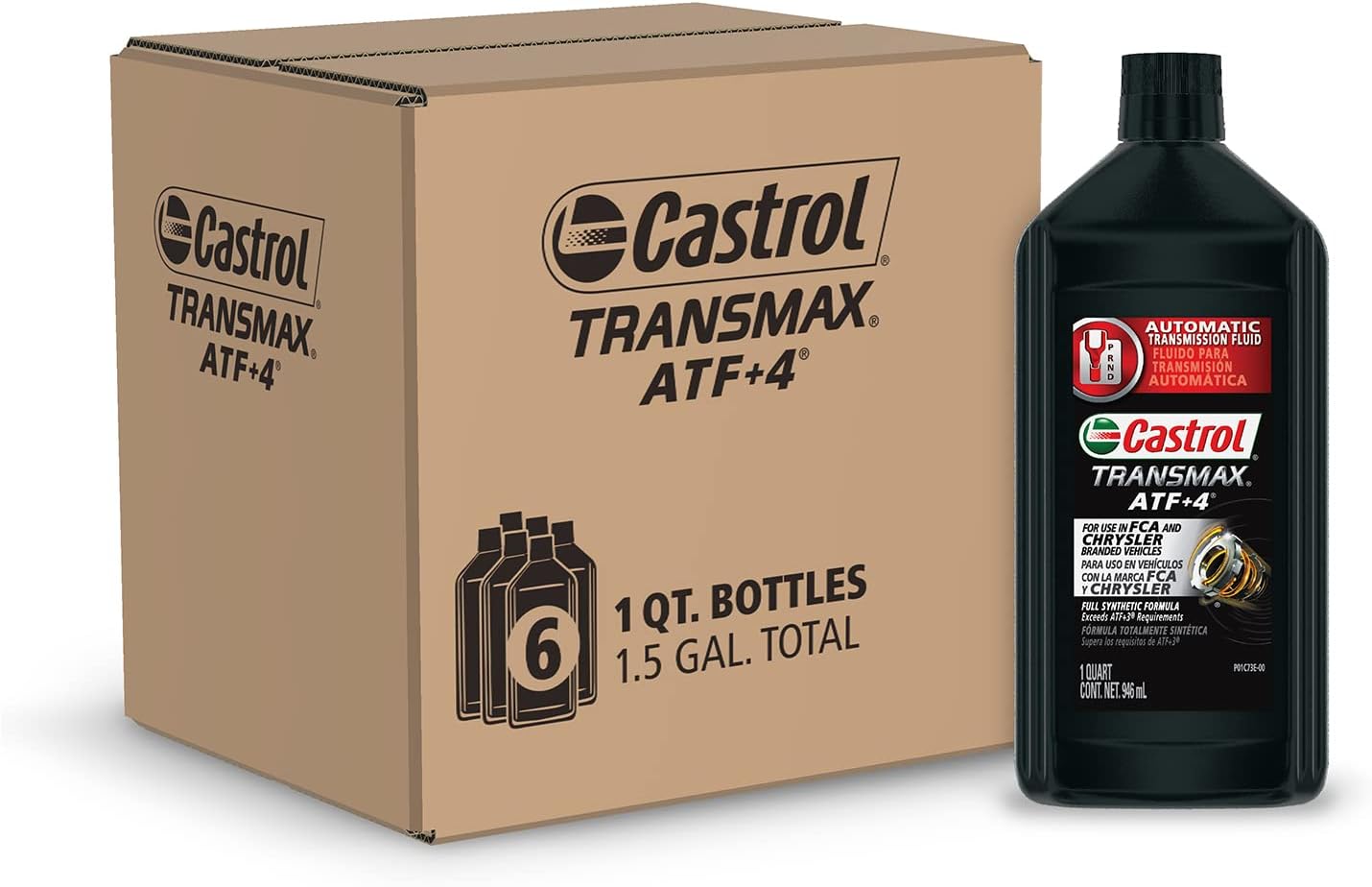
The specifications table in the 46RE section of the service manual lists one recommended fluid: Mopar ATF+4, Type 9602. Every procedure repeats it. The level check says to add only ATF+4 Type 9602 when low, the fill procedure uses ATF+4 for both the filter-change and overhaul amounts, and the rear band adjustment ends with a refill of the same fluid (Chrysler 2001 Ram service manual, 46RE specifications).
Type 9602 refers to Chrysler Material Standard MS-9602. Whatever brand you buy, the bottle should say it meets or is licensed to MS-9602. Shell's Pennzoil Platinum ATF+4 technical data sheet states it is approved against Chrysler specification MS-9602 and is intended for Chrysler automatics where an ATF+3, ATF+2 or ATF+ (MS-7176) fluid is specified. That matters on older 46RE trucks that still have an ATF+3 label on the dipstick: ATF+4 is the correct replacement. It does not work the other way. ATF+3 is not a substitute for ATF+4, and neither is Dexron or Mercon. The fluid itself has a factory part number if you want to buy it from the dealer parts counter rather than an aftermarket bottle: FCA's own NHTSA-hosted bulletin 21-046-15 lists Mopar ATF+4 under part number 05013457AA. That bulletin covers a 62TE minivan transmission, not the 46RE, but the fluid and part number are the same across the Chrysler automatic transmission lineup.
What the wrong fluid does
Chrysler's contamination list puts "adding incorrect fluid" first. The manual says non-recommended fluids lead to erratic shifts, slippage, abnormal wear and eventual failure from fluid breakdown and sludge. On a 46RE the first thing we usually see is a converter clutch shudder at light-throttle cruise, followed by a soft 2-3 shift as the front band and front clutch start to slip. If you buy a truck with a lockup shudder and nobody knows what fluid is in it, get it on ATF+4 before you condemn the converter. The Pennzoil ATF+4 data sheet lists friction durability and retention, shear stability and oxidation stability improvements over ATF+3, which is exactly the friction behavior a lockup clutch depends on as the fluid ages. Our 46RE torque converter shudder guide covers the rest of the diagnosis.
46RE Fluid Capacity
The fluid capacity table on page 0-6 of the 2001 Ram manual gives two numbers for the 46RE (Chrysler fluid capacities table):
| Fill type | Liters | US measure |
|---|---|---|
| Service fill (pan and filter) | 3.8 | 4.0 quarts |
| Overhaul (dry) fill | 9 - 9.5 | 19 - 20 pints (about 9.5 - 10 quarts) |
The dry fill is a range because, as the table's footnote says, it depends on the type and size of the cooler, the length and inside diameter of the cooler lines, and whether an auxiliary cooler is fitted. The same table lists the 42RE and 44RE at those same figures, while the diesel-duty 47RE jumps to 14-16 liters because of its larger converter and cooler circuit. Chrysler's 2004 Ram fluid capacity chart, still published on the Ram Body Builder site, carries the identical 46RE numbers: 3.79 L (8 pints) service fill and 8.99-9.46 L (19-20 pints) overhaul fill, with the same cooler-size footnote, so the figures held steady across the later trucks. Our 47RE fluid guide covers that unit.
What that means for a pan service
Four quarts out of a system that holds roughly ten is only about 40 percent of the fluid. The rest stays in the converter, cooler and lines. If the old fluid is dark, do two pan services a few hundred miles apart, or exchange fluid through the cooler return line. For shopping: buy 5 to 6 quarts for a pan and filter job so you are not short on the top-off, and about 11 to 12 quarts for a rebuild with a flushed cooler, more with a big auxiliary cooler or a deep pan.
How to Fill a 46RE Without Overfilling It
Chrysler's fill procedure exists specifically to prevent overfilling. It does not tell you to pour in the capacity number. It starts low and finishes on the dipstick (Chrysler 46RE fluid and filter procedures):
- Put a clean funnel in the fill tube.
- Add the initial amount of ATF+4: 3 pints (1-1/2 quarts) if only the fluid and filter were changed, or 12 pints (6 quarts) if the transmission was overhauled, the converter was replaced or drained, and the cooler was flushed.
- Set the parking brake, start the engine and let it idle.
- Hold the service brakes, move the selector through every range, then return to Neutral with the engine at curb idle.
- Check the stick. If low, add fluid to the MIN mark. If one side of the dipstick reads higher than the other, it picked up oil from the tube wall. Let it drain and recheck.
- Drive until the fluid is at normal operating temperature, then check again at idle in Neutral with the parking brake on and bring it to the MAX arrow.
Yes, only 3 pints go in first after about 4 quarts came out. The rest goes in a little at a time in steps 5 and 6. The manual's caution is plain: do not overfill, because foaming and shift problems result.
How to Check 46RE Fluid Level
The 46RE is checked hot, engine running, in Neutral, not Park. The dipstick is on the right side of the engine. Chrysler gives two methods.
Procedure one: by the dipstick, hot
- Get the fluid to normal operating temperature, which the manual gives as 82 C (180 F). Drive the truck if needed.
- Park on level ground, start the engine and let it run at curb idle for at least one minute. Set the parking brake.
- Shift momentarily through all ranges, then back to Neutral.
- Wipe the top of the fill tube and the dipstick cap before you pull the stick, so dirt does not fall into the transmission.
- Read it: in the crosshatch area is acceptable, at the MAX arrow is the correct maximum, at or below the MIN line is low. Add only enough ATF+4 to correct it.
Procedure two: by fluid temperature
If the fluid is not fully hot, the manual's second method uses a scan tool. Start the engine, set the brake, shift into Drive for about 2 seconds and Reverse for about 2 seconds, then into Park. Read the transmission temperature on the scan tool (the manual names the DRB), and set the level to the mark the 46RE fluid fill graph gives for that temperature. Either way, after adding fluid, wait at least 2 minutes for it to drain down the fill tube before rechecking. Skipping that wait is the most common way a 46RE ends up overfilled.
The temperature reading itself comes from a thermistor in the transmission that the computer reads as a changing voltage, not a direct gauge. ATRA's technical writeup on the related 42-47RE electronic controls explains that the computer sends a 5-volt reference signal to the sensor and measures how much the sensor's resistance pulls that voltage down to calculate fluid temperature, which is also the same signal the TCM uses to pick its shift strategy and governor pressure response. Most 46RE applications before 1999 use a Negative Temperature Coefficient sensor (resistance drops as it heats up); some 1999-and-later applications switched to a Positive Temperature Coefficient sensor that works the opposite way, so a temperature reading that looks backward (hot at cold start-up, cooling as you drive) usually means the wrong-type sensor got installed.
Why a quart either way matters
The manual explains both failure modes. Low fluid lets the pump draw air, so pressures run low and build slowly, and bands and clutches slip. Too much fluid lets the geartrain churn it into foam, which causes the same symptoms. Either way the air leads to overheating, oxidation and varnish that interfere with valve, clutch and accumulator operation. Foamed fluid can also push out of the vent and get mistaken for a leak. Check the condition while you are there: fluid that smells burned and carries metal or friction material means the unit needs a rebuild, not a fluid change.
46RE Fluid Change Interval
The 2001 Ram maintenance schedules treat the fluid change, filter change and band adjustment as one job (Chrysler maintenance schedules):
- Light Duty Schedule A (normal use): change the fluid and filter and adjust the bands at 100,000 miles.
- Light Duty Schedule B: every 30,000 miles. Schedule B covers trailer towing, frequent short trips, dusty conditions, long idling, stop-and-go driving, sustained high speed in hot weather, commercial service and off-road use.
Most 46RE trucks that tow, plow or work fit Schedule B by Chrysler's own definition. We run 30,000 miles on any 46RE that pulls a trailer, and sooner if the fluid is dark or smells burnt.
Pan, Filter and Band Specs
The band adjustment rides along with the fluid service because the rear band adjuster is inside the pan. From the 46RE sections of the manual (Chrysler 46RE band adjustment):
| Item | Spec |
|---|---|
| Fluid pan bolts | 17 N·m (13 ft-lb) |
| Filter screws | 4 N·m (35 in-lb) |
| Front (kickdown) band adjusting screw | 8 N·m (72 in-lb), then back off 2-7/8 turns |
| Front band locknut | 41 N·m (30 ft-lb) |
| Rear (low/reverse) band adjusting screw | 8 N·m (72 in-lb), then back off 2 turns |
| Rear band locknut | 34 N·m (25 ft-lb) |
| Cooler line fitting at transmission | 18 N·m (13 ft-lb) |
Procedure notes. The front adjuster is on the left side of the case above the manual and throttle valve levers. Back the locknut off 3-5 turns and make sure the screw turns freely before torquing it (the 1998 Ram service manual, pages 21-308 and 21-309, gives the same 3-5 turn locknut back-off, the 2-7/8 front and 2 rear back-off for the 46RE against 1-7/8 and 3 for the 47RE, and 17 N·m pan bolts, per Chrysler's 1998 Ram Truck service manual). If you need Adapter C-3705 to reach it, the manual says to tighten to only 5 N·m (47-50 in-lb), because the adapter changes the effective torque. For the rear band, drop the pan, loosen the locknut 5-6 turns, torque the screw, back it off exactly 2 turns, and hold the screw still while you tighten the locknut. Use a new pan gasket. The pan bolts are 5/16"-18 threaded into the aluminum case, which is why the spec is so low: B&M's instructions for its 10280 deep pan (Rev 10/22/21) call for 5/16-18 screws run down in an alternating pattern and warn that overtightening causes leaks, and Goerend recommends chasing the case threads with a 5/16"-18 tap and snugging the four corners first before final torque.
The back-off counts are where people get burned. The 47RE uses 1-7/8 turns on the front and 3 on the rear. Put 47RE numbers on a 46RE (or the reverse) and you get either a dragging band and a harsh shift, or a loose band that slips and glazes. Our 46RE vs 47RE guide lays out the other differences.
What a 46RE Fluid Change Costs
The parts list for a proper service is short: ATF+4, a filter, and a pan gasket, plus the few minutes it takes to set the bands. Done in the driveway with a torque wrench and an inch-pound wrench, the parts are the whole cost:
- Fluid: 5 to 6 quarts of ATF+4 for a pan and filter job. A six-quart case of Castrol Transmax ATF+4 is $59.99 on our store.
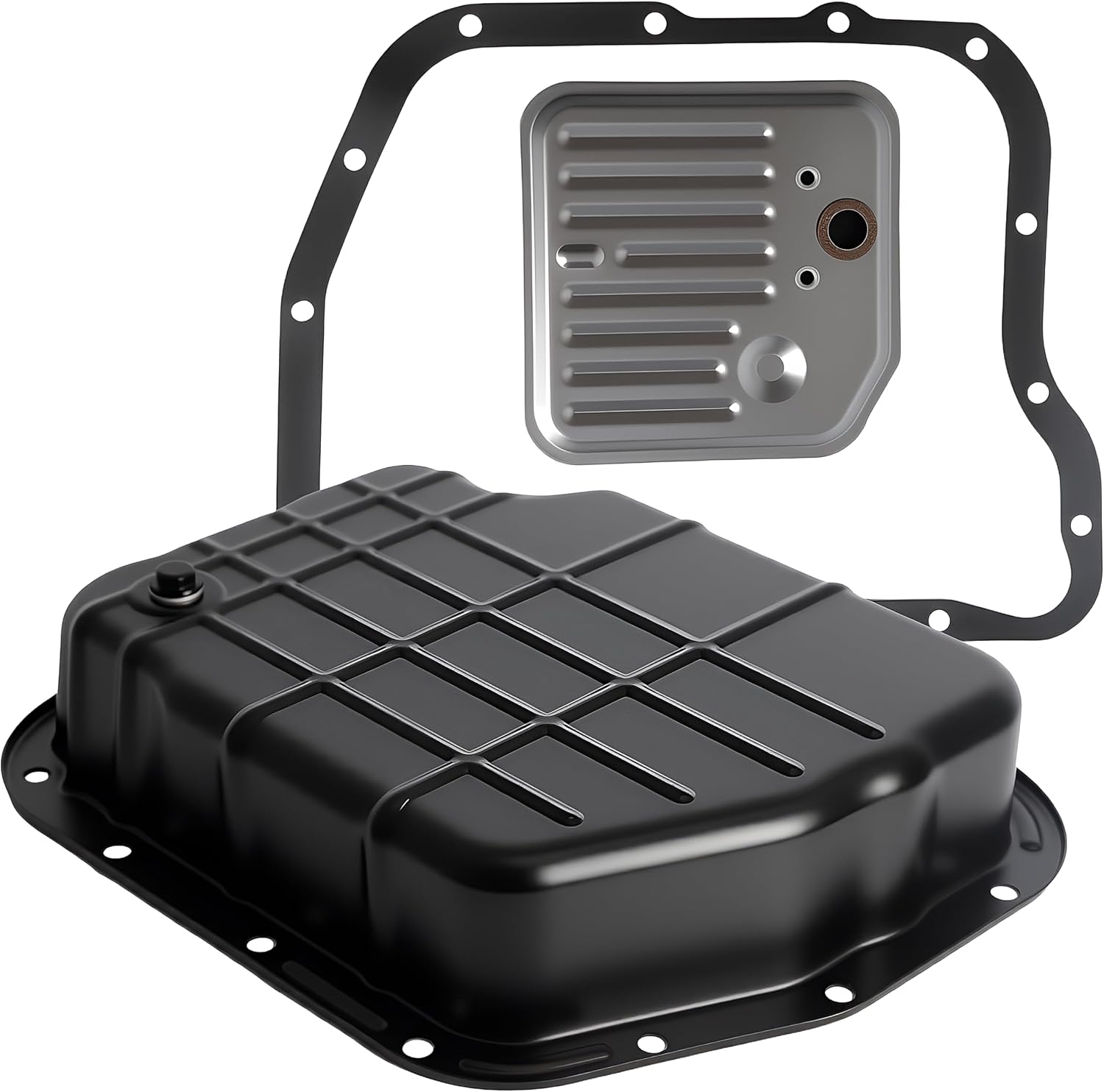
- Filter and gasket: a filter and pan gasket kit, or step up to the $92.99 pan kit with a drain plug and filter so the next service does not mean a pan full of fluid down your arm.
- Optional: a deeper finned pan or an auxiliary cooler if the truck tows. Neither is required by the manual, but both lower fluid temperature, and heat is what ages ATF.
A shop will add labor for the pan drop, refill and band adjustment. Ask whether the band adjustment is included. A "fluid service" that skips the bands is only half of what Chrysler's schedule calls for. Machine flushes are a separate price; if you use one, make sure the shop fills with fluid licensed to MS-9602, not a universal fluid with an additive bottle.
Burnt Fluid Usually Points at the Cooler
When 46RE fluid comes out dark and burnt, the manual names two main causes. The first is restricted flow through the main or auxiliary cooler, usually from a faulty or wrongly installed drainback valve, a damaged cooler, or debris and kinked lines. The second is heavy-duty use in a truck that is not equipped for it. Chrysler says trucks used for towing should have an auxiliary transmission cooler, a heavy-duty cooling system, and an engine and axle ratio suited to the load.
Check the drainback valve before you blame anything else. Per the 46RE section of the 2001 manual (page 21-606), it sits in the cooler outlet (pressure) line near the radiator tank, its spring-loaded check ball opens at about 2 psi, and it is serviced only as an assembly. Chrysler says not to clean a restricted or contaminated valve, to replace it after any failure that produced sludge, clutch material or metal, and warns that a valve installed backwards or in the wrong line will cause overheating. The same page explains why heat shows up on the road first: above about 126°C (260°F) fluid temperature the PCM forces a 4-3 downshift with third-gear converter lockup and will not return to fourth until the fluid cools to about 110°C (230°F).
Sonnax's technical write-up on 46/47RH-RE cooler and converter flow calls cooler restriction the most common issue in this family, names the drainback fitting itself as one of the usual restriction points alongside the auxiliary or radiator-mounted cooler and the lines, and gives a quick bypass test as the first step: loop the cooler lines temporarily and see whether the heat or lockup complaint goes away. If a failure left sludge or debris behind, the manual says to reverse flush the cooler and lines, including any auxiliary cooler, and to replace the converter, because normal converter flushing will not remove all the contamination. If engine coolant got into the ATF, the fix is a new radiator (the cooler inside it is not serviceable) and an overhaul.
When a Fluid Service Does Not Fix It
Fresh ATF+4 at the right level fixes complaints caused by old or aerated fluid, not worn hard parts. If the shift complaint survives a proper service and band adjustment, put gauges on it. The 46RE pressure test chart gives line pressure at the accumulator of 54-60 psi at closed throttle. Governor pressure should respond smoothly to road speed and fall back to 0-1.5 psi at a stop in D, 2 or 1; the manual notes that anything above 1.5 psi at a standstill keeps the transmission from downshifting. Sonnax's dedicated vacuum test guide for this family is the companion check to a pressure gauge: pulling vacuum at each valve body test port isolates a worn bore or a leaking seal from a fluid or band problem before you start pulling the valve body apart on a guess. From there, our 46RE common problems guide and 46RE valve body testing guide walk through the next steps.
RE-Family Filter Kit with Gaskets (1998-2009)
Filter and pan gaskets for a 46RE, 47RE or 48RE fluid service, from CoreTransmissionParts. Check the listing's fitment against your truck, pair it with ATF+4, and set the bands while the pan is down.
View the filter kit →Or browse the full RE-family parts collection
Need parts for this job?
ATF+4, pans, filters, coolers and rebuild parts for the 46RE, all on our own secure checkout.
Shop 46RE parts →Frequently Asked Questions
What transmission fluid does a 46RE take?
The 46RE takes Mopar ATF+4, Type 9602, or any fluid licensed to Chrysler's MS-9602 standard. The 2001 Ram service manual lists ATF+4 as the recommended fluid and calls for it in every fill and top-off procedure. Do not use Dexron, Mercon or a generic multi-vehicle fluid.
How many quarts does a 46RE hold?
Chrysler lists a 46RE service fill of 3.8 liters (4.0 quarts) after a pan and filter change, and a dry overhaul fill of 9 to 9.5 liters (19 to 20 pints), which is about 9.5 to 10 quarts. The dry number changes with cooler size, line length and any auxiliary cooler, so the dipstick has the final word.
How much fluid do I add after a 46RE filter change?
Start with 3 pints (1-1/2 quarts) of ATF+4 after a fluid and filter change, or 12 pints (6 quarts) after an overhaul with a new or drained converter and a flushed cooler. Then idle the engine, shift through the ranges, and add fluid a little at a time until the hot level reads at the MAX arrow in Neutral.
What are the 46RE band adjustment specs?
Both bands are torqued to 72 in-lb first. The front band is then backed off 2-7/8 turns and its locknut tightened to 30 ft-lb. The rear band is backed off 2 turns and its locknut tightened to 25 ft-lb. These are different from the 47RE numbers, so do not mix them up.
How much does a 46RE fluid change cost?
Done yourself, the parts are 5 to 6 quarts of ATF+4, a filter and a pan gasket, or a replacement pan kit if you want a drain plug. On our store that is a $59.99 case of six quarts of Castrol ATF+4 plus a filter kit, or the $92.99 pan kit with drain plug and filter. A shop will add labor for the pan drop and band adjustment, which varies by area.
Sources
Capacity, fill-procedure, band-adjustment and pressure-spec figures in this article are drawn from Chrysler's 2001 Dodge Ram Truck (BR/BE) Service Manual, 46RE section. Our original source copy of that manual went offline after publication; the figures are corroborated below by Chrysler's own 2004 Ram fluid capacity chart, the fluid manufacturer's spec sheet and by live ATRA and Sonnax technical resources for this exact transmission family.
- Shell — Pennzoil Platinum ATF+4 Technical Data Sheet. Backs the Chrysler MS-9602 approval, use where ATF+3, ATF+2 or ATF+ (MS-7176) is specified, and the friction durability, shear and oxidation stability gains over ATF+3. shell-livedocs.com (PDF)
- Sonnax — "46/47RH-RE Cooler and Converter Flow" technical article. Backs cooler restriction as the most common cooler-circuit problem in the RH/RE family and the cooler bypass test used to isolate it. sonnax.com
- Sonnax — "Chrysler 46RE, 46RH, 47RE, 47RH Vacuum Test Guide." Backs vacuum testing at the valve body test ports as the companion diagnostic to a pressure-gauge check, used to isolate a worn bore or leaking seal from a fluid-related complaint. sonnax.com
- Dave Skora, ATRA GEARS Magazine, "Troubleshooting the 42-47RE Transmissions" (October 2006). Backs the transmission temperature sensor's thermistor operation, the 5-volt reference signal and resistance-based temperature calculation, and the pre-1999 NTC versus later PTC sensor distinction. atracom.blob.core.windows.net (PDF)
- DaimlerChrysler / Ram Body Builder — 2004 Ram Truck (DR) fluid capacities chart. Backs the 46RE service fill of 3.79 L (8 pints) and overhaul fill of 8.99-9.46 L (19-20 pints), and the footnote that dry fill varies with cooler type, line length and auxiliary coolers. rambodybuilder.com (PDF)
- B&M Racing (Holley) — Installation Instructions, P/N 10280 Hi-Tek deep transmission pan for Torqueflite A727/A518 (46RH, 46RE)/A618 (47RH, 47RE, 48RE), Rev 10/22/21; Goerend D-PAN-4748 instructions. Back the 5/16-18 pan screw thread, the alternating tightening pattern and the overtightening-causes-leaks caution (B&M), and thread chasing plus the corner-first tightening sequence (Goerend). documents.holley.com (PDF) · goerend.com (PDF)
- Chrysler 1998 Dodge Ram Truck (BR) service manual — Group 21, Transmission and Transfer Case, Adjustments, pp. 21-308 to 21-309. Backs the front band locknut 3-5 turn back-off, 72 in-lb adjusting screw torque, the C-3705 adapter 47-50 in-lb caution, the 46RE 2-7/8 front and 2 rear back-off vs. 47RE 1-7/8 and 3, the 30 ft-lb and 25 ft-lb locknut torques and the 13 ft-lb pan bolts. archive.org
- FCA US LLC — Service Bulletin 21-046-15, "Low Transmission Fluid Level," July 16, 2015, hosted via NHTSA. Backs Mopar ATF+4's factory part number, 05013457AA. Written for the 62TE minivan transmission rather than the 46RE, but it is FCA's own current parts listing for the identical ATF+4 fluid used across the Chrysler automatic transmission lineup. static.nhtsa.gov (PDF)