The 46RE is the gas-engine member of the Chrysler RE family: the four-speed behind the 5.2 and 5.9 Magnum V8s in full-size Rams, Dakotas, Durangos and vans. Its cooler lines get less attention than the diesel trucks' because there is no block-mounted heat exchanger in the way, but they fail the same ways. Steel rusts where it rides the frame, rubber splices go hard near the exhaust, and fittings at the case weep. And because the cooler return on this unit is also the lube feed for the geartrain, a restricted line hurts the transmission long before it ever drips on the driveway.
This guide is written for the gas trucks specifically. It covers the circuit layout, the drainback check valve, the early-truck recall, cracked cases, the flow test and the fill. Specs come from Sonnax, NHTSA and Chrysler's own Ram capacity chart, listed at the end.
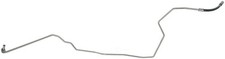


How the 46RE Cooler Circuit Works
Two fittings on the passenger side of the case carry the circuit. The front fitting is the feed: hot oil leaving the converter and heading out to be cooled. The rear fitting is the return, and it is the one Sonnax tells you to measure flow from in its RE-family instructions.
On most 46RE trucks the primary cooler is not a separate box at all. It is a tube cooler inside the radiator's side tank, so the oil gives up heat to engine coolant. Trucks built with a towing or heavy-duty cooling package add an auxiliary air-to-oil cooler in front of the radiator, plumbed in series with the tank cooler. Either way, the path is case, steel line, rubber splice, cooler, rubber splice, steel line, case, with clips and brackets holding the steel along the frame and engine.
The reason this matters for diagnosis is that the oil coming back through the rear fitting does not just go back to the pan. It is the lubrication supply for the bushings, planetaries and clutch packs. Sonnax's tech article on 46-47RH/RE cooler and converter flow says restrictions in the cooler circuit show up as lube failures and also affect converter and valve control. A line that is pinched, kinked behind a bracket, or partly plugged with debris does its damage quietly.
The Drainback Check Valve Hiding in the Line
Many RE-family trucks carry a small check valve in the cooler line, usually called the drainback valve. Its job is to keep the converter from draining back into the pan when the truck sits, so you do not get a delayed engagement every morning. The trouble is that it is a spring and a seat sitting in the middle of the cooler circuit, and it can stick or partially plug.
Sonnax lists the drainback fitting first among the cooler-circuit restriction points in its 46-47RH/RE flow article. Its instruction sheet for the 22771A-02K lube-regulated pressure regulator valve, which covers the 46RE and 46RH, goes further: to prevent converter slippage, restricted cooler flow and possible hydraulic noise, remove the cooler line drainback valve. The same sheet gives the target line pressure for that valve as 62-65 psi idle in Drive, measured at the pressure tap on the passenger side, middle of the case between the accumulators, and warns that more than 80 psi can cause valve binding.
So when you replace 46RE cooler lines, decide on purpose what happens to that valve. If you leave it, test flow with it in place. If the flow test is marginal, take it out and retest. If you remove it, the trade-off is the one it was designed to prevent: a truck that sits for days may take a moment to engage on a cold start while the converter refills. Most builders take that trade.
Fitting Problems: The Recall and Cracked Cases
NHTSA campaign 97V084000 (1994-1997 Ram)
Chrysler recalled about 960,000 1994-1997 Dodge Ram trucks under NHTSA campaign 97V084000. According to the NHTSA record, under high-load conditions the fluid temperature could exceed the melting point of the material in the connector that retained the cooler line to the transmission. The line would not stay connected and fluid could spray onto the exhaust manifold, causing smoke or fire. Dealers replaced the high-temperature side connector fittings with connectors using a stainless steel retainer.
A 1996 or 1997 Ram 1500 with a 46RE falls in that range. Before you order lines, look at what is screwed into the case. If you find an original-style connector on the hot side, replace it with the updated stainless-retainer style regardless of whether it is leaking, and run the VIN for open recalls.
Tapered threads and cracked bosses
The case fittings thread into the aluminum with 1/4 in. tapered pipe threads. Sonnax's product notes for its 22000-01K cooler line repair kit spell out the failure: the tapered threads of OE fittings crack the case when overtightened, and the symptom is an oil leak. A wet boss with a dry line nut is the tell. Cranking the fitting tighter only spreads the crack.
The fix does not require pulling the transmission. Per the 22000-01 instructions, which list the 46RE and 46RH, you remove the OE fitting, re-tap the hole with the kit's tap until it bottoms, clean the chips out, and thread in the adapter. The adapter seals on its leading edge where the tap bottomed, which keeps fluid away from the crack, and its straight threads keep the crack from growing. Sonnax says to pull the adapter once and look for a contact witness mark on the leading edge, then reinstall it with threadlocker and put the OE fitting into it with sealant. The kit is for cases with 1/4 in. pipe fittings only.
Practical rule on every line job: put a backup wrench on the case fitting any time you turn a line nut, and never use the fitting itself as the thing you tighten to stop a leak.
Flow-Test Before and After
Sonnax calls cooler restriction the most common issue on the 46/47RE family and says it may become a problem as cooler head pressure nears 80 psi or more. The symptom list in its flow article is the reason to test instead of guess, because none of these look like a cooler problem on a gas truck:
- P0740 / P1740 converter clutch codes
- Converter clutch slip at high torque, such as climbing a grade with a trailer
- Delayed engagements and slow converter fill
- Excessive stall speed
- Hydraulic noise
The test comes from section 7 of Sonnax's 22771A-01 switch valve instructions, which cover the 46RE:
- Disconnect the return line at the rear of the case and run it into a marked container.
- Start the engine, hold the brakes, and select Drive at idle.
- Flow must be at least 1 quart in 20 seconds (0.8 gpm).
Keep the run short and shut the engine off as soon as you have your reading; the pan is losing what goes in the jug. With a SonnaFlow-style meter plumbed in, Sonnax gives good readings as 0.7 to 0.9 gpm at idle in Drive, 1.8 gpm at 45 mph with the converter clutch off, and a rapid rise to 2.1 to 2.2 gpm when the clutch applies. If flow stays low until lockup and then jumps, Sonnax's flow article points to a restriction in the converter's release oil path rather than the coolers.
When flow is low, split the circuit. Sonnax's own advice is that the most effective check is to temporarily bypass the cooler circuit and retest. Loop the two lines together at the radiator (or jumper past the auxiliary cooler first, then the tank cooler), run the test again, and see which piece brings the number back. If bypassing everything still gives you low flow, the problem is inside the transmission: pump, pressure regulator, or converter.
Clean or Replace the Coolers After a Failure
Sonnax's instructions put it bluntly: there are many problems with restricted lines, drainback valves and contaminated coolers, and if a previous converter failed, the remains end up in the radiator. On a 46RE that means inside the radiator tank cooler, which you cannot see into and cannot fully clean with a garden hose.
- Radiator tank cooler: back-flush it with a proper cooler flusher in both directions until the solvent comes out clean, blow it dry, then prove it with the flow test. If it will not flow after flushing, the radiator gets replaced. There is no in-between.
- Auxiliary air-to-oil cooler: the fine passages trap clutch and converter debris. After a failure, replace it rather than flush it.
- Drainback valve: after a failure, do not reinstall the old one. Either replace it or delete it, as covered above.
Replacing the Lines Step by Step
- Set a clean drain pan under the case and radiator so you can read what drains out.
- Disconnect the lines at the radiator or auxiliary cooler first. Quick-connect style fittings need the correct release tool; do not pry them.
- Note every clip and bracket before removing them. A replacement line that is not clipped where the original was will rub through or sit against the exhaust.
- Disconnect the lines at the case with a backup wrench on each case fitting. Expect fluid from the front port.
- Inspect the case bosses. Any crack gets the Sonnax adapter repair now, while everything is apart. Check what connector style you have on 1994-1997 trucks.
- Decide on the drainback valve and flush or replace the coolers as above.
- Install the new lines loosely along the factory path, clear of the exhaust, steering linkage and suspension travel, then clip them before tightening.
- Tighten the fittings to your line kit's specification, using sealant only where the kit calls for it on pipe threads and never on flare or O-ring seats. Use a backup wrench every time.
- Refill and run the flow test at the rear return, then reconnect and check for leaks after a full heat cycle and again after a loaded drive.
Fluid and Fill After the Job
The 46RE uses ATF+4 (Chrysler MS-9602). Chrysler's Ram fluid capacity chart lists the 46RE at 8 pints (3.79 L) for a service fill and 19 to 20 pints (8.99 to 9.46 L) for an overhaul fill. The footnote on that chart is the part that matters here: dry fill varies depending on the type and size of the internal cooler, the length and inside diameter of the cooler lines, and the use of an auxiliary cooler. A new set of lines, a delete, or an added cooler all change the number.
So do not pour a fixed amount. Add roughly what came out, start the engine, cycle through the gears, and bring the level to the full mark on the dipstick at operating temperature in Neutral. Recheck after the flow test, since that test dumps fluid on purpose.
Stock Lines or Upgrade?
On a gas truck that does not tow, a direct-replacement steel line set routed and clipped like the factory set is the right answer. On a 46RE that tows, the weak link is usually heat rather than the lines themselves. That is when an auxiliary cooler, a deep finned pan and a temperature gauge earn their keep. Our 46RE overheating guide goes through the full cooling picture, and the 46RE towing upgrades post covers what else to change when the truck works for a living.
Shop RE-family transmission parts →
Frequently Asked Questions
Which 46RE cooler line is the return line?
The return line is the one at the rear fitting on the case. Sonnax takes its cooler flow measurement from the return line at the rear of the case, which is how you identify it on the bench and on the truck. The front fitting is the pressure feed out to the coolers.
How much cooler flow should a 46RE have?
Sonnax's spec for the RE family, including the 46RE, is at least 1 quart in 20 seconds (about 0.8 gpm) from the rear return line in Drive at idle. With a flow meter, good readings are 0.7 to 0.9 gpm at idle in Drive, about 1.8 gpm at 45 mph with the converter clutch off, and a quick rise to 2.1 to 2.2 gpm when the clutch applies.
Should I remove the 46RE cooler line drainback valve?
Sonnax's instructions for its 22771A-02K pressure regulator valve, which covers the 46RE, say to remove the cooler line drainback valve to prevent converter slippage, restricted cooler flow and possible hydraulic noise. The valve exists to keep the converter from draining when the truck sits, so after removal some builders expect a brief delayed engagement on a cold start.
How much ATF+4 does a 46RE take after replacing the cooler lines?
Chrysler's Ram fluid capacity chart lists the 46RE at 8 pints (3.79 L) for a service fill and 19 to 20 pints (8.99 to 9.46 L) for an overhaul fill. The chart notes that dry fill varies with cooler size, cooler line length and diameter, and an auxiliary cooler, so fill to the dipstick hot in Neutral rather than to a number.
Sources
- Sonnax — "46-47RH/RE Cooler and Converter Flow" (Bob Warnke). Backs cooler restriction as the most common issue on the 46RE/47RE family, the drainback fitting, auxiliary or radiator coolers and lines as restriction points, restrictions showing up as lube failures, trouble as head pressure nears 80 psi, the symptom list, bypassing the cooler circuit to verify, and low flow until lockup pointing at the converter release circuit. sonnax.com
- Sonnax — 4-Spool Switch Valve 22771A-01 instructions (42RE through 48RE, including 46RE), section 7 "Critical Pump & Cooler Flow Quality Adjustments." Backs the minimum flow of 1 quart in 20 seconds (0.8 gpm) at the rear return line in Drive at idle, the 0.7-0.9 / 1.8 / 2.1-2.2 gpm readings, and converter debris ending up in the radiator. Sonnax instructions (PDF)
- Sonnax — Lube Regulated Pressure Regulator Valve 22771A-02K instructions (covers 46RE/46RH). Backs removing the cooler line drainback valve to prevent converter slippage, restricted cooler flow and hydraulic noise, the 62-65 psi idle-in-Drive line pressure target and tap location, and the 80 psi binding warning. Sonnax instructions (PDF)
- Sonnax — Cooler Line Repair Kit 22000-01K (fits 46RE/46RH) and adapter 22000-01 instructions. Backs tapered OE fittings cracking the case when overtightened, the leading-edge seal and witness mark, threadlocker and sealant steps, the 1/4 in. pipe fitting limitation, and in-vehicle repair. sonnax.com
- NHTSA — Recall campaign 97V084000 (Chrysler, 1994-1997 Dodge Ram). Backs the connector material melting under high-load fluid temperatures, line separation and fluid spraying onto the exhaust manifold, about 960,000 affected vehicles, and the stainless steel retainer remedy. NHTSA recall record
- Chrysler / Ram Body Builder Guide — Ram Fluid Capacities. Backs the 46RE service fill of 8 pints (3.79 L), overhaul fill of 19-20 pints (8.99-9.46 L), and the note that dry fill varies with cooler size, cooler line length and diameter, and auxiliary coolers. Ram fluid capacities (PDF)
Shop 46RE cooler parts, pans, filters and overhaul parts — shipped fast from the USA.
Shop 46RE parts →