A 46RE that will not go into overdrive runs 1-2-3 and then holds third all the way down the highway, engine turning 500 or so rpm more than it should at 60 mph. This is the gas-engine member of the RE family: the four-speed Chrysler bolted behind the 5.2L and 5.9L Magnum V8s in Ram 1500 and light-duty 2500 trucks, Durangos and Dakotas. "No fourth" is one of the most common complaints on it, and most of the time the transmission is not broken inside.
The reason is how this unit shifts. First through third are hydraulic, stroked by governor pressure. The 3-4 shift is electrical: the PCM has to energize one solenoid, and it has a list of reasons to refuse. Chrysler's own diagnosis chart for "No 3-4 Upshift" lists fifteen causes, and the first eight can be found with a scan tool, a test light and a meter before the pan ever comes off. Specs below come from Chrysler's 2001 Ram service manual, ATRA's GEARS and Transmission Digest.
The short version: Make sure the O/D OFF lamp is out and the overdrive fuse is good. Get the fluid warm. On a scan tool, confirm output speed, TPS and fluid temperature make sense. Back-probe the overdrive solenoid control wire (PCM pin B21, brown, on the gas controller): about 12 V when off, near 0 V when the PCM commands fourth. If the PCM never pulls it low, the problem is an input or the PCM. If it pulls low and the truck stays in third, it is the solenoid, the valve body feed orifice, the 3-4 shift or timing valve, or the overdrive clutch and piston. Confirm with the fourth-gear pressure test: 68-72 psi at closed throttle at the overdrive clutch port.
How the 46RE Gets Into Fourth
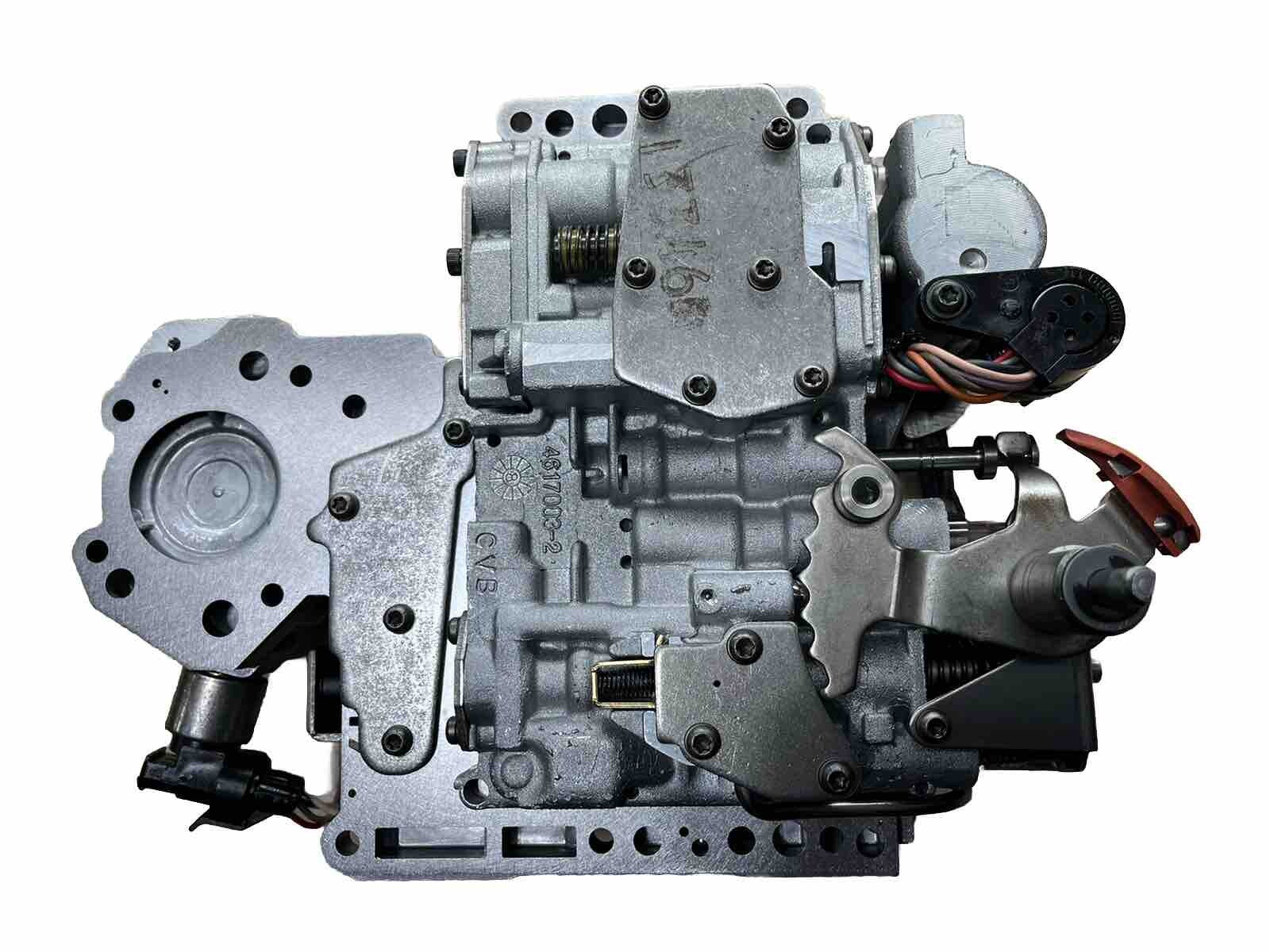
Chrysler describes fourth gear as "electronically controlled and hydraulically activated" (46RE Fourth Gear Powerflow, factory service manual page 21-486). The overdrive solenoid on the valve body contains a check ball that opens and closes a vent port in the 3-4 shift valve feed passage. In first, second, third and reverse the solenoid is off and the vent is open, so line pressure coming from the 2-3 shift valve bleeds away before it can reach the 3-4 shift valve.
When the PCM energizes the solenoid, the ball closes the vent. Line pressure from the 2-3 valve now acts on the 3-4 shift valve, overcomes its spring, and strokes it to the upshift position. That opens feed to four things: the 3-4 timing valve, the 3-4 quick fill valve, the 3-4 accumulator and the overdrive piston. The direct clutch releases, then the overdrive clutch applies. Chrysler's original patent for this add-on overdrive (US 4,798,103) explains why those two events are tied together: a single piston compresses the large direct clutch spring to release the direct clutch while it applies the overdrive clutch and grounds the sun gear, giving an overdrive ratio on the order of 0.69:1. With no pressure on that piston, the spring holds the direct clutch on and the unit passes power through at 1:1. A boost valve raises apply pressure to the overdrive clutch during the shift and while accelerating in fourth, and the accumulator cushions the apply.
Two details matter for diagnosis. First, the manual states that the overdrive control switch must be in the ON position to transmit overdrive status to the PCM. Second, per the valve body section, once the shift happens the 3-4 timing valve holds the 2-3 shift valve in its upshift position so the 2-3 valve cannot downshift ahead of the 3-4 valve (46RE Valve Body, factory service manual page 21-620). The quick fill valve bypasses the piston feed orifice at the start of the shift for a fast fill, then closes once pressure builds in the clutch.
ATSG's 46RE/47RE/48RE technical service information lists the overdrive unit's parts as an overdrive clutch, an OD/direct clutch, an overrun roller clutch and a planetary gearset. The overdrive unit itself is compact on the 46RE. The factory parts breakdown shows the overdrive clutch pack as a reaction plate, four friction discs, three steel plates and a pressure plate, and notes that on the 46RE the reaction plate is the same thickness as the pressure plate (46RE Overdrive Clutch Components, factory service manual page 21-576). That small pack is why a cooked or low-pressure 46RE loses fourth first.
So there are two halves to this problem. Either the PCM is not commanding fourth, or it is commanding fourth and the overdrive unit is not taking it. A truck that never even tries for fourth is almost always the first. A truck that shifts into fourth and flares, slips, or drops back to third is the second.
Chrysler's "No 3-4 Upshift" Chart
The 46RE diagnosis chart lists the possible causes in this order (46RE Diagnosis Charts, factory service manual page 21-499; the identical 15-cause chart appears in the 1998 Ram Truck service manual, pp. 21-230/231):
| # | Cause | Factory correction |
|---|---|---|
| 1 | O/D switch in OFF position | Turn control switch ON |
| 2 | Overdrive circuit fuse blown | Replace fuse, find the short |
| 3 | O/D switch wire shorted, open or cut | 12 V test lamp and voltmeter |
| 4 | Distance or coolant sensor | Check with scan tool |
| 5 | TPS malfunction | Check with scan tool |
| 6 | Neutral sense to PCM wire shorted or cut | Test switch/sensor |
| 7 | PCM malfunction | Check with scan tool |
| 8 | Overdrive solenoid shorted or open | Replace solenoid, repair wiring |
| 9 | Solenoid feed orifice in valve body blocked | Disassemble and clean valve body |
| 10 | Overdrive clutch failed | Disassemble overdrive and repair |
| 11 | Hydraulic pressure low | Pressure test |
| 12 | Valve body valve stuck | Free 3-4 shift valve, 3-4 timing valve |
| 13 | O/D piston incorrect spacer | Check end play, install correct spacer |
| 14 | Overdrive piston seal failure | Replace both seals |
| 15 | O/D check valve or orifice failed | Check free movement, check ball bleed orifice |
Items 1-8 are electrical or inputs, 9, 11 and 12 are pan-off valve body work, and only 10, 13, 14 and 15 mean pulling the transmission.
Step 1: The Switch, the Lamp and the Fuse
Check the obvious first, because it catches more trucks than anyone admits. On these trucks the overdrive OFF switch is a button on the shift lever. If the O/D OFF lamp is lit, press it and see whether the lamp goes out. A switch that never changes the lamp, or a lamp that stays on no matter what, points to the switch, its wire, or the fuse, which are causes 1 through 3 on the chart. The manual's correction is to check the wires and connections with a 12-volt test lamp and voltmeter.
Do not let converter lockup fool you. Lockup drops rpm too, and plenty of drivers mistake it for the shift into fourth. Watch the scan tool gear, or the tach against road speed, instead of trusting the feel.
Step 2: Inputs the PCM Needs
The PCM will not command fourth unless its inputs add up. The chart names the distance (speed) sensor, the coolant sensor, the TPS and the neutral sense wire. On a 46RE, which only came behind gas engines, the GEARS gas-PCM chart gives you real numbers to compare against (GEARS, "Troubleshooting the 42-47RE Transmissions," October 2006):
| PCM pin (1996-2003 RWD gas) | Wire | Circuit | Expected reading |
|---|---|---|---|
| B21 | Brown | OD solenoid control | About 12 V key on, 0.0 V when ON |
| B11 | Orange/black | TCC solenoid control | About 12 V key on, 0.0 V when ON |
| B28 | Lt green/black | Output shaft speed signal | About 3.0 V AC at 30 mph |
| B25 | Dk blue/black | OSS ground | 0.0 V |
| B1 | Violet | Trans temp signal | About 4.5 V cold to 1.0 V hot |
| B30 | Pink | Trans relay control | 0.0 V running, no codes |
| B31 | Orange | 5 V reference | 5 V key on |
Output speed. No speed signal, no governor pressure and no 3-4 shift. A speed sensor that drops out at highway speed is a classic "shifts to fourth, then falls out" cause.
Fluid temperature. Cold fluid holds fourth out on purpose, so test with the fluid warm. Chrysler spells out the lockouts in the 1998 Ram service manual (p. 21-213): no shift to fourth with the overdrive switch off, with transmission fluid below 50 F (10 C) or above 250 F (121 C), before the shift to third is complete, at too low a vehicle speed, or with battery temperature below -5 F (1998 Ram Truck service manual, Group 21). A truck that only refuses fourth on cold mornings or after a long pull with a trailer may be doing exactly what it was programmed to do. GEARS adds a trap worth knowing on these trucks: early systems used a negative temperature coefficient thermistor, and starting in 1999 some vehicles switched to a positive temperature coefficient part. If the scan tool shows fluid temperature starting hot and dropping as the truck warms up, the wrong sensor is in it, and the PCM may think the fluid is too cold for fourth.
TPS and coolant. A TPS that reads wide open at part throttle, or a coolant sensor stuck cold, can both keep the PCM from allowing the 3-4 shift. The chart tells you to check both with a scan tool.
Step 3: Is the PCM Commanding Fourth?
This is the test that splits the problem in half. Back-probe pin B21 (or the solenoid control wire at the case connector) and drive the truck with a meter where you can see it. You should see battery voltage through first, second and third, falling to near zero when the PCM commands fourth, because the PCM completes the solenoid's ground.
- Voltage never drops: the PCM is not asking for fourth. Go back to the switch and the inputs.
- No voltage at all, key on: the solenoids have lost power. GEARS notes the case connector's pin 1 feeds the solenoids and should have system voltage whenever the key is on; losing it puts the unit into limp mode, which is a third-gear start, not just a missing fourth.
- Voltage drops and the truck stays in third: the command is getting there. The problem is the solenoid, its feed orifice, a stuck valve or the overdrive unit.
One quirk on the power side is worth knowing. Transmission Digest traced the transmission-control relay coil on the 46RE and 47RE to the PCM's "Generator Source" output, a feed that is only live with the engine running, and that same bus also powers the EVAP leak detection pump (Transmission Digest). If you check for solenoid power key on, engine off and find nothing, start the engine before you condemn anything. A truck with a charging fault, an EVAP code and a transmission complaint together is pointing at that shared circuit.
Step 4: The Solenoid Assembly and Valve Body
With the pan and valve body off, check the solenoid assembly and case connector for continuity and shorts. On these units the overdrive and converter clutch solenoids are in one assembly, and the factory correction for a shorted or open overdrive solenoid is to replace it and repair any loose or damaged wiring. Look hard at the case connector O-ring and pins; a fluid-soaked connector gives intermittent fourth that comes and goes with temperature.
A solenoid that clicks but will not seal is just as bad as a dead one. If the check ball does not close the vent, 2-3 oil bleeds off and the 3-4 valve never strokes. Then clean the valve body the way the chart says: disassemble it, check the solenoid feed orifice, and make sure the 3-4 shift valve and 3-4 timing valve slide freely in their bores. The chart's correction for a sticking valve is to polish it with crocus cloth if needed. Sonnax publishes a valve body layout reference covering this exact family, the 42RH/44RE/46RE/47RH/47RE/48RE group, which is the place to check before assuming a worn bore needs an oversized valve kit rather than a cleaning (Sonnax, Chrysler 42-44-46-47RH/RE, 48RE Valve Body Layout).
Step 5: Pressure Test the Overdrive Circuit
If the PCM is commanding fourth and the valve body is clean, prove the overdrive circuit with a gauge before you pull the unit. Chrysler's Test Six puts a 300 psi gauge on the overdrive clutch pressure port, which is at the left rear of the case, with the OD switch ON (46RE Hydraulic Pressure Test, factory service manual page 21-489). Drive it until the 3-4 shift happens:
| Condition | Overdrive clutch pressure |
|---|---|
| Closed throttle, just after 3-4 shift | 68-72 psi |
| 1/2 to 3/4 throttle | 90-120 psi |
| Full throttle | Up to about 130 psi |
Pressure that never shows up at the port means oil is not reaching the piston: a stuck 3-4 valve, a blocked orifice or the solenoid. Pressure that shows up but runs low, when line pressure in the other tests is fine, is the textbook "Pressure low in D fourth gear range," which Chrysler's pressure analysis chart pins on the overdrive clutch piston seal or a check ball problem (Pressure Test Analysis Chart, factory service manual page 21-490).
GEARS offers a second way to watch this without the overdrive port. The PCM normally turns the governor solenoid off around 40 mph because the OD solenoid takes over the shift to fourth, so the governor pressure sensor is really reading line pressure while you drive in fourth. A governor pressure reading on the scan tool that sags in fourth is another sign of low line pressure.
Step 6: When It Is the Overdrive Unit
If it shifts into fourth and slips, or flares on the 3-4, the chart for "Slips in Overdrive Fourth Gear" gives the list: low fluid, a worn overdrive clutch pack, a blown-out bleed orifice in the overdrive piston retainer, a damaged overdrive piston or seal, a 3-4 shift valve, timing valve or accumulator problem, an overdrive thrust bearing failure, or a failed O/D check valve and bleed orifice (factory service manual page 21-500). The chart for delayed 3-4 upshifts adds excess overdrive clearance and a missing or stuck check valve.
The factory application chart confirms the logic. The overdrive clutch is applied only in fourth. If the truck slips in fourth but not in third, it is the overdrive clutch (Clutch and Band Application Chart, factory service manual page 21-487). The same page reminds you that if the direct clutch fails instead, you lose reverse and engine braking in manual second, which is a different complaint. That direct clutch is applied by spring force alone, and TransGo lists slipping or no reverse, weak or no coast braking in manual 2nd or 1st, and burned overdrive direct clutch plates as the signature of a faded overdrive direct spring (OEM part 4461027).
When you rebuild the overdrive, do not skip the measurements. Two items on the no-upshift chart are clearance problems: an incorrect O/D piston spacer and excess overdrive clearance. The manual's fix for both is to remove the unit, measure end play and install the correct spacer; the intermediate shaft spacer is chosen with gauge tools 6311 and 6312 and a dial caliper. Replace both overdrive piston seals, check the orifice insert in the piston retainer, and inspect the three overdrive thrust bearings. Then fix whatever cooked it: on a 46RE that usually means a restricted cooler or towing near the limit in fourth.
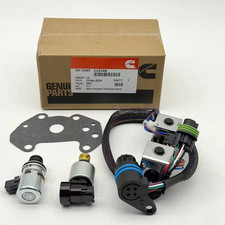
Replacing the solenoid? OEM-style 1996-1999 solenoid assembly (12432A)
For 1996-1999 Ram 1500 trucks with the RE-family unit, this is the overdrive and lockup solenoid assembly that bolts to the valve body. If the B21 test shows the PCM commanding fourth and the solenoid tests open or shorted, this is the part.
View the solenoid kit →Or browse the full RE-family parts collection.
Prevention
Most 46RE overdrive failures start with heat. Keep the fluid at the right level and on ATF+4, change it on schedule, and keep the cooler clear. If the truck tows, use the overdrive OFF button on long grades so the unit is not hunting between third and fourth, and add auxiliary cooling.
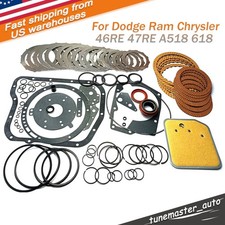
Need parts for this job? Solenoid kits, valve bodies, master rebuild kits and governor solenoid kits for the 46RE are all in one place. Shop 46RE parts →
FAQ
Why won't my 46RE shift into overdrive?
Start with the simple causes on Chrysler's no 3-4 upshift chart: the O/D OFF switch turned off, a blown overdrive fuse, or a broken switch wire. Next come the inputs the PCM needs, including the speed sensor, coolant sensor, TPS and neutral sense wire. Only after those check out do you move to the overdrive solenoid, the valve body and the overdrive clutch.
How do I test the 46RE overdrive solenoid?
Back-probe the overdrive solenoid control wire, which is PCM pin B21 (brown) on the 1996-2003 gas-engine controller, and drive the truck. It should read about 12 volts in first through third and drop to near 0 volts when the PCM commands fourth. With the valve body out, check the solenoid assembly and case connector for continuity and shorts with a meter.
What should overdrive clutch pressure be on a 46RE?
Chrysler's fourth gear test puts a 300 psi gauge on the overdrive clutch port at the left rear of the case. After the 3-4 shift it should read 68-72 psi at closed throttle, 90-120 psi at half to three-quarter throttle, and around 130 psi at full throttle. Low pressure only in fourth points to the overdrive piston seal or check ball.
Can cold fluid keep a 46RE out of fourth?
Yes. The PCM uses the transmission temperature sensor to adjust its shift strategy, and cold fluid holds fourth out on purpose, so always test with the fluid warm. Starting in 1999 some trucks used a positive temperature coefficient sensor instead of the earlier negative coefficient type; if the scan tool shows the fluid getting colder as you drive, the wrong sensor may be installed.
Does a 46RE with no overdrive need a rebuild?
Often not. Eight of the fifteen causes on Chrysler's no 3-4 upshift chart are switches, fuses, wiring, sensors, the PCM or the solenoid. If the PCM commands fourth, the valve body is clean and the truck still slips or will not take fourth, then the overdrive clutch, piston seals or spacer are the problem and the overdrive unit comes apart.
Sources
- Chrysler — 2001 Dodge Ram Truck (BR/BE) Service Manual, Automatic Transmission – 46RE (Fourth Gear Powerflow p. 21-486; Clutch and Band Application p. 21-487; Diagnosis Charts "No 3-4 Upshift" p. 21-499 and "Slips in Overdrive Fourth Gear" / "Delayed 3-4 Upshift" p. 21-500; Hydraulic Pressure Test Six p. 21-489 and Pressure Test Analysis Chart p. 21-490; Overdrive Unit clutch components and spacer selection p. 21-576; Valve Body 3-4 shift/timing/quick-fill valves p. 21-620). Backs the overdrive solenoid check ball and vent port operation, the fifteen-cause "No 3-4 Upshift" chart, the 68-72/90-120/about-130 psi overdrive clutch pressure specs, the clutch-applied-only-in-fourth logic, the four-disc/three-plate overdrive pack, and the timing/quick-fill valve sequence. The manualslib.com scan previously cited for these pages no longer resolves (403, bot-blocked as of October 2026); cited here as the factory manual by page number pending a working public mirror.
- Chrysler — 1998 Dodge Ram Truck Service Manual, Group 21 Transmission (archive.org full scan). Backs the shift-to-fourth lockout conditions (O/D switch off, fluid below 50 F or above 250 F, third not complete, speed too low, battery below -5 F) on p. 21-213 and the identical fifteen-cause "No 3-4 Upshift" diagnosis chart (O/D switch, fuse, switch wire, distance/coolant sensor, TPS, neutral sense wire, PCM, overdrive solenoid, feed orifice, overdrive clutch, hydraulic pressure, stuck 3-4 shift/timing valve, piston spacer, piston seal, check valve/orifice) on pp. 21-230/231. archive.org
- ATRA / GEARS Magazine — Dave Skora, "Troubleshooting the 42-47RE Transmissions," October 2006. Backs the 1996-2003 gas RWD PCM pin and voltage chart (B21 OD solenoid, B11 TCC, B28 OSS, B1 temperature), case connector pin 1 solenoid feed and limp mode, NTC to PTC thermistor change starting in 1999, and the governor sensor reading line pressure in fourth above about 40 mph. GEARS PDF
- Transmission Digest — "46RE/47RE Power Circuit for Transmission-Control-Relay Coil." Backs the relay coil fed from the PCM Generator Source (engine running only), the shared EVAP leak detection pump feed, and the tip to start the engine before condemning a no-power reading. transmissiondigest.com
- Sonnax — "Chrysler 42-44-46-47RH/RE, 48RE Valve Body Layout." Confirms Sonnax maintains a dedicated valve body layout and repair reference for this exact transmission family, backing the point that a sticking 3-4 shift valve or timing valve on a 46RE should be checked against a known layout and oversized-valve option before condemning the casting. sonnax.com
- Chrysler Motors Corp. — US Patent 4,798,103, "Automatic transmission with add-on overdrive." Backs the single overdrive piston that compresses the direct clutch spring to release the direct clutch while applying the overdrive clutch, the sun gear being grounded in overdrive, the spring-applied 1:1 fail-safe mode, and the approximately 0.69:1 overdrive ratio. patents.google.com
- ATSG (Automatic Transmission Service Group) — 46RE, 47RE, 48RE Technical Service Information (2011). Backs the overdrive unit component list: overdrive clutch, OD/direct clutch, overrun roller clutch and planetary gearset. atsg.biz (PDF)
- TransGo — TFOD-SP overdrive direct clutch spring technical page. Backs the spring applying the overdrive direct clutch, OEM part 4461027, and the faded-spring symptoms (slipping or no reverse, reduced coast braking in manual 2nd/1st, burned direct plates). transgo.com