The complaint gets written three different ways and it is always the same noise: "it bangs into reverse," "it clunks backing out of the driveway," "you have to hold the brake or it jumps." Half of these get a rebuild they did not need. The other half get a solenoid thrown at them and come back a week later.
Harsh reverse on a 4L60E is a narrow problem with a short cause list, and every cause on it separates with a pressure gauge, a scan tool, and thirty minutes in the bay. What makes it look complicated is that two of the four common causes are not transmission failures at all. One is normal driveline behavior, and one is something the last shop installed on purpose.
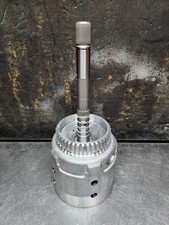
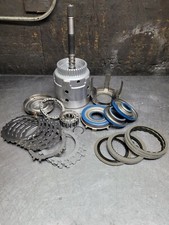
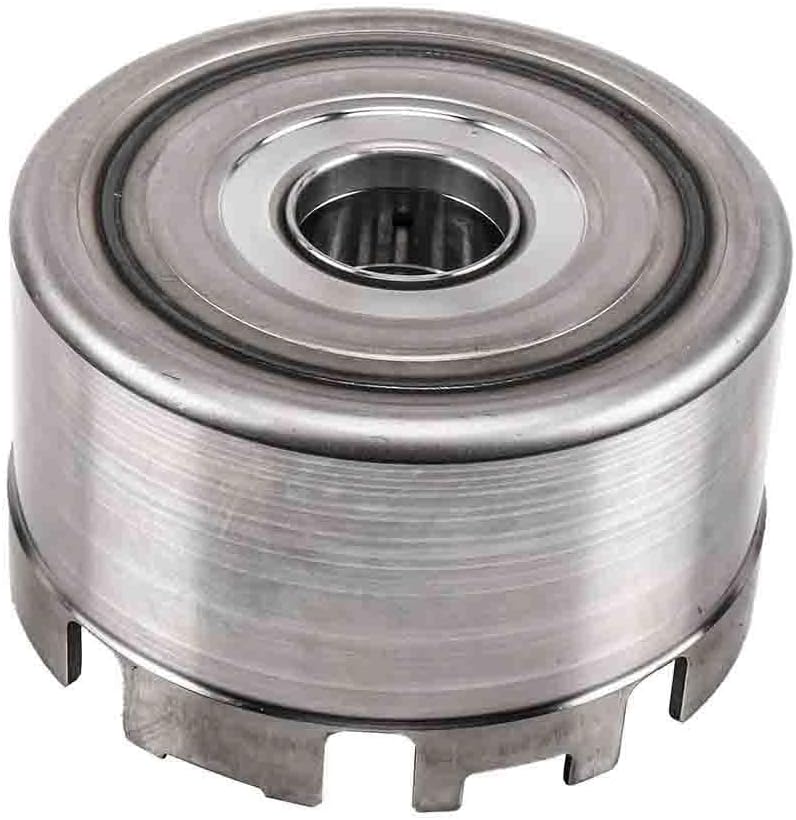
What is actually applying when you pull it into Reverse
Reverse in a 4L60E is a two-component apply. The manual valve routes line pressure into the reverse circuit, which fills the reverse input drum to apply the reverse input clutch, while the low and reverse clutch pack at the rear of the case applies to hold the reaction member. Neither of those gets an accumulator the way the forward clutch does. There is no large cushioning piston sitting in the reverse apply path smoothing things out.
Instead, the reverse apply rate is governed by two much smaller things: the size of the feed orifice into the drum, and how much line pressure is standing behind that orifice at idle. Change either one and the engagement feel changes immediately. That is the whole picture, and it is why this failure has such a short cause list.
It also explains why reverse exposes a pressure problem first. Reverse runs on a boosted line pressure circuit because the reverse clutches need more clamping force than any forward gear. Whatever base line pressure is doing, reverse sees it multiplied.
Rule out the driveline before you open anything
Start here, because it is free and because a real percentage of these complaints are not the transmission. GM has held the same position on this for over twenty years. Corporate bulletin 99-04-20-002K, "Information on Driveline Clunk Noise" (November 2019), states that customers of vehicles with automatic transmissions may comment on a clunk noise when shifting between Park and Drive, Park and Reverse, or Drive and Reverse, and that accumulated freeplay in the driveline, known as lash, is what produces it. The bulletin's diagnostic instruction is blunt: compare the complaint vehicle to a like vehicle, and if the results are the same, this is a normal condition.
The practical version on the lift:
- Chock the front wheels, raise the rear, and have someone shift Park to Reverse to Drive while you watch the driveshaft and pinion flange. You are measuring how much rotational slop takes up before anything moves.
- Grab the driveshaft at both ends and twist. U-joint and slip-yoke wear stacks with pinion lash, and on a 4WD the transfer case stacks on top of that.
- Check the transmission mount and both engine mounts. A collapsed mount lets the powertrain rotate on engagement, and the customer feels that as a bang, not a rock.
- Confirm curb idle. A high idle from a vacuum leak or sticking IAC pushes more converter torque into the driveline at engagement. Fix idle before condemning the transmission.
If the noise is a single sharp clunk with no shudder, no delay, and no rise in engine RPM, and a like vehicle does the same thing, you are done. Write it up as lash and move on.
Cause 1: line pressure is too high (the EPC circuit)
This is the most common real cause on an electronically controlled 4L60E, and the one that produces a genuine slam rather than a clunk. The pressure control solenoid, called EPC or PC depending on your tool, is a variable-force solenoid acting on the pressure regulator valve. The critical point is that the relationship is inverse: high commanded current means low line pressure, low current means high line pressure.
GEARS Magazine, published by ATRA, gives the working numbers for a healthy GM unit. At idle you should see roughly 10% engine load and 0.9 to 1.1 amps commanded to the pressure control solenoid. During a wide-open-throttle pull just before the 1-2 shift, engine load should climb to 90 to 100% and the solenoid command should drop to 0.2 to 0 amps. As load comes up, amperage falls and line pressure rises.
Now apply that to reverse. If the solenoid circuit goes open, the solenoid is contaminated and stuck, the internal harness pass-through is corroded, or the PCM driver has failed, current at idle falls toward zero. The pressure regulator valve sees no opposing force, line pressure defaults to maximum, and the reverse boost circuit multiplies it. The result is what the customer described: it bangs into reverse, every time, hot or cold.
The scan tool and amp clamp test
ATRA Technical Bulletin #1345, "4L60E Circuit Tests," lays out the check that separates a bad solenoid from a bad computer, and it is worth doing in that order before you buy either one. The bulletin's procedure puts a meter in series with the EPC solenoid high circuit, or an amp clamp around it if you would rather not cut anything, then compares real current against what the PCM says it is commanding.
Log these PIDs with the engine idling and the range selector moved through Park, Reverse, and Drive:
- EPC Desired Amps (DES A) and EPC Actual Amps (ACT A) — these should track each other closely
- Engine Load (%) — expect roughly 10% at idle
- TP Angle (%) — must read at or near zero with your foot off the pedal; a TPS reading 8 or 10% at closed throttle has the PCM commanding pressure it should not
- TFT — note whether the harshness is cold-only, which points at viscosity and fill rate rather than pressure
- Transmission Range switch state — confirm the PCM actually sees Reverse
Per ATRA bulletin 1345, the deciding comparison is this: if the scan tool shows the PCM commanding low line pressure (approximately 1 amp) but the meter at the solenoid shows a high-pressure command (near zero amps), the PCM needs to be replaced. If scan data and meter agree on near-zero current at idle, the command itself is wrong and you go upstream to the TP signal and load calculation. If the PCM commands a full amp and the meter reads near zero, the fault is between them: the solenoid, its connector, the internal harness, or the case pass-through.
4L60E EPC Pressure Control Solenoid (1990-2003)
If the meter proves the command is reaching the solenoid but pressure is still pinned high, the solenoid is the part. This is the direct-fit EPC solenoid for 1990-2003 units, a sixty-dollar piece that fixes a slam plenty of shops rebuild for. Match the year range to your case before ordering.
View the EPC solenoid at CoreTransmissionParts →Cause 2: the wrong reverse input drum for the year
This one is the sleeper, and it bites anyone buying used hard parts or working out of a mixed core pile. The feed hole in the reverse input drum is the orifice controlling how fast the reverse input clutch applies, and GM changed it twice.
Per Sonnax's breakdown of the change history:
- 1982-1986: the reverse input drum uses a rectangular feed hole where fluid enters the drum.
- 1987: with the introduction of the auxiliary valve body, the feed hole was changed to a smaller round hole,.095 in., and that hole became the metering orifice for the drum.
- 1993: a reverse feed orifice check ball was added to the valve body, and GM went back to the rectangular feed hole in the drum, because the metering had moved into the valve body.
Mix those up and the symptom is predictable in both directions. Put an early square-hole drum into a 1987-1992 unit with the auxiliary valve body and you have enlarged the feed hole to the reverse input clutch. The clutch applies much faster than the small-hole drum allows, and the engagement is harsh. Go the other way, a round-hole drum into a 1993 unit that already has the reverse feed orifice check ball, and you have two restrictions in series, which delays reverse instead.
That symmetry is the useful diagnostic. Harsh reverse after a rebuild on an early unit points at too much orifice. Delayed reverse on a later unit points at too little. If a unit engaged normally before the rebuild and bangs after, and line pressure checks out, pull the pan, verify the check ball is present and seated, then verify the drum generation matches the valve body it sits behind. Our 4L60E separator plate check ball location guide covers where that ball lives.
If the drum is wrong, replace it rather than modify it. Do not try to shrink a rectangular hole, and do not drill a round one out to "match" a later plate. You cannot re-create a metered orifice with a drill bit and a guess. The correct 1993-up reverse input drum is available as a service part.
Cause 3: somebody installed a pressure kit
Always ask what was done to the unit before it reached you. Line pressure booster kits and shift kits raise pressure on purpose, and they do it with two components working together: stronger pressure regulator springs and larger-ratio boost valves. Because reverse rides on the boosted circuit, a kit intended to firm up upshifts under load will also firm up reverse at idle, where nobody wanted it firmed up.
Sonnax is explicit about this trade-off in the design of its own 4L60E-LB1 line pressure booster kit, describing its pressure regulator springs as approximately 10% stronger than OE and "more conservative in impact than other aftermarket kit springs," with the stated design goal of achieving shorter shifts and increased torque capacity without creating low-speed harshness. That is an explicit engineering objective precisely because low-speed harshness is a real and common side effect of more aggressive kits.
If the unit has an unknown shift kit in it, the complaint is harsh reverse plus harsh garage shifts, and the truck drives well under load, you are probably not looking at a defect. You are looking at a calibration somebody chose, and the fix is a milder spring and boost ratio, not a rebuild. Confirm with a gauge: a pressure kit reads high across every range, including Park and Neutral, not in reverse alone.
Cause 4: pressure regulator and boost valve bore wear
Worth checking, but understand which direction it normally pushes. Bore wear at the pressure regulator valve and boost sleeve usually causes pressure loss, not gain. Sonnax lists the symptoms of a worn OE pressure regulator valve in the 4L60-E, 4L65-E and 4L70-E pump as erratic line pressure, low line rise, 3-4 clutch failure, excess pump noise, and reverse chatter, with the root cause being pressure regulator valve bore wear that allows leakage and contributes to erratic pump slide movement. Their detection standard on a dyno is to look for 50 to 100 psi less than specified in Reverse under boost conditions.
So why check it on a harsh complaint? Because "harsh" and "erratic" get reported the same way by customers. A pressure regulator valve that hangs up intermittently gives inconsistent engagements, smooth three times and then a slam, which is nothing like the every-single-time slam of a high-pressure EPC fault. When the customer says intermittent, put a gauge on it and watch the needle. The tell for unstable pressure control is needle bounce. A steady high reading is a command problem. A bouncing reading is a valve and bore problem, and that unit needs the pump addressed, not a solenoid.
More detail on that repair is in our writeup on 4L60E pressure regulator and boost valve wear.
The thirty-minute sequence
Run it in this order and you will not waste parts:
- Fluid level and condition, hot and level. Low fluid aerates the reverse feed and gives a delayed-then-harsh engagement that mimics everything below it.
- Curb idle and TP angle at closed throttle. Fix these first if either is off.
- Driveline lash check on the lift, per GM 99-04-20-002K, compared to a like vehicle if you have one.
- Gauge on the line pressure tap. Record Park, Neutral, Drive and Reverse at idle, and note whether the needle is steady or bouncing.
- Scan tool: DES A against ACT A, plus engine load, TP angle, TFT, and range switch state, in each range.
- Amp clamp on the EPC high circuit, compared against scan data, per ATRA bulletin 1345. This is the step that tells you solenoid versus PCM.
- Only then pull the pan, verify the reverse feed orifice check ball, and verify the drum generation against the valve body generation.
Steady high pressure in every range with near-zero EPC current is a command or solenoid fault. Steady high pressure in every range with correct EPC current is a mechanical pressure kit or a stuck boost valve. Normal pressure everywhere with a hard bang only in reverse is the drum, the check ball, or lash. That is the entire decision tree.
Shop 4L60E EPC and shift solenoids, reverse input drums, low and reverse clutch packs, pressure regulator and boost valve kits, and full rebuild kits — shipped fast from the USA.
Shop 4L60E parts →What keeps it from coming back
On a rebuild, tag the reverse input drum with the year range of the core it came out of before it goes in the parts washer. That one habit eliminates the most expensive version of this comeback. Verify the reverse feed orifice check ball is in the plate and seated before the valve body goes on, every unit, every time. And when a customer asks for a shift kit, tell them up front what it does to garage shifts and reverse feel at idle, because if you skip that conversation you will have it later for free.
On a diagnostic job, do not sell a rebuild on a reverse complaint alone. A slam into reverse with clean fluid, normal forward shift quality, and no slip is almost never worn clutches. Worn clutches slip. Pressure and orifice problems bang. Different failures, different repairs.
Sources
- Sonnax — "'82-'93 4L60 Harsh or Delayed Reverse Engagements," January 1, 2013. Backs the reverse input drum feed hole change history: the rectangular hole on '82-'86 units, the smaller round.095 in. hole introduced in 1987 with the auxiliary valve body that became the drum feed orifice, the harsh engagement that results from installing an early square-hole drum in a 1987-1992 unit because the feed hole to the reverse input clutch is enlarged and the clutch applies much faster, the 1993 addition of the reverse feed orifice check ball to the valve body with the return to the rectangular drum hole, and the delayed reverse that results from a round-hole drum in a 1993 unit. sonnax.com
- ATRA — Technical Bulletin #1345, "4L60E Circuit Tests," October 2010. Backs the EPC solenoid (force motor) in-series and amp-clamp current test procedure, the use of the EPC desired amps (DES A) and actual amps (ACT A) scan tool data PIDs, and the deciding rule that if the scan tool shows the PCM commanding low line pressure at approximately 1 amp while the meter shows a high-pressure command near zero amps, the PCM must be replaced. atracom (PDF)
- GEARS Magazine (ATRA) — "Controlling Pressure: General Motors." Backs the idle values of roughly 10% engine load with 0.9 to 1.1 amps commanded to the pressure control solenoid, the wide-open-throttle values of 90 to 100% engine load with the command dropping to 0.2 to 0 amps, the inverse relationship in which solenoid amperage falls as engine load and line pressure rise, and the amp-clamp-plus-pressure-gauge verification method. gearsmagazine.com
- General Motors — Service Bulletin 99-04-20-002K, "Information on Driveline Clunk Noise," November 2019 (hosted by NHTSA). Backs the position that a clunk noise when shifting between Park and Drive, Park and Reverse, or Drive and Reverse is produced by driveline freeplay (lash), that lash accumulates across every component in the driveline, and the diagnostic instruction to compare the complaint vehicle to a like vehicle and treat matching results as a normal condition. nhtsa.gov (PDF)
- Sonnax — "Oversized Pressure Regulator Valve 77917-07" part page. Backs the pressure regulator symptom list (erratic line pressure, low line rise, 3-4 clutch failure, excess pump noise, reverse chatter), the stated cause that pressure regulator valve bore wear allows leakage and contributes to erratic pump slide movement, the dynamometer detection standard of 50 to 100 psi less than specified in Reverse under boost conditions, and the instruction to check boost valves for leakage at the same time the pressure regulator valve is replaced. sonnax.com
- Sonnax — "Line Pressure Booster Kit 4L60E-LB1" part page. Backs the construction of line pressure booster kits from stronger pressure regulator springs plus large-ratio boost valves working together, the specification of the Sonnax springs at approximately 10% stronger than OE and more conservative in impact than other aftermarket kit springs, and the stated design goal of shorter shifts and increased torque capacity without creating low-speed harshness. sonnax.com