Every pressure decision a 4L60E makes runs through one part: the electronic pressure control solenoid, or force motor. Line pressure, shift firmness, how hard the 2-4 band grabs, whether the 3-4 pack survives a loaded trailer — all of it comes down to current sent to a solenoid you can reach with the pan off in twenty minutes.
Which is why it gets replaced so often, and why replacing it so often fixes nothing. The EPC solenoid is usually innocent; it is the part that reports the crime. Here is how the circuit works, what the numbers should be, and how to tell a genuinely failed force motor from the four faults that impersonate one.
The short version: The EPC solenoid is a variable-force solenoid that works backwards from what most people expect — high current means low pressure, and zero current means maximum pressure. Before you condemn it, put a meter in the circuit. Per ATRA Technical Bulletin #1345, compare the scan tool's EPC desired and actual amps PIDs against a real amp reading on the wire; if the PCM says it is commanding roughly 1 amp (low pressure) while the meter shows near zero (high pressure), the fault is the PCM, not the transmission.
What the EPC Solenoid Actually Controls
The EPC solenoid does not directly make line pressure. The pump makes pressure; the pressure regulator valve decides how much stays in the line circuit and how much dumps back to converter feed and the suction side. The EPC solenoid sends a variable oil signal — GM calls it torque signal oil — to the pressure regulator boost valve. More torque signal pushes the boost valve harder into the regulator valve and line pressure rises. Less lets it fall.
That output does double duty. Per Transmission Digest, line pressure on a 4L60E is controlled by the EPC solenoid feeding torque-signal oil to the pressure regulator boost valve, and the EPC also controls both accumulator regulator valves. A wrong EPC signal therefore changes line pressure and the cushioning on the 1-2 and 3-4 shifts at once, which is why these complaints never arrive as one clean symptom.
The inverse relationship that trips people up
The force motor is a current-controlled device with an inverted characteristic. Maximum commanded current gives minimum pressure. Zero current gives maximum pressure. Per Gears magazine (ATRA), at idle you should see roughly 0.9 to 1.1 amps commanded to the pressure control solenoid, and during a wide-open-throttle pull, just before the 1-2 shift, that command should drop to 0.2 to 0 amps. As load goes up, amperage goes down, and line pressure rises.
This is deliberate fail-safe design. Lose the wire, the driver, or the connector and current goes to zero, so the transmission jumps to maximum line pressure. The customer gets a truck that slams into gear, but the clutches survive the drive to your shop. Any time a 4L60E shows up with brutally hard shifts and nothing else to explain them, a dead EPC circuit belongs near the top of the list.
The Numbers
Do not diagnose this circuit from memory. These are the values worth writing on the toolbox lid.
| Measurement | Spec | Source |
|---|---|---|
| EPC / pressure control solenoid resistance, case connector pins C & D | 3.5 – 8.0 ohms | ATRA TB #269 |
| EPC force motor resistance, measured at the solenoid | 3.5 – 4.66 ohms | Teckpak-Fitzall 3460SU |
| EPC commanded current, idle in gear | 0.9 – 1.1 amps | Gears (ATRA) |
| EPC commanded current, WOT before the 1-2 | 0.2 – 0 amps | Gears (ATRA) |
| Line pressure, Drive / Park / Neutral, idle to WOT | 50 – 189 psi | Teckpak-Fitzall 3460SU |
| Line pressure, Reverse, idle to WOT | 67 – 324 psi | Teckpak-Fitzall 3460SU |
| Actuator feed limit (AFL) pressure supplying the solenoids | 80 – 115 psi | Sonnax |
| TCC solenoid, pins E & T | 20 – 40 ohms | ATRA TB #269 |
| 1-2 and 2-3 shift solenoids, pins E&A and E&B | 20 – 40 ohms each | ATRA TB #269 |
| 3-2 control solenoid, pins E & S | 9 – 14 ohms | ATRA TB #269 |
| Output speed sensor | 1260 – 1540 ohms | ATRA TB #269 |
| Transmission fluid temp sensor at 68°F (20°C) | 3520 ohms | ATRA TB #269 |
Two notes on the resistance figures. The case-connector reading is wider than the at-the-solenoid reading because you are measuring through the internal harness and the pass-through connector. And resistance moves with temperature, so an intermittent that only shows up hot will never appear on a static ohm check. Resistance tells you the winding is not open or shorted. It does not tell you the solenoid is doing its job.
The Test That Actually Separates the Causes
Here is the trap. Transmission Digest puts it bluntly: diagnosing line pressure on a 4L60E requires a pressure gauge and a DVOM to measure commanded EPC amperage, and it is not advisable to rely on the EPC commanded amperage PID. Far too often the PID displays the correct commanded amperage when the actual current is wrong, and that happens when the ECM's EPC solenoid driver has failed — especially on 1993-1997 models. The computer reports what it intended to do, not what it did.
So measure current for real. ATRA Technical Bulletin #1345 gives both ways to do it on a 1993-1996 unit.
In-series method. Cut the EPC solenoid high-circuit wire. Connect the red DVOM lead to the wire going to the PCM, with the red lead moved to the amps jack and the meter set to DC amps. Connect the black lead to the wire going to the transmission. Start the engine with a scan tool on the DLC and compare the EPC desired amps (DES A) and actual amps (ACT A) PIDs against the meter.
Amp clamp method. Same test with a low-current amp clamp around the high-side circuit wire, no cutting required. If your clamp has a plus mark on one jaw, point it toward high-side current flow. Backwards only gives you a negative reading, not a wrong diagnosis.
The call is straightforward from there. If the scan tool shows the PCM commanding low line pressure (approximately 1 amp) while the meter shows a high pressure command (amps near zero), the PCM has to be replaced. If the meter agrees with the scan tool but the pressure gauge disagrees with both, the problem is hydraulic and it lives downstream of the connector.
Run the gauge at the same time, on the line tap in the case: idle in Drive, then a brake-torque stall. Pressure that wanders while commanded amperage sits steady is hydraulic, not electrical.
The unplug test for pump capacity
Because zero current equals maximum pressure, unplugging the EPC solenoid is a legitimate pump capacity test. Transmission Digest gives the sequence: check minimum line pressure first, then maximum line pressure at a fast idle with the solenoid disconnected. Healthy pump and regulator circuit, pressure jumps to the top of the range. Barely moves, and you have a pump, regulator valve, or bore wear problem that a new force motor was never going to solve.
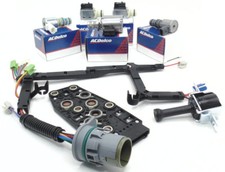
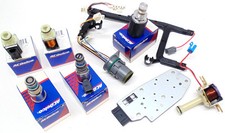
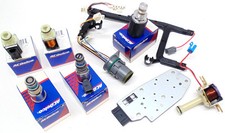
4L60E EPC Pressure Control Solenoid (1990-2003)
Once the meter and the gauge both point at the solenoid, this is the direct-fit force motor for 1990-2003 units. For 2003-up valve bodies with the two-prong plastic connector, use the 2003-up EPC solenoid instead. Both ship from our sister store CoreTransmissionParts, alongside the full 4L60E parts collection.
Shop the 4L60E EPC solenoid →Four Things That Impersonate a Bad EPC Solenoid
1. Actuator feed limit valve bore wear
This is the big one, and it is the reason so many replaced force motors change nothing. The EPC solenoid is not fed line pressure directly. It is fed by the actuator feed limit valve, which regulates line pressure down to a lower, consistent supply for the solenoids — typically in the 80 to 115 psi range per Sonnax.
The problem is mechanical. Per Sonnax, in 4L60-E, 4L65-E and 4L70-E units the AFL valve is a solenoid feed regulator serving both the EPC and the shift solenoids, and the OE valve has a large reaction area that leaves it highly susceptible to side-loading, which wears the valve body bore. The EPC solenoid makes that worse: it oscillates the torque signal and AFL oil, increasing valve action. As bore wear grows, oil pressure to the shift solenoids drops and sets solenoid and ratio codes — and the same AFL oil loss produces lower line pressure.
That failure signature is distinctive: low line pressure plus solenoid and ratio codes together, on a unit whose solenoids all pass a resistance check. That combination is an AFL bore, not a solenoid. Sonnax's repair is the actuator feed limit valve kit 77754-09K, a hardcoat anodized aluminum valve with annular grooves against side-loading, running in a full-contact sleeve giving 54% more support than OE. Vacuum test the bore before you decide.
There is a second, cheaper failure in the same circuit. AFL fluid passes through a screen filter on its way to the EPC solenoid, and that screen fills with debris. A plugged screen drops EPC supply pressure and reads as low line pressure with a perfectly good solenoid on the bench.
2. A failed PCM solenoid driver
Covered above, and common enough on early units to belong on the short list rather than at the end of it. The tell is disagreement between commanded amps on the scan tool and measured amps on the wire. ATRA's bulletin adds that a bad driver can cause flared shifts, and to watch the signal on a graphing meter or scope: voltage should rise and fall quickly, and a ragged edge points at the driver.
3. The transmission being ordered into high line pressure
Sometimes the solenoid is doing exactly what it was told and the command is the problem. Per Transmission Digest, line pressure boost control has been the Achilles heel of the 4L60E for years, and many harsh 1-2 complaints trace to TCC slippage setting P1870 and P0894, which put the transmission into high line pressure mode. Once those are addressed, the remaining suspects are the ECM EPC solenoid driver, lean misfire conditions, MAF sensor problems, and the EPC solenoid itself — in that order.
The MAF and misfire entries are worth sitting with. The PCM calculates commanded line pressure from an engine torque estimate, so a bad load signal produces a pressure wrong for the torque actually going through the unit — with a solenoid that tests perfect. Scan the engine side before you pull the pan.
4. The internal wiring harness
The EPC solenoid reaches the pass-through connector through an internal harness that spends its life in hot fluid, and GM's own position is that the harness is a service item. Per GM bulletin PIP5009G (November 2012), covering 2012 Chevrolet Colorado, Express and Silverado and GMC Canyon, Savana and Sierra with the 4L60E (RPO M30) built after 10/01/11, technicians are told to replace the TCC enable solenoid and wire harness, part number 24237980, any time repairs are performed on the transmission — not only when DTC P0741 is present. The principle carries: if the pan is off and the harness is old, it goes.
When the Solenoid Really Is the Problem
Force motors fail two ways. Electrically, the winding opens or shorts and you get a pressure control solenoid electrical code (P0748 on OBD-II units) with an out-of-range resistance reading. That one is easy. The harder failure is mechanical: contamination inside the solenoid's own valve so it no longer strokes cleanly against current, giving pressure in range but not proportional to command. Resistance passes. Amps pass. The pressure gauge is the only thing that catches it.
Contamination is the usual culprit, and Sonnax makes a pointed recommendation in their 4L60E build guide: fit a pan drain plug, change fluid often to keep micron-sized debris out of circulation, never leave the pan magnets out, and add extra magnets, because they collect the hardest contaminants — the ones most likely to affect the critical EPC solenoid. That is a build-sheet line item, not a nice-to-have.
Replacing it
The force motor sits on the valve body under the pan, held by a retaining clip and bolt, with the filter in the way. Drop the pan, pull the filter, remove the clip, and it comes out. Reuse the original bolt and clip at the published valve body fastener spec. Per the Teckpak-Fitzall install sheet, connector polarity is not critical. Replace the filter and pan gasket while you are in there, and refill with the DEXRON fluid appropriate to the model year.
If you are fitting an adjustable-style aftermarket force motor, the same sheet gives the procedure: 3/8 in. wrench on the adjuster, 5/8 in. on the lock nut, break the lock nut loose while holding the adjuster still, move the adjuster one-sixth of a turn — clockwise raises pressure, counterclockwise lowers it — then re-tighten the lock nut while still holding the adjuster. Test drive between adjustments. One-sixth of a turn is a real change in shift feel.
The Order That Keeps It Fixed
- Pull codes first. If P1870 or P0894 is stored, the high line pressure is commanded — fix the TCC side before you touch the EPC.
- Scan the engine. A lean misfire or drifting MAF gives the PCM a bad torque number and a bad pressure command.
- Ohm the case connector: pins C and D should read 3.5 to 8.0 ohms. Check the rest of the pins in the same pass.
- Gauge on the line tap, amp clamp on the EPC high side, scan tool on DES A and ACT A — all three at once, hot, on a road test.
- Scan tool and meter disagree: PCM driver. Meter and scan tool agree but pressure does not follow: hydraulic.
- Unplug the EPC at fast idle. No jump to maximum pressure means pump or regulator circuit, not solenoid.
- Pan off: check the AFL screen for debris, vacuum test the AFL bore, then judge the solenoid. Replace the internal harness while you are in there.
The EPC solenoid is a fifty-dollar part on a circuit worth diagnosing properly. Spend twenty minutes with a clamp and a gauge before you spend the money.
Related: our pressure regulator and boost valve wear guide covers the valve the EPC signal acts on, and the line pressure specs and testing walkthrough goes deeper on gauge procedure.
Shop 4L60E EPC and shift solenoids, internal wiring harnesses, filters and pan gaskets, valve body parts and full rebuild kits — shipped fast from the USA.
Shop 4L60E parts →Sources
- ATRA (Automatic Transmission Rebuilders Association) — Technical Bulletin #269: GM 4L60-E Solenoid/Switch Resistances. Backs the case connector pin assignments and every resistance spec in the table above: pressure control solenoid pins C and D at 3.5–8.0 ohms, TCC solenoid pins E and T at 20–40 ohms, 1-2 and 2-3 shift solenoids at 20–40 ohms each, 3-2 control solenoid pins E and S at 9–14 ohms, output speed sensor at 1260–1540 ohms, and the transmission fluid temperature sensor resistance table (3520 ohms at 68°F). atracom.blob.core.windows.net/bulletins/1995/allyear/atb269.pdf
- ATRA — Technical Bulletin #1345: 4L60E Circuit Tests, October 2010, 1993 to 1996 model years. Backs the in-series DVOM procedure and the amp clamp procedure for measuring EPC solenoid current, the DES A and ACT A scan tool PID comparison, the decision rule that a scan tool commanding approximately 1 amp against a meter reading near zero means the PCM must be replaced, the amp clamp polarity note, and the observation that a bad PCM solenoid driver can cause flared shifts. atracom.blob.core.windows.net/bulletins/2010/oct/atb1345.pdf
- Gears magazine (ATRA) — Controlling Pressure: General Motors. Backs the EPC commanded current values (0.9–1.1 amps at idle, dropping to 0.2–0 amps at wide open throttle before the 1-2 shift), the inverse relationship between amperage and line pressure, the recommendation to run an amp clamp and a pressure gauge in parallel, and the note that the EPC solenoid is fed by an actuator feed limit valve. gearsmagazine.com/magazine/controlling-pressure-general-motors
- Sonnax — Actuator Feed Limit Valve Kit 77754-09K. Backs the description of the AFL valve as the solenoid feed regulator that feeds the EPC and shift solenoids in 4L60-E, 4L65-E and 4L70-E units, the large-reaction-area side-loading wear mechanism, the statement that the EPC solenoid oscillating torque signal and AFL oil increases valve action, the resulting solenoid and ratio codes plus lower line pressure, and the replacement valve specifications (hardcoat anodized aluminum, annular grooves, 54% more support in a full-contact sleeve). sonnax.com/parts/2459-actuator-feed-limit-valve-kit
- Sonnax — Hydraulics Fundamentals Part VII: AFL/Solenoid Modulator Valves. Backs the AFL feed pressure range of 80–115 psi, the function of the AFL valve in supplying consistent pressure and flow to the solenoids, and the explanation that incorrect AFL feed to a line pressure control solenoid produces compromised control pressure at the pressure regulator valve and therefore high or low line pressure. sonnax.com/tech_resources/1208-uncovering-the-root-cause-of-pressure-complaints
- Transmission Digest — 4L60E Harsh 1-2 Shift. Backs the warning that the EPC commanded amperage PID cannot be trusted on its own and that the failure is most common on 1993-1997 models, the requirement for a pressure gauge and DVOM, and the ranked list of line pressure suspects after TCC slippage codes P1870 and P0894 put the unit into high line pressure mode (ECM EPC solenoid driver failure, lean misfire, MAF sensor problems, then the EPC solenoid itself). transmissiondigest.com/4l60e-harsh-1-2-shift
- General Motors — Bulletin PIP5009G, November 2012, published through NHTSA. Backs the internal wiring harness recommendation: on 2012 Chevrolet Colorado, Express and Silverado and GMC Canyon, Savana and Sierra with the 4L60E (RPO M30) built after 10/01/11, replace the TCC enable solenoid and wire harness part number 24237980 any time repairs are being performed on the transmission, and the associated harsh 1-2 shift with DTC P0741 complaint. static.nhtsa.gov/odi/tsbs/2012/MC-10112566-9999.pdf
- Teckpak-Fitzall — Installation Instructions, GM (Force Motor) EPC Solenoid for 4L30E, 4L60E and 4L80E, part 3460SU. Backs the at-the-solenoid resistance spec of 3.5 to 4.66 ohms, the 4L60E line pressure ranges (Drive, Park or Neutral 50–189 psi and Reverse 67–324 psi, idle to wide open throttle), the note that connector polarity is not critical, and the adjustable force motor procedure (3/8 in. adjuster and 5/8 in. lock nut, one-sixth turn, clockwise to increase pressure). teckpak-fitzall.com/teckfitz/products/pdf/solenoids/34605u.pdf
- Sonnax — Building the Killer 4L60E: Top Tips for Optimizing Your Transmission Upgrades. Backs the contamination-control recommendation: fit a pan drain plug, change fluid often to prevent micron-sized debris from circulating, never leave the pan magnets out, and add extra magnets because they collect the hardest contaminants, the ones most likely to affect the critical EPC solenoid. sonnax.com/tech_resources/293-building-the-killer-4l60e