A slipping TrailBlazer usually comes in on a hook or with a trailer still on the ball. The 2002-2009 TrailBlazer, TrailBlazer EXT and GMC Envoy put a 4L60E behind a heavy body, a lot of them tow, and most of the fluid I drain from them has never been changed. That combination wears out the same few parts in the same order, so a slip on one of these trucks is rarely a mystery once you know which gear it slips in.
The short version: Check the fluid hot the way GM wrote it. Then find the gear. A flare on the 2-3 or a slip in 3rd and 4th is the 3-4 clutch, and Sonnax puts most of those down to low line pressure and 3rd-oil leaks, not worn frictions. A slip in 4th that later burns the 2-4 band points at a worn 4-3 sequence valve bore. RPM creeping up at steady cruise with no shift is the converter clutch circuit. Fix the cause in the valve body and pump, or the new clutches burn up just like the old ones.


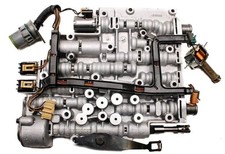
The TrailBlazer Setup, in Numbers
GM's 2005 TrailBlazer owner manual lists the Vortec 4200 inline six and the 5300 V8, both with the 4L60E, and one transmission capacity for both: 5.0 quarts (4.7 L) for a drain and refill. The 2005 book calls for DEXRON-III "Approved for the H-Specification"; the 2007 book specifies DEXRON-VI, which is what goes in any of them today. The 2006-2009 TrailBlazer SS with the 6.0L is a different build; read the RPO tag before you order parts for one.
The shifter reads P, R, N, D, 3, 2, 1. D is overdrive, so a truck in D uses all four gears. That matters because the 4L60E's holding elements map cleanly to gears:
| Range / gear | What holds it | If it slips here only |
|---|---|---|
| 1st (D) | Forward clutch, forward sprag, low roller clutch | Sprag or roller clutch (check if manual 1 holds) |
| 2nd | Forward clutch, 2-4 band | Band, servo, 2nd apply circuit |
| 3rd | Forward clutch, 3-4 clutch | 3-4 clutch and 3rd oil circuit |
| 4th | 3-4 clutch, 2-4 band | Either; a 4th-only slip often traces to the servo feed |
| Reverse | Reverse input clutch, low/reverse clutch | Reverse input clutch or sun shell |
Fourth gear shares the 3-4 clutch with 3rd and the band with 2nd. So a truck that slips in 3rd and 4th is pointing at the 3-4 clutch, and a truck that slips in 2nd and 4th is pointing at the band. If it loses 2nd, 4th and reverse all at once after a bang, that is the reaction sun shell, which our TrailBlazer common problems guide covers in detail. This post is about the trucks that still drive, but slip.
Step 1: Check the Fluid Hot, Exactly as GM Says
A 4L60E that is a quart low will slip on turns, on hills and on hard launches, because the pump pulls air at the filter. GM's TrailBlazer procedure, from the 2005 manual:
- Fluid at 180-200°F (82-93°C): drive about 15 miles when it is above 50°F outside. Below 50°F, drive in THIRD (3) until the temperature gauge moves and then holds steady for 10 minutes.
- If the truck just pulled a trailer, ran at high speed for a long stretch, sat in hot traffic, or it is over 90°F out, wait at least 30 minutes first.
- Level ground, engine running, parking brake on. Foot on the brake, move the lever through every range, about three seconds each, back to PARK, and idle three minutes or more.
- The dipstick is on the passenger side under a handle that flips up to unlock. Pull, wipe, reinsert fully, wait three seconds, pull again. Check both sides and read the lower level.
GM says it "generally" takes less than one pint to bring a low unit up to the HOT area and warns against overfilling, since excess fluid can end up on the exhaust. If it takes a quart or more, you have a leak to find before you go any further.
Then look at the fluid. Clean red fluid and a slip means pressure loss or a circuit leak, and the hard parts may still be saved. Dark, burnt fluid with friction material on the magnet means something has already cooked, and you are now diagnosing what burned it.
Step 2: Rule Out What Is Not a Slip
A soft launch that feels like slipping may be a 2nd-gear start. Transmission Digest's Wayne Colonna explains that the 4L60E valve body sits in 2nd by default with the engine off. Once running, line and AFL pressure have to reach 48 psi to stroke the 1-2 shift valve into first. In his case the line pressure read a correct 62 psi in Drive, and the actual fault was a 1-2 accumulator piston with its seal missing, feeding oil into the band apply circuit. That truck bound up in manual 1, a quick road-test clue. Gauge the line before you blame clutches for a lazy launch.
A little converter slip at cruise is normal. Per Sonnax, 1998-and-later 4L60-E units use EC3 converter clutch control, which normally runs 20-40 RPM of TCC slip and seldom locks solid. Seeing a small gap between engine speed and what full lockup would give is not a fault on its own.
Step 3: Scan Tool and Gauge
The 4L60E has no input speed sensor, so you diagnose slip from engine speed, output speed and the PCM's own TCC slip speed. Pull codes first. A P0894 or P1870 means the PCM commanded the converter clutch on and saw more slip than it allows. That can be the TCC circuit or the transmission slipping in the gear underneath it, so treat it as a lead, not a verdict.
Next, check the engine data before the transmission data. Sonnax lists TP, MAP and MAF sensor faults among the causes of low line pressure, because the PCM sets line pressure from engine load. A truck with a lazy MAF commands a soft line and slips the 3-4 under load. Fix any engine codes first.
Then put a gauge on the line pressure tap and watch it while you drive. Low line in every range points at the pump, the pressure regulator or the pressure control solenoid circuit. Normal line with a one-gear slip is a leak inside that gear's circuit. Our line pressure guide has the full test.
Cause 1: The Burnt 3-4 Clutch (Slips in 3rd and 4th)
This is the most common TrailBlazer slip I see. It starts as a flare on the 2-3 shift or a slip in 4th climbing a grade with a load, then gets worse fast. Teardown shows black frictions and a blued backing plate.
Sonnax's Brian Wing is blunt about it: low line pressure and leaks of 3rd-gear oil are the root cause of most 3-4 slipping. The pack is the victim. Before you trust a new one, check:
- Input housing checkball. Vacuum test it. Sonnax treats a reading below 25 in-Hg as an unacceptable leak.
- Pump and stator. A stator sleeve rotated over a feed hole, worn stator bushings, cracked pump passages, and a worn boost valve bore all bleed off 3rd oil or line pressure.
- AFL screens. The screen feeding the pressure control solenoid can plug and drop line pressure. Replace all three.
- Backing plate flex. Sonnax notes the OE 3-4 backing plate flexes during apply and heats the pack unevenly; a heavy-duty plate stops that.
Sonnax also warns against cramming in thinner plates for more frictions. It trades engagement capacity against holding, and less steel means less heat soak, which a towing TrailBlazer needs. More detail is in our 3-4 clutch pack guide.
Cause 2: Slips in 4th, Then the Band Burns (4-3 Sequence Valve)
Here is one that gets missed. The truck slips in 4th, or drops out of 4th, while 2nd still feels fine. Someone puts a band in it. A few thousand miles later it is slipping again and the new band is burnt.
Sonnax explains the mechanism on its oversized 4-3 sequence valve kit (77964-04K): continuous oscillation of the sequence valve wears its bore, and that wear lets 4th gear accumulator oil exhaust, leaving the servo short of apply pressure. Low 4th pressure means a slip or no 4th, and continued slipping burns the 2-4 band. Sonnax lists "2-4 band burned," "low 4th gear pressure" and "no 4th" as the complaints the kit helps cure. Repairing the bore takes the 77964-RM2 reamer; when the two inboard spools are also worn, Sonnax points to its 77964-14K kit instead.
The takeaway: on a high-mileage TrailBlazer with a burnt band, vacuum test the sequence valve bore before you close it up. Replace the band and inspect the drum surface, set servo travel per our band and servo guide, and fix or replace the valve body. A band alone is a temporary fix.
Cause 3: RPM Creep at Cruise (TCC Circuit)
If the engine speed drifts up at a steady 60 mph with no shift and no load change, and the fluid runs hot, look at the converter clutch control. Sonnax's Tory Royce explains that constant EC3 oscillation wears the TCC regulator and isolator valve bores until apply oil leaks to exhaust. Sonnax lists the results: codes 894 and 1870, an overheated converter, low TCC apply pressure, a burned 3-4 clutch, harsh 1-2 shifts and low line pressure. That last pair is why one worn bore can set up Cause 1 as well. The repair is a reconditioned bore with the 77754-04K valve kit, plus the 77754-ISO sleeve when the isolator end is worn. Our P1870 guide walks the code logic.
Cause 4: Heat and Cooler Flow on Trucks That Tow
Heat ties the first three together. GM's owner manual says D can be used for towing, but to shift to THIRD (3) if the transmission shifts too often; the 2007 manual adds that THIRD means less shifting when towing and on hilly, winding roads. Constant 3-4 cycling under a trailer is exactly what cooks the 3-4 pack. GM also warns that spinning the tires or holding the truck on a hill with the throttle can damage the transmission.
The cooler has to keep up. GM bulletin 02-07-30-052J states that insufficient flow through the cooling system will cause premature transmission failure, and specifies flow checking with the J-45096 TransFlow tool. It also gives the 4L60-E line direction: feed out the bottom fitting, return in at the top. After any 3-4 burnup, back-flush the cooler and lines and confirm a strong return stream before the truck leaves. Our cooler flush guide has the process.
The Fix, and Keeping It Fixed
- Level was low, fluid clean: find and fix the leak, refill with DEXRON-VI, hot check, road test with a gauge.
- 3-4 clutch burnt: overhaul with a heavy-duty 3-4 pack and backing plate, then vacuum test the input housing checkball and fix the pump, stator and AFL screens before it goes back in.
- Band burnt or 4th slipping: band, drum inspection, servo travel, and a valve body with the 4-3 sequence valve bore repaired.
- TCC codes: repair the TCC regulator and isolator bores, and check the converter.
- Always: flush the cooler, confirm flow and line direction, and put the truck on GM's 50,000-mile fluid and filter schedule if it tows, climbs grades, or sits in heat over 90°F. Otherwise GM's interval is 100,000 miles.
Heavy-Duty 4L60E Rebuild Kit with 3-4 Power Pack (1993-2008)
Seals, gaskets, and a heavy-duty friction setup with the 3-4 power pack, a sound base for a TrailBlazer or Envoy that burned its 3-4 clutch towing. For single parts like bands, servos and valve body pieces, the full 4L60E lineup is here.
See the heavy-duty kit →FAQ
Why is my TrailBlazer transmission slipping?
Start with a hot fluid check at 180-200 degrees F, because a low 4L60E slips on turns and hard launches. If the level is right, note which gear slips: 3rd and 4th points at the 3-4 clutch, 2nd and 4th at the 2-4 band and servo, and a slip only at steady cruise with the converter applied points at the TCC circuit.
What transmission fluid does a TrailBlazer take?
GM's 2005 TrailBlazer manual calls for DEXRON-III approved for the H-Specification, and the 2007 manual specifies DEXRON-VI. DEXRON-VI is the fluid to use in all of them today. A pan drop and filter change takes about 5.0 quarts (4.7 L).
Can towing make a TrailBlazer transmission slip?
Yes, mostly through heat. Towing raises fluid temperature and load on the 3-4 clutch and the 2-4 band. GM's manual says to use THIRD instead of DRIVE when towing if the transmission shifts too often, and puts any truck that tows frequently on the 50,000-mile fluid and filter schedule.
Can a valve body cause a TrailBlazer to slip in 4th?
Yes. Sonnax notes that wear in the 4L60-E 4-3 sequence valve bore lets 4th gear accumulator oil exhaust, which leaves the 2-4 servo short of apply pressure. The result is a slip or no 4th, followed by a burnt 2-4 band. Replacing the band without fixing the bore brings the slip back.
Keep the numbers at the bench. Our free transmission fluid spec chart lists the correct ATF type for the 4L60E and dozens of other units, so you never top off with the wrong fluid.
Sources
- General Motors — 2005 and 2007 Chevrolet TrailBlazer Owner Manuals. Backs: the 4200 and 5300 engine lineup, the 5.0 qt (4.7 L) drain and refill, DEXRON-III H-Specification (2005) and DEXRON-VI (2007), the 180-200°F hot check, 15-mile warm-up and cold-weather THIRD (3) procedure, 30-minute wait, three-minute idle and lower-level reading, the less-than-one-pint note, the 50,000/100,000-mile intervals, and the D vs THIRD towing guidance. GM: 2005 TrailBlazer owner manual (PDF) and GM: 2007 TrailBlazer owner manual (PDF)
- General Motors service bulletin 02-07-30-052J, via NHTSA. Backs: insufficient cooler flow causing premature transmission failure, the J-45096 TransFlow test, and 4L60-E cooler line direction (feed bottom, return top). NHTSA: GM bulletin 02-07-30-052J (PDF)
- Sonnax — All Over the Map: Attacking 4L60/E Burnt 3-4 Clutches with Confidence (Brian Wing). Backs: low line pressure and 3rd-oil leaks as the root cause of most 3-4 slipping, the 25 in-Hg input housing checkball limit, pump, stator and AFL screen checks, TP/MAP/MAF effects on line pressure, and backing plate flex. sonnax.com/tech_resources/659
- Sonnax — Oversized 4-3 Sequence Valve Kit 77964-04K. Backs: sequence valve bore wear exhausting 4th gear accumulator oil, low servo apply pressure, slip or no 4th followed by a burnt 2-4 band, the 77964-RM2 reamer and the 77964-14K alternative. sonnax.com/parts/2508
- Sonnax — Understanding 4L60-E Series Isolator Bore Wear and How to Address It (Tory Royce). Backs: EC3 control on 1998-and-later units, the normal 20-40 RPM TCC slip, TCC regulator and isolator bore wear, the 894/1870 codes, burned 3-4 clutch, harsh 1-2 and low line pressure, and the 77754-04K and 77754-ISO repair. sonnax.com/tech_resources/1440
- Transmission Digest — Fixing 4L60-E 1-2 Shift Issues (Wayne Colonna, July 2022). Backs: the valve body's 2nd-gear default with the engine off, the 48 psi needed to stroke the 1-2 shift valve, the 62 psi Drive reading, and the missing 1-2 accumulator piston seal feeding the band apply circuit. transmissiondigest.com