"It's leaking somewhere" is not a diagnosis, and on a 4L65E it can mean four or five different jobs that cost four or five different amounts. GM has actually written up one of these leaks by name in a service bulletin, which tells you something: this is not random seal rot, it is a short list of known failure points, each with its own cause and its own fix. Chase the wrong one and you pull a transmission, replace a seal, and watch the same wet spot come back in a month.
The short version: On a 4L65E, check these spots in order: front pump/bellhousing area (the one GM documented in Bulletin 06-07-30-016), pan gasket and pan bolts, the output shaft/extension housing seal and the rear stator support bushing behind it, the 2nd gear servo cover, the vehicle speed sensor O-ring, and the cooler line fittings. Clean, drive, and recheck before you pull anything apart — fluid runs downhill and the drip point is rarely the leak point.


Find the Leak Before You Fix It
Fluid runs downhill and gets thrown around by spinning parts, so the wet spot on the ground or on the crossmember almost never sits directly under the actual leak. Before replacing anything:
- Clean everything first. Degrease the pan, bellhousing, extension housing, and cooler line fittings with brake cleaner or a pressure washer, then let it dry completely.
- Check the fluid level hot, the GM way. An overfilled 4L65E will push fluid out the vent or dipstick tube and mimic a seal leak with no actual seal failure. GM's own owner-manual notice for its 4-speed trucks warns that too much fluid can come out and land on hot engine or exhaust parts and start a fire. The procedure, per the 2008 Chevrolet Silverado owner manual (which covers the 4L60-E and 4L70-E): bring the fluid to 180-200 F (82-93 C), about 15 miles of driving above 50 F; park level with the engine running, cycle every range about three seconds, idle at least three minutes, then read the lower side of the dipstick in the HOT crosshatch. A cold check is reference only. Check at least twice, and if readings will not repeat, check that the transmission breather is clean and not clogged before you chase a seal.
- Fluid out the vent right after an overhaul? Check the input speed sensor. Transmission Digest (Wayne Colonna, "GM 4L70E Leaking out of Vent," April 2021) documents a freshly overhauled 4L70E, the 4L65E's sister unit in the same family, that pushed fluid out the case vent with no cooler restriction, filter problem or cavitation. The cause was the input speed sensor: the ISS passage and the vent passage in the pump can be connected, and the builder had either left the O-ring off the sensor or left out its retaining bolt, so the sensor backed out of its bore. That case also set P0717. If your unit has a pump-mounted ISS and it leaks from the vent after a rebuild, confirm the sensor O-ring and retaining bolt before you go looking for an overfill or a bad seal.
- Drive it, then look with a flashlight from underneath at the pan rail, bellhousing, extension housing/driveshaft yoke, the speed sensor, and the cooler line fittings on the driver's side of the case, in that order.
- Use UV dye if the first pass doesn't show a clear source. A few ounces of dye in the fluid and a UV light will light up the exact seam, which saves you from pulling a pan for a leak that's actually at the bellhousing.
1. Front Pump / Bellhousing Area — the One GM Put in Writing
This is the leak GM itself documented. Service Bulletin #06-07-30-016 covers 2006 Chevrolet Corvettes built with the 4L60-E or 4L65-E (RPO M30 or M32) and describes automatic transmission fluid leaking from the oil pump or bellhousing area. The root cause GM lists is small burrs left on the torque converter hub and the pump drive slots during machining, which cut and compromise the torque converter hub-to-oil pump seal assembly (GM calls it out as part 243 in the bulletin) as the converter spins against it.
The fix in the bulletin is two steps, not one: deburr the torque converter hub and the pump drive slots, then install a new torque converter hub-to-oil pump seal assembly. Replacing just the seal without deburring the hub is why some shops report the same leak coming back within a few thousand miles — the burr is still there, cutting the new seal the same way it cut the old one.
Because the pump and bellhousing sit at the very front of the case, this leak often gets misread as a rear main engine seal leak, since fluid can run back along the bellhousing and drip near the same spot. If you're chasing what looks like an engine oil leak on a 4L65E-equipped truck or Corvette and the fluid is pink or red instead of amber/black, it's the transmission, not the engine.
2. Pan Gasket and Pan Bolts
The most common leak on any 4L60-series transmission, and the cheapest to fix if you catch it early. Common causes: a reused gasket, a pan bolt that backed out from vibration, or a warped pan flange from overtightening. Per the Chevrolet Performance Supermatic transmission spec sheet, which covers the 4L65-E (19260380) built on the shared 4L60-E/4L65-E/4L70-E case, pan-to-case bolts torque to 18 ft-lb (24 N-m) and the drain plug, where equipped, to 25 ft-lb (34 N-m). Tighten in a crosshatch pattern. Overtorquing a stamped steel pan is a leading cause of a "new gasket, still leaking" complaint, because it bows the flange between bolt holes instead of sealing evenly.
| Leak point | What causes it | Typical fix |
|---|---|---|
| Pump / bellhousing | Burrs on torque converter hub cut the pump seal (GM Bulletin 06-07-30-016) | Deburr hub and pump drive slots, replace hub-to-pump seal assembly |
| Pan gasket | Reused gasket, loose/overtorqued bolts, warped flange | New gasket, torque to 18 ft-lb in a crosshatch pattern |
| Output shaft / extension housing | Worn rear stator support bushing lets the output shaft walk and cut the seal lip | Replace bushing (Sonnax 77002BT-01) and seal together, not seal alone |
| 2nd gear servo cover | Hardened piston/separator/apply-pin seals in the servo bore | Replace cover seal kit (Sonnax 77911-03SK) |
| Speed sensor | O-ring nicked on install or reused during a service | New sensor O-ring, seat it fully before tightening |
| Cooler lines | Loose, cross-threaded, or vibrating-loose fitting | Reseat with new sealing washer/O-ring, torque to spec |
3. Output Shaft / Extension Housing — Usually a Bushing Problem Wearing a Seal, Not Just a Seal
Fluid on the driveshaft yoke and flung forward onto the exhaust or crossmember points to the extension housing area at the rear of the case. The part that actually leaks is the output shaft seal, but the part that's usually worn out underneath it is the bushing that supports the shaft inside the housing. Sonnax's own product listing for its rear stator support bushing (part 77002BT-01, fitting 4L60, 4L60-E, 4L65-E, and 4L70-E) states plainly that the original GM bushing "commonly fail[s] or wear[s] out prematurely," and that cheap aftermarket replacements "typically have a poor quality fit" and wear again quickly. Sonnax's fix is a bimetal, PTFE-lined bushing built to a tighter bore tolerance than the factory part.
Here's the part that costs people a comeback: once that bushing wears, the output shaft is no longer centered inside the housing. It rides slightly off-axis every time the truck moves, and that off-center motion is what beats up the lip of the output shaft seal, not normal mileage. Install a fresh seal over a worn bushing and the new seal lip takes the same beating the old one did — most shops see that "new seal" leak again within a few thousand miles. The bushing and seal are a pair on this transmission; replace them together.
4. 2nd Gear Servo Cover
Less common than the first three, but worth checking if the leak is on the side of the case rather than the front, rear, or bottom. The 2nd gear (band) servo lives in a bore on the case side under a cover, and its internal seals — piston seal, separator seal, and apply pin seal — can harden with age and let fluid seep past the cover. Sonnax's replacement seal kit for this servo bore (part 77911-03SK, fitting 4L70-E, 4L60, 4L60-E, and 4L65-E) is built specifically to restore that seal and stop the leak without replacing the whole servo assembly.
5. Vehicle Speed Sensor O-Ring
A small, cheap leak that gets missed because people assume a sensor can't leak. The vehicle speed sensor threads into the case near the tailshaft, sealed by a single O-ring. That O-ring is an easy thing to nick on installation or to reuse during an unrelated service, and once it's compromised it drips steadily rather than sprays. If you see a small, steady wet spot near the speed sensor connector and nowhere else, pull the sensor, inspect the O-ring for a flat spot or cut, and replace it before reinstalling — don't just reuse the old one because the sensor itself tests fine.
6. Cooler Line Fittings
The last stop before you start pulling the transmission. The cooler lines run from the case to the radiator's transmission cooler (and to an auxiliary cooler on a lot of tow-rated builds), and the fittings at the case can loosen from vibration, get cross-threaded on a prior cooler line swap, or lose their sealing washer. Fluid here tends to streak straight down the side of the case in a line rather than pool, which is the easiest way to tell it apart from a pump or pan leak. Reseat the fitting with a new sealing washer or O-ring and torque it to the fitting manufacturer's spec rather than just "snug plus a quarter turn," which is how most of these get cross-threaded in the first place.
While You're Under There: Fluid Type and Capacity
Any of these fixes means some fluid comes out, so put the right fluid back in. GM's current global fill specification for this family of transmissions is DEXRON-VI, documented in SAE paper 2006-01-3242, "General Motors DEXRON-VI Global Service-Fill Specification." Per the Chevrolet Performance Supermatic spec sheet, total dry fill for the 4L65-E with a 300 mm converter is 10.6 L (11.2 qt); a pan-drop service after one of these repairs only replaces a fraction of that, so check the level hot per the dipstick procedure rather than assuming a quart or two brings it back to full. For scale, GM's 2008 Silverado owner manual lists a pan removal and filter replacement on the 4L60-E and 4L70-E at 4.7 L (5.0 qt), and says a hot top-off generally takes less than one pint (0.5 L). The same manual lists DEXRON-VI for the automatic transmission.
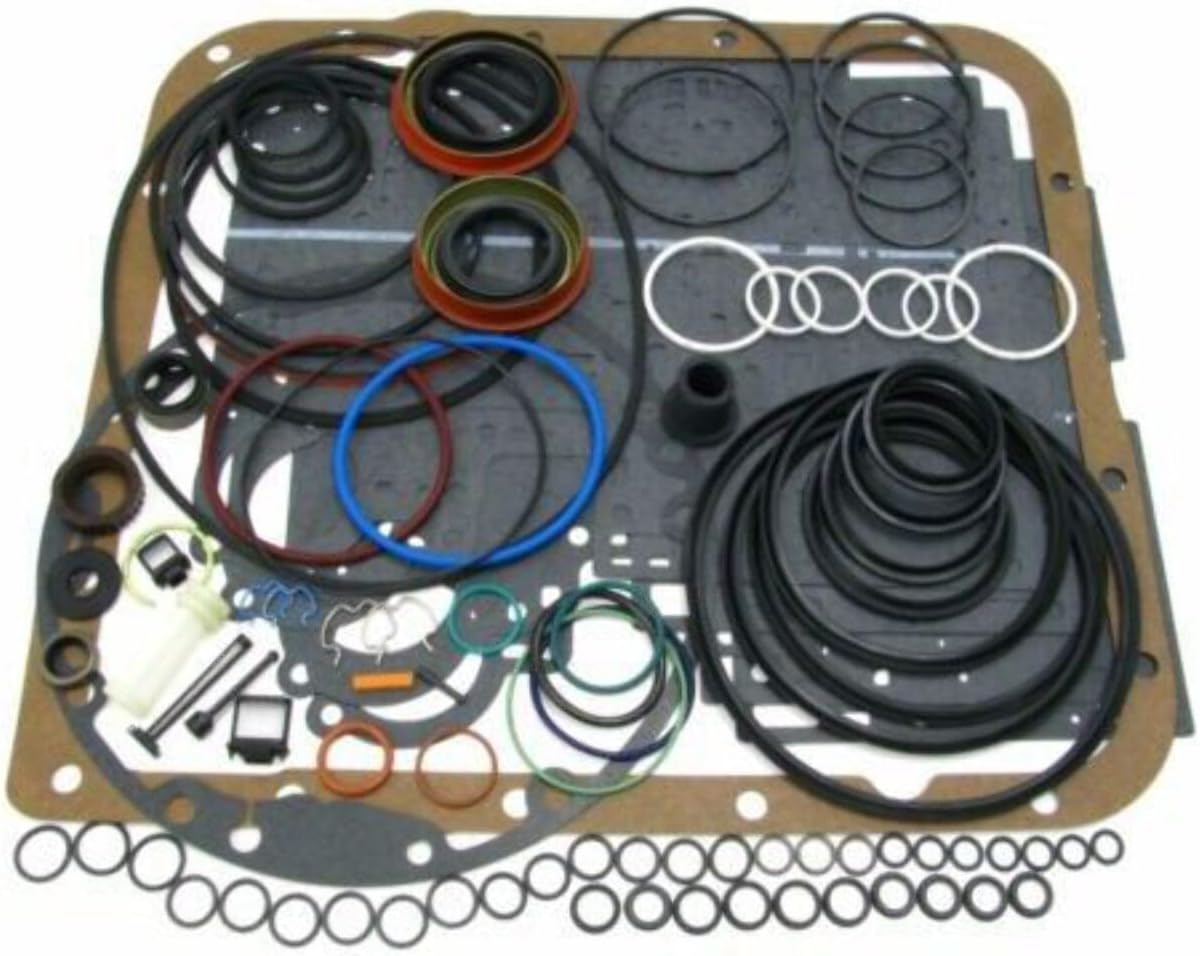
4L65E Front Pump Seal Kit with Gasket and Bushing
Pump seal, gasket, and bushing in one kit — the exact parts a front pump/bellhousing leak repair calls for once the torque converter hub is deburred.
Shop the 4L65E front pump seal kit →Need a different part? Browse the full 4L65E parts collection.
FAQ
Where does a 4L65E leak fluid most often?
The front of the case, at the oil pump and bellhousing area, is the single most documented external leak point. GM's own Service Bulletin 06-07-30-016 covers 2006 Corvettes with the 4L60-E or 4L65-E traced to small burrs on the torque converter hub and pump drive slots cutting into the torque converter hub-to-oil pump seal. The pan gasket and the output shaft/extension housing area are the next two most common spots.
How do I tell a pan gasket leak from a rear seal leak on a 4L65E?
Clean the whole underside of the transmission and bellhousing with brake cleaner, drive it, then look at the pattern. A pan gasket leak shows wet fluid tracking down from the pan rail itself. A rear leak at the extension housing or output shaft seal shows fluid on the yoke and driveshaft, usually flung forward and down by the tailshaft spinning, not pooled at the pan.
Can a worn rear stator support bushing cause an external leak?
Indirectly, yes. The rear stator support bushing centers the output shaft inside the extension housing. Sonnax notes the stock GM bushing commonly wears out prematurely, and once it does, the output shaft can move off-center enough to beat up the lip of the output shaft seal, which is what actually leaks. Replacing just the seal without addressing a worn bushing often means the new seal leaks again in a few thousand miles.
Is a 4L65E fluid leak always a seal problem?
No. An overfilled pan, a loose or cross-threaded cooler line fitting, a missing or crushed pan bolt sealing washer, or a vehicle speed sensor O-ring that was reused instead of replaced can all look exactly like a seal failure. Confirm the fluid level and torque the easy stuff before pulling anything apart.
Keep the numbers at the bench. Our free transmission fluid spec chart lists the correct ATF, capacity, and pan torque for the 4L65E and dozens of other units.
Sources
- General Motors — Service Bulletin #06-07-30-016, "Automatic Transmission Fluid Leak From Oil Pump or Bell Housing Area," covering 2006 Chevrolet Corvette with 4L60-E or 4L65-E (RPO M30/M32). Backs: burrs on the torque converter hub and pump drive slots as the root cause, and the deburr-plus-seal-assembly-replacement fix. (GM dealer service information, bulletin 06-07-30-016; cited by number, no public OEM-hosted copy. Ask a GM dealer or pull it from GM Service Information by bulletin number.)
- Sonnax — Rear Stator Support Bushing, part 77002BT-01 (fits 4L60, 4L60-E, 4L65-E, 4L70-E). Backs: the factory bushing commonly failing or wearing out prematurely, and the role a worn bushing plays in output shaft seal leaks. sonnax.com/parts/2423-rear-stator-support-bushing
- Sonnax — Replacement Seal Kit, part 77911-03SK (fits 4L70-E, 4L60, 4L60-E, 4L65-E). Backs: the 2nd gear servo's piston, separator, and apply-pin seals as a documented leak point and repair. sonnax.com/parts/2487-replacement-seal-kit
- SAE International — "General Motors DEXRON-VI Global Service-Fill Specification," paper 2006-01-3242. Backs: DEXRON-VI as the current GM global service-fill specification for this transmission family. saemobilus.sae.org/content/2006-01-3242
- General Motors / Chevrolet Performance — Supermatic Transmission Specifications (covers 4L65-E 19260380). Backs: 10.6 L (11.2 qt) dry fill with 300 mm converter, 18 ft-lb pan bolt torque, 25 ft-lb drain plug torque. Chevrolet Performance Supermatic spec sheet (PDF)
- General Motors — 2008 Chevrolet Silverado Owner Manual (4-speed automatic section, capacities and recommended fluids). Backs: the overfill fire notice, the 180-200 F (82-93 C) hot check, the 15-mile warm-up, the range-cycling and three-minute idle procedure, reading the lower side of the dipstick, the check-twice rule and clogged-breather cause of inconsistent readings, the under-one-pint top-off, the 4L60-E/4L70-E 4.7 L (5.0 qt) pan-and-filter capacity, and DEXRON-VI. assets.gm.com (PDF)
- Transmission Digest — Wayne Colonna, "GM 4L70E Leaking out of Vent," Transmission Tech/Talk (April 14, 2021). Backs: the post-overhaul vent leak with no cooler, filter or cavitation cause, the connected ISS and vent passages in the pump, the missing ISS O-ring or retaining bolt as the cause, the P0717 code, and the O-ring/bolt correction. transmissiondigest.com