
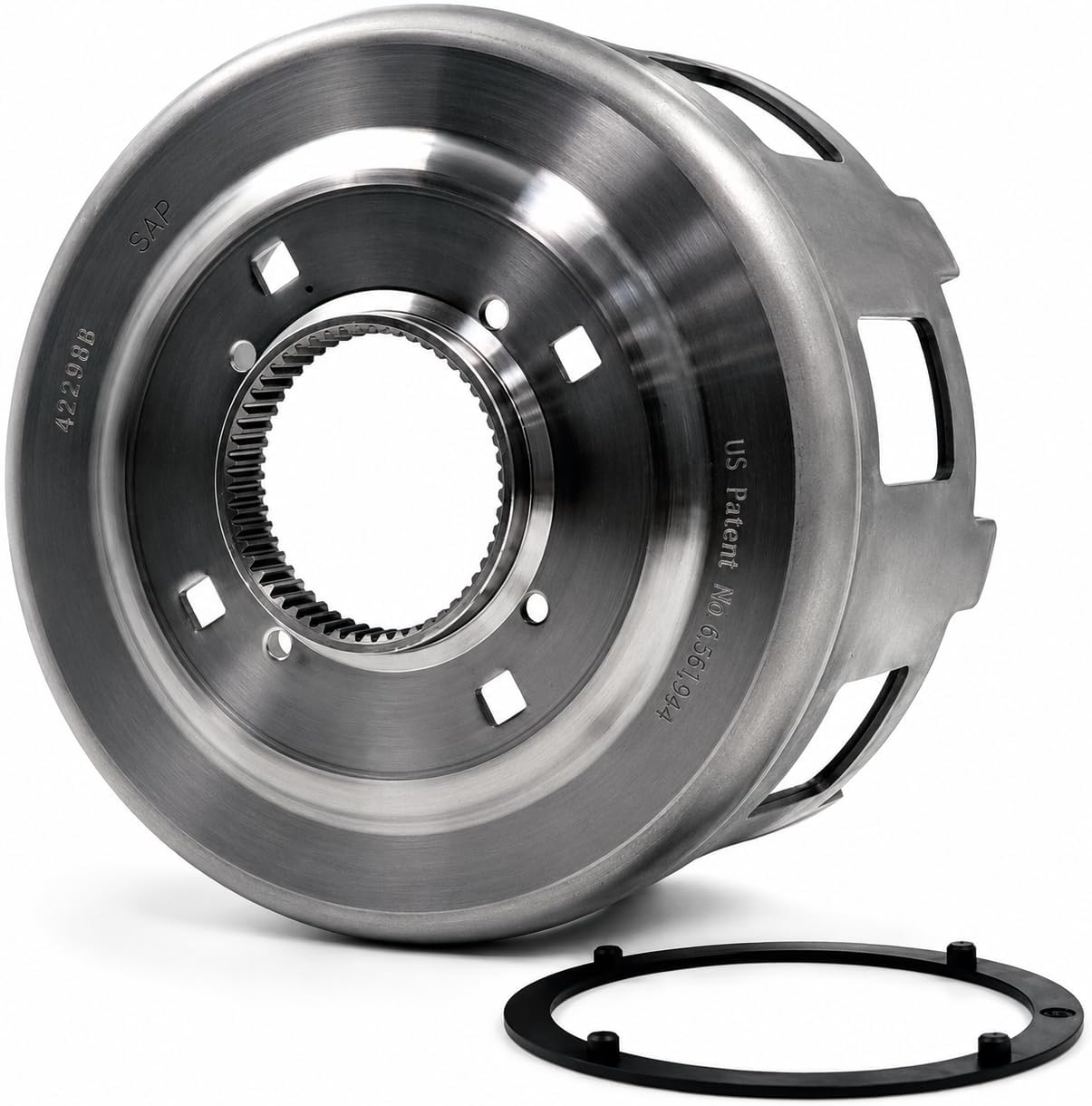

A 4L65-E that slips is telling you which element let go, and it tells you in the gear it slips in. That is the whole trick. This unit has one band and five clutch packs, and the application chart is short enough to memorize. Get the gear right on the road test and you have thrown out three-quarters of the parts catalog before you ever pull the pan.
The 4L65-E ran from 2001 to 2013 behind 6.0-liter trucks and SUVs, the Hummer H2, the SSR and the Trailblazer SS. Five-pinion planetaries and a heavier input shaft are what separate it from a 4L60-E. The hydraulics did not change, which is why every Sonnax and ATRA bulletin written for the 4L60-E applies to this unit word for word.
Name the gear, name the element
Drive it first and write down exactly where it flares, watching the tach against road speed rather than the feel in the seat. A converter clutch dropping out under load imitates a slipping friction element well enough to fool a good driver.
| Gear | Holding elements | What a slip here means |
|---|---|---|
| 1st (Drive) | Forward clutch, lo roller clutch | Forward clutch or low line pressure |
| 2nd | Forward clutch, 2-4 band | 2-4 band, servo, or band apply oil |
| 3rd | Forward clutch, 3-4 clutch | 3-4 clutch pack or 3rd gear oil circuit |
| 4th (OD) | 3-4 clutch, 2-4 band | 3-4 clutch if 3rd also slips, band if 2nd also slips |
| Reverse | Reverse input clutch, lo/reverse clutch | Reverse input clutch, or a split reaction shell |
Read the overlaps and the answer falls out. Slips in 3rd and 4th but pulls clean in 1st and 2nd: the 3-4 clutch or the oil that feeds it. Slips in 2nd and 4th: the 2-4 band or the servo. Slips in every forward gear including first: forward clutch, or line pressure that is too low to hold anything. Slips under load only, and only right at a shift: line pressure again. And if 3rd, 4th and reverse all leave at the same moment and the engine free-revs like the lever is in neutral, that is not a friction element at all, that is the reaction sun shell splitting at the splines.
Why the 3-4 clutch is the pack that burns
Sonnax puts it plainly in their 3-4 burnup bulletin: low line pressure and leaks of 3rd gear oil are the root cause of most 3-4 slipping. The reason this pack takes the beating rather than the forward clutch is circuit length. The 3-4 circuit is long, and it is interconnected to the D4, forward clutch, 2nd, 2nd clutch and 3rd accumulator circuits. Every one of those is another bore, another seal, another checkball that can bleed a few psi. None of them alone will burn a clutch. Four of them together will.
There is a mechanical contributor too, and it is built into the OE input housing. The stock 3-4 backing plate flexes during clutch apply, which means the pack does not load evenly across its face. Heat builds in the spots that carry the load and the frictions cook from the inside out.
Add the age factor: the 3-4 piston lip seals shrink with heat cycles, apply oil blows past the piston instead of loading the pack, and the pack slips under exactly the conditions that generate the most heat. If you replace a burnt 3-4 pack without finding out where the pressure went, you are buying the same repair twice.
The hidden checkball that kills 3-4 clutches and 2-4 bands
This one is worth knowing because it is invisible with the unit assembled and it accounts for a lot of comebacks. Sonnax calls out the 3rd accumulator checkball assembly in the case as a leading cause of 3-4 clutch failure on 4L60-E, 4L65-E and 4L70-E units: leakage at the hidden number seven checkball reduces 3-4 clutch apply pressure. The same leak also reduces band release pressure, which lets the 2-4 band drag. One bad capsule, two burnt friction elements.
Two ways to test it, both easy. With a vacuum test stand and a soft rubber tip, a good assembly pulls a near-perfect seal. No test stand, no problem: stand the case pan-side up, drip solvent into the 3rd accumulator checkball assembly and watch the inside of the case for solvent coming through. If it leaks, try reseating the ball with a punch and a light tap. If it still leaks after that, remove and replace the assembly. Sonnax sells the servo release check valve kit as 77701-076.
What you do not do is drive a cup plug in there to stop the leak. That circuit has to vent, and blocking it trades one problem for a worse one.
Line pressure: the number that decides whether anything holds
Every slip story eventually comes back to pressure. On this family the PCM commands mainline through the pressure control solenoid, which acts on the spring side of the pressure regulator valve. The actuator feed limit valve supplies that solenoid with a steady feed so its output stays consistent regardless of what line pressure is doing.
The useful part for diagnosis is that the relationship is inverse. Per GEARS, the ATRA technical magazine, you should see roughly 0.9 to 1.1 amps on the pressure control solenoid at idle, and during a wide-open-throttle pull just before the 1-2 shift that command should drop to 0.2 amps or all the way to zero. As engine load comes up, solenoid amperage drops and line pressure should rise. That gives you a three-instrument test:
- Scan tool for engine load percentage and the pressure control solenoid command in amps.
- Amp clamp on the solenoid ground wire, to verify the computer is actually delivering what the scan tool claims it is.
- Pressure gauge on the line tap, to verify the hydraulics answer the command.
Now you can split the fault three ways. If commanded amps track load correctly and the gauge follows, pressure is not your problem, go look at the clutch. If amps are right and the gauge does not follow, the leak is hydraulic. And if the amp clamp shows an erratic signal while the scan tool shows a steady command, the solenoid and the valve body are innocent and the driver circuit is not. GEARS documented exactly that case: erratic amperage on the clamp mirroring erratic pressure spikes on the gauge, with clean-looking scan data, which turned out to be a computer failure.
The two pump valves that bleed line rise
When pressure will not come up, two valves in the pump are the usual suspects. Sonnax lists the symptoms of a worn pressure regulator valve bore as erratic line pressure, low line rise, 3-4 clutch failure, excess pump noise and reverse chatter. That is a slipping 4L65-E described in five bullet points. The repair is to ream the damaged bore and fit an oversized valve; Sonnax recommends the carbide reamer kit 77917-TLC over the standard steel kit specifically because 4L60-family pump castings vary in hardness enough to spoil a reamer.
The boost valve is the other one, and it wears because the pressure control solenoid duty cycle works the sleeve constantly. Sonnax describes the leak path precisely: oil entering the torque signal orifice leaks past the boost valve and exhausts at the reverse orifice, resulting in poor line rise. Reverse oil can exhaust both to the sump and back through that torque signal orifice, which is why a unit with a worn boost sleeve often shows up with a lazy reverse engagement alongside the slip. The listed consequences are 3-4 clutch failure, 2-4 band failure and poor shift quality. The Sonnax replacement runs a 0.490-inch valve against the 0.470-inch OE spec, with a 1.907-inch early-style sleeve, so you get an increased ratio and a fresh sealing surface in one part.
When it is the sun shell, not a clutch
The failure that gets called slipping more often than any other on this family is the reaction sun gear shell. The stock shell is stamped, and the splines are the weak point. When it lets go you lose 3rd, 4th and reverse in the same instant, because all three depend on that shell holding the reaction sun gear.
You can usually hear the difference on the road test. A slipping clutch flares and recovers, or holds at light throttle and lets go under load. A broken shell gives you engine speed with no vehicle response at all in the affected ranges, while 1st and 2nd still pull normally. Any time a 4L65-E is on the bench, that shell gets replaced with a heavy-duty unit whether or not it is the reason the unit came in. It is a cheap part and it is one of the most common reasons a rebuilt one comes back.
Bench checks to run before you buy clutches
If the electrical and pressure testing did not find it, the unit comes out. The Sonnax burnup bulletin is the best leak-hunting checklist published for this transmission, and it is worth working through in order rather than fixing the first thing you find:
- Input drum. Air check the loaded drum for 3-4 and forward clutch leakage. Then air check the input housing bore-to-shaft fit using a long blow gun with the tip removed, inserted into the 3-4 feed port.
- Input housing checkball. It must pull a minimum of 25 in-Hg of vacuum. Anything under that gets replaced, no exceptions.
- Stator support. Inspect the stator sleeve where the input shaft seal rings ride, and replace both the front and rear stator support bushings. Those bushings get skipped constantly and they are a direct leak path on a circuit that cannot spare one. Dial-indicate the stator for perpendicularity on installation.
- Valve bores. Vacuum test the actuator feed limit valve, TCC regulator valve, isolator valve, 3-2 downshift valve at the abuse plug, 2-3 shift valve, 3-4 shift valve, forward abuse valve and 3-4 relay valve.
- AFL screen. It fills with debris and starves the pressure control solenoid of feed pressure. Replace it, do not just look at it.
- Pump body. Vacuum or wet air test the 3-4 and forward passages for hairline cracks. Shake the assembled dry pump halves to catch a sticking slide before the unit goes back together.
- Reassembly details. New load release springs so the piston does not float, the proper installer for the Teflon seal rings on the input shaft, Loctite above the feed hole on input shaft installation, and dress the sharp edge at the press area.
One more that lives outside the transmission: engine-side codes for the throttle position, MAP or MAF sensors will move line pressure, because the PCM builds the pressure command from the load signal. Clear those before you condemn anything hydraulic.
Fluid, and what it will and will not fix
The 4L65-E takes DEXRON-VI. GM's own parts listing for the ACDelco DEXRON-VI fluid confirms it is backward compatible with previous DEXRON automatic transmission fluids, which is the licensed answer for a 2001 unit that shipped with DEXRON-III printed on the dipstick. A pan and filter service takes roughly five quarts; a dry fill with the converter runs eleven to twelve quarts depending on pan and converter size, so set the level hot and in gear rather than by bottle count.
Fluid level matters to a slip diagnosis for one reason: low fluid aerates, aerated fluid will not hold pressure, and a unit that is two quarts down can slip exactly like a burnt clutch. What fluid will not do is reverse damage. If it comes out dark and smells burnt, friction material is already suspended in it, and no flush puts that material back on the plates.
The repair order that actually works
- Road test and write down the exact gear or gears that slip.
- Check fluid level and condition cold, then scan for codes and clear anything engine-side that affects the load signal.
- Watch the pressure control solenoid command against engine load on the scan tool, with an amp clamp on the ground wire and a gauge on the line tap.
- If the command, the current and the pressure all agree and the slip is still there, the fault is inside. Pull the unit.
- On the bench, run the leak checklist above before ordering a single friction plate.
- Then build it: new 3-4 pack with steels and a heavy-duty backing plate, new bonded 3-4 piston, a fresh 3rd accumulator checkball assembly, pressure regulator and boost valve service, and a heavy-duty reaction shell.
The short version
Slips in 3rd and 4th is the 3-4 clutch, and the 3-4 clutch is almost never the cause, only the casualty. The cause is 3rd gear oil going somewhere it should not, or line pressure that never came up. Prove the pressure with a gauge and an amp clamp before you open anything, then hunt every leak on the bench: the number seven checkball, the pressure regulator bore, the boost sleeve, the input housing checkball at 25 in-Hg, the stator bushings, the AFL screen. Fix the circuit and the clutch lasts. Fix only the clutch and you will see the truck again.
FAQ
What causes a 4L65E to slip in 3rd and 4th gear?
Third and fourth are the two gears that depend on the 3-4 clutch pack, so a slip in both of them points straight at that pack. The pack itself is usually the casualty rather than the cause. Sonnax identifies low line pressure and leaks of 3rd gear oil as the root cause of most 3-4 slipping, because the 3-4 circuit is long and ties into the D4, forward clutch, 2nd, 2nd clutch and 3rd accumulator circuits. Find the leak or the new clutches burn too.
Can low transmission fluid cause a 4L65E to slip?
Yes, and it is the first thing to rule out because it costs nothing. Low fluid lets the pump pick up air, aerated fluid will not hold pressure, and a unit two quarts down can slip exactly like a burnt clutch pack. Check the level hot and in gear. If the fluid is also dark and smells burnt, friction material is already suspended in it and topping it off will not undo that damage.
Will a fluid and filter change fix a slipping 4L65E?
Only if the slip was caused by the level being low or the filter being plugged. A pan and filter service on this unit takes roughly five quarts and it is worth doing, but fresh fluid does not restore friction material that has already been cooked off the plates. If the unit slipped before the service it will almost always slip after it.
What does a broken sun shell feel like in a 4L65E?
It does not feel like a slip, it feels like neutral. The reaction sun gear shell holds the reaction sun gear for 3rd, 4th and reverse, so when the stamped shell splits at the splines you lose all three in the same instant while 1st and 2nd still pull normally. There is no gradual decline and no partial engagement, which is the giveaway on the road test.
How do you check line pressure on a 4L65E?
Put a gauge on the line pressure tap, then watch the pressure control solenoid command on the scan tool against engine load. Per GEARS, the ATRA technical magazine, expect roughly 0.9 to 1.1 amps at idle dropping to 0.2 amps or zero at wide-open throttle just before the 1-2 shift, with line pressure rising as amperage falls. An amp clamp on the solenoid ground wire proves the computer is really sending what the scan tool displays.
Sources
- Sonnax — "All Over the Map: Attacking 4L60/E Burnt 3-4 Clutches With Confidence." Backs the root-cause statement that low line pressure and leaks of 3rd gear oil cause most 3-4 slipping; the 3-4 circuit being interconnected to the D4, forward clutch, 2nd, 2nd clutch and 3rd accumulator circuits; the 25 in-Hg minimum vacuum spec on the input housing checkball; the blow-gun air check of the input housing bore-to-shaft through the 3-4 feed port; replacing both front and rear stator support bushings and dial-indicating stator perpendicularity; the vacuum-test list covering the AFL, TCC regulator, isolator, 3-2 downshift, 2-3 shift, 3-4 shift, forward abuse and 3-4 relay valves; the debris-filled AFL screen starving the EPC solenoid; wet air testing the pump for hairline cracks and shaking the dry pump for a sticking slide; the weak OE 3-4 backing plate flexing during application and building heat unevenly; new load release springs, Teflon seal ring tooling and Loctite above the input shaft feed hole; and engine codes for TP, MAP and MAF affecting line pressure. sonnax.com
- Sonnax — "Guard Against 4L60/E Band & 3-4 Clutch Failure: Test the 3rd Accumulator Checkball Assembly for Leakage." Backs the hidden number seven checkball as a leading cause of 3-4 clutch failure on 4L60-E, 4L65-E and 4L70-E units; that leakage there reduces 3-4 clutch apply pressure and also reduces band release pressure so the 2-4 band drags; the vacuum test with a soft rubber tip yielding a near-perfect seal on a good assembly; the solvent drip test with the case pan-side up watching the inside of the case; reseating the ball with a punch and light tap before replacing the assembly; and the servo release check valve kit 77701-076. sonnax.com
- Sonnax — Oversized Pressure Regulator Valve 77917-07 (4L60-E, 4L65-E, 4L70-E). Backs the symptom list for a worn pressure regulator valve bore: erratic line pressure, low line rise, 3-4 clutch failure, excess pump noise and reverse chatter. Also backs the repair method of reaming the damaged bore and fitting an oversized valve to eliminate leakage, and the recommendation of the carbide reamer kit 77917-TLC over the steel kit 77917-TL because of inconsistent 4L60/E pump casting hardness. sonnax.com
- Sonnax — Boost Valve Kit 77898E-K (GM 4L60-E, 4L65-E). Backs the boost valve leak path and dimensions: oil entering the torque signal orifice leaks past the boost valve and exhausts at the reverse orifice resulting in poor line rise; reverse oil exhausting both to sump and back through the torque signal orifice; a worn boost sleeve allowing torque signal and reverse oil cross-leakage; and the 0.490 in. valve diameter with a 1.907 in. early-style sleeve as an increased ratio upgrade over the 0.470 in. OE spec. Also backs the listed consequences of poor line rise: 3-4 clutch failure, 2-4 band failure and poor shift quality. sonnax.com
- GEARS Magazine (ATRA) — "Controlling Pressure: General Motors." Backs the pressure control solenoid specifications and the diagnostic sequence: roughly 0.9 to 1.1 amps at idle, dropping to 0.2 amps or zero at wide-open throttle just before the 1-2 shift; the inverse relationship where solenoid amperage drops as engine load rises and line pressure rises with it; the actuator feed limit valve supplying consistent oil to the solenoid, which acts on the spring side of the pressure regulator valve; the three-instrument method of scan data, amp clamp and pressure gauge; and the documented case where erratic amperage on the clamp with clean scan data indicated a computer failure rather than a solenoid or valve body fault. gearsmagazine.com
- GM Parts / ACDelco — DEXRON-VI Automatic Transmission Fluid product listing (part 88865601). Backs the DEXRON-VI fluid specification and its backward compatibility with previous DEXRON automatic transmission fluids, which is why it is the correct fill for a 2001 unit originally specified for DEXRON-III. parts.gmparts.com
Need parts for this job?
3-4 clutch packs, bonded pistons, heavy-duty reaction shells, valve bodies, pumps and full master kits for the 4L65E, all in one place with secure on-site checkout.
Shop 4L65E parts →