Most comebacks I see on a 4L65E that "just got a TCC code" are not solenoid failures. They are a 25-year-old valve body design wearing exactly where it was always going to wear, and a scan tool that finally caught up to it. Understanding how GM actually commands lockup on this case -- and what the PCM is watching for when it decides something is wrong -- saves you from throwing a converter or a solenoid at a problem that lives in the valve body bore.
The short version: The 4L65E uses GM's EC3 slip-controlled lockup strategy, commanding a PWM solenoid to hold the torque converter clutch at a small, deliberate amount of slip rather than a hard 0-RPM lockup. P0741 (stuck off) and P0742 (stuck on) are the generic TCC circuit codes; P1870 is GM's own catch-all for excessive slip across this transmission family. The single most common root cause behind real-world TCC codes on this case is wear in the TCC regulator/isolator valve bore -- not a bad solenoid, not a bad converter. Confirm with slip-speed and duty-cycle PIDs before you order parts.


How GM's TCC Control Evolved on This Case
The torque converter clutch (TCC) exists to cancel the slip built into a hydraulic torque converter once the vehicle is up to cruise speed, so the engine can turn slower for the same road speed and burn less fuel. How GM commands it changed three times on the 4L60-E case before the 4L65E (RPO M32) was ever built:
- 1993-1994: a simple on/off TCC solenoid. The clutch was either fully applied or fully released, with no control over how fast it got there.
- 1995: a pulse-width-modulated (PWM) solenoid was added alongside the on/off solenoid. The on/off solenoid still turned the circuit on and off; the PWM solenoid now controlled the rate of apply and release, smoothing out the engagement.
- 1997-1998 (EC3): GM introduced the Electronically Controlled Capacity Clutch strategy, first in W-body 3.4L cars in 1997, then across the lineup by 1998. EC3 is a slip-controlled apply strategy -- the PCM can bring the converter clutch into partial engagement as early as second gear, targeting a small amount of continuous slip instead of a hard mechanical lockup.
Because the 4L65E was not introduced as its own RPO until roughly 2001 -- it is the five-pinion, heavy-duty running mate to the 4L60-E, sharing the same case casting -- every 4L65E you will work on uses the EC3 control strategy. That matters later when you are ordering a valve body repair kit, because Sonnax sells two different versions split by EC3 status, not by model name.
What "Locked Up" Actually Means to the PCM
Under EC3, the PCM does not simply flip a switch. It commands the PWM TCC solenoid with a duty cycle -- roughly 0 to 90% -- at a fixed control frequency, and watches the resulting slip speed (calculated engine RPM minus turbine or input-shaft RPM) in real time. The strategy is more aggressive about fuel economy than most people assume: rather than clamping down hard the instant you ask for lockup, the PCM intentionally ramps the duty cycle down until the clutch just starts to slip, then nudges it back up only as far as needed to control that slip. It is hunting for the minimum pressure that holds the target slip range, because less clamping force means less parasitic load and less heat.
Motor Magazine's Wayne Colonna documents the hardware side of that duty cycle directly: the PCM drives the PWM solenoid with a negative duty cycle at a fixed 32 Hz frequency, and on a dual-channel scope the command waveform looks almost identical to an injector pulse. He also lists the exact three PIDs a scan tool exposes for this circuit -- TCC Enabled (yes/no), PWM solenoid duty cycle percentage (often labeled "ON Time" on a scan tool), and converter slip RPM -- which is the same trio you should be graphing in the step-by-step below.
Transmission Digest documented this behavior directly on a 1998 Camaro 4L60-E with EC3, using a PC-based scan tool graphing TCC slip and TCC duty cycle together against throttle and vehicle speed. In a normal warm-cruise frame, the PCM pushed duty cycle up to roughly 80% under added throttle load, then gradually dropped it toward 50% and lower as it searched for the minimum hold point -- then sharply increased duty cycle again the instant slip spiked, pulling the clutch back under control within a couple of frames. That adaptive behavior is the system working correctly. The same vehicle, with a worn TCC regulator and AFL valve bore, showed the opposite: slip would surge in and out even as the PCM reacted, because the hydraulic circuit itself could not hold the pressure the PCM was commanding.
The Code Family: P0741, P0742, P1870, P0894, P1887
These codes get lumped together by owners as "the TCC code," but they are not the same fault, and knowing which one you have narrows the diagnosis considerably.
| Code | Name | Set condition | PCM response |
|---|---|---|---|
| P0741 | TCC Circuit Performance or Stuck Off | Generic OBD-II code: PCM commands lockup but measured slip stays too high for too long (commonly cited around a 180 RPM slip threshold held for several seconds, duty cycle above ~50%) | TCC apply disabled; MIL commanded on two-trip |
| P0742 | TCC Circuit Stuck On | Clutch will not release when PCM commands it off (e.g., slip stays near zero through a commanded release, such as at idle or deceleration) | Varies by strategy; can affect idle quality and stall behavior |
| P1870 | Transmission Component Slipping | GM-proprietary code shared across 4L60-E/4L65E/4L80-E/4L30-E/4T60-E: calculated engine-to-vehicle-speed slip exceeds threshold after lockup is commanded in a high gear | PCM raises main line pressure and halts further TCC apply attempts |
| P0894 | Transmission Component Slipping | Later-strategy equivalent of P1870 tracked alongside TCC regulator valve wear complaints | Same line-pressure/TCC-apply response pattern |
| P1887 | TCC Release Switch Malfunction | TCC commanded on and slip indicates the clutch applied, but the release switch input disagrees | Flags a switch/circuit fault rather than a hydraulic one |
P1870 and P0894 are the ones that show up most on a 4L65E, and per Sonnax's own code-reference material, both are commonly triggered by the same handful of root causes: a worn TCC regulator valve bore, a defective PWM or apply solenoid, a pump bearing seal leak, a sticking TCC apply valve, or a restricted separator-plate orifice. A worn valve bore is, in practice, the one that shows up on this case over and over.
Colonna's P1870 writeup lays out the PCM's actual decision tree, and it matches the table above exactly: the PCM compares engine speed to vehicle speed only after the converter clutch has been commanded on in high gear or Overdrive, and once that ratio breaks outside the expected range, the PCM both elevates main line pressure and stops any further TCC apply attempts -- sometimes inhibiting 4th gear and sometimes not illuminating the MIL at all. That last detail matters on the bench: a 4L65E can be actively fighting a P1870 slip condition on a given drive cycle without a check-engine light to point you at it, which is why graphing slip and duty cycle directly beats waiting on a code.
The Root Cause: TCC Regulator Valve Bore Wear
The TCC regulator valve on the 4L60-E/4L65E/4L70E case oscillates constantly while the PCM is modulating duty cycle, and that constant motion wears its aluminum bore over tens of thousands of cycles. Once the bore wears enough, regulated converter apply pressure starts exhausting past the worn valve instead of staying in the circuit -- which drops apply pressure, lets the clutch slip, and triggers P1870/P0894. Because the same circuit feeds line pressure logic, the symptoms that show up alongside it read like a parts list: overheated converter, low TCC apply pressure, a burned 3-4 clutch, a harsh 1-2 upshift, and low line pressure overall.
This is also why a TCC code showing up right after a transmission or torque converter replacement is such a common complaint pattern on this case. GM documented exactly this scenario in a 1996-2000 Corvette-era service bulletin on 4L60-E units (RPO M30): harsh 1-2 upshift with the Check Engine light illuminated and DTC P1870 set, traced to wear in the control valve body bore housing the TCC isolator and regulator valves -- not the freshly installed converter or transmission at all. The fix GM specified was a control valve body carrying revised TCC regulator and isolator valves, the same category of fix Sonnax's current kits address.
The Repair to Avoid: Blocking the Regulator Valve
Do not do this. Some builders "fix" TCC slip by blocking the regulator valve with a 700-R4 pump slide spring, forcing full, unregulated line pressure -- roughly 140 psi -- onto the converter clutch instead of the OE-regulated 60-80 psi. Slip goes away because the clutch is being crushed on, not because the circuit was repaired. The tradeoff: friction lining delamination, cracked TCC pistons, broken damper rivets, a harsh, noticeable engagement feel, and ultimately converter failure. It masks the wear instead of fixing it.
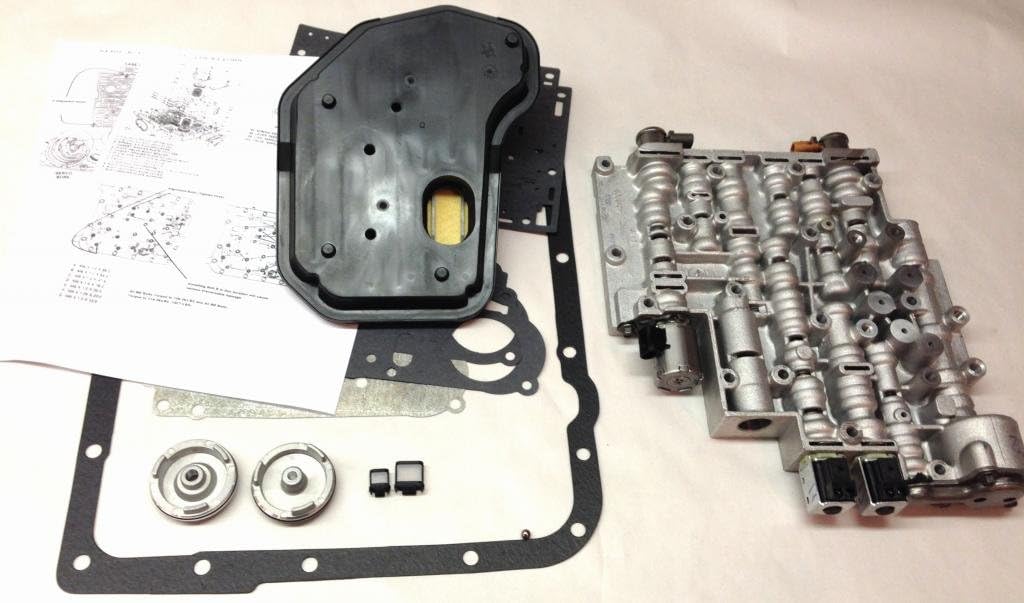
The correct repair reconditions the actual bore and installs a proper replacement valve kit, which restores apply pressure to the pressure the circuit was designed around instead of overpowering a leak. Sonnax sells this as two separate kits split by control strategy rather than by model name: 77754-03K for 1997-and-earlier non-EC3 units, and 77754-04K for 1998-and-later EC3 units. Since every 4L65E runs the EC3 strategy, confirm you are ordering the EC3-specific kit for your case rather than assuming the older part number because the model name matches a listing you found.
CTP 4L65E Pressure Control Solenoid Kit (2003-2005)
If you are already into the valve body for a TCC regulator repair, the pressure control (EPC) solenoid is the other high-cycle wear item worth checking at the same time -- it governs the overall line pressure strategy the TCC circuit rides on top of.
Shop the 4L65E pressure control solenoid kit →Need the regulator valve kit itself or other hard parts? Browse the full 4L65E parts collection.
Step-by-Step: Diagnosing TCC Slip on the Bench and on the Road
- Confirm lockup is supposed to happen. GM restricts converter clutch apply on purpose in some conditions. The 2007 GMC Yukon owner manual states that when the startup transmission temperature is about 64°F (18°C), the converter clutch temporarily will not operate, and normal operation resumes once the fluid rises above 68°F (20°C). The 2005 Yukon manual adds that at about 265°F the transmission enters a protection mode with changed shift patterns. Log transmission fluid temperature with every TCC complaint so a programmed lockout is not read as a failed converter.
- Pull the actual code first. Don't assume "a TCC code" means the solenoid. Note whether it's P0741, P0742, P1870, P0894, or P1887 -- each points you in a different direction per the table above.
- Graph slip speed against duty cycle on a scan tool. Overlay vehicle speed and throttle position so you can see what the driver was doing when slip occurred, not just that it occurred.
- Watch the shape of the response, not just the number. A healthy EC3 system shows duty cycle climbing in direct response to a slip event and settling once slip is controlled, the pattern Transmission Digest's graphs show on a good unit. If duty cycle is already pinned near maximum while slip keeps climbing, or duty cycle is dropping while slip rises rather than the PCM clamping down, that is a hydraulic circuit that cannot deliver the pressure being commanded -- a valve body problem, not a wiring problem.
- Rule out the electrical side before you pull the pan. Check the TCC/PWM solenoid resistance against spec, inspect the internal harness and connector for the solenoid, and confirm the TFP (fluid pressure) switch inputs the PCM uses for gear-state logic are reading correctly.
- If electrical checks pass, go to the valve body. Pull the valve body and inspect the TCC regulator and isolator valve bore for scoring, discoloration, or visible wear at the bore wall -- the failure Sonnax's kits and GM's own valve-body bulletin both describe.
- Repair the bore correctly, don't block it. Ream and sleeve per the kit instructions, install the EC3-correct valve set, and verify apply pressure is back in the 60-80 psi OE range rather than full line pressure.
Prevention and What to Check at Every Service
- Don't ignore an intermittent TCC code just because it clears. A P1870/P0894 that comes and goes under load is early valve bore wear, not a fluke.
- If you're already replacing a converter or transmission, inspect the TCC regulator/isolator bore rather than assuming a code that appears afterward means the new part is bad.
- Never accept the pump-slide-spring "fix." It trades a comeback diagnosis for a comeback failure.
- Confirm EC3 vs. non-EC3 before ordering a valve kit. Every 4L65E is EC3; buying the wrong kit by model name alone wastes the install.
- Check the level hot, and check it twice. GM's 2005 Yukon procedure is a hot check at 180-200°F, repeated, and if the readings will not repeat, GM says to check the transmission breather hose. A low unit takes line pressure, and converter apply pressure with it, down first.
- Keep fluid current. Degraded ATF changes the friction coefficient the PWM strategy was calibrated around and can mimic a mechanical slip complaint.
Keep the numbers at the bench. Our free transmission fluid spec chart lists the correct ATF for the 4L65E and dozens of other units.
FAQ
What does it mean when a 4L65E's torque converter clutch is locked up?
It means the PCM has commanded the TCC apply circuit to clamp the converter's clutch disc against the front cover, turning the fluid coupling into a near-direct mechanical link between the engine and the transmission input shaft. On an EC3-strategy 4L65E this usually is not a hard, 0-RPM lockup -- the PCM targets a small amount of controlled slip, commonly in the 20-40 RPM range, rather than full mechanical lockup, to cut heat and noise without losing the fuel-economy benefit.
What is the difference between P0741, P0742, and P1870 on a 4L65E?
P0741 is the generic OBD-II code for TCC stuck off or performance -- the PCM commanded lockup and still saw too much slip. P0742 is the opposite, TCC stuck on, where the clutch will not release when commanded off. P1870 is GM's own proprietary code, used on the 4L60-E/4L65E/4L80-E/4L30-E/4T60-E family, for general transmission component slipping detected by comparing engine speed to vehicle speed after lockup is commanded; it does not point at the TCC as specifically as P0741 does, which is why a scan tool PID check is needed before you start ordering parts.
What scan tool PIDs should I watch to diagnose 4L65E TCC slip?
Graph TCC slip speed (calculated engine RPM minus turbine/input shaft RPM) against TCC duty cycle or TCC percent, with vehicle speed and throttle position overlapped. Steady highway cruise should settle into low double-digit slip RPM at a moderate, stable duty cycle. A duty cycle that is pinned near maximum while slip still climbs, or a duty cycle that ramps down while slip increases rather than the PCM compensating, points at a hydraulic problem in the TCC apply circuit rather than a wiring or solenoid-only fault.
Why does a 4L65E set a TCC code right after a transmission or converter swap?
This is a known pattern on this case: a harsh 1-2 upshift with the Check Engine light on and a TCC-related code stored, showing up almost immediately after a transmission or torque converter replacement. The usual cause is pre-existing wear in the valve body bore that houses the TCC isolator and regulator valves -- wear that was already there, got blamed on the new parts, and sets the code as soon as the PCM tries to command lockup through a leaking circuit.
Can I just block the TCC regulator valve to stop the slip for good?
You can, and some builders do it with a 700-R4 pump slide spring to force full line pressure to the converter clutch, but it is not the same as a proper repair. Forcing roughly 140 psi of apply pressure onto a circuit designed for 60-80 psi can delaminate the friction lining, crack the TCC piston, break the damper rivets, and take out the converter -- while also producing a harsh, noticeable engagement feel. Reconditioning the actual valve bore and installing the correct replacement valve kit keeps the apply pressure in spec instead of just overpowering the leak.
Sources
- Sonnax — "Beyond 1870: GM Converter Codes P0741, P0742 and 1887" (tech resource article). Backs: the definitions and set conditions for P0741, P0742, P1870, and P1887, including the model list for P1870 (4L60-E, 4L80-E, 4L30-E, 4T60-E) and common root causes such as worn TCC valve bores and defective PWM solenoids. sonnax.com/tech_resources/120
- Sonnax — "20 Years Later: What's New With 4L60-E PWM Modifications" (tech resource article). Backs: the evolution from on/off TCC control to PWM in 1995 and the EC3 slip-controlled strategy from 1997-98 onward, the TCC regulator valve bore-wear failure mode, OE apply pressure spec (60-80 psi) versus the full-line-pressure "fix" (~140 psi) and its damage pattern. sonnax.com/tech_resources/214
- Sonnax — TCC Regulator & Isolator Valve Kit 77754-03K, product page. Backs: the two-kit split by EC3 status (77754-03K for '97-earlier non-EC3, 77754-04K for '98-later EC3), the symptoms addressed (codes 894/1870, overheated converter, low apply pressure, burned 3-4 clutch, harsh 1-2 shift), and the bore-reconditioning repair approach. sonnax.com/parts/2457
- Transmission Digest — "4L60-E EC3 TCC Control and Adapt," R&R Tech, by Richard Middleton (January 2011). Backs: the real-world scan-tool data showing the PCM's adaptive duty-cycle strategy on an EC3 4L60-E, the behavior difference between a healthy circuit and a worn TCC regulator/AFL valve bore, and the overbore-and-oversize-valve repair that resolved it. transmissiondigest.com/4l60-e-ec3-tcc-control-and-adapt
- Motor Magazine — "Deciphering GM Transmission DTC P1870," by Wayne Colonna (June 2006). Backs: the P1870 set logic (PCM compares engine speed to vehicle speed only after TCC is commanded on in high gear/Overdrive; an out-of-range ratio elevates main line pressure, halts further TCC apply, and may inhibit 4th gear without necessarily lighting the MIL); the 4L60-E TCC hardware timeline (1993-1994 on/off solenoid with check ball, 1995 added PWM solenoid requiring a new pump and valve body); the PCM's fixed 32 Hz negative duty-cycle drive frequency for the PWM solenoid; and the three scan-tool PIDs used to observe it (TCC Enabled, PWM duty cycle / "ON Time," and converter slip RPM). motor.com (PDF)
- General Motors — 2007 GMC Yukon Owner Manual. Backs: the cold-start converter clutch restriction at about 64°F startup temperature with normal operation resuming above 68°F. GM: 2007 GMC Yukon owner manual (PDF)
- General Motors — 2005 GMC Yukon Owner Manual. Backs: the 265°F transmission protection mode, the 180-200°F hot fluid check, and the check-twice and breather hose guidance. GM: 2005 GMC Yukon owner manual (PDF)