An otherwise healthy 4L80E that's leaving a small puddle under the front of the truck is, more often than not, leaking at a cooler line fitting rather than the pan gasket. The pan gets blamed because it's the first thing underneath, but the two cooler lines running from the case to the radiator or auxiliary cooler see more heat cycling, more road debris, and more thread corrosion than almost anything else on the transmission — and this unit has shipped with at least three different fitting styles across its production run, which is exactly why the wrong replacement part gets ordered so often.
Here's how to identify which fitting your case actually has, what line size to run, which tool you need to get a snap-in fitting apart without cracking it, and why GM's own recall history on this transmission is worth knowing before you call a slow drip "no big deal."

Identify Your Fitting Before You Order Anything
The 4L80E and its heavy-duty sibling the 4L85E went through more than one case-port design over a production run that spans 1991 to the mid-2010s, and the fitting on your case is tied to the case casting, not strictly to a single cutoff year. Per Bowler Transmissions' own fitment guide for its 4L80-E/4L85E cooler line fittings, most 1996-2008 cases use 1/4 NSPT threads — the stock adapter measures roughly 0.521 inch across the threads — while 2009-and-up cases switch to 9/16-18 threads, measuring roughly 0.5568 inch. Bowler's instructions are blunt about it: pull the stock adapter and measure it yourself before buying, rather than guessing from the model year alone, because the two thread sizes are easy to mix up and a mismatched fitting will not seal.
Separately, a number of 1997-and-later 4L80E/4L85E cases were built with a snap-in (quick-connect) fitting rather than a threaded port. These use an internal spring-steel retainer that locks onto the line's bead and releases only when you spread the retaining tabs evenly — which is precisely where people run into trouble, covered below.
Line Diameter: Don't Go Smaller Than Stock
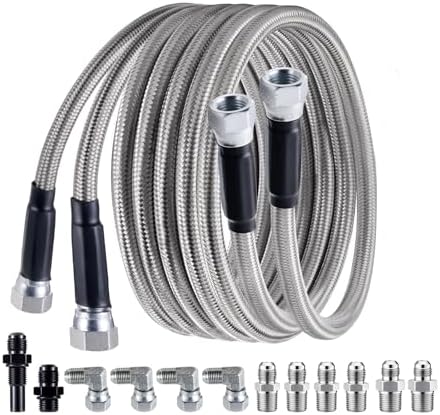
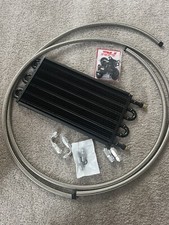
Factory 4L80E cooler lines on most trucks and vans ran 5/16-inch steel tube. If you're replacing a corroded or kinked line, stepping up to 3/8-inch tube or an equivalent-ID braided line is a common and safe upgrade, since the larger inside diameter reduces flow restriction through the cooler circuit rather than adding any. What actually causes problems is going the other direction: a narrower replacement line, or a fitting with a smaller internal passage than stock, creates a restriction point in a circuit that's already doing double duty cooling the fluid and feeding the torque converter clutch apply circuit. If you're unsure which size you pulled off, measure the old tube's outside diameter directly rather than estimating.
The Rear Port Is Not Like the Front
One detail that catches people doing their own line work: on 1996-and-up cases, the rear cooler line port uses a special fitting that must be installed together with its matching lube tube. Per Bowler Transmissions, skipping or substituting that lube tube on the rear port can cause transmission damage — it's not just sealing fluid, it's routing lubrication internally. Reuse the stock lube tube with a new fitting, or buy the pair together, and don't treat the rear port as interchangeable with a generic front-style fitting.
Disconnecting a Snap-In Fitting Without Cracking It
If your case has the later snap-in style port, resist the urge to pry it apart with a screwdriver or channel-locks. The plastic retaining collar on these fittings is thin, and uneven prying is the single most common way people turn a simple line swap into a cracked-case repair. A purpose-built disconnect tool — the OTC 7937 is made specifically for GM 4L60E/4L80E cooler line fittings — slips over the line and compresses the internal retaining tabs evenly all the way around, so the line pulls free without stressing the collar. If your case instead has threaded 1/4 NSPT or 9/16-18 fittings, you don't need a disconnect tool at all; just the correct flare-nut wrench so you don't round off the fitting.
Why This Isn't Just a "Drip, Ignore It" Item
It's tempting to let a slow cooler-line weep go until the next service interval. Two pieces of GM's own recall history are worth knowing before you make that call. NHTSA Campaign 95V026000 covered 1995 GM pickup trucks and vans built specifically with the 4L80-E transmission, for a thin transmission case casting that could develop an external leak; GM's own filing states plainly that the resulting oil spray onto the exhaust system could cause a vehicle fire, and the remedy was dealer inspection and, where involved, a transmission case replacement. That recall was about the case casting itself, not the cooler line fittings, but it's a documented example of GM treating an external 4L80E leak as a fire-risk safety defect rather than a cosmetic nuisance.
Separately, NHTSA Campaign 14V152000 recalled 2014 Chevrolet Silverado and GMC Sierra and 2015 Suburban, Tahoe, Yukon and Yukon XL models — these are 6-speed automatic (feature code MYC) trucks, a different transmission family than the 4L80E — because a transmission oil cooler line could be left not securely seated in its fitting, and GM's filing again states the consequence plainly: oil leaking from an unseated fitting onto a hot surface could cause a vehicle fire. This recall doesn't cover the 4L80E, but it's the same underlying failure mode as a snap-in cooler line fitting that doesn't fully seat: GM has had to recall vehicles for exactly that condition on a different transmission. The practical takeaway for a 4L80E job is the same either way — after you install a new fitting, confirm it's fully seated (you should feel and often hear the retainer click into place on a snap-in style, or torque a threaded fitting to a snug seal) and road test with a known-clean cardboard check under the line before calling the job done.
Step-by-Step Replacement
- Confirm the leak source first. Clean the area around both fittings and the pan, then drive the truck a short distance and recheck under a light before assuming it's the cooler line and not the pan gasket or a dipstick tube seal.
- Identify the fitting style and thread size as described above — pull the stock adapter and measure it, don't guess by year.
- Relieve pressure and have a drain pan ready. Disconnecting either line will release whatever fluid is in that section of the circuit.
- Disconnect the old line. Use the OTC 7937 (or equivalent) on a snap-in fitting, or the correct flare-nut wrench on a threaded fitting. Never use pliers or an adjustable wrench on a flare nut — it rounds the flats and you'll be cutting the old fitting off next.
- Install the new line and fitting, matching the thread size you measured, and don't forget the special fitting-plus-lube-tube pairing on the rear port.
- Route the new line clear of the exhaust and any frame rub points. Heat-cycling against an exhaust pipe is exactly how the factory lines fail in the first place; zip-tie or clip the new line away from anything hot or sharp-edged.
- Refill and road test. Bring the fluid to a proper hot-check level, then run the truck through a full range cycle in the driveway before road testing, and recheck both fittings after the drive for seepage.
You're also disturbing the transmission's lube and converter-apply circuit any time you crack a cooler fitting, which is why GM's own warranty bulletin on automatic transmission oil cooler service calls for the correct fluid and a flow check after the circuit has been opened for repair, not just a visual leak check. GM's bulletin specifies DEXRON-VI as the fluid used to flush and flow-test the cooler circuit, and keeps the DT-45096 TransFlow machine on the recommended-tools list specifically for diagnosing a restriction or an overheating condition after the lines have been apart. You don't need a shop flush machine to swap a leaking fitting, but if the line you pulled was collapsed, kinked, or had visible debris in it, that's the point to flow-check the cooler rather than just bolting the new line on and calling it done — GM dropped the requirement to do this on every transmission repair in December 2018, but it never dropped the recommendation to do it when there's an actual reason to suspect restriction.
6AN PTFE cooler line kits, the disconnect tool for snap-in fittings, and a replacement cooler if the old one's clogged or crushed — shipped fast from the USA.
Shop 4L80E parts →FAQ
What size are 4L80E transmission cooler line fittings?
It depends on the case. Most 1996-2008 4L80E/4L85E cases use 1/4 NSPT threads (stock adapter measures about 0.521 inch across the threads), while 2009-and-up cases use 9/16-18 threads (about 0.5568 inch). Measure the stock adapter before ordering rather than assuming by year.
What diameter cooler line should I run on a 4L80E?
5/16 inch is the factory size on most 4L80E trucks and vans. Stepping up to 3/8 inch on a replacement is a common, safe upgrade since it reduces flow restriction. Going smaller than stock is what actually causes trouble.
Do I need a special tool to disconnect 4L80E cooler lines?
Only for the later snap-in/quick-connect style fitting. Prying it apart with pliers or a screwdriver commonly cracks the plastic retaining collar. A purpose-built tool like the OTC 7937 releases the internal retaining tabs evenly. Threaded fittings just need the correct flare-nut wrench.
Is there anything special about the 4L80E's rear cooler line port?
Yes. On 1996-and-up cases, the rear port uses a special fitting that must be installed with its matching lube tube; skipping the lube tube can cause transmission damage. Don't substitute a generic fitting on the rear port.
Has GM ever recalled 4L80E transmissions for external leaks?
Yes. NHTSA Campaign 95V026000 covered 1995 GM pickups and vans with the 4L80-E for a thin case casting that could cause an external leak, with GM warning the resulting oil spray onto the exhaust could cause a vehicle fire. That recall was about the case casting, not the cooler lines, but it shows GM has treated external 4L80E leaks as a safety issue before.
Related guides
If the cooler line turns out not to be your leak, or you're doing this as part of a broader service, these cover the rest of the external-leak and maintenance picture on this transmission.
Sources
- Bowler Transmissions — "4L80-E / 4L85-E Transmission Cooler Line Fitting" product and fitment listing. States the 1/4 NSPT thread spec (approx. 0.521 in.) for most 1996-2008 4L80-E/4L85-E cases versus the 9/16-18 thread spec (approx. 0.5568 in.) for 2009-and-up cases, the recommended measurement method, and the rear-port special-fitting-plus-lube-tube requirement. bowlertransmissions.com
- NHTSA — Recall Campaign Number 95V026000 (General Motors Corp., reported February 1995). Covers 1995 Chevrolet/GMC pickup trucks and vans equipped with the 4L80-E automatic transmission; describes a thin transmission case casting that can cause an external leak, with transmission oil spray onto the exhaust system creating a possible vehicle fire, remedied by dealer inspection and case replacement where involved. api.nhtsa.gov (NHTSA recall data)
- NHTSA — Recall Campaign Number 14V-152 (General Motors LLC, acknowledged March 31, 2014). Covers model year 2014 Chevrolet Silverado and GMC Sierra and model year 2015 Suburban, Tahoe, Yukon and Yukon XL vehicles equipped with a 6-speed automatic transmission (feature code MYC) — a different transmission family than the 4L80E — for a transmission oil cooler line not securely seated in its fitting, with GM stating the resulting leak onto a hot surface could cause a vehicle fire. Cited here for the documented fitting-seating failure mode, not as a 4L80E-specific recall. static.nhtsa.gov
- General Motors — Warranty Bulletin 17-NA-066, "Automatic Transmission Oil Cooler Flush and Flow Test" (March 2017, revised through December 2018). Backs the DEXRON-VI fluid specification for cooler circuit flush and flow-test service and the requirement to use the DT-45096 TransFlow machine to flush and flow-check the transmission oil cooler and oil cooler pipes after the circuit has been opened for repair. static.nhtsa.gov (GM Bulletin 17-NA-066, PDF)
- GM TechLink — "Changes in Transmission Oil Cooler Flush Requirements." Backs the December 1, 2018 policy change dropping the mandatory cooler flush and flow-test requirement for most transmission and torque converter repairs, while keeping the TransFlow tool recommended specifically for diagnosing an overheating condition or a restriction after the cooler circuit has been disturbed. gm-techlink.com