Most of the money wasted on a 4L80E job gets spent before a single bolt comes out. Somebody reads "4L80E" off a parts-store lookup, orders a valve body, and it shows up with the wrong temperature sensor provision. Or a 4L85E goes back together with 4L80E geartrain hard parts in it. The unit itself is not hard to identify. The problem is that people stop identifying it one step too early.
There are three questions to answer, in order. Is it a 4L80-family unit at all? Is it the 4L80E or the 4L85E? And what year range is the internal hardware? Answer all three and the parts order writes itself. Answer only the first and you are guessing on everything that actually changed across a production run that spanned more than two decades.

Step 1: confirm it is a 4L80-family unit
Start with the pan, because it is the fastest tell and you can do it on a creeper. The 4L80E uses a 17-fastener pan, and the factory bolts take a 13 mm socket. Mag-Hytec's installation sheet for its 4L80E pan lists 17 cap screws and calls out the 13 mm socket for removing the original cover, which matches what is on the truck. A 4L60E, by comparison, uses a 16-bolt pan. Most 4L80E pans, factory and aftermarket, also carry a drain plug, which the 4L60E does not.
Next, look at the cooler line fittings. This one is worth knowing because it catches swapped units. Chevrolet Performance's own 4L80-family documentation states plainly that the return cooler line fitting is unique to the 4L80 family, and GM sells two specific parts to convert it to a standard inverted flare: 8637742 for the transmission-to-cooler line and 24205178 for the cooler-to-transmission line. That same instruction sheet carries a warning worth repeating, that installing the wrong fittings into the transmission could ruin it. If the fittings on the case do not look like anything else in the shop, you are on a 4L80-family unit.
Then check the mass. GM lists the 4L80-family transmission at 104.5 kg (230 lb) dry and 115.5 kg (255 lb) wet, with an overall length of 817.23 mm. Nothing in the 4L60E family is close. If two people are fighting it onto the jack and the pan has 17 bolts, you have your answer.
At the bellhousing, the 4L80E bolts to the engine with six bolts at 50 N-m (37 lb-ft) per the Chevrolet Performance 4L80 family installation kit, and the flexplate-to-converter bolts (GM 11589040) go to 60 N-m (44 lb-ft). One note on that figure: the 4L85E specification sheet prints the converter bolt spec with the units transposed, as "60 ft.-lbs. / 44 N-m." The installation kit sheet has it the right way round. Use 44 lb-ft.
One more field cue, offered as bench experience rather than a published spec: the 4L80E carries a turbine (input) speed sensor on the case in addition to the output speed sensor, so you will find two sensor bosses on the left side rather than one. Be careful leaning on this in four-wheel-drive trucks, where vehicle speed may be picked up at the transfer case instead, but on a bare unit on a stand it is a quick confirmation.
Step 2: 4L80E or 4L85E? MT1 versus MN8
Externally these two are close enough that you will not separate them by eye. The clean way is the RPO code. GM bulletin PIP3259J identifies the 4L80E as RPO MT1 and the 4L85E as RPO MN8, and that same bulletin lists the vehicles the pair was used in, which is a useful cross-check when you are working from a VIN instead of a unit:
- 2002-2007 Chevrolet Avalanche
- 1999-2008 Chevrolet Express and GMC Savana
- 1999-2007 Chevrolet Silverado and Suburban
- 1999-2007 GMC Sierra and Yukon XL
On these trucks and vans the Service Parts Identification label is normally on the glove box door, and the RPO list printed on it will carry MT1 or MN8. That is a 30-second check that beats any amount of squinting at a case.
The reason it matters is internal. The 4L85E uses five-pinion low and intermediate planetary sets where the 4L80E uses four-pinion. Ratios are identical, the case is shared, and most soft parts and valve body components are listed for both, which is exactly why people assume the geartrain hard parts interchange too. They do not. Order a carrier or a sun gear against the wrong RPO and it will look right in the box and be wrong in the unit.
For reference, the ratios GM publishes for the 4L80 family are 1st 2.482, 2nd 1.482, 3rd 1.000, 4th 0.750, Reverse 2.077. Those numbers are also your scan-tool verification tool, which we will come back to.
Step 3: pin the year, because that is where the parts change
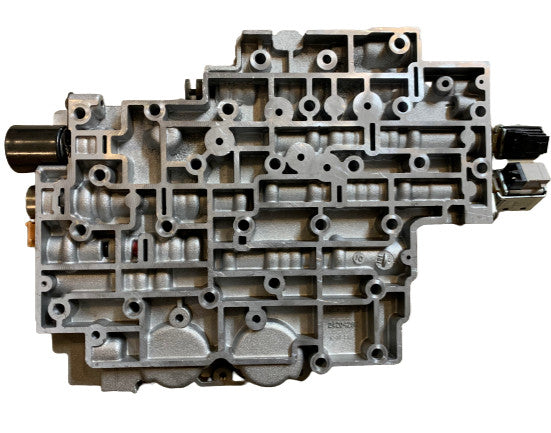
This is the step that separates a clean parts order from a return. Sonnax splits the 4L80E valve body into four groups, and the identification cues are all things you can see with the pan off:
| Years | Sonnax valve body group | What you look for |
|---|---|---|
| 1991-1992 | GM026 (warranty only) | Screw-in temperature sensor on the valve body |
| 1992-1996 | GM027 | Temperature sensor moved into the internal wire harness |
| 1997-2003 | GM028 | Lube hole relocated; the two small holes on the upper right side are gone |
| 2004 and later | GM029 | Late-style EPC solenoid, identified by the silver canister |
The two small holes are the quickest of those. Per Sonnax, they appear on the upper right side of 1991 to 1996 valve bodies and do not appear on 1997-later units. If you are holding a valve body with no paperwork, that single feature puts you on one side or the other of the biggest break in this unit's life.
Hard parts give you two more year lines, both from Sonnax's 4L80E build guide data:
| Component | Earlier | Later |
|---|---|---|
| Low/reverse servo | 1995 and earlier uses an adjustable servo pin | 1996 and later uses a servo spacer |
| Intermediate clutch backing plate | 1998 and earlier, .375 in. thick | 1999 and later, .275 in. thick |
| Case saver retainer | 1998 and earlier | 1999 and later, different part |
| Overrun clutch valve | Not applicable | Smart-Tech kit fits 1997-later only |
Measure the backing plate. A .100 in. difference sounds trivial until you stack a clutch pack against it and end up with clearance that puts the intermediate clutches on the edge. If you are rebuilding a unit whose history you do not know, that measurement is a better year indicator than any tag, because tags follow cases and cases get swapped.
There is one more date worth knowing, and it comes straight out of GM. PIP3259J instructs the technician to check rear unit end play on units built after 9-01-03, with a specification of 0.127 to 0.508 mm (0.005 to 0.020 in.) and a target of .010 to .015 in. So there is a GM-recognized production break in the output planetary area at that date, and if you are chasing a whine in first and second on a 2004-up unit, that is exactly where GM points you before it allows the transmission to be condemned.
Step 4: verify what you identified, on the scan tool and on the gauge
Identification is not finished until the unit behaves like the unit you think it is. Two checks close the loop.
Ratio math. Drive it, hold a steady gear, and divide input speed by output speed on the scan tool. You should land on 2.482, 1.482, 1.000 and 0.750. If the numbers are right but the gear the module commanded is wrong, you have a shift problem, not an identification problem. If the numbers themselves are off, something in the geartrain is not what the label says it is, which is common on units that have been apart before.
Pressure. The GEARS Magazine article on 400 and 4L80 rebuilds gives the figures that separate this unit from its TH400 ancestor: the 4L80E runs roughly 100 psi converter charge pressure under high load against about 60 psi on a TH400, with maximum line pressure near 180 psi on both. If a unit that came out of a truck as a "4L80E" charges the converter like a TH400, you are looking at a hybrid build, not a factory transmission. The same article gives 0.020 to 0.025 in. as typical direct clutch housing endplay, which is worth checking while you are in there.
Fill specs, once you know what you have
Everything in this table comes from GM's own 4L80-family specification sheet, so there is no guesswork in it:
| Item | Specification |
|---|---|
| Fluid type | Dexron VI |
| Capacity, bottom pan removal | 7.3 L (7.7 quarts) |
| Capacity, dry | 12.5 L (13.2 quarts) |
| Oil pan to case | 24 N-m (18 lb-ft) |
| Oil drain plug | 34 N-m (25 lb-ft) |
| Cooler pipe connector nut to case | 38 N-m (28 lb-ft) |
| Transmission to engine | 50 N-m (37 lb-ft) |
| Flexplate to torque converter | 60 N-m (44 lb-ft) |
| Maximum engine torque, 4L80-family Supermatic rating | 650 lb-ft |
Two practical notes from the same GM document. It calls for 6 to 8 ounces of Dexron VI poured into the converter before it goes onto the pump, because a dry start will damage the converter internals. And the converter has to seat through two distinct steps into the pump, the stator shaft and the input shaft; with it fully home and the case against the block, the gap between the flexplate and the converter mounting pad should be between 1/8 in. and 1/4 in. Outside that window, the converter is either not in or it is the wrong converter for the application. Separately, if the truck is wearing an aftermarket deep pan, use that pan maker's torque figure. Mag-Hytec, for one, ships its own 8 mm allen cap screws at 12 to 16 lb-ft, not the factory 18.
The mis-IDs that actually cost money
- Ordering a valve body by model year instead of by what is in front of you. On a 20-year-old truck the unit in it may be a salvage-yard replacement from a different year entirely. Identify the valve body by its sensor provision and lube hole, not by the VIN.
- Treating MN8 as a trim level. It is a different geartrain. Confirm the RPO before you touch planetary hard parts.
- Mixing a deep pan with a standard filter. Deep pans need either a longer filter or a filter with stand-off pads. A standard filter in a deep pan will pull air under load and you will be back in it.
- Skipping the backing plate measurement. The 1998/1999 change is .375 in. to .275 in., and nothing on the outside of the case tells you which one is in there.
Need parts for this job?
Year-correct 4L80E valve bodies, solenoid kits with the internal harness, master rebuild kits split by production era, filters, pans and hard parts, all shipped from the USA on our own checkout.
Shop 4L80E parts →FAQ
How do I tell a 4L80E from a 4L60E?
Count the pan bolts and look for a drain plug. The 4L80E family uses a 17-fastener pan, and most factory and aftermarket 4L80E pans have a drain plug, while the 4L60E uses a 16-bolt pan with no drain. Weight settles it if you are still unsure: GM lists the 4L80-family unit at 230 lb dry and 255 lb wet, which is far heavier than a 4L60E. The cooler line fittings are another giveaway, since the 4L80 family uses a return fitting unique to that transmission.
What is the RPO code for a 4L80E?
MT1. GM bulletin PIP3259J lists the 4L80E as RPO MT1 and the 4L85E as RPO MN8. Both codes appear on the Service Parts Identification label, which on these trucks and vans is normally on the glove box door. If the label is intact you can confirm which of the two you have without putting the vehicle on a hoist.
Are 4L80E and 4L85E parts interchangeable?
Many are, but not all. The two units share ratios, the case, the pan and most of the soft parts, which is why rebuild and valve body components are commonly listed for both. The 4L85E uses five-pinion low and intermediate planetary sets where the 4L80E uses four-pinion, so geartrain hard parts are not a blind swap. Check the RPO before you order any carrier, sun gear or planetary component.
How do I find the year of a 4L80E if the tag is gone?
Read the valve body and the hard parts. Per Sonnax, 1991 to 1996 valve bodies have two small holes on the upper right side that 1997 and later units do not, 1991 units use a screw-in temperature sensor while 1992 to 1996 moved it into the internal harness, 1997 to 2003 relocated the lube hole, and 2004 and later use the late-style EPC solenoid with the silver canister. Confirm with the low and reverse servo and the intermediate clutch backing plate, both of which changed at known year breaks.
What fluid does a 4L80E take and how much?
Dexron VI. GM's own specification sheet for the 4L80-family Supermatic unit lists 7.3 L (7.7 quarts) for a bottom pan removal and 12.5 L (13.2 quarts) dry. Pan-to-case bolts go to 18 lb-ft (24 N-m) and the drain plug to 25 lb-ft. If you have fitted an aftermarket deep pan, use that manufacturer's torque value instead, because most of them ship their own fasteners.
Sources
- Chevrolet Performance (General Motors) — Supermatic Transmission (19300175) Specifications, instruction sheet 19211852. Backs the gear ratios (2.482 / 1.482 / 1.000 / 0.750, Reverse 2.077), the Dexron VI fluid requirement, fluid capacity (7.3 L / 7.7 qt pan removal, 12.5 L / 13.2 qt dry), dry and wet weight (230 lb / 255 lb), 817.23 mm overall length, the unique 4L80-family return cooler line fitting and its conversion part numbers 8637742 and 24205178, the converter pre-fill and seating procedure, and the torque specs for the pan, drain plug, cooler pipe connector nut and case bolts. chevrolet.com (PDF)
- Chevrolet Performance (General Motors) — 4L80 Family Transmission Installation Kit 19259119, instruction sheet. Backs the six-bolt bellhousing-to-engine attachment at 50 N-m (37 lb-ft), the flexplate-to-torque-converter bolt spec of 60 N-m (44 lb-ft) with GM bolt 11589040, and the flexplate cover fastener specs. chevrolet.com (PDF)
- General Motors — Bulletin PIP3259J, "Whine Noise In First And Second Gear," December 2012 (NHTSA document MC-10112681). Backs the RPO identification (4L80E = MT1, 4L85E = MN8), the model and year coverage list used in this article, the 9-01-03 transmission build-date break, and the rear unit end play specification of 0.127 to 0.508 mm (0.005 to 0.020 in.) with a 0.010 to 0.015 in. target. static.nhtsa.gov (PDF)
- Sonnax — GM 4L80-E Valve Body Identification. Backs the four valve body generations and their visual cues: the 1991 screw-in temperature sensor, the 1992 to 1996 harness-mounted sensor, the two small holes on the upper right side of 1991 to 1996 valve bodies that are absent on 1997 and later, the relocated lube hole on 1997 to 2003 units, and the silver-canister late-style EPC solenoid on 2004 and later. sonnax.com
- Sonnax — 4L80-E Performance & Heavy Duty Transmission Build Guides. Backs the hard-part year breaks used in the identification table: the low/reverse servo split at 1995 and earlier versus 1996 and later, the intermediate clutch backing plate change from .375 in. on 1998-and-earlier units to .275 in. on 1999-and-later units, the matching case saver retainer change at the same 1999 break, and the overrun clutch valve kit that fits 1997-later units only. sonnax.com
- GEARS Magazine (ATRA) — "Improve Your 400 and 4L80 Rebuilds." Backs the pressure figures used to sanity-check a unit on the gauge: roughly 100 psi converter charge pressure under high load on the 4L80E against 60 psi on a TH400, a maximum line pressure near 180 psi on both, and the 0.020 to 0.025 in. direct clutch housing endplay range. gearsmagazine.com
- Mag-Hytec — GM 4L80E Transmission Pan Installation Recommendations, 05/11/17. Backs the 17-fastener pan count, the 13 mm socket size for the factory pan bolts, and the note that aftermarket deep pans ship their own fasteners with their own torque value (12 to 16 lb-ft on this pan) rather than the factory 18 lb-ft. mag-hytec.com (PDF)
4L80E Level 2 rebuild kit, 1997-Up → or browse all 4L80E parts →