The 4L80E has no throttle valve and no vacuum modulator. Everything the transmission knows about engine load arrives through one part: the electronic pressure control solenoid, called the EPC solenoid, the pressure control solenoid or the force motor depending on who is talking. It is a variable-current device, and the relationship runs backwards from what most people assume. More current means less line pressure.
That inversion is why EPC failures show up as two opposite complaints on the same transmission. This is the diagnosis, with the actual numbers.

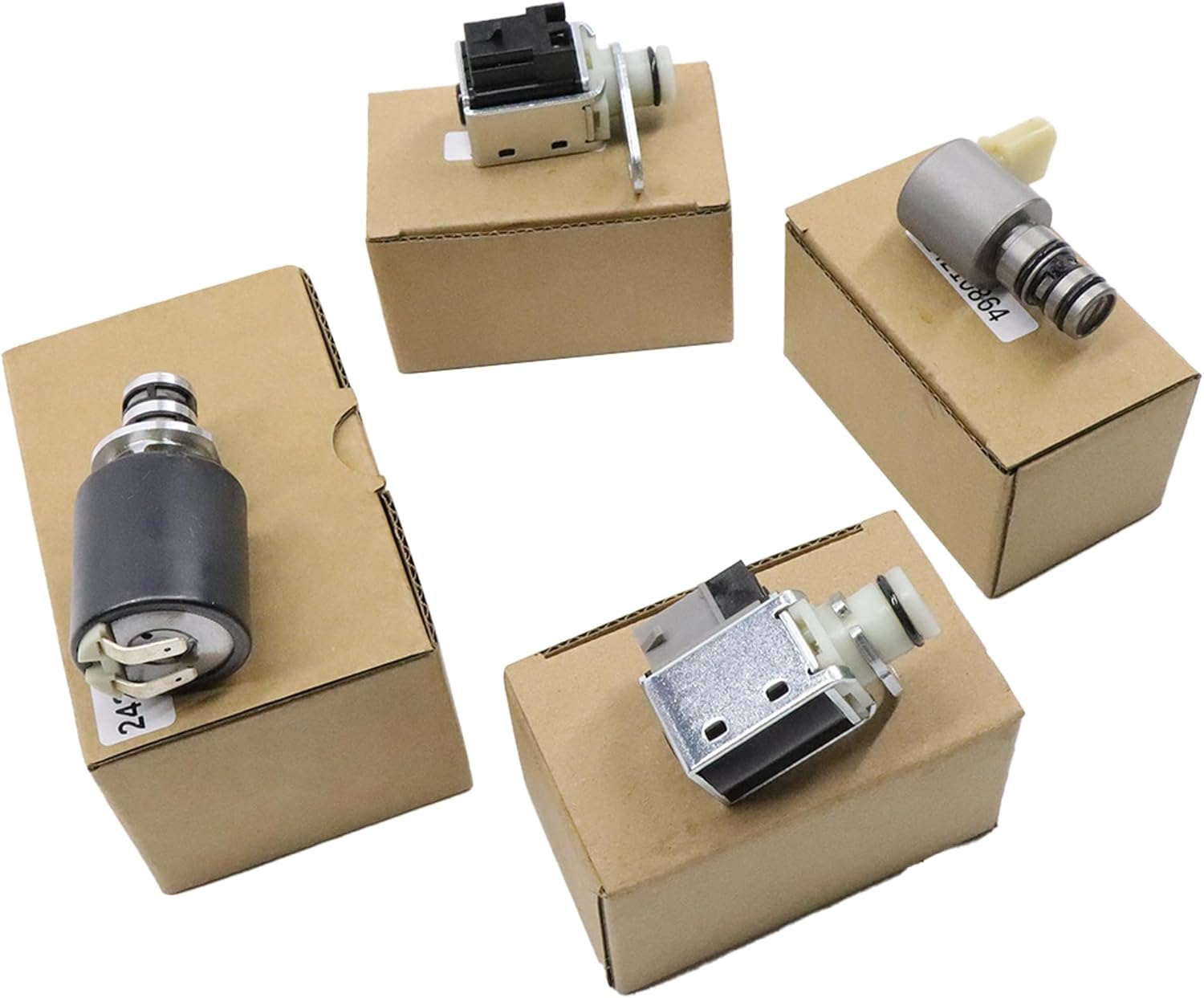

What the EPC solenoid controls, and how the TCM watches it
Per the GM-derived 4L80-E troubleshooting supplement issued for HMMWV service, the pressure control solenoid is a TCM-controlled device used to regulate line pressure. The TCM compares throttle position voltage, engine RPM and other inputs to decide the appropriate pressure for a given load, then regulates it by applying a varying amperage to the solenoid. Applied amperage varies from 0.1 to 1.1 amp, and the module monitors amperage on the return line.
Two facts fall out of that, and they explain nearly every EPC symptom you will see:
- Current and pressure move opposite each other. Near zero current the solenoid is doing almost nothing to lower pressure, and line runs in the 157-177 psi range. At 0.98-1.1 amp the solenoid is pushing pressure down to its floor, 35-55 psi.
- The failure default is maximum line pressure. When return amperage varies by more than 0.16 amp from the commanded amperage for one second, the TCM sets the pressure control solenoid current-error code (DTC 73 on the early TCM systems, P0748 on OBD-II applications) and commands maximum line pressure.
That default is the most useful thing to know about this circuit. A 4L80E that suddenly slams every shift and bangs into gear is not a broken valve body until proven otherwise; it is a transmission running on the electrical failure default, which is exactly what GM designed it to do so the clutches survive the drive home.
The symptom list, and what each one is telling you
Everything bangs, at every throttle opening
Hard 1-2 and 2-3 shifts, a jolt into Drive or Reverse, and the harshness does not change whether you are feathering the pedal or in it. That is the max-pressure default: an open circuit, a shorted winding, a corroded case connector, a bad TCM ground, or a solenoid the module cannot verify. Electrical complaint, not hydraulic, and the scan tool usually has the code to confirm it.
Soft, sliding, flared shifts and burnt clutches
The opposite failure. The solenoid is pulling pressure down when it should be raising it, either because it is leaking internally or because the module is being fed a load signal that says the engine is barely working. Slipping shifts under load are what kill the forward, intermediate and direct clutches on this unit, and they kill them fast.
Delayed engagement, worse cold
Low pressure at idle takes longer to stroke the forward clutch piston. If the delay shortens as the fluid warms, suspect low pressure and a leaking feed circuit before the clutch pack itself.
Limp mode, second gear only
The electrical defaults arrive together: second gear commanded, line pressure to maximum, TCC inhibited.
Codes in the solenoid and ratio family
DTC 68 (component slipping), 85 (undefined ratio), 86 (low ratio) and 87 (high ratio) can sit downstream of a pressure problem rather than a mechanical one. Sonnax lists exactly that set of codes as a consequence of actuator feed limit valve bore wear in the 4L80-E and 4L85-E, covered further down.
The electrical checks, with the real specs
Do these before anything comes apart. Resistance values for the 4L80E internal harness, measured at the J1 connector:
| Component | Wire / pin | Resistance | Circuit |
|---|---|---|---|
| Pressure control (EPC) solenoid | Purple, pin C / Lt. Blue, pin D | 3.5 - 5.2 ohms | 1228 / 1229 |
| 1-2 shift solenoid | Red, pin E / Lt. Green, pin A | 18 - 24 ohms | 1149A / 1222 |
| 2-3 shift solenoid | Red, pin E / Yellow, pin B | 18 - 24 ohms | 1149B / 1223 |
| TCC solenoid | Red, pin E / Black, pin S | 10 - 14 ohms | 1149C / 1350 |
Zero your meter on its own leads first and subtract that value, because a 4-ohm part measured with 0.4 ohm of lead resistance is not a 4-ohm reading. ATRA's published range for the later solenoid design is slightly wider at 3-8 ohms, so a part sitting at the high end of that is not automatically condemned on resistance alone.
Check what the module is commanding, too. Per ATRA, duty cycle on the Holley-built solenoid normally reads about 50 to 70 percent at idle and decreases as load increases. A duty cycle that never moves with load points at the input side of the problem, not the solenoid.
Do not put the wrong force motor in it
This one has burned a lot of rebuilds, and it is documented in ATRA Technical Bulletin #266. The 1991-93 4L80E used a Bosch-built pressure control solenoid, GM part 8677314, identified by its silver exterior. Starting with 1994 production GM switched to a Holley-built unit, GM part 8684216, black exterior.
They are not interchangeable. Internally the spool valve was enlarged and a spring added, which eliminated the ten-second cleaning pulse, and the oil channeling was changed to suit it. That change removes the balance oil from the end of the solenoid. ATRA's warning is direct: the Bosch unit must not be used to replace a Holley solenoid, or high line pressure will result. If a unit is banging shifts after somebody else worked on it, look at the color of the force motor.
Prove it with pressure, not with parts
The line pressure test comes first. Use a gauge with 325-350 psi (2240-2413 kPa) capacity, because Reverse will walk right past a 300 psi gauge.
| Range | Minimum at idle | Maximum at greater throttle |
|---|---|---|
| Park, Neutral, both Drive ranges | 35 psi (241 kPa) | 171 psi (1179 kPa) |
| Reverse | 67 psi (462 kPa) | 324 psi (2234 kPa) |
Low in every range points at the pump: worn or damaged gears, a blown-out cup plug, cross leakage or a worn bushing. High points at the pressure control solenoid, the reverse/boost or pressure regulator valves, a bad TCM ground, or a poor solenoid connection.
The EPC override sweep
This is the test that separates a bad solenoid from a bad pump, and it takes ten minutes. Hook up a scan tool and a pressure gauge, set the parking brake, put it in Park and idle the engine. Use the scan tool's override pressure control solenoid function to step current up in the increments below, letting the gauge settle 3 to 5 seconds after each change, and write the readings down.
| Commanded amperage to EPC solenoid | Expected line pressure, psi (kPa) |
|---|---|
| 0.0 - 0.02 | 157 - 177 (1083 - 1220) |
| 0.10 | 151 - 176 (1041 - 1214) |
| 0.20 | 140 - 172 (965 - 1186) |
| 0.30 | 137 - 162 (945 - 1117) |
| 0.40 | 121 - 147 (834 - 1014) |
| 0.50 | 102 - 131 (703 - 903) |
| 0.60 | 88 - 113 (607 - 779) |
| 0.70 | 63 - 93 (434 - 641) |
| 0.80 | 43 - 73 (296 - 503) |
| 0.90 | 37 - 61 (255 - 421) |
| 0.98 - 1.1 | 35 - 55 (241 - 379) |
Read it this way:
- Pressure barely moves and stays high through the whole sweep: fault in the TCM, the wiring or the solenoid. That is your part.
- Pressure is low everywhere, including at zero current: oil pump fault or a hydraulic circuit fault. A new solenoid will not fix it.
- Pressure tracks the table but the truck still shifts wrong: the solenoid and the pump are both doing their jobs. The problem is upstream in the load signal, or downstream in the valve body.
When the solenoid is good and the bore is not
Here is the failure that makes people replace two or three EPC solenoids on the same transmission and still not fix it. The actuator feed limit valve, the AFL, is what feeds the solenoids. Sonnax describes its job as providing consistent fluid pressure to the solenoids so they can control EPC and torque signal pressures, line pressure, and the apply and release of the converter clutch, clutches and bands. It takes line pressure in and regulates it down to a lower maximum, typically in the 80-115 psi range.
On the 4L80-E and 4L85-E that valve has a large reaction area and is heavily affected by side loading, which wears the bore. Sonnax's own wording: "The EPC solenoid oscillates the torque signal and AFL oil, which increases valve action and accelerates wear." The solenoid doing its job is what wears the bore out.
Once the bore leaks, oil pressure to the shift solenoids drops, and Sonnax lists the result as wrong gear starts, 2nd gear starts, no 4th gear, 2-3 neutral, low solenoid feed pressure, clutch failure, band failure and solenoid performance codes 68, 85, 86 and 87. That same AFL oil loss also lowers line pressure, which is the part that gets blamed on the EPC solenoid. Sonnax's repair is the oversized hard-coat anodized valve and wear-resistant sleeve in kit 34200-16K, which restores solenoid feed pressure instead of masking the loss. Their recommendation, and it is the right one, is to vacuum test these bores during the rebuild rather than find out on the comeback.
The EPC failure that is not the transmission at all
On a 1994-or-later GM truck with the 6.5L electronically injected diesel and a 4L80E with soft sliding shifts, poor line rise and burnt forward, intermediate and direct clutches, check the injection pump before you touch the transmission. This one comes from Gregg Nader of the Sonnax TASC Force, writing in Transmission Digest.
The 6.5L EFI is drive-by-wire with an accelerator pedal position sensor and no throttle cable, and that APP signal is the load input the module uses to command line pressure. A worn or scored injection pump leaks internally and delivers more fuel than the computer asked for. The truck then pulls away from a stop using only 2 to 10 percent throttle, where it would normally use 50 to 100 percent. The module sees a nearly unloaded engine and commands nowhere near enough pressure rise. The chain, as the article puts it: leaking injection pump, more fuel to burn, less throttle used to accelerate, less commanded line pressure, clutch slippage.
The five-minute check: hot engine, transmission in Park or Neutral, slowly raise engine speed and try to hold 2,000 RPM. If speed keeps climbing while you hold the pedal steady, suspect the pump. To confirm, watch fuel rate on a scan tool. Normal fuel rate is 10-13 mm at idle, and it should rise with engine speed. If engine speed increases while fuel rate goes down, the computer is cutting fuel trying to control a runaway. A fuel rate below 6 mm at idle is the same tell. GM extended warranty coverage on these pumps to eleven years/120,000 miles under special policy bulletin #00064A.
Fluid, and what this circuit needs from it
The EPC solenoid has integral fluid screens and a variable bleed orifice. Debris and varnish are what stick force motors, so the fluid is part of the repair, not an afterthought. Current service fill for the 4L80 family is DEXRON-VI. Shell's Pennzoil DEXRON-VI technical data sheet states the fluid meets GM specification GMN10060 and is fully back serviceable for DEXRON-III(H), III and IIE applications, which is the back-service that covers an early 4L80E originally filled with DEXRON III. The same sheet credits it with improved oxidation and thermal stability over DEXRON-III(H), which matters when varnish is what sticks a force motor.
Capacities vary by pan. For reference, the 4L80-E in HMMWV service is specified at roughly 5 qt (4.7 L) refill after a filter change, 11.5 qt (10.9 L) dry fill, and 1-2 qt in the cooler and lines. Light-duty truck pans hold more, so verify against the application and set the level hot.
Diagnostic order that does not waste a solenoid
- Pull codes and freeze frame. A current-error code (DTC 73 / P0748) with everything banging is the electrical default.
- Inspect the case pass-through and TCM connectors for oil intrusion, spread terminals and corrosion. Poor connections are the first listed diagnostic aid on this circuit for a reason.
- Measure EPC solenoid resistance at the J1 connector: 3.5-5.2 ohms, lead resistance subtracted.
- Run the line pressure test in Park, Neutral, both Drive ranges and Reverse against the 35/171 and 67/324 psi limits.
- Run the EPC override amperage sweep. This is the step that decides solenoid versus pump versus valve body.
- On a 6.5L diesel, do the 2,000 RPM hold and fuel rate check before condemning anything inside the transmission.
- If the unit is coming apart, vacuum test the AFL and pressure regulator bores and correct them. Otherwise you are installing a new solenoid into the circuit that ate the last one.
FAQ
What are the symptoms of a bad EPC solenoid on a 4L80E?
Two opposite sets, depending on how it failed. An electrical failure makes the TCM default to maximum line pressure, so every shift bangs and it jolts into gear regardless of throttle. A solenoid leaking internally, or one being commanded wrong, gives soft sliding shifts, shift flare, delayed engagement and burnt forward, intermediate and direct clutches. Limp mode in second gear with TCC inhibited rides along with the electrical version.
What resistance should a 4L80E EPC solenoid read?
Measured at the J1 connector between the purple wire on pin C and the light blue wire on pin D, the pressure control solenoid should read 3.5 to 5.2 ohms; ATRA gives a wider 3 to 8 ohms for the later Holley-built design. Zero your meter on its leads first and subtract that value, because lead resistance is a large share of a 4-ohm reading. On the same connector, the shift solenoids read 18 to 24 ohms and the TCC solenoid 10 to 14 ohms.
Does more current mean more line pressure on a 4L80E?
No, it is the reverse. The TCM applies 0.1 to 1.1 amp to the EPC solenoid, and pressure falls as current rises. At 0.0 to 0.02 amp line pressure should be 157 to 177 psi; at 0.98 to 1.1 amp it should be down to 35 to 55 psi. That inversion is why an open circuit produces maximum line pressure and harsh shifts rather than slipping.
Will replacing the EPC solenoid fix harsh shifting?
Only if the amperage sweep shows the solenoid cannot move pressure. If pressure tracks the expected table, the fault is elsewhere: commonly a worn actuator feed limit valve bore leaking solenoid feed oil, a bad ground or connector, or the wrong force motor design in the case. Replacing a good solenoid on a worn valve body is the most common repeat repair on this unit.
Can I use a 1991-93 EPC solenoid in a 1994-up 4L80E?
No. ATRA Technical Bulletin #266 documents that the silver Bosch solenoid, GM 8677314, and the black Holley solenoid, GM 8684216, use different internal spool valves and different oil channeling, with the balance oil removed from the end of the later design. Installing the Bosch unit in a Holley application produces high line pressure.
Related guides
- 4L80E P0748: Pressure Control Solenoid Circuit Fix
- 4L80E Low Line Pressure: Diagnosis
- 4L80E Shift Solenoid Symptoms
- 4L80E Harsh Shift Causes
- 4L80E Valve Body Problems and Testing
Need parts for this job?
EPC and shift solenoids, solenoid kits with internal harnesses, valve bodies, pumps and rebuild kits for the 4L80E and 4L85E, on our own checkout and shipped from the USA.
Shop 4L80E parts →Sources
- ATRA Technical Bulletin #266, "4L80E Updates". Backs the Bosch vs. Holley pressure control solenoid change (GM 8677314 silver, 1991-93; GM 8684216 black, 1994-95), the enlarged spool valve and added spring, the removal of balance oil from the end of the solenoid, the warning that a Bosch unit installed in a Holley application causes high line pressure, the 3-8 ohm resistance range for the later design, and the 50-70 percent idle duty cycle that decreases under load. https://atracom.blob.core.windows.net/bulletins/1995/allyear/atb266.pdf
- AM General / GM 4L80-E Transmission Troubleshooting supplement (HMMWV service data). Backs the DTC 73 circuit description and set conditions (0.1 to 1.1 amp applied, return amperage varying more than 0.16 amp from commanded for one second, default to maximum line pressure), the line pressure test limits (35-171 psi in P/N/D, 67-324 psi in Reverse, 325-350 psi gauge), the full pressure control solenoid override amperage-to-pressure table, the component resistance chart (EPC 3.5-5.2 ohms, shift solenoids 18-24 ohms, TCC 10-14 ohms) with wire colors and circuit numbers, and the fluid capacities. https://gear-report.com/wp-content/uploads/2017/03/Supplement_7_4L80E-Transmission_Troubleshooting.pdf
- Sonnax, Actuator Feed Limit Valve Kit 34200-16K (GM 4L80-E, 4L85-E). Backs the AFL valve bore wear mechanism, the quoted line that the EPC solenoid oscillates the torque signal and AFL oil which increases valve action and accelerates wear, the resulting drop in shift solenoid feed pressure and line pressure, and the complaint and code list (wrong gear starts, 2nd gear starts, no 4th, 2-3 neutral, band and clutch failure, codes 68, 85, 86, 87). https://www.sonnax.com/parts/1990-actuator-feed-limit-valve-kit
- Sonnax, "Uncovering the Root Cause of Pressure Complaints: The Critical Role of Solenoid Modulator & AFL Valves". Backs the function of the AFL valve as the consistent feed to the solenoids that control EPC, torque signal and line pressures, the 80-115 psi regulated range it supplies, the symptom set produced by bore wear, and the recommendation to vacuum test these bores during a rebuild. https://www.sonnax.com/tech_resources/1208-uncovering-the-root-cause-of-pressure-complaints-the-critical-role-of-solenoid-modulator-afl-valves
- Gregg Nader (Sonnax TASC Force), "Low Line Pressure in 4L80-E in Diesel-Powered Trucks," Transmission Digest. Backs the 6.5L EFI diesel injection pump failure that mimics an EPC problem: the APP sensor as the load input, the 2-10 percent throttle from a stop versus a normal 50-100 percent, the resulting low commanded line pressure and burnt forward, intermediate and direct clutches, the 2,000 RPM hold test, the 10-13 mm normal idle fuel rate and the below-6 mm indicator, and GM special policy warranty bulletin #00064A. https://www.transmissiondigest.com/low-line-pressure-in-4l80-e-in-diesel-powered-trucks/
- Shell / Pennzoil, ATF DEXRON-VI Technical Data Sheet. Backs the fluid specification: meets GM specification GMN10060, recommended for 2006-and-newer GM Hydra-Matic transmissions, fully back serviceable for DEXRON-III(H), III and IIE applications, and improved oxidation and thermal stability vs. DEXRON-III(H). https://shop.sclubricants.com/pub/media/pds/pennzoil/Pennzoil-ATF-Dexron-VI-Technical-Datasheet.pdf