A 4R75W or 4R75E with P0750 almost always drives the same way: it leaves the light in second, makes a normal shift to third, and never finds overdrive. Sometimes it is the opposite, holding first and then jumping straight to fourth. Both are shift solenoid 1 problems, and both are usually electrical. What makes the 4R75 different from the older 4R70W is that it spans two completely different internal wiring designs and has its own Ford bulletin for a pinched internal harness on early 2009 builds. Get the build year right and you will know which parts and which failure you are looking at before the pan comes off.
This guide covers what SS1 does in the 4R75, how the dead-solenoid and stuck-solenoid shift patterns come out, the 2009 harness bulletin, meter testing from the case connector in, and when the real problem is solenoid feed pressure in the valve body. Sources are listed at the bottom, and the biggest claims are cited in the text.
What P0750 means on a 4R75W or 4R75E
P0750 is the generic code for a fault in the shift solenoid A circuit. Ford calls that solenoid SS1. It is an electrical code: the PCM drives the solenoid, monitors the circuit, and sets P0750 when what it sees does not match what it commanded, such as an open, a short to ground or a short to power. P0751 through P0754 are the performance, stuck and intermittent versions of the same solenoid, and P0755 is the same circuit fault on SS2.
There is no separate transmission module on these trucks and cars. The PCM runs the transmission, so a PCM is in the list of suspects, but it belongs at the bottom. In real shop work the case connector, the internal harness and the solenoid body account for nearly all of these codes.
One rule saves a lot of time: if P0750 and P0755 are both stored, stop thinking about one solenoid. The two shift solenoids share a body and a supply circuit, so a pair of codes points at whatever they have in common, starting with the supply, the case connector and the internal harness.
Why SS1 failure produces these exact shifts
The 4R70W/4R75 family is a two-shift-solenoid four-speed. GEARS Magazine's solenoid application charts list the 4R70W/AODE under the "Type 3" pattern (GEARS, January/February 2006):
| Gear | SS1 | SS2 |
|---|---|---|
| 1st | ON | OFF |
| 2nd | OFF | OFF |
| 3rd | OFF | ON |
| 4th | ON | ON |
SS1 dead (open coil, open wire, no supply on that side). First (ON/OFF) becomes OFF/OFF, which is second. Second and third never use SS1, so they work. Fourth (ON/ON) becomes OFF/ON, which is third. That is the classic P0750 drive: second-gear starts, a good 2-3, no overdrive.
SS1 stuck on (shorted control side, or a plunger hung open on debris). Second (OFF/OFF) becomes ON/OFF, which is first, and third (OFF/ON) becomes ON/ON, which is fourth. The vehicle holds first, then skips to fourth when SS2 comes on.
Both solenoids dead. Every forward range lands on OFF/OFF, which is second gear. If the vehicle only has second and both P0750 and P0755 are stored, check the shared supply, the fuse and the case connector before anything else.
Write the pattern down on the road test. It tells you which way the circuit failed before you pick up a meter.
First question: which 4R75 do you have?
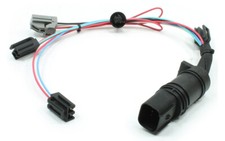
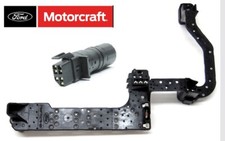
The internal electrical parts on this family changed twice, and nothing crosses over. According to ATSG's Wayne Colonna, Ford replaced the conventional internal harness on the AODE/4R70W in 1998 with a molded circuit board, the "hard wire frame," which also changed the pass-through case connector and every internal solenoid. Then for 2009, all 4R75E transmissions went back to a soft internal wire harness with a new set of solenoids, and none of the 2009 parts retrofit to earlier units.
Colonna lists the 2009-later Ford service numbers as:
- Internal wire harness: 9L3Z-7G276-A
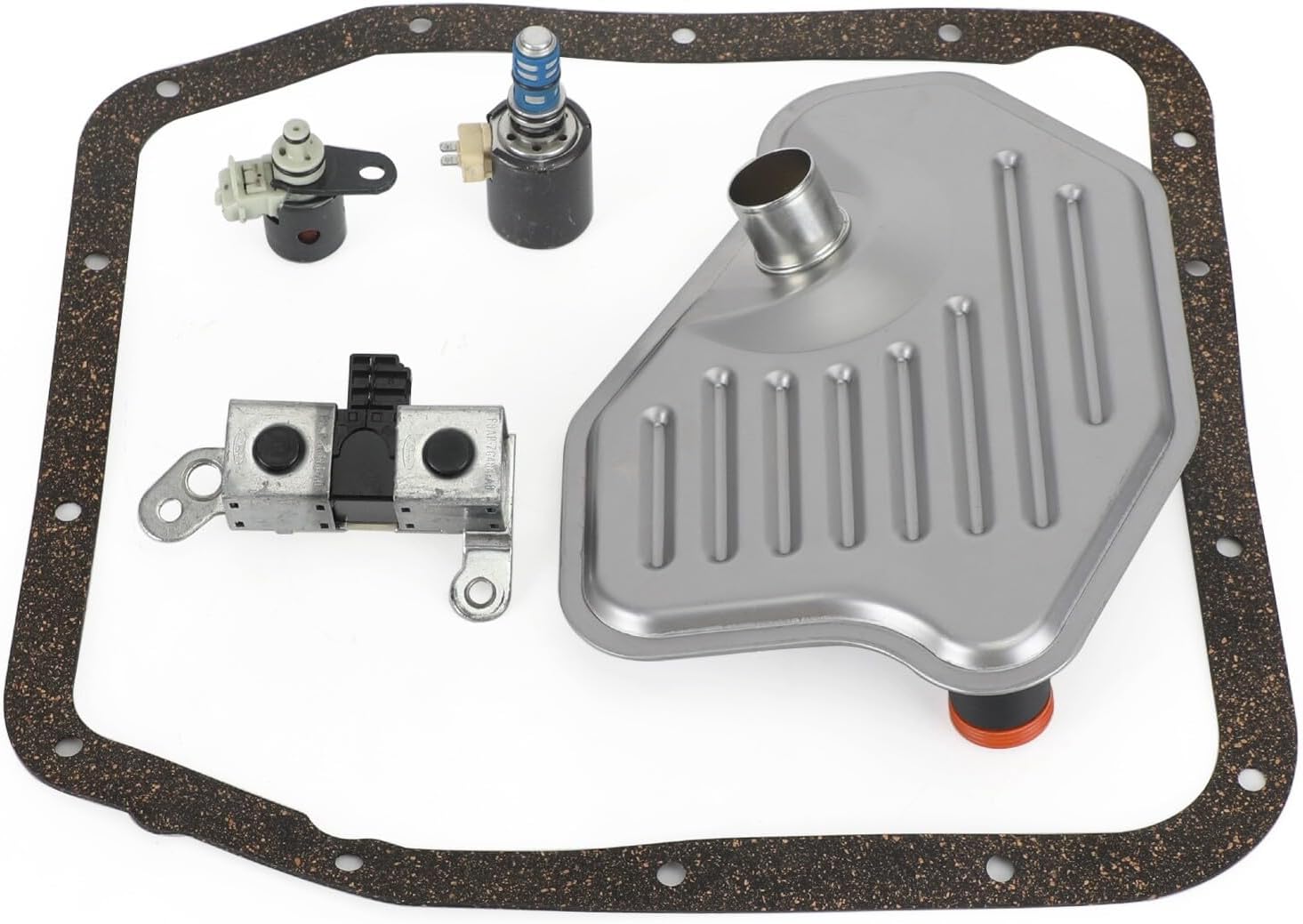
- Shift solenoid 1 and 2 assembly: 9L3Z-7G484-A
- TCC solenoid: 9L3Z-7G136-A
- EPC solenoid: 9L3Z-7G383-A
The practical result: SS1 and SS2 are one assembly on these units, so a P0750 that is truly the solenoid means replacing the pair. And a 2004-2008 F-150 or Crown Victoria takes the hard-wire frame parts, while a 2009-later unit takes the soft harness parts. Ordering the wrong generation is the most common parts mistake on this code.
The 2009 4R75E pinched harness bulletin
Ford issued a service bulletin for some 2009 F-150, E-150, Crown Victoria, Grand Marquis and Town Car vehicles with the 4R75E and a transmission build date before 12/1/2008. The complaint is improper gear selection, converter clutch operation or shift feel. P0750 heads the list of likely codes, along with P0753, P0755, P0758, P0740, P0743, P0748, P0962, P0963 and P0712.
Ford's cause is an intermittent electrical open or short, a blown fuse in the battery junction box (BJB), or both. The most likely cause is the internal harness routed wrong and pinched between the fluid pan and the main control. The procedure:
- Read the build date on the transmission tag. If it is on or after 12/1/2008, the bulletin does not apply and you go to normal diagnostics in workshop manual section 307-01.
- If it is before 12/1/2008, check BJB fuse F21 on the Crown Victoria, Grand Marquis and Town Car, or F79 on E-series and F-series.
- Drop the pan and inspect the internal harness routing. If the harness has been pinched, replace it rather than taping it.
If a 2009 unit comes in with several solenoid codes at once, check this first. A blown fuse plus a crushed harness can look like a failed PCM until you see the pan rail marks on the wiring.
Step-by-step diagnosis
1. Road test and scan data
Confirm the shift pattern against the table above. With a scan tool, compare commanded gear to actual ratio from turbine and output speed (only the 4R75E has a turbine speed sensor; on a 4R75W, use engine rpm and road speed). Watch the SS1 command state, and note fluid temperature when the code sets. A code that only returns hot is the fingerprint of a connection that opens with heat.
If your tool has an output state test, run it key on, engine off. Command SS1 on and off and listen at the pan for the click.
2. Use a meter, not a test light
GEARS Magazine's solenoid circuit testing column (Mike Brown, 2017) makes the point every builder learns eventually: do not put a test light on a computer-controlled circuit. Some test lights glow at as little as 8 volts, well under what a solenoid needs. Use a voltmeter and test the circuit in sections: supply, control side, then the solenoid itself. The same article sets the bar for PCM grounds: back-probed with the connector plugged in and the key on, a good ground reads below 0.10 volt.
3. Resistance and current
Sonnax's installation sheet for its remanufactured 4R70E/4R70W/4R75E/4R75W valve bodies (F095 for '01-'08, F098 for '09-later) gives these solenoid values:
| Solenoid | Resistance | '09-later soft harness wire |
|---|---|---|
| SS1 | 20-40 ohms | Red/White |
| SS2 | 20-40 ohms | Red/Black |
| EPC | 3-6 ohms | Red/Blue |
| TCC | 10-16 ohms | Red/Green |
Every 2009-later wire color starts with red. That red is the shared solenoid supply, which is why a single bad supply terminal takes out every solenoid at once.
Measure in this order:
- At the case connector, vehicle harness unplugged. This reading includes the internal harness or hard-wire frame. SS1 inside 20-40 ohms and not shorted to the case means the inside is probably fine electrically.
- Key on, vehicle side of the connector. Check for battery voltage on the solenoid supply. No voltage sends you to the fuse and the vehicle harness, not into the transmission.
- At the solenoid, pan off, only if the connector reading was out of range. Good at the solenoid but bad at the connector means the harness, the frame or the connector itself.
You can check current with Ohm's law. A 20-40 ohm coil on a 12.6-volt engine-off battery should pull roughly 0.32 to 0.63 amps. Far more than that points to a shorted coil, and far less with good supply voltage points to a resistive connection.
4. Pan off: what to look at
On 2004-2008 units, look at the hard-wire frame where it clips over the solenoids and at the case connector terminals. You are looking for terminals pushed back or spread, cracks in the molded frame, burn marks, and any clip that does not sit flush. Flex the frame gently with the meter connected; an open that comes and goes when you move it is your fault.
On 2009-later units, follow the soft harness from the case connector to each solenoid. Look for crush marks along the pan rail (the bulletin failure), insulation rubbed through on the valve body, and connectors that are not fully latched.
When it is not electrical: solenoid feed pressure
A clean P0750 is an electrical code, but a shift solenoid can only move a shift valve if it gets the right feed. Sonnax describes the solenoid regulator (solenoid modulator) valve as the valve that takes line pressure and regulates it down to a steady feed, typically 80-115 psi, for the solenoids that control shift valves, clutch apply, line pressure and the converter clutch. When its bore wears, feed goes too high and floods the solenoids, or too low so the shift valves never stroke fully. Sonnax lists erratic shifts, 2-3 neutral, neutral after fourth, no second, third and reverse only, and solenoid codes among the results.
In other words: if the circuit tests good, the solenoid clicks and the code keeps coming back with performance or ratio codes beside it, vacuum test the solenoid regulator bore. Sonnax offers the 76948-14K kit and the oversized 76948-47K for the 4R70W/4R75 family. A valve body with a worn regulator bore will chew through new solenoids and keep shifting wrong.
The fix, by what you found
- Blown BJB fuse and pinched harness on a pre-12/1/2008 2009 unit: replace the internal harness, route it correctly, replace the fuse, and clear codes.
- Open or out-of-range reading at the connector, good at the solenoid: internal harness or hard-wire frame, plus the case connector if the terminals are damaged.
- Out of range at the solenoid itself: replace the SS1/SS2 assembly for your generation. Change the filter and fluid at the same time.
- No supply voltage at the vehicle side: fuse, vehicle harness and connector. The transmission is not the problem.
- Circuit good, symptoms persist: vacuum test the valve body, starting with the solenoid regulator bore.
When you refill, use the fluid the owner guide calls for on that model year (the 4R75W fluid type and capacity guide covers the MERCON V to MERCON LV change). Clear codes and road test through all four gears with a scan tool on it, watching SS1 command against actual ratio.
FAQ
Can I drive with P0750 on a 4R75W?
Usually it will drive, but only in a limited way. With SS1 dead it starts in second and never reaches overdrive, which raises rpm on the highway and makes towing hard on the unit. Diagnose it soon, because a shorted circuit or stuck plunger can also hold first and slam into fourth.
Do I replace just shift solenoid 1 for a 4R75 P0750?
On the 4R75, SS1 and SS2 are a single assembly, so you replace the pair. Match the generation: 2004-2008 units use the hard-wire frame solenoids, and 2009-later units use the soft-harness solenoid assembly 9L3Z-7G484-A. None of the 2009 parts retrofit to earlier transmissions.
What should shift solenoid 1 measure on a 4R75W?
Sonnax's 4R70W/4R75 valve body instructions list SS1 and SS2 at 20-40 ohms, EPC at 3-6 ohms and TCC at 10-16 ohms. Measure at the case connector first so the reading includes the internal harness, then at the solenoid only if the connector reading is out of range.
Why do P0750 and P0755 set together?
SS1 and SS2 share a solenoid body and a supply circuit, so two codes at once points at what they share: the supply, fuse, case connector or internal harness. On some 2009 4R75E vehicles built before 12/1/2008, Ford's bulletin traces it to an internal harness pinched between the pan and the main control.
Working a 4R75 this week?
Internal harnesses, shift solenoid kits, valve bodies and rebuild parts — shipped fast from the USA.
Shop 4R75W parts →Sources
- Wayne Colonna, ATSG — "Ford 4R75E: Internal Wire Harness and Solenoids," Vehicle Service Pros, April 2014. Backs the 1998 change to the molded hard wire frame and new case connector and solenoids, the 2009 return to a soft harness with new solenoids, no retrofit to earlier models, and part numbers 9L3Z-7G276-A, 9L3Z-7G484-A, 9L3Z-7G136-A and 9L3Z-7G383-A. vehicleservicepros.com
- Ford Motor Company service bulletin for 2009 4R75E vehicles, as reprinted by Vehicle Service Pros ("Fouled Ford Transmission"). Backs the affected 2009 models with build date before 12/1/2008, the DTC list starting with P0750, the harness pinched between pan and main control, BJB fuses F21 and F79, and workshop manual section 307-01. vehicleservicepros.com
- GEARS Magazine (ATRA) — "Solenoid Application Charts," January/February 2006, p. 77-78 (PDF). Backs the 4R70W/AODE listed as a Type 3 two-solenoid pattern: 1st ON/OFF, 2nd OFF/OFF, 3rd OFF/ON, 4th ON/ON. atracom.blob.core.windows.net (PDF)
- Mike Brown, GEARS Magazine — "A Logical Approach to Solenoid Circuit Testing," 2017. Backs never using a test light on computer circuits (some light at 8 volts or less), testing the circuit in sections with a voltmeter, PCM grounds below 0.10 volt, and calculating solenoid current with I = V/R at 12.6 volts. gearsmagazine.com
- Sonnax — Remanufactured Valve Body F095 ('01-'08) / F098 ('09-later) installation instructions for 4R70E/4R70W/4R75E/4R75W (PDF). Backs the solenoid resistance values (SS1 and SS2 20-40 ohms, EPC 3-6 ohms, TCC 10-16 ohms) and the 2009-later soft harness wire colors. cdn.transend.us (Sonnax PDF)
- Sonnax — "Uncovering the Root Cause of Pressure Complaints: The Critical Role of Solenoid Modulator & AFL Valves." Backs the solenoid regulator valve function and 80-115 psi typical feed, high and low feed failure modes, the symptom list, and kits 76948-14K and 76948-47K for the 4R70W/4R75 family. sonnax.com