Most 4R70W P0750 trucks come in with the same complaint: it pulls away from a stop like it is already in second, it will shift into third, and it never goes into overdrive. Sometimes the owner adds that it was fine until somebody "did the transmission" or swapped a filter. Both of those details matter, and both point you at the electrical side of shift solenoid 1 before anything inside the case.
This guide covers what SS1 does in the 4R70W and 4R75W, why the symptoms come out the way they do, how to test the circuit from the PCM to the solenoid, the hard-wire frame and case connector traps, and when the real problem is solenoid pressure in the valve body. Sources are at the bottom and the biggest claims are cited as you go.
What P0750 means on a 4R70W
P0750 is the generic code for a fault in the shift solenoid A circuit. Ford calls that solenoid SS1. It is an electrical code: the PCM saw an open, a short, or a circuit state that did not match what it commanded. The related codes P0751 through P0754 cover performance and intermittent faults, and P0755 is the same fault on SS2. If P0750 and P0755 set together, stop thinking about solenoids and start thinking about whatever the two circuits share: the 12-volt supply, the case connector and the internal harness.
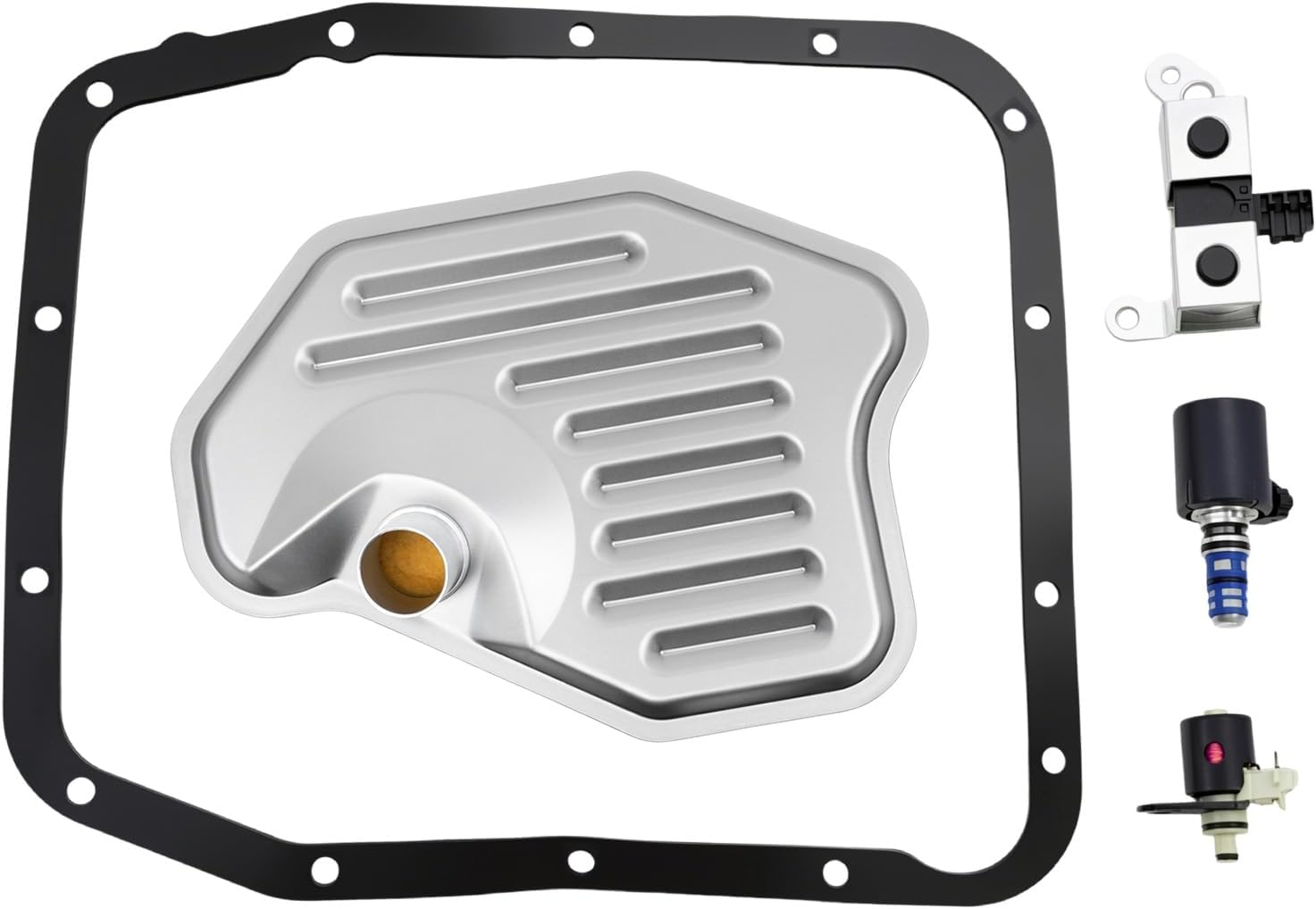
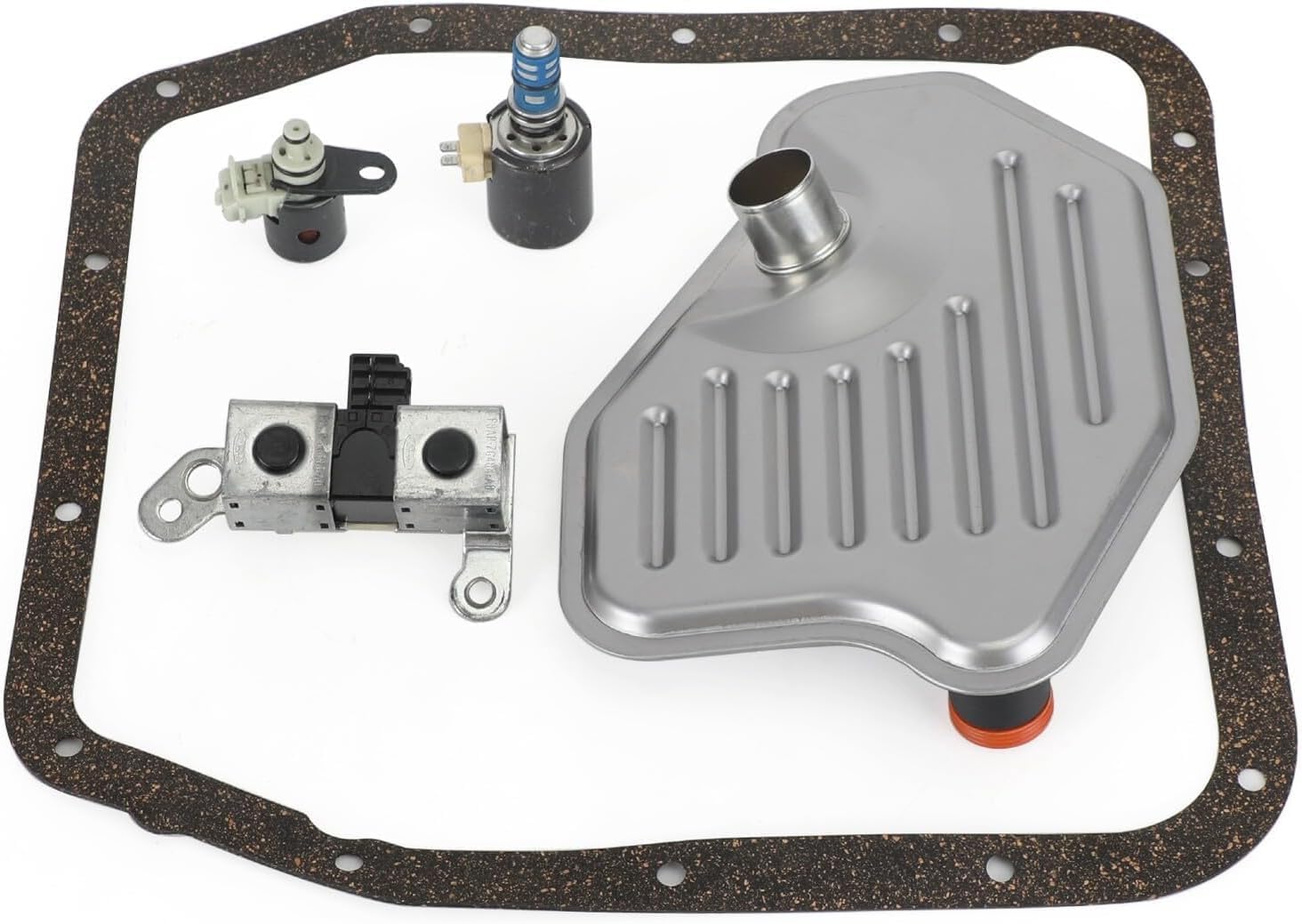
The 4R70W runs four solenoids off the valve body: SS1 and SS2 (the two share one dual-solenoid body; on 2009-later 4R75 units ATSG's Wayne Colonna lists it as Ford 9L3Z-7G484-A), the electronic pressure control (EPC) solenoid and the TCC solenoid. SS1 and SS2 are simple on/off solenoids. EPC and TCC are the variable ones.
What SS1 does, and why the symptoms make sense
The 4R70W is a two-shift-solenoid four-speed. GEARS Magazine's solenoid application charts list the 4R70W/AODE as a "Type 3" pattern:
| Gear | SS1 | SS2 | Apply components (Sonnax chart) |
|---|---|---|---|
| 1st | ON | OFF | Forward clutch |
| 2nd | OFF | OFF | Intermediate + forward clutch |
| 3rd | OFF | ON | Intermediate + forward + direct clutch |
| 4th | ON | ON | Overdrive band + intermediate + direct clutch |
Work the table with SS1 dead and the complaint writes itself. With SS1 unable to turn on, first (ON/OFF) becomes OFF/OFF, which is second. Second and third do not use SS1, so they still work. Fourth (ON/ON) becomes OFF/ON, which is third. That is the classic P0750 drive: second-gear starts, a normal 2-3 shift, no overdrive.
Now work it the other way. If SS1 is stuck on hydraulically, or its control side is shorted so the PCM cannot turn it off, second (OFF/OFF) becomes ON/OFF, which is first, and third (OFF/ON) becomes ON/ON, which is fourth. The truck holds first, then jumps to fourth when SS2 comes on. That pattern usually comes with P0750 too, and it is a good tell for a shorted circuit or a hung plunger rather than an open.
And if both solenoids go dead at once, OFF/OFF is second gear in the forward ranges. That is what you get when the shared 12-volt solenoid supply is lost, and it is why a "higher gear start" with both shift solenoid codes is a supply or connector problem until proven otherwise.
Common causes, in the order to check them
- The case connector and the hard-wire frame. From 1998 Ford replaced the conventional internal harness on all AODE/4R70W units with a molded "hard wire frame," a circuit board that also changed the pass-through case connector and the solenoids, according to ATSG's Wayne Colonna. Sonnax's valve body identification guide confirms the split: '96-'97 used a soft wire harness, '98-'08 used the molded lead frame, and '09-later went back to a soft wire harness. Colonna notes the hard frame has had "a number of electrical concerns" over the years, and none of the 2009 parts retrofit to earlier units.
- A bad aftermarket connector after a repair. Transmission Digest published a case where a 4R70W came out of an overhaul with a new hard wire frame and case connector, took off in a higher gear and set several solenoid codes that were not there before. The aftermarket case connector had two terminals pushed back so they never touched the frame, and one of them was the 12-volt solenoid supply. OE Ford parts fixed it: hard wire frame F8AZ-7G276-BA and connector F8AZ-7G276-A.
- The SS1/SS2 assembly itself. An open or shorted coil sets P0750 directly. A plunger hung on debris more often sets a ratio or performance code first.
- Vehicle harness and PCM. Chafed wiring between the case connector and the PCM, fluid wicked into the connector, or a PCM driver fault. The PCM is last on the list, not first.
- Solenoid supply pressure in the valve body. Not a P0750 cause by itself, but a worn solenoid regulator valve bore gives you shift symptoms that look exactly like a solenoid problem. More on that below.
Step 1: Confirm the drive pattern
Drive it and write down what it does. Second-gear start, good 2-3, no 4th points at SS1 off. First then straight to fourth points at SS1 on. Second-gear start with both P0750 and P0755 points at the supply or connector. Check fluid level and condition while you are at it; the 4R70W takes MERCON V, and burnt fluid with friction material in it means the solenoid code may not be your only problem.
Step 2: Scan data and an output test
With a scan tool on the PCM, look at commanded gear against actual ratio. If you can calculate ratio from turbine and output speed, a commanded first that shows a second-gear ratio confirms SS1 is not doing its job. Watch the SS1 command state as you drive, and note transmission fluid temperature when the code sets. A code that only returns when the unit is hot is the fingerprint of an intermittent connection that opens with heat.
If your tool has a solenoid output test, run it with the engine off. Command SS1 on and off and listen at the pan for the click. No click, with no change in the circuit state the PCM reports, keeps you on the electrical side.
Step 3: Test the circuit with a meter, not a test light
GEARS Magazine's solenoid circuit testing article makes the point every builder learns the hard way: never use a test light on a computer-controlled circuit. A test light can glow at about 8 volts, well below what a solenoid needs to work. Use a voltmeter and test one piece of the circuit at a time: power, then the control side, then the solenoid.
The Sonnax install sheet for its F095 ('01-'08) and F098 ('09-later) remanufactured 4R70W valve bodies lists these resistance values:
| Solenoid | Resistance | F098 soft-harness wire color |
|---|---|---|
| SS1 | 20-40 ohms | Red/White |
| SS2 | 20-40 ohms | Red/Black |
| EPC | 3-6 ohms | Red/Blue |
| TCC | 10-16 ohms | Red/Green |
The wire colors apply to the 2009-later soft harness only. Notice they all start with red: that is the shared supply, which is why one bad supply terminal takes out every solenoid at once.
Measure in this order:
- At the transmission case connector, vehicle harness unplugged. That reading includes the internal harness or hard-wire frame. SS1 in the 20-40 ohm range and not shorted to the case means the inside of the transmission is probably fine electrically.
- Key on, at the vehicle side of the connector, check for battery voltage on the solenoid supply. No voltage there sends you to the vehicle harness and fuse, not the transmission.
- At the solenoid, with the pan off, if the case connector reading was out of range. Good at the solenoid but bad at the connector means the hard-wire frame or the case connector.
You can also check current. Using the GEARS method of V divided by R, a 20-40 ohm solenoid on a 12.6-volt engine-off battery should draw roughly 0.32 to 0.63 amps. A reading far outside that, with good supply voltage, is a solenoid or a resistive connection.
Before you condemn the PCM, back-probe its power and ground pins with the connector plugged in and the key on. GEARS puts good grounds below 0.10 volt. If those are good and a known-good solenoid wired into the circuit still sets the code, then you can look at the PCM.
Step 4: Pan off, valve body and hard-wire frame
On 1998-2008 units, look closely at the hard-wire frame where it clips over the solenoids and at the case connector terminals. You are looking for terminals that are pushed back, spread or burned, cracks in the molded frame, and any connection that does not sit flush. Flex the frame gently while watching your meter; an open that comes and goes when you move it is your answer.
If the valve body comes off, Sonnax's install sheet calls for 100 in-lb on the valve body to case bolts, rechecked after a 10 to 15 minute set. Over-torquing the valve body distorts it and causes its own shift problems, so use an inch-pound wrench.
When the circuit tests good and it still shifts wrong
The shift solenoids exhaust a supply of oil that comes from the solenoid regulator valve. Sonnax explains that this valve limits pressure to the solenoids so they are not overloaded beyond what they can exhaust. A stuck valve raises solenoid pressure and can cause wrong gear starts; bore wear lowers solenoid pressure, and that is the more common failure. Sonnax's 76948-14K solenoid regulator valve kit lists erratic shifts, loss of forward under hard acceleration from a stop, 2-3 neutral, neutral after 4th, no 2nd, and 3rd and reverse only as symptoms. The kit uses the 76948-BST2 bore sizing tool, and Sonnax ties the repair to a failed vacuum test at the specified ports.
So if you replaced the SS1/SS2 assembly, the circuit is in spec, and you still have odd gear starts or no-shift complaints without a fresh P0750, vacuum test the valve body before you buy another solenoid.
Refill and road test
Refill with MERCON V to the correct level. Sonnax's road test procedure for its 4R70W valve bodies is a good standard to follow after any solenoid or harness repair: warm the fluid to about 185 degrees F, then run 10 to 15 upshift and downshift cycles through all four gears. Clear codes first, and drive it long enough to get fully hot, because a heat-related open will not show up on a five-minute lap.
Preventing a repeat P0750
- Use OE-quality connectors and frames. The Transmission Digest case is the whole argument: a cheap case connector created the exact fault it was supposed to fix.
- Match the harness to the year. '98-'08 hard-wire frame parts and '09-later soft harness parts do not interchange.
- Change fluid and filter on schedule. Debris is what hangs solenoid plungers and wears the solenoid regulator bore.
- Keep it cool. Heat is what opens marginal connections and hardens seals around the solenoids.
Shop the part for this fix
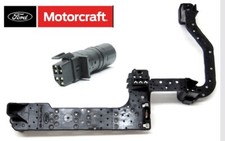
If the fault traced to the hard-wire frame or case connector on a 1998-2008 unit, this internal hard wire harness is the OE Ford F8AZ-7G276-BA part number called out in the Transmission Digest case. Sold by our sister store, CoreTransmissionParts.
Shop the 4R70W hard wire harness →Need solenoids or something else for the job? See the full 4R70W parts collection.
Need parts for this job?
Our 4R70W parts page carries internal wiring harnesses for each harness generation, shift solenoid kits with filters, EPC and TCC solenoids, and complete valve bodies. Checkout is on site.
FAQ
What does P0750 mean on a Ford 4R70W?
P0750 means the PCM saw an electrical fault in the shift solenoid A circuit, which Ford calls shift solenoid 1 (SS1). It is set by an open, a short or a circuit state that does not match the command. It does not by itself mean a clutch or band is slipping.
Why does my 4R70W start in second and not shift into overdrive?
Per the GEARS solenoid chart, the 4R70W needs SS1 on for first and fourth. If SS1 cannot turn on, first becomes second and fourth becomes third, while second and third still work. That gives you a second-gear start, a normal 2-3 shift and no overdrive.
What should 4R70W shift solenoid resistance be?
Sonnax's install sheet for its 4R70W remanufactured valve bodies lists SS1 and SS2 at 20 to 40 ohms, EPC at 3 to 6 ohms and TCC at 10 to 16 ohms. Measure at the case connector first so the reading includes the internal harness, then at the solenoid if it is out of range.
Can a bad internal harness cause P0750 on a 4R70W?
Yes, and on 1998-2008 units it is one of the first things to check. Those years use a molded hard-wire frame and a matching case connector. Transmission Digest documented a case where an aftermarket case connector with pushed-back terminals cut off the 12-volt solenoid supply, set solenoid codes and caused a higher-gear start until OE Ford parts were installed.
Do P0750 and P0755 together mean both solenoids failed?
Rarely. SS1 and SS2 share a 12-volt supply and the same connector and internal harness, so a fault in any of those can set both codes at once. Check supply voltage and the connector before replacing the solenoid assembly.
Related guides
- 4R70W Shift Solenoid Symptoms
- 4R70W Won't Shift Into Overdrive
- 4R70W P0730: Incorrect Gear Ratio Causes & Fix
- 4R70W Pressure Control Solenoid Symptoms
- 4R70W Valve Body Problems and Testing
Sources
- GEARS Magazine (ATRA), "Solenoid Application Charts," January/February 2006, pp. 77-78. Backs the 4R70W/AODE listing as a Type 3 two-solenoid pattern and the SS1/SS2 on-off states for each gear. atracom.blob.core.windows.net (PDF)
- Sonnax, "4R70E, 4R70W, 4R75E, 4R75W Remanufactured Valve Body F095/F098 Tech & Install Tips." Backs the SS1/SS2 20-40 ohm, EPC 3-6 ohm and TCC 10-16 ohm values, the F098 wire colors, the 100 in-lb valve body bolt torque with recheck, the 185 degree F road test with 10-15 shift cycles, and the clutch and band application chart. cdn.transend.us (PDF)
- Sonnax, "AODE, 4R70W/75W Valve Body Identification." Backs the '96-'97 soft wire harness, '98-'08 molded lead frame and '09-later soft wire harness split. sonnax.com
- Wayne Colonna (ATSG), "Ford 4R75E: Internal wire harness and solenoids," Vehicle Service Pros. Backs the 1998 change to the hard wire frame on AODE/4R70W, its electrical concerns, the 2009 return to a soft harness, the non-retrofit warning, and part numbers 9L3Z-7G276-A and 9L3Z-7G484-A. vehicleservicepros.com
- Wayne Colonna, "Ford 4R70W solenoid codes set," Transmission Digest, January 23, 2023 (archived copy). Backs the aftermarket case connector with pushed-back terminals, the lost 12-volt solenoid supply and higher-gear start, and OE parts F8AZ-7G276-BA and F8AZ-7G276-A. transmissiondigest.com (archive.org)
- Sonnax, Solenoid Regulator Valve Kit 76948-14K. Backs the solenoid regulator valve's role, the wrong-gear-start and low-solenoid-pressure failure modes, the listed symptoms and the 76948-BST2 tool. sonnax.com
Circuit testing method (voltmeter instead of test light, V/R current check, PCM ground below 0.10 volt): GEARS Magazine, "A Logical Approach to Solenoid Circuit Testing." gearsmagazine.com