The 4T60-E and 4T65-E look like the same transaxle on the lift. Same chain-drive layout off the side of the engine, same four forward gears, and the same pan filter fits both. Our own 58837 filter kit is stamped for both units. That's why people swap them, misdiagnose them and order the wrong parts for them. They are close relatives, but the 4T65-E changed the parts that control the transaxle and the way it reports problems, and those changes decide how you diagnose it.
GM's SAE paper on the 4T65-E (980821) calls it "the third evolution of GM's original 4-speed F.W.D. automatic." It debuted for the 1997 model year. The 4T60-E didn't disappear that year, though. GM's own OBD diagnostic tables still list the 4T60-E behind the 3.8L (L36) in the 1997 W-car and behind the 3.1L (L82) in the 1998 W-car. So on a 1997-98 GM front-driver you have to look at the unit itself, not just the model year. Below is what actually changed, what carries over, and how each one shows a problem on the scan tool and on the bench.

The Short Version
| 4T60-E | 4T65-E | |
|---|---|---|
| Line pressure control | Vacuum modulator with modulated-line boost valves (Sonnax 4T60-E layout) | PCM-driven pressure control solenoid ("force motor"), DTC P0748 |
| Input/turbine speed sensor | None in GM's 1997-98 OBD tables | Yes. ISS DTCs P0716/P0717 |
| Slip detection | TCC slip only (P1870) | Gear ratio from ISS vs output speed (P0730), plus P1811 long-shift adapt |
| TCC monitoring | TCC enable solenoid (P0740) plus TCC PWM solenoid (P1860); stuck-on read from slip | TCC PWM (P1860) plus TCC release switch (P1887); stuck-on read from the switch |
| Torque converter | Earlier design | Larger diameter, lower internal leakage, controlled-slip clutch (SAE 980821) |
| Pump and chain | Earlier design | Revised pump, new phased drive chain with powdered-metal sprockets (SAE 980821) |
| Fluid | DEXRON-III era | DEXRON-III early, DEXRON-VI later; GM lists 7.4 qt (7.0 L) total in the 2008 Impala |
Line Pressure: Vacuum Modulator vs Force Motor
This is the change everything else follows from. The 4T60-E is electronic for shift timing and converter clutch, but line pressure still comes from engine vacuum. Sonnax's 4T60/4T60-E valve body layout still lists the modulated-line boost valve kit (84754-17K) and the reverse and modulated-line boost valve kit (84754-25K), for "low line rise, soft shifts, 2nd clutch distress, 3rd clutch distress." GM's 1997 and 1998 4T60-E OBD tables have no force motor code at all. The transmission codes stop at the shift solenoids, the TCC solenoids, the speed sensor and the temperature sensor.
The 4T65-E moved line pressure under PCM control. GM's 2004 4T65-E diagnostic table lists P0748 for the force motor circuit and spells out a retest strategy. When a circuit fault is detected, the PCM shuts the force motor off, waits 2 seconds, turns it back on at 0.1 amp, and does that up to five times before it leaves it off for the rest of the key cycle. With the force motor shut off, the PCM is no longer metering line pressure, which is why a P0748 car usually comes in complaining of harsh shifts rather than slips. The pressure circuit also gained valves the 4T60-E never had. Sonnax's 4T65-E vacuum test guide adds an actuator feed limit (AFL) valve that feeds the solenoids, and a torque signal regulator valve (Sonnax 84754-44, '97-later only) linked to erratic line pressure, code 1811, P0741/P0742 and shudder.
What that means on the bench: on a 4T60-E with soft shifts and low line rise, check the vacuum supply and modulator before you condemn the valve body. On a 4T65-E with the same complaint, look at the force motor, the AFL and pressure regulator bores, and the boost valve (Sonnax 84754-30K). The pressure regulator bore wears on both. Sonnax lists the same oversized PR valve kit, 84754-46K, for the 4T60, 4T60-E and 4T65-E, for erratic line pressure, burnt clutches and overheating.
The Sensor That Changed Diagnosis
Wayne Colonna put it plainly in Transmission Digest: unlike the 4T65-E, the 4T60-E "does not have a computer strategy that will snitch on the transmission if it slips." The 4T65-E has a turbine speed sensor, so the PCM can compare input speed against output speed and calculate the actual gear ratio. GM's 2004 table shows how tight that check is. During the 1-2 shift solenoid performance test, first gear has to read 2.87-2.97:1. The TCC stuck-off check accepts 0.95-1.05 in third and 0.7-0.8 in fourth.
On a 4T60-E, the only slip the PCM watches is at the converter. GM's 1997 table defines P1870 "Transmission Component Slipping" as TCC slip between 200 and 1,500 rpm with the TCC at maximum apply, in D4 between 35 and 75 mph. The counter has to reach 3 before the code sets. A burned second clutch on a 4T60-E won't set a ratio code at all. The driver feels it first.
Colonna's article also explains why rebuilt 4T65-E units come back three to six months later with P0730 or P1811. The PCM's adaptive strategy tries to fix a shift that takes longer than 0.65 second by raising line pressure. If it fails twice in one drive cycle, P1811 sets. If the shift completes but the PCM sees slip in any gear for more than six seconds, P0730 sets. GM doesn't publish second and third clutch clearances, and both units tend to build loose. The rule of thumb in the article is 0.008-0.012 inch per friction plate. A loose pack that a 4T60-E would hide is exactly what a 4T65-E reports.
Scan tool data that actually helps on a 4T65-E
- 1-2, 2-3, 3-4 shift error: desired minus actual shift time in seconds. A negative number means a long shift.
- Shift time: the last shift, in seconds. Compare it to the 0.65-second P1811 threshold.
- TAP cells: the adaptive pressure the PCM added to make each shift on time. Large numbers mean it's fighting a slow apply.
- Steady-state TAP (kPa): the pressure added to stop slip while in a gear. Per TD, second clutch slip shows up in second, third and fourth gear, while third clutch slip shows only in third.
Converter Clutch Control
Both units run a PWM converter clutch. They confirm it differently. GM's 1997-98 4T60-E tables list a TCC enable solenoid (P0740) and a separate TCC PWM solenoid (P1860, which flags duty cycle below 10% or above 90%). The PCM decides the clutch is stuck on (P0742) by watching for -20 to 50 rpm slip when it has commanded the TCC off. The 2004 4T65-E uses a TCC release switch instead. P0742 sets when the switch reads applied while the TCC is commanded off. P1887 sets when the switch reads released while the TCC is commanded on and slip is low. P0741 (stuck off) is slip of 180 rpm or more for 7 seconds, twice.
Hydraulically the TCC circuits are also different. Sonnax's 4T60-E layout lists a TCC regulator and isolator valve kit (84754-01K) for '93-later 4T60-E. The 4T65-E guide adds the torque signal regulator, the TCC regulator apply valve and the TCC apply valve, each linked to P0741 and shudder. The parts aren't interchangeable, so make sure the valve kit you buy names the correct unit.
What Carries Over (and What Wears on Both)
Plenty of hard-part problems are common to both, and they're the same repairs:
- Forward band and servo bore wear. Sonnax's extended forward band servo pin (84571-01K) fits both units. It adds about .200 inch to a roughly .400 inch stroke and comes with two sealing rings for a worn case bore.
- 1-2/2-3 accumulator piston pin wear. A Sonnax TASC Force tip in Transmission Digest covers the 4T60-E accumulator housing. Pin bore wear leaks line pressure into lower-pressure accumulator circuits and causes slips, bumps and clutch failure. The fix is a .014 inch oversized pin, or a drilled housing with a cup plug when the pocket is too far gone.
- Differential lube. Another TD TASC Force tip traces blown 4T60-E differential and parking gear bearings to a starved lube tube. Check cooler flow, the cooler fitting check ball and the lube tube. On GM service replacement units, look for cleaning media lodged in the tube. Air will pass where oil won't, so run a pipe cleaner through it.
- Pressure regulator bore wear, as covered above.
What Does Not Swap Straight Across
Valve bodies, channel plates and solenoids are unit-specific. Sonnax's 2-3 shift valve (84754-36K) and 3-2 manual downshift valve (84754-37K) fit the 4T60-E from '94 on, and also the GM 4T65-E. They don't fit Geartronic or TAPshift 4T65-E units. The 4T65-E channel plate alone comes in five castings in the Sonnax identification chart (24211900, 24224086/24229721, 24224896, 24213496, 24224897/24229720). Sonnax warns not to install a plate with a converter drain-back ball on a unit that never used one, because it can restrict lube and cause a failure. The pressure control solenoid also changed within the 4T65-E run. Sonnax lists separate AC Delco-replacement solenoids for '97-'02 (84431G) and '03-later (84431H).
Swapping a complete 4T65-E into a car built with a 4T60-E isn't just a bolt-in. The 4T60-E car's PCM was never set up to monitor a force motor or an input speed sensor, judging by GM's code tables, and the harness has to match. Treat it as a calibration and wiring job, not a weekend swap. Final drive matters too. TD notes that P0730 right after an install usually means the wrong ratio, from either a mismatched exchange unit or incorrect sprockets or final drive in the rebuild.
Fluid and Service
Both units came out of the DEXRON-III era. GM's Service Insights says DEXRON-VI replaces DEXRON-III(H) and DEXRON-II(E), so DEXRON-VI is the right fill for either one today. For a 4T65-E, GM's 2008 Impala owner manual lists 7.4 qt (7.0 L) total capacity and notes that more fluid may be needed when draining or replacing the converter. A pan drop takes far less than that. Both units use the same pan filter and gasket. Check the level hot, and on a 4T60-E check the modulator vacuum line before you blame the fluid for a soft shift.
Which One Do You Have, and Which Is Better?
Read the tag, then look at the evidence. If there's a vacuum line to a modulator on the case and no input speed sensor connector, it's a 4T60-E. On a 1997-98 W-car, GM's own OBD tables show both units were in use, so don't go by the model year alone.
For a daily driver, the 4T65-E is the better transaxle. GM rebuilt the converter, pump and chain for lower noise and better cooling, and the PCM controls line pressure and adapts it. The tradeoff is that it reports every loose clutch pack and worn PR bore with a code. The 4T60-E is simpler and can be forgiving, but that's partly because it can't see its own slip. A rebuilt 4T60-E needs correct clutch clearances just as much. It just won't set a code to tell you they're wrong.
Need parts for this job?
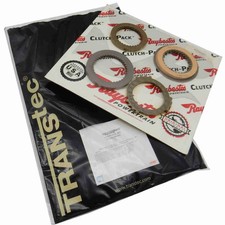
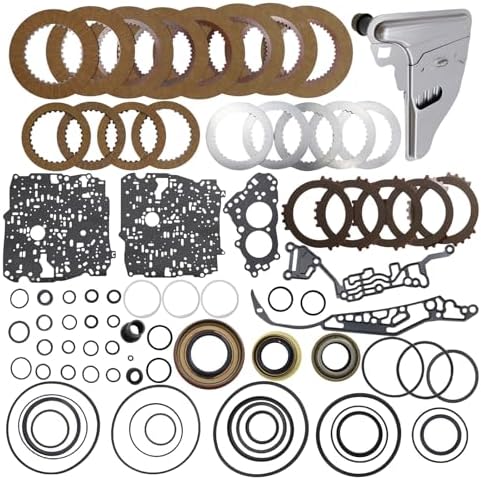
We stock 4T65-E master kits, valve bodies, pressure control solenoids and pumps, plus 4T60-E rebuild kits and the 4T60-E/4T65-E filter and pan gasket kit.
Shop 4T65E parts →Get the 4T65E master rebuild kit → All rebuild kits
FAQ
Will a 4T65E bolt in place of a 4T60E?
Physically they share the same layout, but it is not a plug-and-play swap. GM's OBD tables show the 4T60-E has no force motor or input speed sensor monitors, while the 4T65-E relies on both, so the PCM calibration and harness have to match the transaxle. A wrong final drive or sprocket set will also set P0730 right after install.
Does the 4T60E have a pressure control solenoid?
No. The 4T60-E sets line pressure with a vacuum modulator and modulated-line boost valves, and GM's 1997-98 4T60-E diagnostic tables list no force motor code. The 4T65-E added a PCM-controlled force motor, monitored as DTC P0748.
Why does a rebuilt 4T65E set P0730 or P1811 when a 4T60E never did?
The 4T65-E has a turbine speed sensor, so the PCM can calculate gear ratio and catch slip. P1811 sets when shifts take longer than 0.65 second twice in a drive cycle, and P0730 sets on slip lasting more than six seconds. Loose second and third clutch packs that a 4T60-E would hide get reported; Transmission Digest suggests 0.008-0.012 inch clearance per friction plate.
Do the 4T60E and 4T65E use the same fluid and filter?
Both came from the DEXRON-III era, and GM says DEXRON-VI replaces DEXRON-III, so DEXRON-VI is correct for either today. They share the same pan filter and gasket. GM lists 7.4 qt (7.0 L) total for the 4T65-E in the 2008 Impala, with more needed if the converter is drained.
Sources
- SAE International, Paper 980821 — "General Motors 4T65-E Electronic Four-Speed Automatic Transaxle." Backs the 4T65-E as the third evolution of GM's original four-speed FWD automatic, its 1997 model-year debut, the larger-diameter low-leakage converter with controlled-slip clutch, and the revised pump and phased drive chain with powdered-metal sprockets. saemobilus.sae.org
- General Motors — 1997 3.8L (L36) W-car and 1998 3.1L (L82) W-car 4T60-E Transmission Diagnostic Parameters. Backs the 4T60-E code set (P0502/P0503, P0711, P0740, P0742, P0751/P0753, P0756/P0758, P1860, P1870) with no force motor or input speed codes, the P1870 200-1,500 rpm TCC slip criteria, P1860 duty-cycle limits and the P0742 slip window. 1997 (pdf) · 1998 (pdf)
- General Motors — 2004 4T65-E Transmission Diagnostic Parameters. Backs ISS codes P0716/P0717, the P0748 force motor retest strategy, P0741 (180 rpm for 7 s), P0742 and P1887 via the TCC release switch, and the gear-ratio windows (2.87-2.97 first, 0.95-1.05 third, 0.7-0.8 fourth). gsi.ext.gm.com (pdf)
- Transmission Digest, Wayne Colonna — "The 4T65-E: 'Slip-Sliding Away.'" Backs the turbine speed sensor difference, the 4T60-E's inability to flag slip, the P1811 0.65-second rule and P0730 six-second slip logic, the PCS adjustment note, the shift error/shift time/TAP cell PIDs, unpublished clutch clearances and 0.008-0.012 in. per friction, and wrong-ratio P0730 after install. transmissiondigest.com
- Sonnax — GM 4T60, 4T60-E Valve Body Layout. Backs the modulated-line boost valve kits (84754-17K, 84754-25K), TCC regulator and isolator kit 84754-01K ('93-later 4T60-E), 2-3 shift and 3-2 manual downshift valves ('94-later 4T60-E) and PR valve kit 84754-46K. sonnax (pdf)
- Sonnax — GM 4T65-E Vacuum Test Guide. Backs the AFL valve, torque signal regulator valve 84754-44 ('97-later), boost valve 84754-30K, TCC valve symptoms and the Geartronic/TAPshift exclusion for 84754-36K/37K. sonnax.com
- Sonnax — "Stop 4T60-E & 4T65-E Case Wear, Band Slippage & Breakage with a Longer Servo Pin." Backs 84571-01K fitting both units (+.200 in. on a ~.400 in. stroke), oversized PR valve kit 84754-46K fitting 4T60/4T60-E/4T65-E, and the '97-'02 vs '03-later 4T65-E EPC solenoids 84431G/84431H. sonnax.com
- Sonnax — "4T65-E Channel Plate Identification." Backs the five channel plate castings and the drain-back ball warning. sonnax.com
- Transmission Digest, Gregg Nader (Sonnax TASC Force) — "Easy Fix for 4T60-E Accumulator Housing Pin Wear." Backs the 1-2/2-3 accumulator pin bore leak, .014 in. oversized pins and the cup-plug housing repair. transmissiondigest.com
- Transmission Digest, Gary Carne (Sonnax TASC Force) — "Good Vibrations: 4T60-E Differential Problems." Backs the differential and parking gear bearing lube failures and the cleaning media found in service replacement lube tubes. transmissiondigest.com
- General Motors — 2008 Chevrolet Impala Owner Manual, and GM Service Insights "Use the Right Transmission Fluid." Backs DEXRON-VI, the 7.4 qt (7.0 L) 4T65-E capacity with the converter footnote, and DEXRON-VI replacing DEXRON-III(H)/II(E). Owner manual (pdf) · gmserviceinsights.com