The 4T65E is the transaxle GM built into nearly every mainstream front-wheel-drive car and minivan it sold from the late 1990s through the 2000s — Impala, Grand Prix, Monte Carlo, Century, Venture, Uplander and more. It replaced the 4T60-E for the 1997 model year as what SAE's own engineering paper on the unit calls the third evolution of GM's original four-speed FWD automatic, built to cut noise and improve fuel economy while letting shift feel be tuned differently from one GM brand to the next.
This page collects the ratios, RPO codes, clutch counts and fluid numbers a builder or rebuilder actually reaches for, with every figure tied to a source at the bottom. Where a spec varies by model year or application — and on a transaxle this widely used, several do — we say so instead of handing you one number that is only right half the time.
Gear Ratios
The 4T65E runs the same internal ratios across its entire production life: 2.921:1 first, 1.568:1 second, 1.000:1 third (direct drive) and 0.705:1 fourth (overdrive), with reverse at 2.385:1. Those four forward ratios do not change from one model year to the next or between the standard and heavy-duty builds — what changes is the final-drive ratio bolted onto the output and the sprocket pairing that sets it, not the transmission's own planetary gearset.
What the steps mean on the road
Divide the next gear by the current one to see how far the engine falls at each upshift:
- 1-2 shift: 1.568 / 2.921 = 0.537. Shift at 6,000 rpm and the engine drops to about 3,220 rpm.
- 2-3 shift: 1.000 / 1.568 = 0.638. Shift at 6,000 rpm and you land near 3,830 rpm.
- 3-4 shift: 0.705 / 1.000 = 0.705. Shift at 6,000 rpm and overdrive settles in around 4,230 rpm.
That fairly even spacing is typical of a transaxle tuned for a wide range of four- and six-cylinder FWD applications rather than one engine's power band, which is part of why the 4T65E shows up behind everything from a 2.2L Cavalier-class four to a supercharged 3800 V6.
RPO Codes and Converter Sizes
GM split the 4T65E family with three RPO codes that still matter at the parts counter. M15 is the standard-duty version built around a 245 mm torque converter and is the version most commonly found across the lineup. MN3 uses a larger 258 mm converter and shows up mainly behind the supercharged 3800 in cars like the Buick Regal, Park Avenue and Oldsmobile Intrigue. MN7 is the heavy-duty "4T65E-HD," also built on the 258 mm converter, used behind higher-output applications including the supercharged 3800 and the FWD LS4 V8 in cars like the Pontiac Grand Prix GXP and Chevrolet Impala SS.
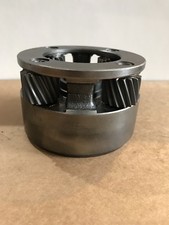
The HD unit shares its case and most of its internals with the standard 4T65E; the real difference sits in the final-drive hardware, where different sprocket and differential combinations are used to handle the extra torque. SAE's paper on the transaxle confirms the core engineering behind this split: a larger, lower-leakage torque converter with a controlled-slip clutch was built into the 1997 redesign specifically to improve cooling and fuel economy at higher engine power levels, which is exactly the load case the 258 mm MN3/MN7 converters were sized for.
Tiptronic vs. Non-Tiptronic Valve Bodies
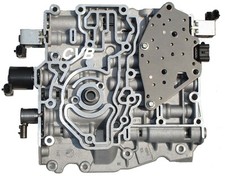
One detail that catches a lot of rebuilders off guard: some 4T65E units, mostly in Volvo and Pontiac Grand Prix applications with a floor shifter, run a "Tiptronic" valve body that is not interchangeable with the standard unit. Transmission Digest's Carlos Costa laid out the difference in a 2009 technical article. In the Tiptronic version, moving the shifter out of D and into the Tiptronic gate still leaves the manual valve sitting in the D3 position mechanically, but a reworked valve body casting, 2-3 shift valve, 3-2 downshift valve, channel plate and separator plate let the driver hold or tip through first and second with engine braking, and third and fourth on demand, while the dash displays the TCM-commanded gear.
The part that trips people up is the separator plate: a Tiptronic valve body and channel plate will run as a non-Tiptronic unit if a one-notch plate is installed, but you cannot take a Tiptronic valve body, channel plate or notched separator plate and drop it into a standard case expecting it to bolt up and function — per Costa, no parts interchange between the two builds. If a Tiptronic-equipped car comes in with shift complaints after a rebuild, checking that the correct notched separator plate went back in is worth doing before chasing anything electrical.
Known Weak Points
Two wear patterns show up often enough on high-mileage 4T65E and 4T60-E units that Sonnax has built specific fixes for them. The first is forward band wear, shudder and eventual breakage. Per Sonnax's technical write-up, the root cause is usually twofold: an EPC solenoid that hangs up when hot, creating an intermittent no-pressure-rise condition where the band slips before the pressure spikes and slams it on "almost like a Neutral drop," combined with case bore wear that lets the standard 0.400-inch forward band servo pin travel further than it should before the band applies. Sonnax's extended-length servo pin kit, part 84571-01K, is roughly 0.200 inch longer than stock, cutting servo stroke by about half and adding dual sealing rings to compensate for the worn bore — but it is meant to be installed alongside a fresh EPC solenoid and a pressure check, not as a standalone fix.
The second is 1-2 and Reverse servo boost valve bore wear. Sonnax describes the cause as continuous reciprocation of those two boost valves wearing their bores in the valve body over time, which drops apply pressure and shows up as 1-2 flare, delayed engagement, low Reverse pressure and a burned 1-2 band. The fix is Sonnax's oversized 1-2 and Reverse servo boost valve kit, part 84754-40K, machined from hardcoat-anodized aluminum with more than double the valve-to-bore contact area of the original. Each kit covers one bore, so a transmission with both bores worn needs two kits.
Clutch Pack Specs
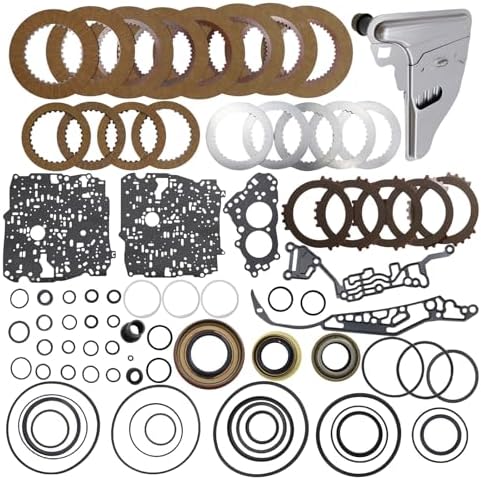
Raybestos Powertrain's OE-replacement friction clutch pack modules show exactly what changed in the 4T65E's clutch count partway through its production run. The 1997-2002 pack, RCP96-084, contains 6 second-clutch High Energy plates, 2 fourth-clutch High Energy "thin" plates, 4 input-clutch Tan plates and 7 third-clutch plates split 2 single-sided OD-spline and 5 ID-spline — 19 friction plates total. The 2003-and-up pack, RCP96-173, carries the same 6 second, 2 fourth and 4 input-tan counts but steps the third clutch up to 10 plates, split 5 external-tooth and 5 internal-tooth High Energy — 22 friction plates total, three more than the earlier design, all added at the third clutch. That matches the valve-body and internal updates GM made to the unit for the 2003 model year, and it is worth checking which generation of third clutch is in a given case before ordering a friction pack, since the two are not interchangeable.
Fluid Spec and Capacity
GM originally specified DEXRON-III automatic transmission fluid for the 4T65E. Dexron VI, GM's current-generation fluid, is backward-compatible and is the correct fill for a modern top-off or full service on these units; there is no need to hunt down discontinued DEXRON-III stock. Capacity depends on how much of the unit you actually drain. A pan-and-filter service — the fluid you can get to without pulling the unit — runs around 7.4 quarts on most applications. A full overhaul that empties the torque converter and internal cooler circuit along with the pan typically takes closer to 10 quarts total. As with any transaxle, finish the job by checking the level on the dipstick or per the fill-plug procedure with the engine running and fully warmed up, since a cold or static check on this family reads high.
Identifying What You Have Before You Order Parts
Because the 4T65E ran for over a decade across dozens of models, "it's a 4T65E" is not enough information to order a valve body, clutch pack or converter with any confidence. Pull the RPO code off the service parts sticker (usually inside the glove box or on the driver-door jamb) to confirm M15, MN3 or MN7, and note the model year on either side of the 2003 cutoff before buying a friction pack, since the 19-plate and 22-plate third-clutch counts are not interchangeable. If the car has a floor shifter with a manual/Tiptronic gate, check the separator plate before assuming the valve body is a standard unit — a notched plate in a non-Tiptronic case, or vice versa, is a common source of shift complaints after a rebuild that otherwise went together correctly.
4T65E Quick Spec Table
- Type: 4-speed electronic FWD transaxle, phased drive chain, controlled-slip torque converter clutch
- Introduced: 1997 model year, replacing the 4T60-E
- Ratios: 2.921 / 1.568 / 1.000 / 0.705, reverse 2.385
- RPO codes: M15 (245 mm converter, standard), MN3 (258 mm converter), MN7 (258 mm converter, heavy duty)
- Friction count: 19 plates 1997-2002 (RCP96-084), 22 plates 2003-up (RCP96-173)
- Known weak points: forward band servo pin/bore wear, 1-2 and Reverse servo boost valve bore wear, EPC solenoid pressure-rise faults
- Fluid: originally DEXRON-III, Dexron VI compatible; about 7.4 qt pan service, about 10 qt full overhaul
FAQ
What are the 4T65E gear ratios?
The 4T65E runs 2.921:1 in first, 1.568:1 in second, 1.000:1 in third (direct drive) and 0.705:1 in fourth (overdrive), with reverse at 2.385:1. These four forward ratios are the same across every model year and RPO variant; only the final-drive ratio changes by application.
What is the difference between the 4T65E and 4T65E-HD?
The 4T65E-HD (RPO MN7) shares its case and most internals with the standard 4T65E and uses the same 258 mm torque converter as the MN3 variant. The real difference is in the final-drive hardware: different sprocket and differential combinations are used to handle the extra torque in higher-output applications like the supercharged 3800 and the FWD LS4 V8.
Can I swap a Tiptronic 4T65E valve body into a standard unit?
No. Per Transmission Digest's technical breakdown, the Tiptronic valve body, channel plate and notched separator plate are built for a reworked 2-3 shift valve and 3-2 downshift valve circuit that a standard case does not have. No parts interchange between the two builds, though a Tiptronic valve body and channel plate will run as a non-Tiptronic unit if a one-notch separator plate is installed.
How much fluid does a 4T65E take?
A pan-and-filter service runs around 7.4 quarts on most applications. A full overhaul that empties the torque converter and internal cooler circuit along with the pan typically takes closer to 10 quarts total. GM originally specified DEXRON-III; Dexron VI is backward-compatible and correct for a modern fill.
What commonly fails first on a high-mileage 4T65E?
Two wear patterns show up most often: forward band servo pin and case bore wear that delays band engagement and causes shudder or breakage, and 1-2/Reverse servo boost valve bore wear that causes 1-2 flare, delayed engagement and low Reverse pressure. Both are tied to an EPC solenoid that should be checked or replaced at the same time.
Sources
- SAE International — "General Motors 4T65-E Electronic Four-Speed Automatic Transaxle," Technical Paper 980821. Backs the 1997 model-year redesign as the third evolution of GM's FWD 4-speed automatic, the larger low-leakage torque converter with controlled-slip clutch sized for higher engine power levels, the phased drive chain on powdered-metal sprockets, and the revised oil pump for noise reduction. saemobilus.sae.org
- Transmission Digest — "The 4T65-E: Does It Have a Twin?" by Carlos Costa, published April 1, 2009. Backs the Tiptronic vs. non-Tiptronic valve body, channel-plate and separator-plate differences, and that no parts interchange between the two builds. transmissiondigest.com
- Sonnax Tech Resource 612, "Stop 4T60-E/4T65-E Case Wear, Band Slippage & Breakage With a Longer Servo Pin." Backs the forward band wear/slippage/breakage failure mode, the EPC solenoid pressure-rise cause, and the 84571-01K extended servo pin fix. sonnax.com/tech_resources/612
- Sonnax Part 2566, Oversized 1-2 & Reverse Servo Boost Valve Kit, part no. 84754-40K. Backs the 1-2/Reverse servo boost valve bore wear symptoms (1-2 flare, delayed engagement, low Reverse pressure, burned 1-2 band) and the oversized hardcoat valve fix. sonnax.com/parts/2566
- Raybestos Powertrain — GM 4T65E Friction Clutch Pack Module, RCP96-084 (1997-2002). Backs the 19-plate 1997-2002 friction count: 6 second, 2 fourth (thin), 4 input tan, 2 third OD-spline and 5 third ID-spline. raybestospowertrain.com
- Raybestos Powertrain — GM 4T65E Friction Clutch Pack Module, RCP96-173 (2003-on). Backs the 22-plate 2003-up friction count: 6 second, 2 fourth, 4 input tan, 5 third external-tooth and 5 third internal-tooth. raybestospowertrain.com
- wbodytech.com — GM Hydra-Matic Transmission Family technical reference, 4-Speed 4T65E-HD. Industry technical reference (not a GM primary document) used to cross-check the 2.921/1.568/1.000/0.705 ratio set, the M15/MN3/MN7 RPO/converter breakdown, and the approximate 7.4 qt pan / 10 qt overhaul fluid figures against multiple independent rebuild sources. wbodytech.com