There is a real difference between "reverse is weak" and "reverse is gone," and on a 4T65E that difference tells you almost exactly where to look. A reverse that is slow to take hold, soft, or that slips before it catches is a hydraulic wear problem — pressure that is leaking somewhere before it reaches the apply element. A reverse that is simply not there at all — you pull the shifter into R, the engine note doesn't change, and the car just sits — is usually something that can no longer transmit force even if full pressure shows up, which is a different and often more mechanical class of failure.
This guide is for the second case: true, total loss of reverse on a GM 4T65E, with Drive and the forward gears otherwise unaffected. If your reverse is present but weak, delayed, or disappears only after the trans is hot, read our 4T65E slipping causes and fix guide instead — that is the servo boost valve bore-wear pattern, and it is a different repair than what's covered here.


Rule Out Fluid First, Because It's Free
Before you treat this as a valve body or band problem, check fluid level and condition hot, in Park, on the dipstick. The 4T65E is specified for DEXRON-VI, and Mobil's own DEXRON-VI product documentation confirms the fluid is fully back-serviceable into GM units that previously called for earlier DEXRON specs, so there's no compatibility question if a prior fill used something older. Low fluid on its own is more likely to cause an intermittent slip than a hard, total loss of reverse, but a severely low level can starve the pump enough to kill apply pressure everywhere, reverse included, and it costs you nothing but a few minutes to rule out before you start pulling parts.
If the level and color are both normal and reverse is still completely dead, you're looking at one of two failure families: the boost valve and sleeve assembly that regulates line pressure to the reverse circuit, or a mechanical break in the band and servo that actually apply the gear.
Worn Boost Valve and Sleeve — Pressure That Never Gets There
The most common hydraulic cause of a dead reverse on this casting family is wear in the OE boost valve and sleeve assembly. Sonnax's technical documentation describes the factory assembly as two steel valves and a steel plug riding inside an aluminum sleeve in the valve body, and as the steel wears the softer aluminum bore, it opens a leak path around the valve instead of through it. The symptom list Sonnax documents for this wear is specific: erratic line pressure, soft upshifts (especially 1-2), low line rise in Forward, low line rise in Reverse, and delayed Reverse. On a unit that's been slowly wearing this way for years, "delayed" can progress all the way to "none," because once the leak path is big enough, pressure never finishes building before the driver gives up and shifts out of R.
The fix is Sonnax's boost valve kit, part 84754-30K, built specifically for the 4T65-E. Rather than just enlarging the OE parts, the kit redesigns the flow path — oil is delivered around the valve from multiple directions, the spool's wear surface is lengthened, and the replacement sleeve has machined oil channels for even pressure distribution. Both the valve and sleeve are hardcoat anodized aluminum, which is what actually stops the problem from recurring: the OE failure mode is steel wearing aluminum, and matching the hardness on both sides removes that wear pair entirely.
This is a distinct part from the oversized 1-2/Reverse servo boost valve kit (84754-40K) covered in our weak-reverse guide — that kit addresses bore wear in the servo boost valves specifically, while 84754-30K addresses the main boost valve and sleeve assembly upstream of it. A unit with genuinely zero reverse and no slip at all is more consistent with this upstream assembly having failed outright rather than the servo boost bores simply loosening up.
A Cracked Band or a Broken Servo Pin — Mechanical, Not Hydraulic
If fluid is good and the boost valve assembly tests fine (or has already been replaced and reverse is still dead), the next suspect is purely mechanical: the reverse band itself, or the servo pin that applies it, has physically broken. The 4T65E applies Reverse through a band-and-servo arrangement, the same basic design GM used for the companion 1-2 (Forward) band on this casting family. Sonnax's technical notes on that forward band describe the failure mode directly — the OE servo pin has more travel than the band needs to fully apply, and that extra stroke lets the band flex further on every single apply cycle than it was designed to. Over enough cycles, the band fatigues and cracks, usually right where the apply pin contacts it.
A band that has cracked or broken at either end cannot apply at all, in any amount, regardless of how much hydraulic pressure arrives at the servo. That's the mechanical signature that separates this failure from the boost valve wear above: no slip, no delay that gets worse with heat, just nothing, the moment the break happens. It tends to announce itself suddenly rather than building up gradually, because unlike a hydraulic leak that worsens slowly as a bore wears, a crack either holds or it doesn't.
4T65E Banner Rebuild Kit
If the band or apply pin failed, the clutch packs and seals that were running alongside it on the same mileage are worth replacing at the same time rather than reopening the case twice. A banner kit covers the frictions, steels, seals and gaskets in one order.
View the banner rebuild kit →While the Valve Body Is Off, Check the Channel Plate Too
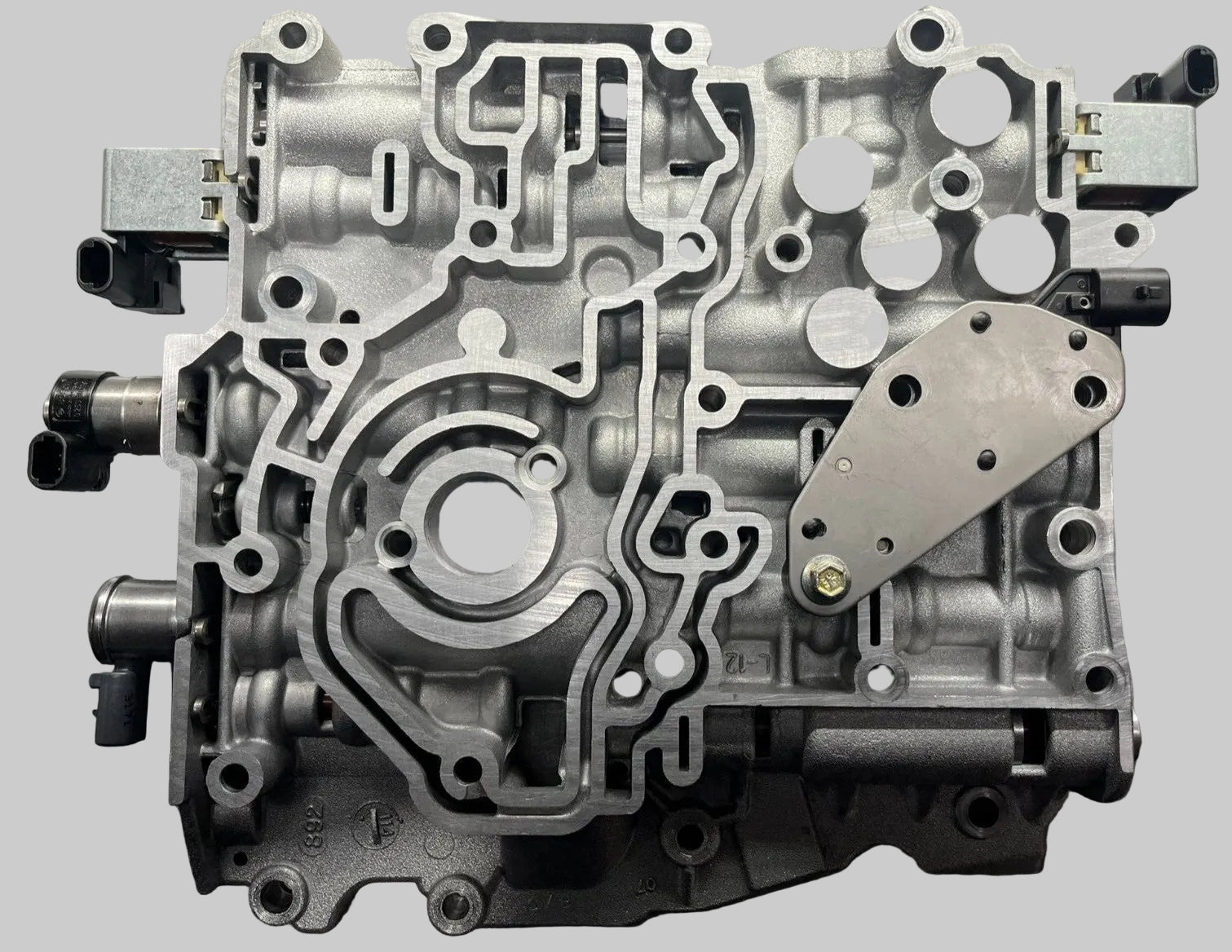
Whether you're in there for the boost valve or the band, it's worth inspecting the channel plate while the valve body is separated from the case, because it's a documented wear point on the same unit and it's far cheaper to address now than on a second teardown. Sonnax's technical notes on the 4T65-E channel plate list a worn actuator feed limit (AFL) valve bore, pump shaft sleeve wear, axle bearing wear, and channel plate-to-case gasket blowout as the common failure points. The AFL valve regulates line pressure to a maximum of roughly 115 psi and feeds the EPC and shift solenoids, so when its bore wears, the symptoms that show up are different from a reverse complaint — inadequate line pressure rise that can trigger code P1811, torque converter clutch slip (P0741), premature 2nd-gear engagement, or a loss of 4th gear. None of that is reverse-specific, but if any of those symptoms are also present on the same vehicle, it's a sign the channel plate is worn enough to address in the same job rather than a separate one later.
The repair for a blown gasket surface is to flat-sand both channel plate faces so the new gasket seals properly; a worn AFL bore gets reamed oversized and fitted with an oversized AFL valve and matched springs. Neither requires splitting the case.
How to Actually Narrow It Down Before You Commit
In order: check fluid level and condition first, since it's free. If that's clean, and you have access to a pressure gauge port, check line pressure in Reverse against spec — a reading that's low or won't build at all points at the boost valve and sleeve assembly, while a reading that builds normally but the car still doesn't move points at the band or servo. If you don't have gauge access, pull the pan and look at the servo and band directly before assuming either part — a visibly cracked band or a bent/broken apply pin confirms the mechanical failure on sight, and it costs you nothing you weren't already spending to get the pan down for inspection.
Don't keep driving the vehicle hoping it frees up. A boost valve that's wearing will only get worse, and if the actual cause is a cracked band, continuing to try reverse under load risks shedding material from the break into the valve body and clutch circuits, which turns an isolated repair into a full rebuild.
Confirmed it's the boost valve, the band, or both?
Remanufactured and OE-style valve bodies, filter and gasket kits, and full banner rebuild kits for the 4T65E are in stock and ship fast.
Shop 4T65E parts →FAQ
What is the difference between weak reverse and no reverse at all on a 4T65E?
Weak or delayed reverse still engages, just slowly or softly, and that pattern points at hydraulic wear — the boost valve and sleeve assembly or the 1-2/Reverse servo boost valve bore losing apply pressure. True no reverse means you pull the shifter into R and get nothing at all, not even a delayed clunk, which points instead at a mechanical failure: a cracked reverse band or a broken servo apply pin that can no longer transmit force even with full hydraulic pressure present. If your unit has some reverse but it is soft or slow to take hold, read our 4T65E slipping guide instead — this article is for the complete, zero-engagement case.
Can a worn boost valve cause complete loss of reverse on a 4T65E?
Yes. Sonnax documents the OE boost sleeve assembly on the 4T65-E as two steel valves and a steel plug riding in an aluminum sleeve, and as that assembly wears, the listed symptoms include low line rise in Reverse and delayed Reverse alongside erratic line pressure and soft 1-2 upshifts. On a unit that has run for years with this wear progressing, delayed reverse can progress to no reverse once the leak path gets bad enough that apply pressure can no longer build at all before you give up and shift to Drive.
Does a cracked or broken reverse band mean the 4T65E needs a full rebuild?
Not necessarily a full rebuild, but it does mean the pan and valve body come off and the band gets replaced, which is most of the labor of a rebuild anyway. Sonnax's technical notes on the companion forward band servo pin describe the same case-and-servo design on this transaxle family: excess pin travel lets the band flex further than it should on every apply cycle, and a band that cracks or breaks at either end simply cannot apply, producing a hard, total loss of that gear rather than a slip. If the band let go because of this wear pattern rather than abuse, a tech will typically also check the matching servo pin length while it's apart.
Will low or old transmission fluid cause a 4T65E to lose reverse completely?
On its own, low fluid is more likely to produce an intermittent slip or flare than a hard, total loss of reverse, but it is still the fastest and cheapest thing to rule out before you assume a hydraulic or mechanical failure. The 4T65E is specified for DEXRON-VI fluid, which Mobil's own DEXRON-VI product documentation confirms is backward-compatible with earlier DEXRON fluids in GM automatic transmissions. Check the level hot, in Park, per the dipstick procedure, and look at the color and smell before pulling anything apart.
What else should I check on a 4T65E valve body while diagnosing no reverse?
While the valve body is off for a boost valve or band repair, it is worth inspecting the channel plate at the same time. Sonnax's technical notes on the 4T65-E channel plate list a worn actuator feed limit (AFL) valve bore, pump shaft sleeve wear, axle bearing wear, and channel plate-to-case gasket blowout as common failure points on this casting — none of them specific to reverse, but all of them capable of causing other pressure-related complaints (P1811, TCC slip, 2nd-gear engagement issues) that can show up on the same vehicle around the same mileage.
Sources
- Sonnax — Boost Valve Kit (84754-30K) product page. Backs the OE boost valve/sleeve wear mechanism on the 4T65-E, and the erratic line pressure, low line rise in Forward and Reverse, and delayed Reverse symptom set. sonnax.com
- Sonnax — Oversized 1-2 & Reverse Servo Boost Valve Kit (84754-40K) technical page. Backs the separate servo boost valve bore-wear mechanism and its low Reverse pressure symptom, used here to distinguish it from the main boost valve assembly covered above. sonnax.com
- Sonnax — "Stop 4T60-E/4T65-E Case Wear, Band Slippage & Breakage with a Longer Servo Pin" technical article. Backs the band-and-servo-pin apply design on this casting family and the mechanism by which excess pin travel leads to band fatigue and breakage. sonnax.com
- Sonnax — "GM 4T65-E Channel Plate: Common Problems & Solutions" technical article. Backs the AFL valve bore wear, pump shaft sleeve wear, axle bearing wear and channel plate-to-case gasket blowout failure points, and their non-reverse symptom set (P1811, TCC slip, 2nd-gear and 4th-gear issues). sonnax.com
- Mobil — DEXRON-VI ATF product documentation. Backs DEXRON-VI as the current GM-licensed transmission fluid specification and its back-compatibility with earlier DEXRON fluids. mobil.com