Most 4T65E units that come through the door have somewhere between 120,000 and 220,000 miles on them. They are in W-body Impalas, Grand Prix, LaCrosse and Century sedans, Montana and Venture vans, and Rendezvous crossovers, and a lot of them have never had the pan dropped. The owner wants to know one thing: should they service it, or will a service "stir it up" and kill it? The honest answer is that a careful service almost never kills a healthy unit, and a careless one can't save a dying one. What matters is reading the transaxle before you touch it, doing the service the way GM wrote it, and knowing which findings mean you stop and quote a rebuild.
This is the checklist I run on a high-mileage 4T65E, in order. The specs come from GM's own owner documentation and service guidance, and the diagnostic numbers come from Sonnax and Transmission Digest technical articles, all listed at the bottom.

1. Scan It Before You Touch It
Plug in before you pull the dipstick. A 4T65E with a problem usually tells on itself, because unlike the older 4T60E it has a turbine speed sensor. As Wayne Colonna explained in his August 2003 Transmission Digest article on this unit, the PCM compares turbine speed against output speed, so it can see slip and time every shift.
Two codes matter most on a high-miler:
- P1811 (maximum adapt and long shift). If a shift takes longer than 0.65 second and the adaptive pressure can't shorten it, a counter goes up by one. Two of those in one drive cycle sets P1811.
- P0730 (incorrect gear ratio). If the shift happens in time but the PCM then sees slip in any gear for more than six seconds, it sets P0730. Before it gets there, it raises line pressure to try to hold the clutch.
No code doesn't mean no problem, because the PCM covers slip with pressure first. Pull up the data the same article describes: 1-2, 2-3 and 3-4 shift error (a negative number means the shift took longer than desired), shift time in seconds for the last shift, and the TAP cells, which show the adaptive pressure the PCM had to add. The steady-state TAPs are shown in kPa and show the pressure needed to hold each gear. High numbers there mean the PCM is already fighting slip. Write those numbers down before the service so you have a baseline to compare against afterward.
Also check for P0741 (TCC slip). Sonnax lists TCC slip from low line rise as one of the results of a worn AFL valve bore, which we'll get to below.
2. Check the Level the Way GM Wrote It
Half the "low fluid" and "overfull" calls I see are checked wrong. GM's procedure in the owner manual for 4T65E cars like the 2008 Impala is specific, and it is done with the engine running:
- Get the fluid to operating temperature, 180-200°F (82-93°C). GM says that takes about 15 miles of driving when it is above 50°F outside, and longer in the cold.
- If the car was just driven hard (above 90°F outside, sustained high speed, heavy traffic in the heat, or towing), wait at least 30 minutes before checking. Overheated fluid reads high.
- Park level, set the parking brake, and with your foot on the brake move the lever through every range, pausing about three seconds in each. Return to Park.
- Let it idle three to five minutes. Leave the engine running.
- Pull and wipe the dipstick, push it all the way in, wait three seconds, and pull it again. Check both sides and read the lower level. It must be in the cross-hatched area.
GM notes that a low reading usually takes less than one pint (0.5 L) to correct. If yours needs a quart or more, there's a leak, and you should find it before you service anything. GM also warns that overfilling can push fluid out onto hot exhaust parts, so don't top off a cold unit to the full mark.
3. Read the Fluid and the Pan
Smell and color tell you something, but the pan tells you more. Drop it, and before you clean anything, look at what's on the bottom and wipe a finger across the magnet.
| What you find | What it usually means | Next step |
|---|---|---|
| Fine gray paste on the magnet, no chunks | Normal wear for the mileage | Service it |
| Dark clutch material, burnt smell, high TAP cells | Clutch pack slipping, often second or third | Service won't fix it. Quote a rebuild. |
| Black flakes of friction lining | Possible TCC piston lining failure | Check the cooler return circuit (below) |
| Brass or bronze flakes | Thrust washer or bushing wear | Teardown |
| Steel chips, chipped-gear debris | Gear or bearing failure; on AWD units, check the final drive washer | Teardown |
The TCC lining is worth explaining because it gets missed. Sonnax's "Troubleshooting the 4T65-E: A Matter of Interpretation" walks through a 258 mm TCC piston damaged by too much apply pressure. The lining comes apart, and the debris collects at the return cooler checkball seat and in the cooler circuit, so you may only see traces in the pan. Sonnax lists the symptoms as transmission noise, no movement as the filter plugs up, harsh TCC apply, a stall on engagement, or shudder on coastdown. The usual causes are on the pressure side: the pressure regulator valve, the AFL valve, the boost sleeve, or the TCC regulator valve. If you see lining material, a fluid change is not the repair. Find out why the converter was overpressurized.
4. Use the Right Fluid, and Know What a Service Actually Replaces
The fill is DEXRON-VI. Units that came from the factory on DEXRON-III don't need a "classic" fluid. GM's own fluid guidance says DEXRON-VI replaces DEXRON-III(H) and DEXRON-II(E), and it is approved for GM transmissions that call for earlier DEXRON fluids. That same chart warns that DEXRON ULV is not a substitute for DEXRON-VI, so don't grab the wrong jug just because both say DEXRON.
GM lists total capacity for the 4T65E in the Impala as 7.4 qt (7.0 L), with a footnote that more fluid may be needed when the converter is drained or replaced. That is the whole system. A pan drop only gets you part of it, because the converter and cooler stay full. Measure what you drain, put back about that much, then finish on the dipstick using the hot check above.
| GM schedule (2008 Impala owner manual) | Fluid and filter change |
|---|---|
| Severe service | At 50,000, 100,000 and 150,000 miles |
| Normal service | At 100,000 miles |
| Counts as severe | Heavy city traffic where it regularly hits 90°F or higher; hilly or mountainous driving; frequent trailer towing; taxi, police or delivery use |
Be honest with the customer: most of these vehicles were driven severe-service and never knew it. A delivery van, or a commuter in Phoenix traffic, falls in GM's own severe definition. On an unknown-history unit at high mileage, I would rather do two pan-and-filter services a few hundred miles apart than one pressure flush. That's my shop practice, not a GM rule. Fresh fluid twice gets the concentration up without forcing a lot of fresh fluid through a unit at once.
5. Filter, Seal and Pan
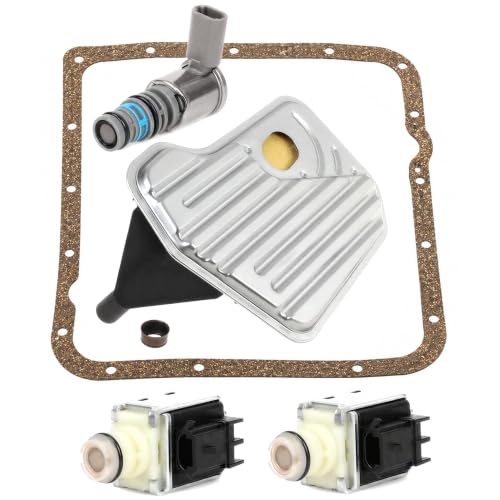
Every pan drop gets a new filter and its seal, not just a gasket. Clean the pan and magnet completely so the next pan drop shows you what happened since this service, not what was there before. A filter that partly plugs with debris is exactly the "no movement as the filter gets plugged" symptom Sonnax describes, and on a high-mileage unit you want to start clean. Our 4T65E filter and pan service guide covers the job itself step by step.
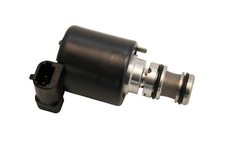
6. The Pressure Control Solenoid Is a Wear Item
If the scan showed P1811, or the customer complains of harsh or erratic shifts, slips or flares that come and go, look at the pressure control (PC) solenoid before anything bigger. GM addressed this on 1997-2002 4T65E units in a corporate bulletin widely reproduced as 00-07-30-002B. It blames sediment inside the PC solenoid that makes it bind mechanically, sediment in the valve body that makes the torque signal regulator valve stick, and an incorrect fluid level. The correction is a new PC solenoid assembly. Because these problems come and go, the bulletin says to repeat the road test at least three times. Colonna's Transmission Digest article agrees from the field: P1811 is very common, and a new PC solenoid, with a slight 1/8-turn clockwise adjustment of its adjusting screw, cures it in most cases.
Colonna's caution matters on a high-miler, though. If P1811 or P0730 comes back weeks after a new solenoid, the solenoid probably wasn't the root cause. Loose clutch packs are. His rule of thumb is 0.008-0.012 in of clearance per friction plate. The second clutch has six frictions, so that is 0.048-0.072 in total. A worn second clutch pack is far beyond that, and no solenoid fixes it.
7. Check the Channel Plate Problems From the Outside
Sonnax names four common 4T65-E channel plate problems. A high-mileage service is the time to look for them:
- Worn AFL valve bore. The actuator feed limit valve caps the supply to the EPC solenoid and the 1-2 and 3-4 shift solenoids at 115 psi maximum. When the bore wears, that pressure leaks to exhaust. Sonnax lists the symptoms as low line rise with P1811 and adapts at maximum, TCC slip setting P0741, second-gear starts, and falling out of fourth. The fix is reaming the bore for an oversize valve. That's a valve body job, not a service.
- Channel plate to case gasket blowout. The fix is flat-sanding both sides of the plate when it is apart.
- Worn pump shaft sleeve, which needs a new sleeve pressed in.
- Pitted or noisy axle bearing. Replace it with a new axle seal. A wet axle seal on a high-miler is worth replacing during the service anyway.
None of these show up on the dipstick. They show up as the scan symptoms in step 1, which is why that step comes first.
8. AWD Units: Listen Before You Close It Up
The all-wheel-drive 4T65E, first used in the 1999 Montana and later in the Rendezvous, has its own weak spot. Sonnax's Ed Lee documented the selective washer at the final drive sun gear. It locates with five tabs but isn't locked, so it spins on a harder shaft and wears quickly, and the debris chews up the differential gears. The target end play there is 0.020-0.024 in. On any AWD unit, a coast whine plus steel in the pan means the final drive needs a look. A fluid change won't help. Front-wheel-drive units set differential end play at 0.005-0.025 in with selective thrust washers.
9. Reset Adapts and Road Test Against Your Baseline
After the service, set the level hot again, clear the codes, reset the transmission adapts with your scan tool, and drive the same route you used for the baseline. Compare shift times and TAP cells with the numbers you wrote down in step 1. TAP numbers that come back down and stay down are a good service. TAP cells that climb right back to where they were, or a P1811 that returns, mean the clutches or the hydraulics are worn, and the fluid was never the problem. That's the point where you give the customer a rebuild quote, not another service.
Shop 4T65E filter kits, pressure control solenoids, solenoid kits and rebuild kits, shipped fast from the USA.
Shop 4T65E parts →FAQ
Is it safe to change the fluid in a 4T65E with 150,000 miles?
Yes, if you read the transaxle first. Scan for P1811, P0730 and P0741, record the TAP cells, and inspect the pan. A unit with normal wear paste is a good service candidate. One that is already slipping, with clutch material in the pan and high TAP cells, needs a rebuild, and a fluid change will not fix it either way.
How much fluid does a 4T65E take?
GM lists 7.4 quarts (7.0 L) total for the 4T65E in the Impala, and notes more may be needed if the converter is drained or replaced. A pan and filter service only drains part of that, so measure what comes out, put back about the same amount, and finish on the dipstick with the fluid at 180-200 degrees F.
What fluid does a 4T65E use?
DEXRON-VI. GM's fluid guidance says DEXRON-VI replaces DEXRON-III(H) and DEXRON-II(E), so it is correct even for early units that originally called for DEXRON-III. Do not use DEXRON ULV, which GM says is not a substitute for DEXRON-VI.
What does code P1811 mean on a 4T65E?
P1811 means maximum adapt and long shift. It sets when a shift takes longer than 0.65 second and the PCM cannot shorten it with more pressure, twice in one drive cycle. A sticking pressure control solenoid is the most common cause, but if it comes back after a new solenoid, look at worn clutch clearance or a worn AFL valve bore.
Shop the 4T65E filter at CoreTransmissionParts → or browse all rebuild kits
Related 4T65E guides
Sources
- General Motors — 2008 Chevrolet Impala Owner Manual (Automatic Transmission Fluid; Capacities; Maintenance Schedule). Backs the hot check procedure (180-200°F, 15-mile warm-up, 30-minute wait after hard driving, cycling ranges, reading the lower level), adding generally less than one pint, DEXRON-VI, the 7.4 qt (7.0 L) capacity with the converter footnote, and the severe/normal service intervals and severe-service definition. assets.gm.com (PDF)
- GM Service Insights — "Use the Right Transmission Fluid." Backs DEXRON-VI replacing DEXRON-III(H) and DEXRON-II(E), and DEXRON ULV not being a substitute for DEXRON-VI. gmserviceinsights.com
- Wayne Colonna, Transmission Digest — "The 4T65-E: 'Slip-Sliding Away,'" August 2003. Backs the turbine speed sensor strategy, the 0.65-second / two-per-drive-cycle P1811 logic, the six-second P0730 slip logic, shift error, shift time and TAP cell interpretation, the PC solenoid fix with a 1/8-turn adjustment, and 0.008-0.012 in clearance per friction (0.048-0.072 in for the six-friction second clutch). transmissiondigest.com
- Sonnax — "GM 4T65-E Channel Plate Common Problems & Solutions." Backs the AFL valve's 115 psi maximum feed to the EPC and shift solenoids, worn-bore symptoms (P1811, P0741, second-gear starts, falling out of fourth), and the gasket blowout, pump shaft sleeve and axle bearing fixes. sonnax.com
- Sonnax — "Troubleshooting the 4T65-E: A Matter of Interpretation." Backs the overpressurized 258 mm TCC piston, debris at the return cooler checkball seat, its symptoms, and the pressure regulator, AFL, boost sleeve and TCC regulator valve as causes. sonnax.com
- Ed Lee, Sonnax — "4T65-E All Wheel Drive Problems: Noise and Gear Failures," November 2005. Backs the 1999 Montana AWD introduction, the five-tab washer that wears and damages the differential, 0.020-0.024 in AWD end play, and the 0.005-0.025 in FWD differential end play. sonnax.com
Also referenced: GM corporate bulletin 00-07-30-002B (1997-2002 4T65-E harsh or erratic shifts with P1811/P0748), as reproduced in technician and owner forums. It is not counted as a source because GM's official copy is not publicly hosted.