"Shift problems" on a Lincoln LS covers a lot of ground: a 1-2 that bangs on a cold morning, a 2-3 that flares up an on-ramp, a 3-2 that clunks when you roll back into the throttle, or shifts that come too early, too late or hunt back and forth. On a 2003-2006 LS with the 5R55S, nearly all of those are decided by the PCM, eight solenoids and a handful of sensors before a band or clutch is ever involved. That is good news for the owner, because a lot of LS shift complaints get fixed without pulling the transmission.
This guide covers the 2003-2006 V6 and V8 cars with the 5R55S, which Ford's 2005 LS owner guide lists behind both engines [1]. It runs in the order I work a shift complaint: rule out what is normal, check the calibration, prove the inputs, test the solenoids, and only then talk hard parts. Where something is my bench habit rather than a published spec, I say so.
The short version: A 2003 LS built between 11/18/2002 and 5/17/2003 with harsh shifts gets the PCM reflash in Ford TSB 03-15-8 first, followed by its 20-engagement relearn [3]. Harsh shifts with no codes and about 150 psi at idle in Drive point at PCM control of the pressure solenoids, not the valve body [5]. A 2-3 flare is often the wrong solenoid pack: 1L2Z-7G391-AG for a 2003 LS, 9L2Z-7G391-A for 2004-2006 [4]. Early, late or hunting shifts start with the speed sensors and the throttle and MAF signals [2].
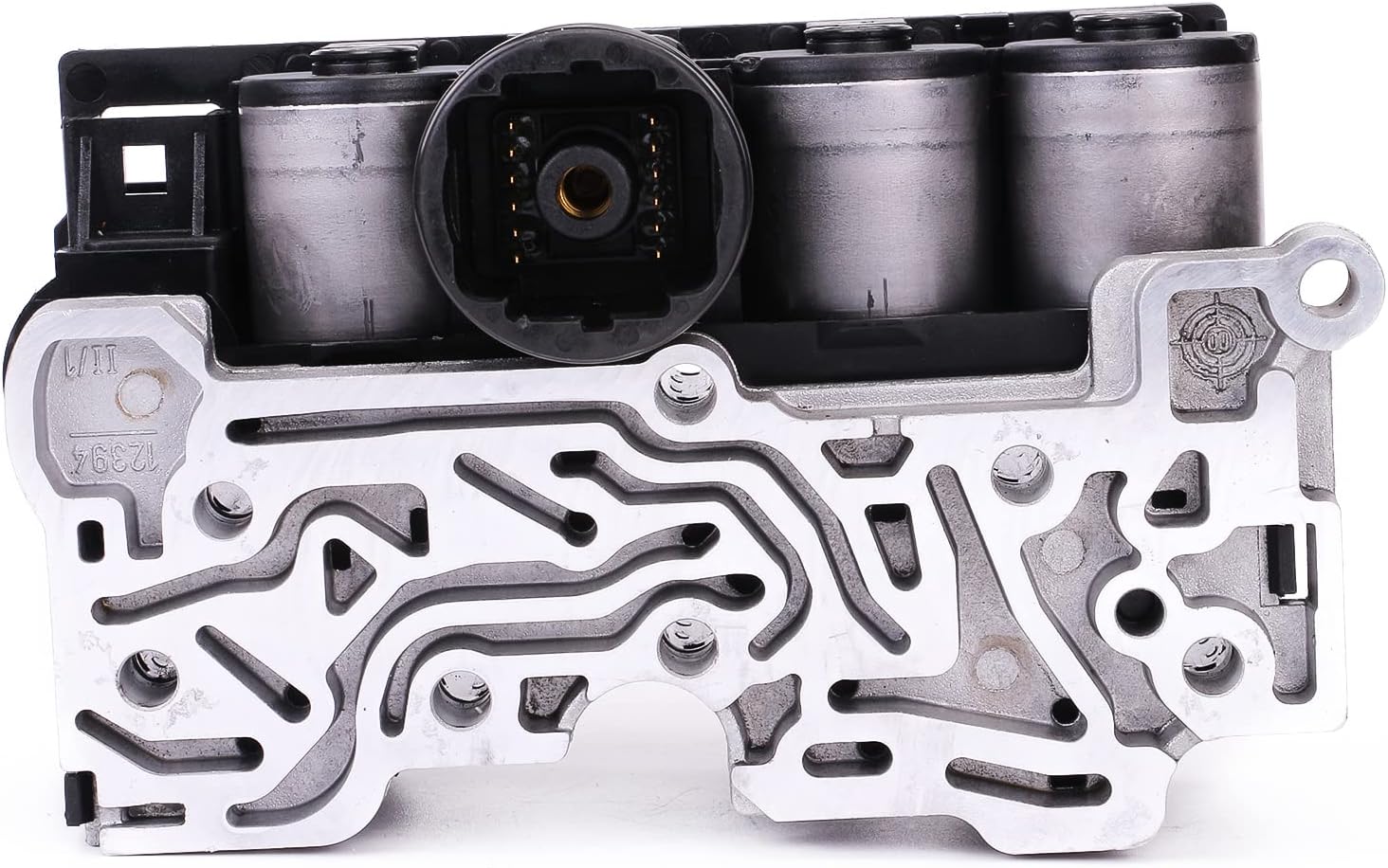
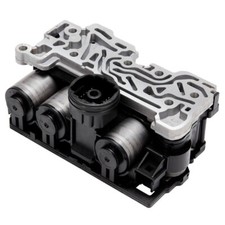
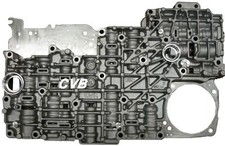
How a 5R55S Decides When and How Hard to Shift
You cannot diagnose shift quality on this unit without knowing who does what. Per Ford, the solenoid body holds four on/off shift solenoids (SSA, SSB, SSC, SSD), a PWM converter clutch solenoid, and three variable force pressure control solenoids, PC-A, PC-B and PC-C [2]. The shift solenoids pick the gear. The pressure control solenoids decide how the shift feels.
ATRA's write-up spells out the pressure side. PC-A and PC-B raise and lower line pressure with throttle in every range from Park to manual 1, and the PCM runs them with opposite commands: when one is high, the other is low [4]. PC-A also feeds the VFS1 modulator, which applies the intermediate servo in 3rd. PC-B feeds the VFS2 modulator, which applies the overdrive servo and the coast clutch. PC-C applies the direct clutch in 4th and 5th and controls reverse engagement [4]. ATRA's summary is the one to remember: the solenoids have a direct effect on shift timing and feel, and most of the complaints are soft flare shifts, usually 2-3, or harsh downshifts [4].
Jesse Zacarias showed in Transmission Digest that even a Park-to-Drive engagement is a PCM-managed event. The four shift solenoids do not change state between Park, Reverse, Neutral and Drive, so only PCA, PCB and PCC control the engagement. PCB is held at about 0.5 amp while VFS pressure builds, and the whole engagement takes about two seconds [6]. Every one of those steps is a current command. If the command is wrong, the hydraulics do exactly what they are told and nothing sets a code.
Step 1: Rule Out What Is Normal on an LS
A few LS complaints are the car doing what Ford designed it to do. Check these before you put a gauge on anything.
- Firmer shifts after a battery disconnect. Ford's owner guide says the adaptive shift strategy has to relearn after the battery has been disconnected, that this can take several upshifts and downshifts, and that slightly firmer shifts may occur during the learning process [1]. A customer who just had a battery or PCM job done may be feeling this.
- The SST shifter holding a gear. On cars with the Select Shift (SST) shifter, manual mode will not upshift or downshift unless the lever is moved. If the driver stops in 2nd or 3rd, the car stays there. Only 4th or 5th returns to 1st automatically [1]. "It won't downshift at a stop" is often an LS left in the manual gate.
- One downshift at a time. In SST manual mode, tapping minus several times only drops one gear, and the next one is allowed once speed falls below a calibrated entry speed [1]. That is engine protection, not a stuck solenoid.
Step 2: Check the Calibration (TSB 03-15-8)
Early 2003 cars have a bulletin. Ford TSB 03-15-8 covers 2003 Lincoln LS and Thunderbird models with the 5R55S built between 11/18/2002 and 05/17/2003 that may exhibit harsh shifts. The action is to verify the condition, then reprogram the PCM to the latest calibration. Cars built after 05/17/2003 are not affected [3].
The calibration chart is split by engine and by shifter. The LS 3.0L lines move to new calibrations 3LQ16B0512 (base shifter) and 3LQ16S0512 (SST shifter), and the 3.9L lines move to 3LQ18B0513 and 3LQ18S0513 for 50-state cars, with separate Mexico calibrations. The bulletin calls for WDS B26.2 or later [3]. Read the current calibration off the PCM before you flash anything; on a twenty-year-old car it may already have been done.
The part people skip is the relearn. The TSB says the engagement pressures will not adapt properly unless you perform it [3]:
- Monitor TFT and warm the fluid to at least 130°F (54°C).
- Five Park-to-Reverse engagements, 5 seconds apart.
- Five Drive-to-Reverse engagements, 5 seconds apart.
- Five Reverse-to-Drive engagements, 5 seconds apart.
- Five Neutral-to-Drive engagements, 5 seconds apart.
I run the same 20-engagement sequence after any solenoid pack, valve body or PCM work on an LS, bulletin or not. It costs five minutes and removes "it hasn't learned yet" from the list. If the harsh shift is still there after the flash and the relearn, the TSB says to continue with normal diagnosis [3], which is the rest of this guide.
Step 3: Harsh Shifts With No Codes, Gauge It
This is the classic LS pattern. Wayne Colonna of ATSG describes 2003-and-newer Lincoln LS cars with harsh engagements and harsh upshifts, especially 1-2, before or after an overhaul, with no codes in the PCM. Many had already had a solenoid assembly or a complete valve body replaced without a change [5]. His suspect is the PCM commanding the pressure control solenoids into high line pressure.
The test is cheap. With a gauge on the line pressure tap, ATSG gives about 100 psi at idle in Drive as normal and says 150 psi may point at a PCM control problem [5]. Then clamp an amp probe on each solenoid feed at idle, one at a time: PCS B is pin 1 and PCS A is pin 11 at the solenoid body connector. About 0.75 to 0.98 amp at low signal pressure is normal. Near 0.23 amp suggests the PCM [5]. Before condemning the module, ATSG says to confirm clean connections from the PCM to the transmission and to check Mode 6 and run monitors for a failure mode state that sets no codes [5]. A replacement PCM has to be programmed [2] [5].
Ford's own pressure table reads the high side the same way: high line pressure at idle in all ranges points at wiring, the boost valve, a PC solenoid or the main regulator valve [2]. ATRA adds a hard-parts check on the same circuit: inspect the pressure regulator valve and sleeve for wear and replace the valve, sleeve or the whole setup as needed [4]. Normal pressure plus a harsh shift moves you on to Step 4.
Step 4: Prove the Inputs Before the Solenoids
Ford's symptom charts route almost every harsh, early, late or erratic shift through the same short list of tests: Test A (shift and TCC solenoids), Test B (TFT sensor), Test C (range sensor), Test D (PC-A, PC-B, PC-C) and Test E (ISS, OSS and TSS speed sensors) [2]. Early or late shifts and erratic or hunting shifts go straight to Test E [2]. These are the inputs Ford calls out, and what each one does to the shift when it lies [2]:
| Input | What a bad signal does to shifting (per Ford) |
|---|---|
| Throttle position (TP) | Fail-safe mode with raised line pressure: harsh engagements, firm shifts, abnormal shift schedule, TCC not engaging or cycling |
| Mass airflow (MAF) | Affects control pressure, shift scheduling and TCC scheduling |
| Output shaft speed (OSS) | Harsh engagements, firm shift feel, abnormal shift schedule, unexpected closed-throttle downshifts |
| Turbine shaft speed (TSS) | Increased engine rpm on engagements, harsh shifts, or delayed shifts with hard apply |
| Intermediate shaft speed (ISS) | Used for pressure decisions; DTCs P0791 and P0794 list a harsh 2-3 |
| Fluid temperature (TFT) | Incorrect line pressure; P1713 and P1718 list harsh engagements and shifts |
| Digital range sensor (DTR) | Harsh engagements, firm shift feel, improper shift selection |
On the scan tool I log TP, MAF, TFT, turbine, intermediate and output speed and commanded gear on one graph. A speed sensor that drops out shows as a spike or a flat line that does not match the others, and it usually lines up exactly with the bad shift. A TFT that reads ambient after twenty minutes of driving explains a harsh shift by itself. Ford's TFT test is simple: the TFT and TFTV PIDs should rise as the unit warms and fall as it cools, with 4.5-5.5 volts reference at pin 2 of the 16-pin case connector [2].
Step 5: Test the Solenoids, and Read the Codes Right
When the codes do show up, Ford's DTC table tells you exactly what the driver feels [2]:
| DTC | Circuit | Symptom Ford lists |
|---|---|---|
| P0750 / P0753, P1714 | SSA | Shorted: no 4th or 5th. Open: no 1st |
| P0755 / P0758, P1715 | SSB | Shorted: no 1st. Open: no 3rd |
| P0760 / P0763, P1716 | SSC | Incorrect gear selection depending on mode and lever position |
| P0765 / P0768, P1717 | SSD | No engine braking in manual gears (P1717: incorrect gear selection) |
| P0745 / P1746 | PC-A | Open: high PC-A pressure, harsh engagement, slips in gear, 3rd gear incorrect |
| P0775 / P1789, P0779 | PC-B | Low PC-B pressure, limited engine torque, no 2nd and 5th |
Ford's electrical specs at the 16-pin case connector, measured from pin 3 (the common feed): 16-45 ohms for SSA, SSB, SSC and SSD, 9-16 ohms for the TCC solenoid, and 3.3-7.5 ohms for each PC solenoid [2]. The shift solenoid terminals are 16 (SSA), 15 (SSB), 6 (SSC), 5 (SSD) and 14 (TCC), and any of them reading under 5 ohms to chassis ground means replacing the solenoid body [2]. With the connector back on, Ford has you cycle each solenoid through output state control and listen for the click [2].
A pack that ohms out fine can still be wrong for the car. ATRA's application split names the Lincoln directly: the 2003 LS takes the early-design pack, Ford P/N 1L2Z-7G391-AG; the 2004-2006 LS takes the later design, originally 4L2Z-7G391-AA, updated to 9L2Z-7G391-A, and Ford recommends only the updated design for those years [4]. ATRA measured a 4 psi difference between PCA solenoids from different packs at the same 0.6 amp command [4]. On a 2-3 overlap, that is enough to turn a clean shift into a flare. If the complaint started right after a used valve body or a "good" pack from a parts car, read the number on the pack before anything else.
Step 6: Harsh Downshifts and the Coast Side
The 3-2 and 2-1 clunks get less attention than the 2-3 flare, but they are common on these cars. Ford's mechanical checklist for a harsh 3-2 is incorrect line pressure, sticking valves, loose valve body bolts causing cross-leaks, the overdrive band and servo, the direct clutch and the intermediate band and servo. For a harsh 2-1 it is line pressure, valve body, valve body bolts, the overdrive band and servo, and the direct one-way clutch [2].
Two things I check on the coast side before I drop the pan. First, the OSS signal: Ford lists unexpected closed-throttle downshifts as an OSS symptom [2], and a downshift the PCM did not plan is always harsh. Second, VFS2. Since PCB drives the VFS2 modulator that applies both the overdrive servo and the coast clutch [4], a PCB current problem shows up on the coast side as well as on the 2-3. ATRA also points at worn overdrive and intermediate servo control valves and plugs, which leak during engagements and shift timing sequences [4].
Step 7: When It Really Is the Valve Body
If the calibration is current, the inputs are clean, the pack is correct and the pressure test is in range, the valve body is next. Ford's lists for early or late shift speeds and for erratic or hunting shifts both include sticking valves and incorrectly torqued valve body bolts causing cross-leaks, along with fluid level and condition, and a plugged filter for hunting shifts [2]. I clean and inspect the regulator and servo control valves first, since those are the two areas ATRA singles out [4], and I torque the valve body in sequence instead of by feel.
A harsh shift that only appears hot usually turns out to be a worn bore leaking more as the fluid thins. A harsh shift that is worst cold and goes away is more often TFT or the calibration. That is my pattern from the bench, not a Ford spec, but it saves a lot of guessing.
Do Not Forget the Fluid
Shift complaints on a car with no dipstick often come back to fluid. Ford specifies Motorcraft MERCON V for the LS 5R55S, warns that MERCON and MERCON V are not interchangeable, and says not to use additives or cleaners [1]. Low fluid gives delayed engagements and flares that look like electrical faults, so set the level at the check plug at the right temperature before you condemn a solenoid.
Shop the part for this fix
ATRA's first hard-parts check on 5R55S flare and harsh-shift complaints is the pressure regulator valve and sleeve. The Sonnax 56947J-77 replacement valve is the fix when that bore is worn.
View the Sonnax 56947J-77 at Core Transmission Parts →Need something else? Browse all 5R55S parts at Core Transmission Parts.
Solenoid packs, pressure control solenoids, valve bodies and shift kits for the 2003-2006 Lincoln LS 5R55S, with checkout on our site.
Shop 5R55S parts →FAQ
Why does my Lincoln LS transmission shift hard?
On a 2003-2006 LS with the 5R55S, harsh shifts are usually a control problem first. Early 2003 cars built between 11/18/2002 and 5/17/2003 have Ford TSB 03-15-8, a PCM reflash with an engagement relearn. Past that, ATSG traces many no-code harsh shifts to the PCM commanding high line pressure, about 150 psi at idle in Drive instead of about 100. Bad TP, OSS, TSS or TFT signals can also raise pressure and firm up shifts.
What causes a 2-3 flare on a Lincoln LS?
The 2-3 releases the overdrive band while applying the intermediate band, so small pressure changes show up as a flare. ATRA lists the wrong solenoid pack as a frequent cause: a 2003 LS takes 1L2Z-7G391-AG and a 2004-2006 LS takes the updated 9L2Z-7G391-A. Worn pressure regulator and servo control valves cause the same complaint.
How do you reset the transmission adaptive learning on a Lincoln LS?
Ford's owner guide says the adaptive strategy relearns by itself over several upshifts and downshifts after a battery disconnect, with slightly firmer shifts until it does. For engagement pressures, TSB 03-15-8 gives a procedure: warm the fluid to at least 130 degrees F, then do five each of Park to Reverse, Drive to Reverse, Reverse to Drive and Neutral to Drive, 5 seconds apart.
Why won't my Lincoln LS downshift when I stop?
If the car has the Select Shift (SST) shifter and the lever is in the manual gate, the transmission will not change gears unless you move the lever. Ford says a car stopped in 2nd or 3rd stays there, and only 4th or 5th returns to 1st on its own. Move the lever back to D5 and see if the complaint goes away.
What are the shift solenoid resistance specs on a 5R55S?
Ford specifies 16-45 ohms for SSA, SSB, SSC and SSD, 9-16 ohms for the TCC solenoid, and 3.3-7.5 ohms for each pressure control solenoid, measured from pin 3 of the 16-pin case connector. Any solenoid terminal reading under 5 ohms to chassis ground means replacing the solenoid body.
Sources
- Ford Motor Co. — 2005 Lincoln LS Owner Guide, "Driving" and "Maintenance and Specifications," on the adaptive transmission shift strategy and relearn after battery disconnect, D5/D4/3/2/1 operation, Select Shift (SST) manual mode behavior, the recommended upshift schedule, no dipstick on the 5R55S, Motorcraft MERCON V, 11.2 L (11.9 qt) approximate dry capacity, and the additive and MERCON/MERCON V warnings. 2005 Lincoln LS Owner Guide (PDF, archive.org)
- Ford Motor Co. service information (Mitchell reprint) — "5R55W/S Diagnosis," on the solenoid body layout, input sensor effects on shifting, symptom test routing (Tests A-E), the DTC symptom table, solenoid resistance specs and case connector pinout, TFT test, PCM programming, and the mechanical checklists for harsh, early/late and erratic shifts. Written for the Explorer/Mountaineer 5R55W/S. 5R55W/S Diagnosis (PDF)
- Ford Motor Co. — TSB 03-15-8, "Transmission - 5R55S - Harsh Shifts - Vehicles Built Between 11/18/2002 and 5/17/2003 Only," 2003 Lincoln LS and Thunderbird, on the PCM reprogram, the calibration chart by engine and shifter, and the 20-engagement adaptive relearn at 130°F TFT. TSB 03-15-8 full text (archived reprint, archive.org)
- ATRA — 2013 technical seminar manual, "Ford 5R55W/S Erratic Transmission Operation," on PCA/PCB/PCC roles, VFS1 and VFS2 modulator functions, the 2003 vs 2004-2006 Lincoln solenoid pack part numbers, the 4 psi difference at 0.6 amp, and the pressure regulator and servo control valve checks. ATRA 2013 seminar, pp. 112-120 (PDF)
- ATSG — Wayne Colonna, "Easing harsh engagements on a Lincoln LS 5R55S," Vehicle Service Pros, on harsh engagements and 1-2 shifts with no codes, the 100 vs 150 psi idle pressure check, PCS A/B current at pins 11 and 1 (0.75-0.98 A normal, about 0.23 A suspect), Mode 6 checks and PCM replacement. vehicleservicepros.com
- Transmission Digest — Jesse Zacarias, "Understanding the 5R55S/W Initial Engagements" (Shift Pointers, November 2012), on common 5R55S/W complaints, the solenoid complement, and how PCA, PCB and PCC control forward and reverse engagements. transmissiondigest.com