The Lincoln LS was Ford's rear-drive sport sedan from 2000 through 2006, built on the same DEW98 platform as the 2002-2005 Thunderbird and the Jaguar S-Type. Most of them were sold with a five-speed automatic, and that automatic changed partway through the run. The 2000-2002 cars used the 5R55N. Sonnax notes that Ford replaced the N with the 5R55S in 2003 in the Lincolns and Thunderbirds [5], and Ford's 2005 LS owner guide lists the 5R55S behind both the 3.0L V6 and the 3.9L V8 [1].
That split matters more on an LS than on any other 5R55 car, because the N and the S look alike on the lift and share almost nothing inside. This is the list of what actually goes wrong in the 2003-2006 LS 5R55S, in the order I chase it, with notes where a 2000-2002 car with the N behaves differently. Ford specs and trade bulletins back each point. Where something is my bench experience rather than a published number, I say so.
The short version: The signature 2003-up LS complaint is harsh engagements and a harsh 1-2 with no codes, which ATSG traces in many cars to PCM control of the pressure control solenoids, not the valve body [4]. Behind that come worn servo apply pin bores that flare or lose 2nd, 3rd and 5th [5], parts mix-ups between the 5R55N and 5R55S [5] [6], and low fluid on a transmission with no dipstick. Ford specifies MERCON V, 11.9 qt (11.2 L) approximate dry capacity [1].
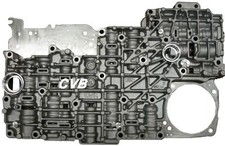
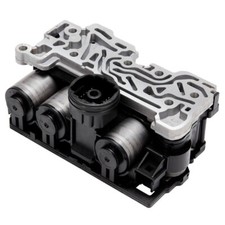

Problem 1: Harsh Engagements and a Harsh 1-2 With No Codes
This is the LS-specific one. Wayne Colonna of ATSG wrote up a pattern on 2003 and newer Lincoln LS cars with the 5R55S: harsh engagements and harsh upshifts, especially 1-2, with no codes stored in the PCM. The cars he describes had already had a solenoid assembly replaced, and sometimes a complete valve body, and the complaint was still there [4]. That is an expensive way to learn the problem is upstream of the transmission.
Why the PCM can make it harsh
The 5R55S has four on/off shift solenoids, a PWM solenoid for the converter clutch and three variable force pressure control solenoids, PC-A, PC-B and PC-C [2] [6]. Jesse Zacarias laid out in Transmission Digest how engagements actually happen. In Park, Reverse, Neutral and Drive the four shift solenoids do not change state, so only the three pressure control solenoids control the engagement [6]. When Drive is selected, the PCM drives PC-B at about 0.5 amp to hold the forward engagement control valve closed against line pressure. It then lowers PC-A current, which raises VFS 1 pressure and starts applying the forward clutch, until VFS 1 pressure strokes the engagement valve and lets full line pressure in. Reverse works the same way through PC-C and the direct clutch. Each engagement takes about two seconds [6].
Every one of those steps is a current command from the PCM. If the PCM commands the wrong current, the hydraulics do exactly what they are told, and the shift is harsh with nothing for the code monitor to catch.
How to prove it before buying parts
- Line pressure at idle in Drive. ATSG puts normal at about 100 psi. If you see around 150 psi, the article points at PCM control [4]. Ford's own pressure diagnosis lists high line pressure at idle in all ranges as wiring, the boost valve, the PC solenoid or the main regulator valve [2], so the gauge reading tells you which half of the problem to chase.
- Solenoid current. ATSG gives 0.75 to 0.98 amp at idle (low signal pressure) as normal and about 0.23 amp as a sign of a PCM problem, measured at pin 1 for PCS B and pin 11 for PCS A at the solenoid body connector [4]. Low current on a variable force solenoid means high pressure.
- Connections and monitors. Clean every connection between the PCM and the transmission, then check run monitors and Mode 6 data for a failure mode management state that has not set a code [4]. Ford's diagnosis treats more than 5 ohms in a harness or connection check as open and says to clean any connection approaching that [2].
- Solenoid resistance. With the case connector off, Ford's specs are 16-45 ohms for SSA through SSD and 9-16 ohms for the TCC solenoid [2]. Good numbers here plus high pressure and low current points away from the solenoid body.
If all of that checks out and the pressure and current are still wrong, ATSG's fix is a PCM, and the article notes the replacement has to be programmed by a dealer [4]. On the other side of the coin, if a PC-A circuit code is set, Ford's chart lists an open PC-A circuit as causing high PC-A pressure, harsh engagement and slipping [2]. That one is a solenoid or harness repair, not a PCM.
One note from the bench before you condemn anything: the LS has an adaptive shift strategy. Ford's owner guide says that after the battery is disconnected the transmission relearns its shift parameters over several upshifts and downshifts, and shifts may be slightly firmer while it learns [1]. Sonnax adds that units built after 2002 need a relearn after solenoid service [5]. A car that came in firm the day after a battery replacement deserves a few drive cycles before a diagnosis.
Problem 2: Worn Servo Apply Pin Bores (Flares and Lost Gears)
The 5R55 family uses three bands. The overdrive and intermediate servos push apply pins that ride directly in bores machined into the aluminum case, with no sleeve. Over enough miles the bores wear oval. Sonnax explains the result: apply oil fed through the pin leaks into the barrel of the case and drops band apply pressure, and release oil cross-leaks into the apply circuits. Sonnax lists the symptoms as 1-2, 2-3 and 4-5 flares, lost gears, codes 732, 733 and 735, band lining failure and delayed reverse [5]. GEARS gives the short version of the same diagnosis for the W/S: slipping in 2nd and 5th or a bind on the 2-3, check the servo pin bore [6].
On the scan tool it shows up as ratio codes with clean circuits. Ford's chart describes P0732, P0733 and P0735 as no 2nd, 3rd or 5th gear, with RPM higher or lower than expected [2]. Log turbine speed against output speed on a warm road test. A good shift pulls turbine speed smoothly down to the new ratio. A worn bore lets it hang or flare before the band catches, and it is usually worse once the fluid is hot.
The repair is mechanical: ream the bores and sleeve them. Sonnax's 56361J-01K kit carries an overdrive and an intermediate sleeve and installs with the S-56361J-TL tool kit and its fixture [5]. New servo seals in an oval bore will feel fine on the test drive and come back. If the bands are already burned, it is a rebuild, and the case gets sleeved while it is apart.
5R55S Servo Bore Sleeve Kit, Complete Set (Sonnax)
The full set of Sonnax servo bore sleeves for the 5R55S case, the permanent fix for flared or lost 2nd, 3rd and 5th on a 2003-2006 LS.
View the 5R55S sleeve kit →Need something else? Browse all 5R55S parts at Core Transmission Parts.
Problem 3: 5R55N and 5R55S Parts Mixed Together
Because the LS is the main car that carried both versions, it is where the mix-ups land. A 2003-2006 car that got a junkyard valve body or solenoid pack from a 2000-2002 car, or the other way around, can come in with symptoms nobody can explain. Sonnax is blunt about it: only a few parts interchange between the N and the W/S, and most others can cause problems if installed in a W/S unit [5].
What to look at:
- The solenoid assembly. It looks interchangeable across N, W and S, but Sonnax says the critical parts are the base plate and the filter, and mixing them causes loss of reverse, loss of TCC apply and loss of solenoid oil pressure [5].
- The case bosses. The N has two cast bosses behind the intermediate servo cover, with the closest one tapped for the PC-C pressure port. The W/S has only one boss [5].
- The reverse pressure switch. The N uses a base plate similar to the 4R70W with a reverse pressure switch. The W/S solenoid body has no RP switch terminals [5].
- The intermediate clutch. GEARS notes the N has an intermediate clutch that the W/S does not [6]. A whole-unit swap between years is not a bolt-in.
Read the ID tag and check the case before you order anything for an LS. "5R55" on a parts listing is not enough.
Problem 4 (2000-2002 Cars): Wrong Gear Starts and Bind-Ups
If the LS in your bay is a 2000-2002 with the N, there is a servo failure worth knowing. GEARS describes it: both servo pistons use release oil on the large side to hold them off. If a piston is hard, has a torn seal or is delaminated, release oil leaks across and becomes apply oil, applying the band when it should be off [6]. A bad leak gives binds in reverse and manual low plus wrong gear starts. A small leak gives wrong gear starts, or early clutch and band failure with ratio codes. These servos can pass an air check because the damage is on the release side [6].
The test in that article is simple. With the engine running, the car in the air and in Drive, a second tech tries to turn each band adjusting screw in. In Drive both bands should be off and both screws should turn freely. A tight screw means a servo is applying the band [6]. GEARS also says to verify the commanded gear first, since stored codes, an out-of-adjustment range sensor or a speed sensor picking up noise can all make the computer command the wrong gear [6].
Problem 5: Low or Wrong Fluid With No Dipstick
Ford's 2005 Lincoln LS owner guide is direct: the 5R55S transmission does not have a transmission fluid dipstick, the transmission does not consume fluid, and the level should be checked if it slips, shifts slowly or leaks [1]. On a 20-year-old sedan with a seeping pan gasket, nobody has checked it in years.
| Item | Ford spec, 2005 Lincoln LS |
|---|---|
| Transmission | 5R55S (3.0L V6 and 3.9L V8) |
| Fluid | Motorcraft MERCON V, XT-5-QM |
| Capacity | 11.2 L (11.9 qt), approximate dry, includes cooler and tubes |
| Dipstick | None |
| Additives | Ford says do not use supplemental additives, treatments or cleaning agents |
All of that comes from the guide's maintenance chapter and capacity table, which also warns that MERCON and MERCON V are not interchangeable and must not be mixed [1]. The quart count is for a dry unit. A pan and filter service takes back far less, so the level is always set at the plug. ATRA Technical Bulletin 746 lays out Ford's method for the 5R55N, S and W: watch the TFT PID, idle in Park at about 650 rpm with the car level on a hoist, remove the small center level plug from the larger drain plug with a 3/16-inch Allen key, fill through the 307-437 adapter, and finish with fluid between 80 and 120°F [3].
How I Diagnose a 2003-2006 Lincoln LS 5R55S
- Confirm the transmission. 2003-2006 should be a 5R55S; 2000-2002 is the N [5]. Ask whether the valve body, solenoid pack or whole unit has ever been replaced, and with what.
- Set the fluid level with the TFT PID in the 80-120°F window [3]. Look at the fluid on the plug. Band material means the job is already a rebuild.
- Pull codes and sort them. Circuit codes point at the connector and solenoid body. Ratio codes P0732, P0733 and P0735 with clean circuits point at the servo bores [2].
- Ohm the solenoids: 16-45 ohms shift solenoids, 9-16 ohms TCC [2].
- Gauge line pressure at idle in Drive. About 100 psi is normal; around 150 psi with no codes is the ATSG PCM pattern [4].
- Check PC-A and PC-B current at pins 11 and 1 if pressure is high: 0.75-0.98 amp normal, about 0.23 amp suspect [4].
- Road test with data. Log TFT, turbine speed and output speed, and watch the 1-2, 2-3 and 4-5 for flares [5].
- Decide on hard parts. PCM for the confirmed no-code harsh pattern, solenoid body for real electrical faults, a sleeved case on any rebuild.
Valve bodies, pressure control solenoids, rebuild kits and filter kits for the 2003-2006 Lincoln LS 5R55S, with checkout on our site.
Shop 5R55S parts →FAQ
What are the most common transmission problems on a Lincoln LS?
On 2003-2006 cars with the 5R55S, the big ones are harsh engagements and a harsh 1-2 shift with no codes, worn servo apply pin bores that flare or lose 2nd, 3rd or 5th, parts mixed up between the earlier 5R55N and the 5R55S, and low fluid on a transmission with no dipstick. ATSG traces many of the no-code harsh shifts to the PCM commanding high line pressure rather than to the valve body.
What transmission is in a Lincoln LS?
The 2000-2002 Lincoln LS automatic is the Ford 5R55N. Ford replaced it with the 5R55S in 2003, and the 2005 owner guide lists the 5R55S behind both the 3.0L V6 and the 3.9L V8. The two look similar but share few internal parts, so confirm which one you have before ordering.
Does the Lincoln LS transmission have a dipstick?
No. Ford's 2005 Lincoln LS owner guide states that the 5R55S does not have a transmission fluid dipstick. The level is set at a small center plug in the pan drain plug with the engine idling in Park, the car level on a lift, and fluid temperature between 80 and 120 degrees F on the TFT PID.
How much transmission fluid does a Lincoln LS take?
Ford lists 11.2 L (11.9 qt) of Motorcraft MERCON V, part XT-5-QM, as the approximate dry capacity including the cooler and tubes. A pan and filter service takes far less than that, so the final level is always set at the level plug. Ford warns MERCON and MERCON V are not interchangeable.
Why does my Lincoln LS shift hard with no check engine light?
ATSG has documented 2003-up LS cars with harsh engagements and harsh 1-2 shifts and no codes, often after a solenoid body or valve body had already been replaced. Check line pressure at idle in Drive: about 100 psi is normal and around 150 psi points at PCM control of the pressure control solenoids. Also allow a few drive cycles after a battery disconnect, since the adaptive strategy relearns and may shift firmer meanwhile.
Sources
- Ford Motor Co. — 2005 Lincoln LS Owner Guide, "Driving" (pp. 235-237) and "Maintenance and Specifications" (pp. 301, 304-307), on the 5R55S behind the 3.0L V6 and 3.9L V8, adaptive shift relearn after battery disconnect, no dipstick, Motorcraft MERCON V XT-5-QM, 11.2 L (11.9 qt) approximate dry capacity including cooler and tubes, and the MERCON/MERCON V and no-additive warnings. 2005 Lincoln LS Owner Guide (PDF, archive.org)
- Ford Motor Co. service information (Mitchell reprint) — "5R55W/S Diagnosis," on the shift, TCC and PC-A/B/C solenoids, the DTC chart (P0732/P0733/P0735, P0745/P1746), solenoid resistance (SSA-SSD 16-45 ohms, TCC 9-16 ohms), the 5-ohm open-circuit rule and line pressure test results. 5R55W/S Diagnosis (PDF)
- ATRA — Technical Bulletin 746 (February 2003), "5R55N, 5R55S & 5R55W: New Rotunda Tool for Checking Fluid Level and Filling Transmissions," on the fill plug, the 650 rpm idle, the TFT PID 80-120°F window, the 3/16-inch level plug and the 307-437 adapter. ATRA TB 746 (PDF)
- Wayne Colonna, ATSG — "Easing harsh engagements on a Lincoln LS 5R55S," Vehicle Service Pros (January 2020), on no-code harsh engagements and 1-2 shifts on 2003-up LS, 100 vs 150 psi idle line pressure, PCS A/B current values at pins 11 and 1, Mode 6 checks and PCM replacement with dealer programming. vehicleservicepros.com
- Sonnax — Bob Warnke, "Figuring Out the 5R55 Alphabet," on the S replacing the N in 2003 Lincolns and Thunderbirds, N vs W/S identification (case bosses, RP switch, base plate and filter), limited interchange, and adaptive relearn after solenoid service; and the Overdrive & Intermediate Servo Pin Bore Sleeve Kit 56361J-01K page, on how pin bore wear leaks apply and release oil, flares, 732/733/735 codes and the sleeve tooling. sonnax.com (5R55 Alphabet) | sonnax.com/parts/2207
- Transmission trade press — Jesse Zacarias, "Understanding the 5R55S/W Initial Engagements," Transmission Digest, on the solenoid layout and how PC-A, PC-B and PC-C control forward and reverse engagement; and GEARS Magazine (ATRA), "5R55N with Wrong Gear Starts and Bindups? Look for a Faulty Servo" (March 2017), on 5R55N applications, the N's intermediate clutch, servo release-side leaks and the band adjusting screw test. transmissiondigest.com | gearsmagazine.com