The 2006-2010 Explorer and Mountaineer (and the 2007-2010 Explorer Sport Trac) are the generation people forget runs a different drivetrain split than the trucks before it. On the 2002-2005 trucks, both engines got a 5R55-family five-speed. From 2006 on, Ford put the six-speed 6R60 behind the 4.6L V8 and kept the 5R55S behind the 4.0L SOHC V6. Ford's own 2007 Explorer owner guide lists them as two separate transmissions with two separate fluids: the 5R55S on MERCON V, the 6R60 on MERCON SP [1]. So before anything else: if the truck you are looking at is a V8, this article is not about your transmission.
On the V6 trucks, the 5R55S has a short list of failures that account for most of what comes through the door. Some are carry-overs from the earlier W/S units. Two of them are specific to this body style, and one of those is not a transmission problem at all. This is the list I work from, with the Ford specs and part numbers you need to back it up.
The short version: On a 2006-2010 Explorer 5R55S, check five things in this order: water from the A/C drain corroding the solenoid body connector (P0713 and solenoid codes, Ford TSB 09-22-15) [4]; harsh or delayed engagements, which are controlled by the three pressure control solenoids and the range sensor [5]; worn servo apply pin bores causing 1-2, 2-3 and 4-5 flares [6]; the 2009-up valve body and spacer plate that will not interchange with earlier parts [3]; and fluid level, which has no dipstick to check. Ford specifies MERCON V, 12.4 qt (11.7 L) approximate dry fill [1].
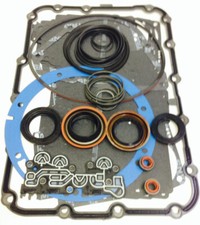
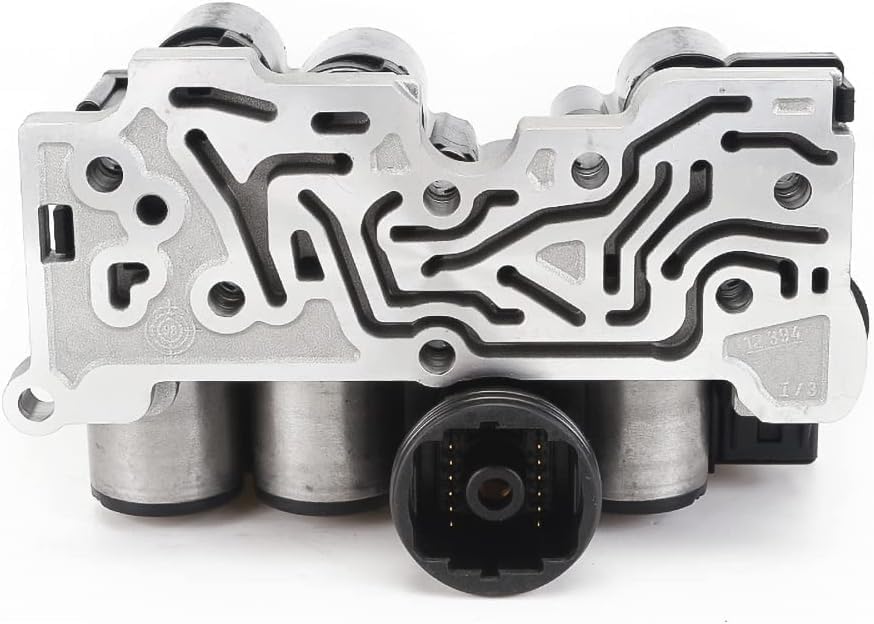

Problem 1: Water in the Solenoid Body Connector (P0713)
Start here, because it is cheap to check and it fakes a lot of expensive problems. The 16-pin solenoid body connector sits on the left side of the transmission case, and on this body style the A/C evaporator drain dumps water right above it. Ford's bulletin covers 2006-2010 Explorer and Mountaineer and 2007-2010 Sport Trac built on or before August 12, 2009 with the 5R55S, and describes a check engine light with P0713 and/or other solenoid body connector codes caused by water running down from the A/C drain into that connector [4].
P0713 is the TFT sensor reading -40°F, which Ford's code chart defines as an open circuit, and the symptom it lists is firm shift feel [2]. That makes sense once you know what the PCM does with TFT: it uses fluid temperature to set control pressure, shift scheduling and converter clutch operation, so a dead TFT signal means the computer thinks the fluid is arctic-cold and runs pressure up [2]. The driver reports harsh shifts. The parts store reads a code and sells a solenoid pack.
Mike Greer of Certified Transmission wrote up a 2006 Explorer that came in with exactly this: P0713, a previous shop's failed repair, and a connector so corroded the center retaining bolt bound up and the harness side had to be broken out [4]. His shop replaced the harness with Ford repair harness 4L2Z-7C078-DA, cleaned the case-side connector, and finished the bulletin by installing a waterproof patch over the connector, cut from Ford material F65Z-9240-DC [4].
How to check it: unbolt the connector and look before you condemn anything internal. Green crust, water, or fluid wicking up the pins means you have found at least part of the problem. Ford's diagnostic data defines an open circuit as more than 5 ohms and recommends cleaning any connection approaching that and coating it with dielectric grease [2]. With the connector off, you can also ohm the solenoids through the case connector: Ford lists 16-45 ohms for SSA, SSB, SSC and SSD and 9-16 ohms for the TCC solenoid [2]. If they all read in range on the case side and the codes came from a corroded harness, the solenoid body is probably fine.
Problem 2: Harsh or Delayed Engagements Into Drive and Reverse
Jesse Zacarias opened his Transmission Digest piece on the 5R55S/W with its common complaints: harsh forward engagement, harsh reverse engagement, delayed and harsh initial engagements, 3-4 flares and bind-up on shifts [5]. That list is the Explorer customer's complaint list almost word for word.
The reason this unit is hard to diagnose is that engagements are not hydraulic-only. The transmission has four on/off shift solenoids, one PWM solenoid for the converter clutch and three variable-force solenoids (PCA, PCB, PCC). In Park, Reverse, Neutral and Drive the four shift solenoids do not change state; only the three variable-force solenoids control the engagement [5].
On a Drive engagement, the PCM holds PCB at about 0.5 amp so VFS 2 pressure keeps the forward-engagement control valve closed, then lowers PCA amperage so VFS 1 pressure starts filling the forward clutch. When VFS 1 overcomes VFS 2 at the valve, it strokes and lets full line pressure in. Reverse works the same way with PCC feeding the direct clutch through the reverse-engagement control valve. Each engagement takes about two seconds [5].
What that means on the shop floor:
- A bad range sensor can stop engagement. The whole sequence starts with the transmission range sensor telling the PCM which gear was selected [5]. If the PCM does not see Drive or Reverse, it never runs the engagement. Check the PRNDL PID against the lever before going inside.
- A PCA fault shows up as harsh engagement. Ford's chart lists an open PC-A circuit (P0745/P1746) as high PC-A pressure, harsh engagement, slipping in gear and incorrect 3rd [2].
- Sticking valves give a delay, then a bang. If the engagement control valve is slow to stroke, the clutch fills on modulated pressure, then slams when line pressure hits. That is a valve body problem, not a solenoid problem.
Watch TFT on the scan tool during any engagement test. A wrong TFT reading (see Problem 1) changes the pressure the PCM commands, and you will chase a valve body that isn't broken.
5R55S Servo Bore Sleeve Kit, Complete Set (Sonnax)
The full set of servo bore sleeves for the 5R55S case. This is the repair that saves a worn case instead of building a comeback with new servo seals in oval bores.
View the 5R55S sleeve kit →Need something else? Browse all 5R55S parts at Core Transmission Parts.
Problem 3: Flares From Worn Servo Apply Pin Bores
This is the mechanical failure that ends most 5R55S units, and the Explorer's weight and towing habits make it worse. The overdrive and intermediate band servos push apply pins that ride directly in bores machined into the aluminum case. Every band apply and release moves the pin, and over the years the bore wears oval.
Sonnax lists the symptoms for its 56361J-01K sleeve kit, which applies to the 5R55N, S and W: flares on the 1-2, 2-3 and 4-5 shifts, gear loss, codes 732, 733 and 735, band lining failure, and loss of overdrive and intermediate servo control [6]. Those codes are P0732, P0733 and P0735, the gear ratio errors for 2nd, 3rd and 5th. Ford's chart describes them as RPM higher or lower than expected, set after four consecutive failures [2].
The tell is a ratio code with no electrical code. If the solenoids ohm good and the connector is clean, a solenoid pack will not fix a 2-3 flare. The fix is reaming and sleeving the bores. The Sonnax kit includes an overdrive repair sleeve and an intermediate repair sleeve, installed with the S-56361J-TL tool kit and the SERVO-FIX fixture [6]. New servo pistons alone feel better for a while, but the oval bore is still leaking apply oil.
Problem 4: The 2009-2010 Valve Body Is Not the Same Part
This one catches rebuilders and junkyard swappers alike. ATSG, via Transmission Digest, reports that starting in the 2009 model year Ford fitted the 5R55S with a redesigned valve body and spacer plate. The casting changed in the VFS 1, VFS 2 and line pressure passages, and the bonded spacer plate changed to match [3]. The spacer was revised again for the 2009-2010 Explorer and Mountaineer to eliminate a whistling noise in all ranges above 170°F [3].
The key line: none of the 2009 valve body and spacer plate parts retrofit to earlier applications [3]. ATSG has already seen shops put the 2009 bonded spacer plate on an earlier valve body. The extra hole in the new plate connects a line pressure passage to the VFS 2 circuit, which produces a harsh 1-2 upshift and a flared 2-3 upshift [3]. The current Ford bonded spacer plate is 9L2Z-7Z490-B [3].
Practical rules for the Explorer:
- A 2009-2010 truck with a whistle in every range once it is hot is a candidate for the latest spacer plate, not a pump.
- A truck that went from fine to harsh 1-2 and flared 2-3 right after valve body work should have its spacer plate checked first.
- When buying a used or remanufactured valve body, match the model year range. A 2006-2008 valve body is not a drop-in for a 2009-2010, and the reverse is also true.
Problem 5: Low Fluid on a Transmission With No Dipstick
Ford's 2007 Explorer owner guide is blunt about it: the automatic transmission does not have an underhood dipstick, and the fluid should be checked and topped off by a dealer [1]. In the real world that means nobody checks it. A slow cooler line or pan seep on a 5R55S goes unnoticed until the truck flares or slips hot.
Ford's numbers for the 2007 Explorer 4.0L [1]:
| Item | Ford spec |
|---|---|
| Transmission | 5R55S (4.0L V6); 4.6L V8 uses the 6R60 |
| Fluid | Motorcraft MERCON V, XT-5-QM |
| Capacity | 12.4 qt (11.7 L), approximate dry fill |
| Dipstick | None; level set by a technician |
| Additives | Ford says do not use supplemental additives, treatments or cleaning agents |
Ford notes the capacity is an approximate dry-fill figure that varies with cooler size, and that the level should be checked by a qualified technician [1]. A pan drop only gets a fraction of that 12.4 quarts out, so plan on a couple of services or a full exchange if the fluid is dark. Ford also says vehicles that require MERCON V should use only MERCON V or a fluid specified as dual MERCON/MERCON V [1]. Do not let anyone put MERCON LV or MERCON SP in a 5R55S because the 6R60 on the shelf next to it takes SP.
How I Diagnose a 2006-2010 Explorer 5R55S
- 1. Confirm it is a V6 with a 5R55S. A V8 has the 6R60 and a different fluid [1].
- 2. Pull codes and sort them. Electrical and TFT codes point at the connector and harness first. Ratio codes with no electrical code point at mechanical wear [2].
- 3. Pull the solenoid connector. Look for water and corrosion per TSB 09-22-15, and ohm the solenoids through the case connector [2] [4].
- 4. Watch TFT, PRNDL, turbine and output speed. A flare shows up as turbine speed rising during a shift while output speed holds. A PRNDL mismatch points at the range sensor [5].
- 5. Set the fluid level correctly. MERCON V only.
- 6. Then decide on the hard parts. Solenoid body for confirmed electrical faults, the correct-year valve body and spacer for 2009-up issues [3], and a sleeved case on any rebuild [6].
Overhaul kits, solenoid packs, valve bodies and filter kits for the 2006-2010 Explorer and Mountaineer 5R55S, with checkout on our site.
Shop 5R55S parts →FAQ
What are the most common 5R55S problems in the 2006-2010 Explorer?
The big ones are water from the A/C drain corroding the solenoid body connector, harsh or delayed engagements controlled by the three pressure control solenoids, and flares from worn servo apply pin bores in the case. On 2009-2010 trucks, the redesigned valve body and spacer plate add a parts-interchange trap. Low fluid is common too, because there is no dipstick.
Why does my Explorer have a P0713 code and harsh shifts?
P0713 means the transmission fluid temperature sensor reads -40 degrees F, an open circuit, and Ford lists firm shift feel as the symptom. On 2006-2010 Explorers built on or before August 12, 2009, Ford TSB 09-22-15 traces it to A/C drain water getting into the solenoid body connector on the left side of the transmission. Inspect and clean the connector before replacing any internal parts.
Does the V8 Explorer have a 5R55S?
No. From 2006 on, Ford paired the 4.6L V8 with the six-speed 6R60 and kept the 5R55S behind the 4.0L V6. The 2007 owner guide lists MERCON V for the 5R55S and MERCON SP for the 6R60, and the two fluids are not interchangeable.
How much fluid does a 2006-2010 Explorer 5R55S take?
Ford lists 12.4 quarts (11.7 L) of Motorcraft MERCON V as the approximate dry-fill capacity for the 2007 Explorer 5R55S. A pan drop only removes part of that, and there is no underhood dipstick, so the level has to be set by a technician.
Can I put a 2009 5R55S valve body in a 2007 Explorer?
No. ATSG reports that the 2009 valve body and spacer plate changed the VFS 1, VFS 2 and line pressure passages, and none of those parts retrofit to earlier applications. Running a 2009 spacer plate on an earlier valve body can cause a harsh 1-2 upshift and a flared 2-3 upshift.
Sources
- Ford Motor Co. — 2007 Explorer Owner Guide, "Maintenance and Specifications," on the 5R55S (4.0L) versus 6R60 (4.6L) application, MERCON V XT-5-QM, 12.4 qt (11.7 L) approximate dry fill, no underhood dipstick, and the no-additives warning. 2007 Explorer Owner Guide (PDF, archive.org)
- Ford Motor Co. service information (Mitchell reprint) — "5R55W/S Diagnosis," on TFT sensor function, the DTC chart (P0713 open TFT circuit, P0745/P1746 PC-A, P0732/P0733/P0735 ratio codes), the 5-ohm open-circuit rule, and solenoid resistance specs (SSA-SSD 16-45 ohms, TCC 9-16 ohms). 5R55W/S Diagnosis (PDF)
- Transmission Digest (ATSG), December 2018, "Ford 5R55S: Avoid 1-2 harsh shifts and 2-3 flared shifts," on the 2009 valve body and spacer plate redesign, the whistle-above-170°F revision, non-interchangeability with earlier units, and spacer plate 9L2Z-7Z490-B. transmissiondigest.com
- Transmission Digest — Mike Greer, "Diagnostic Protocol Saves Time, Money" (January 2015), on a 2006 Explorer 5R55S with P0713, Ford TSB 09-22-15 (A/C drain water in the solenoid body connector), repair harness 4L2Z-7C078-DA and patch material F65Z-9240-DC. transmissiondigest.com
- Transmission Digest — Jesse Zacarias, "Understanding the 5R55S/W Initial Engagements" (November 2012), on the common engagement complaints, the four shift solenoids, PWM TCC solenoid and three variable-force solenoids, and the forward and reverse engagement sequence. transmissiondigest.com
- Sonnax — Overdrive & Intermediate Servo Pin Bore Sleeve Kit 56361J-01K, on 5R55N/S/W pin bore wear, 1-2/2-3/4-5 flares, 732/733/735 codes, band failure, and the S-56361J-TL and SERVO-FIX tooling. sonnax.com/parts/2207