The 2002-2005 Explorer and Mountaineer were the first generation of the body-on-frame Explorer with independent rear suspension, and behind both the 4.0L SOHC V6 and the 4.6L V8 sits the same five-speed: the 5R55W. Ford's own service data lists one transmission for both engines, the 5R55W/S [2]. These trucks are now twenty-plus years old, most have well over 150,000 miles on them, and the 5R55W has a reputation that gets passed around parts counters as "they all fail." That isn't a diagnosis. The 5R55W fails in a handful of specific, well-documented ways, and once you know them you can usually tell from the symptoms which one you are looking at before the pan comes off.
This is the list I work from on an Explorer that comes in with a shift complaint, in the order I see them, with the factory specs you need to prove it.
The short version: The big four on the Explorer 5R55W are worn servo apply pin bores in the case, which cause 1-2, 2-3 and 4-5 flares, ratio codes and burnt bands [5]; overdrive planetary failure from poor lube flow through the internal cooler bypass/thermal valve [6]; a front planet bearing on 2002-2004 W units that Sonnax calls especially prone to failure [4]; and solenoid body or pressure control faults, which Ford's diagnostic data ties to specific DTCs [1]. Ford specifies MERCON V, 12.6 qt (12.0 L) total, checked by the plug method at 81-120°F TFT [2].
First: Is It a 5R55W or a 5R55S?
Before you order a single hard part, confirm which unit you have. Sonnax's breakdown of the 5R55 family puts the W in the 2002-2003 Explorer and Mountaineer, giving way to the 5R55S in 2004-2005 models [3], while its front planet bearing article describes the W running through 2004 and the S taking over in 2005 [4]. In practice, the changeover depends on build date, so treat the model year as a hint and the parts as the proof.
The quickest physical check is the overdrive sun gear: Sonnax lists 24 teeth on the W and 38 teeth on the S [3]. Hard parts vary between the two even though the case and solenoid body look the same from the outside. If you are buying a planetary, a sun gear, or a rebuild kit with hard parts in it, count the teeth or match the tag before you order. With the unit still in the truck, Sonnax notes the W/S has a single cast boss for the PCC pressure port behind the intermediate servo cover, while the older 5R55N has two [3], which at least rules out a junkyard N swap.
Problem 1: Worn Servo Apply Pin Bores
This is the failure that defines the 5R55W. The overdrive and intermediate bands are applied by servos whose apply pins ride directly in bores machined into the aluminum case. The pins oscillate constantly as the bands apply and release, and over time they wear the case bore oval. Sonnax describes "severe wear of the case at the servo apply pin bore" from that continuous oscillation [5].
Once the bore is worn, two things happen. Apply oil leaks past the pin into the case barrel, so the band doesn't get full apply pressure and the shift timing goes sloppy. Release oil cross-leaks into the apply circuit and exhausts at the shift valves [5]. The symptom list Sonnax gives is exactly what Explorer owners describe:
- 1-2, 2-3 and 4-5 flares (the engine flares up between gears)
- Gear loss and ratio codes, specifically 732, 733 and 735 (P0732, P0733, P0735 gear ratio errors)
- Delayed Reverse engagement, because both servos charge from the release side
- Band lining failure, and eventually burnt clutches
- Fluid foaming and fluid coming out of the vent, with false readings at the fill plug [5]
That last one matters. An Explorer that keeps "losing fluid" out the vent with no leak at the pan or lines is often a worn-bore unit, not an overfill. Topping it off makes it worse.
The fix is not a new servo piston by itself. A new piston with a fresh seal will tighten things up for a few thousand miles, but the oval bore is still there. The real repair is reaming the case and installing a sleeve. Sonnax's 56361J-01K kit includes both an overdrive and an intermediate repair sleeve, and its tooling (the S-56361J-TL tool kit with SERVO-FIX) aligns from the pin bore centerline instead of the servo piston bore [5]. That is what lets you save a case that would otherwise be scrap. If you are rebuilding a 5R55W and don't sleeve the pin bores, you are building a comeback.
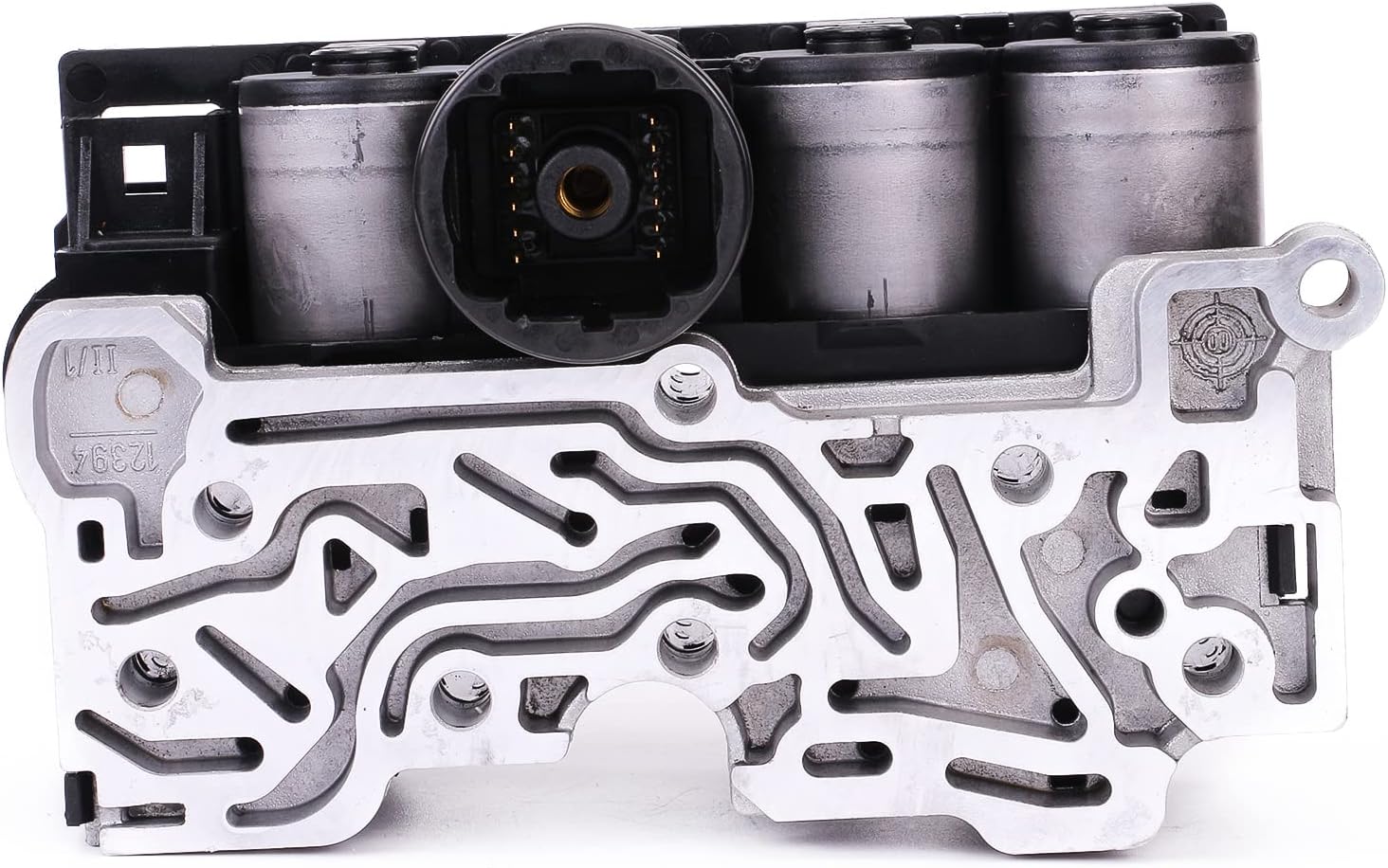
5R55W Shift Solenoid Block Pack 2002-Up for Explorer
The complete solenoid body for the Explorer and Mountaineer 5R55W. Swap it when the PC or shift solenoid codes and a pressure test both point at the solenoid body, not before.
View the Explorer solenoid pack →Need something else? Browse all 5R55W parts at Core Transmission Parts.
Problem 2: Overdrive Planetary Failure
The second big one is a destroyed overdrive planetary. The pinions run dry, the planet welds itself or sheds pinion gears, and the truck loses gears or makes metal. Wayne Colonna's write-up in Motor Age traces it to lubrication loss: a malfunctioning cooler bypass/thermal valve line-up in the valve body reduces lube to the coast clutch drum and the center lube for the overdrive planetary, while rear lube, fed from the pressure regulator valve, stays normal [6]. On the 5R55N/S/W the thermal bypass valve is inside the transmission, not out in the cooler, and Colonna notes Ford's thermal valve can stay closed too long before cooler flow starts [6].
Why this hits Explorers so hard: these trucks tow, they carry families and gear up long grades, and the fluid is rarely changed. A thermal valve that holds back cooler flow during warm-up plus marginal lube flow to the front planet is a slow-motion failure that shows up at 120,000-180,000 miles.
The second half of the problem is what happens after the rebuild. Colonna documents units that come back from overhaul with erratic shifts: flares, slide-bump shifts and harsh shifts that change from one shift cycle to the next [6]. The cause is a sticking pump flow control valve, which feeds oil to pressure control solenoids A, B and C, and a sticking solenoid regulating valve, which feeds the TCC and shift solenoids, often after the same overheat event that killed the planet [6]. If you replace the planet and reuse the pump without servicing those two valves, the shift quality will be all over the place. The corrective kit described in the article (Superior's K5R55/W/N/S) includes a new pump flow control valve, updated solenoid regulating valves, and a redesigned cooler bypass/thermal valve line-up that the author says nearly triples lube flow to the overdrive planets [6].
Problem 3: The 2002-2004 Front Planet Bearing
This one is specific to the W, which is why it matters on the Explorer. Sonnax says the 5R55W front planet bearing in 2002-2004 Explorers and Mountaineers was "especially prone to failure," and the front planet and sun gear were not carried over to the 5R55S [4]. The failure starts when the center of the bearing cage on the sun gear side gets stamped out, and it ends in a catastrophic failure if nobody catches it [4]. A growl or whine that changes with load in the lower gears, followed by bronze-colored debris on the pan magnet, is the usual warning.
The bearing isn't sold separately and can't be replaced without taking the planet apart, so the factory answer is a new planet, Ford part number 2L2Z-7A398-AA [4]. If you catch it early and the planet-side race is still serviceable, Sonnax describes a substitution using the bearing from between the stator support and direct drum of an RE4F02A. It is 0.020 in. thinner than the original, so you make up the difference with a front endplay shim between the sun gear and bearing: 0.010 in. (77406-10) or 0.015 in. (77409-15) [4]. Either way, recheck endplay after assembly.
Problem 4: Solenoid Body and Pressure Control Faults
The 5R55W is fully electronic. Ford's diagnostic data describes four shift solenoids (SSA, SSB, SSC, SSD) and three pressure control solenoids (PC-A, PC-B and PC-C) that set line pressure and band and clutch apply pressure [1]. They all live in one solenoid body bolted to the valve body. When that body acts up, the complaints are harsh or flared shifts, wrong gear starts, or a failsafe gear.
Read the codes before you buy anything. Ford's DTC chart for the 2002 Explorer 5R55W/S ties circuit codes to specific symptoms. A few worth knowing [1]:
| DTC | Ford description | What the driver notices |
|---|---|---|
| P0750 / P0753 | SSA solenoid circuit/hydraulic failure | If shorted, no 4th or 5th gear; if open, no 1st gear |
| P0755 / P0758 | SSB solenoid circuit/hydraulic failure | If shorted, no 1st gear; if open, no 3rd gear |
| P0765 / P0768 | SSD solenoid circuit failure | No engine braking in manual gears |
| P0775 / P1789 | PC-B solenoid circuit failure | If shorted, low PC-B pressure, limited engine torque, no 2nd and 5th |
| P0732 / P0733 / P0735 | No 2nd / 3rd / 5th gear (ratio error) | RPM higher or lower than expected (think servo bores first) |
| P0715 / P0720 | Insufficient input from TSS / OSS sensor | Harsh shifts, abnormal shift schedule |
An electrical code (open or short) on one solenoid is a legitimate reason to replace the solenoid body. A ratio code with no electrical code is usually mechanical, and a new solenoid pack won't fix a worn servo bore. Unplug the case connector and look for fluid wicking up the harness or corrosion on the pins while you are there; a bad connection can set codes on several solenoids at once.
How to Diagnose It With a Gauge, Not a Guess
Line pressure
Ford's line pressure procedure is to tee a gauge into the line pressure tap, watch engine RPM on the scan tool, set the service and parking brakes, and check every range [1]. For the 4.0L Explorer and Mountaineer, Ford's table lists roughly 75-120 psi at idle in Park/Neutral, 145-190 psi at idle in Reverse and 80-110 psi at idle in the forward ranges, rising to 228-263 psi forward and 282-350 psi in Reverse at WOT stall [1]. Confirm the figures against the table for your engine, since the 4.6L has its own rows. Ford's own interpretation is useful: low at idle in all ranges points at low fluid, a bad filter or filter seal, loose valve body bolts, pump or pump gasket leakage, case leakage, or a bad valve body or separator plate [1].
Stall speed
Ford's stall spec for the 5R55W/S is 2557-3036 rpm on the 4.0L and 2687-3150 rpm on the 4.6L [1]. Run the line pressure test first; Ford warns that stalling a unit with low pressure will do more damage [1]. Low stall in all ranges means poor engine performance or a faulty converter stator one-way clutch [1]. High stall in a specific range points at the clutch or band applied in that range.
Scan tool data
Watch TFT (transmission fluid temperature), the commanded gear, and the turbine and output shaft speeds together. A flare shows up as turbine speed climbing during a shift while output speed stays flat. If TFT climbs well past normal on a highway run with no tow load, think about cooler flow and the internal bypass valve from Problem 2.
Fluid, Capacity and Service: Ford's Numbers
Ford specifies MERCON V (XT-5-QM or XT-5-DM) for the 5R55W/S and warns that any other fluid could damage the transmission [2]. Total capacity is 12.6 quarts (12.0 L) [2]; a pan drop only gets a fraction of that out. There is no dipstick to guess with. The level is set with the check plug: monitor TFT with a scan tool, run the engine until TFT is between 81 and 120°F (27-49°C), and with the engine running in Park, remove the level plug in the pan with a 3/16 in. Allen key while holding the larger drain plug with a wrench [2]. Ford's fill tool is 307-437, and if you are using pressurized fill equipment Ford says to cut it to one psi or fluid will come out of the vent [2].
The pan has 16 bolts, tightened in a crisscross sequence to Ford's torque spec, and the pan gasket is reusable if it cleans up and inspects good [2]. Ford's normal service interval is fluid and filter at 150,000 miles, dropping to 30,000 miles for towing, sustained temperatures above 90°F, heavy loads or hilly terrain, dusty or off-road use [2]. Most Explorers qualify for the severe schedule. On a truck this age with servo bore and planet lube weaknesses, 30,000 miles is cheap insurance.
One more Ford requirement that gets skipped: after a rebuild or a replacement unit, the cooler must be replaced or the cooler tubes cleaned and backflushed, and Ford spells out a cooler flow test [1]. Debris left in the cooler from a failed planet will go straight back into the new unit.
Repair Order That Saves Money
- 1. Codes and fluid — electrical codes versus ratio codes, and a correct plug-method level check [2].
- 2. Line pressure in every range — against Ford's table [1].
- 3. Pan inspection — band material, bronze bearing debris, steel from a planet.
- 4. Solenoid body — only with an electrical code or a confirmed pressure control fault.
- 5. Rebuild — sleeve the servo pin bores [5], inspect the front planet bearing [4], service the pump flow control and thermal bypass valves [6], and flush the cooler.
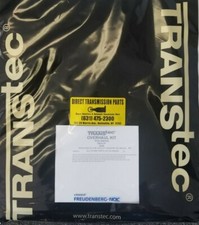
Rebuild kits, solenoid packs, planetaries and filter kits for the 2002-2005 Explorer and Mountaineer 5R55W, with checkout on our site.
Shop 5R55W parts →FAQ
What are the most common 5R55W problems in the Explorer?
Worn servo apply pin bores in the case are the biggest one, causing 1-2, 2-3 and 4-5 flares, ratio codes, delayed Reverse and burnt bands. After that come overdrive planetary failures from poor lube flow past the internal thermal bypass valve, the front planet bearing on 2002-2004 5R55W units, and solenoid body or pressure control faults. Read the codes and check line pressure before deciding which one you have.
How much transmission fluid does a 2002-2005 Explorer 5R55W hold?
Ford lists 12.6 quarts (12.0 L) total capacity and specifies MERCON V. A pan drop only removes part of that. The level is set with the check plug in the pan at 81-120 degrees F transmission fluid temperature with the engine running, not with a dipstick.
Why does my Explorer flare between gears?
On the 5R55W, flares on the 1-2, 2-3 and 4-5 shifts most often come from servo apply pins wearing their bores in the aluminum case. Apply oil leaks into the case and release oil cross-leaks, so the bands do not get full pressure. Sonnax lists codes 732, 733 and 735 with this wear, and the fix is reaming and sleeving the bores, not just new servo seals.
Will a new solenoid pack fix my 5R55W?
Only if the problem is the solenoid body. An electrical code on a shift or pressure control solenoid, or a pressure control fault confirmed with a gauge, justifies the swap. A gear ratio code with no electrical code is usually mechanical, such as worn servo bores or burnt bands, and a solenoid pack will not fix it.
Is my Explorer a 5R55W or a 5R55S?
Sonnax places the 5R55W in 2002-2003 Explorers and Mountaineers with the 5R55S taking over in 2004-2005, though the changeover followed build date. The reliable check is the overdrive sun gear: 24 teeth on the W and 38 teeth on the S. Confirm it before ordering hard parts.
Sources
- Ford Motor Co. service information (Mitchell reprint) — 2002 Ford Explorer, "5R55W/S Diagnosis," on the SSA-SSD and PC-A/B/C solenoids, the DTC chart, the line pressure test procedure and specifications, stall speed specifications, and the cooler flow test and backflush requirement. 5R55W/S Diagnosis (PDF)
- Ford Motor Co. service information (Mitchell reprint) — 2002 Ford Explorer, "Servicing - Explorer & Mountaineer," on the 5R55W/S application for 4.0L and 4.6L, MERCON V (XT-5-QM/XT-5-DM), 12.6 qt (12.0 L) capacity, the 81-120°F TFT check-plug procedure, fill tool 307-437, and the 150,000/30,000-mile service intervals. 5R55W/S Servicing (PDF)
- Sonnax — "Figuring Out the 5R55 Alphabet," on the W in 2002-2003 Explorers and Mountaineers, the S in 2004-2005, the 24-tooth (W) versus 38-tooth (S) overdrive sun gear, and the single PCC boss on W/S cases. sonnax.com/tech_resources/195
- Sonnax — Ed Lee, "A Fix for 5R55W Front Planet Bearing Failure," on the failure-prone bearing in 2002-2004 Explorers and Mountaineers, Ford planet 2L2Z-7A398-AA, the RE4F02A bearing substitution and the 77406-10 / 77409-15 endplay shims. sonnax.com/tech_resources/182
- Sonnax — Overdrive & Intermediate Servo Pin Bore Sleeve Kit 56361J-01K, on case pin bore wear, the 1-2/2-3/4-5 flare, 732/733/735 code, delayed Reverse and fluid-out-the-vent symptoms, and the sleeve repair and tooling. sonnax.com/parts/2207
- Motor Age / VehicleServicePros — Wayne Colonna, "Ford 5R55N/S/W's Overdrive Planetary Failure," on lube loss from the internal cooler bypass/thermal valve, erratic shifts after overhaul from the pump flow control and solenoid regulating valves, and the K5R55/W/N/S corrective kit. vehicleservicepros.com