"It's stuck in limp mode" is how most 5R55S jobs come through the door. The Explorer or Mustang has a flashing O/D OFF light, the shifts are hard, it won't pull, and it may be holding one gear or skipping two. The owner has usually already read that a solenoid pack fixes everything. Sometimes it does. Often it doesn't, and a pack thrown at a mechanical failure is $230 gone.
On this unit, limp mode isn't one fixed behavior. Ford's diagnostic data for the 5R55W/S lists a specific failure response for each fault: raise pressure, cut engine torque, drop certain gears, or run a substitute value. Once you know which response you're looking at, you know which circuit to test. This guide covers the 5R55S and 5R55W together, since they share the solenoid body, the PCM strategy and the code list. Specs trace to the sources at the bottom. Where something is my shop habit and not a published procedure, I say so.
What the PCM is working with
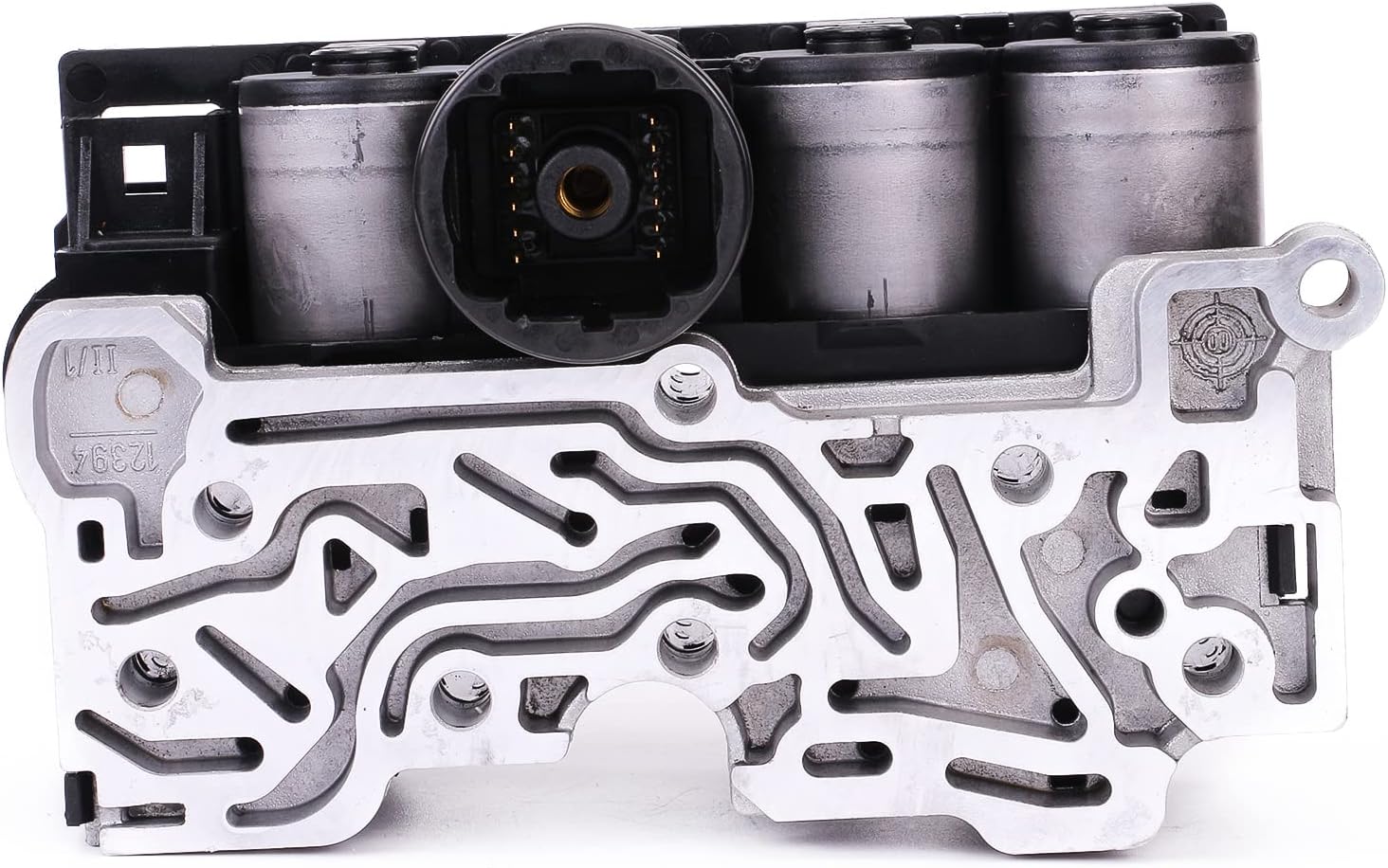
Ford's 5R55W/S diagnosis section says the PCM runs the transmission through four on/off shift solenoids (SSA, SSB, SSC, SSD), one pulse-width-modulated TCC solenoid, and three pressure control solenoids (PC-A, PC-B, PC-C). They all live in one solenoid body bolted to the valve body, along with the transmission fluid temperature (TFT) sensor. The same section says the PCM has "built-in self-diagnosis" and a fail-safe operating mode.
Jesse Zacarias explained the division of labor in Transmission Digest: the four shift solenoids line up the valves, and the three variable-force solenoids control how fast each clutch and band applies and releases. ATRA's 2013 seminar notes fill in the rest:
- PC-A (with PC-B) sets mainline pressure, and through the VFS1 modulator it applies the intermediate servo in 3rd.
- PC-B feeds the VFS2 modulator, which directly applies the overdrive servo and the coast clutch.
- PC-C controls reverse engagement and directly applies the direct clutch in 4th and 5th.
That map matters because each limp-mode response in Ford's code table lines up with one of those circuits.
Is it really limp mode? Read the O/D OFF light
Before anything else, look at the lamp. Ford calls it the Transmission Control Indicator Light (TCIL), labeled O/D OFF.
- Steady light: that's the Transmission Control Switch on the shifter. Pressing it cancels 5th and turns on the coast clutch, and cycling the ignition re-enables 5th. A truck stuck in 4th with a steady light may just have a sticking switch. Ford lists P1780 for a TCS that isn't changing states.
- Flashing light: per Ford, the TCIL flashes when a PC solenoid is open, shorted to voltage or grounded, or when the PCM has a fault in a monitored sensor used for transmission control. That's the real failure strategy, and there will be a code.
What each fault does to the truck
This is condensed from Ford's 5R55W/S DTC table. If the symptom your customer describes matches one of these rows, test that circuit first.
| DTC | Fault | What the driver feels (per Ford) |
|---|---|---|
| P0775, P1789, P0779 | PC-B circuit short / failure | Low PC-B pressure, limits engine torque, no 2nd and no 5th |
| P1788 | PC-B circuit open | Maximum PC-B pressure, harsh engagements and shifts |
| P1747, P1760 | PC-A short to ground | Low PC pressure, limits engine torque, slips in gear, 3rd incorrect |
| P1746, P0745 | PC-A open | Maximum PC-A pressure, harsh engagements and shifts |
| P0799, P0795, P0797 | PC-C short / failure | Low PC-C pressure, limits engine torque, wrong ratio in 4th and 5th |
| P0796 | PC-C open | Maximum PC-C pressure, harsh engagements and shifts |
| P0750, P0753, P1714 | SSA | Shorted: no 4th or 5th. Open: no 1st |
| P0755, P0758, P1715 | SSB | Shorted: no 1st. Open: no 3rd |
| P0708 | Digital TR sensor TR3A open | Higher control pressure, defaults to the OD position in all ranges |
| P0712 / P0713 | TFT reads 315°F / -40°F | Firm shift feel |
| P0715, P0717, P0720 | Turbine or output speed sensor | Harsh shifts, abnormal shift schedule |
| P1783 | Transmission overheating (270°F) | Increased PC pressure |
| P1700 | Direct one-way clutch failure | FMEM active; no 1st, 3rd or 4th in automatic mode |
Three patterns jump out. A shorted PC solenoid gives low pressure and the PCM pulls engine torque to protect the clutches. That's the "won't pull, feels choked" limp mode. An open PC solenoid goes to maximum pressure and bangs every shift. And a bad sensor (TFT, TR, speed, or even the throttle position sensor, which Ford says drives the PCM into fail-safe with raised line pressure) makes the unit shift hard and on a strange schedule even though nothing inside is broken.
Step 1: pull every code and read them in order
Get KOEO, KOER and continuous codes, including engine codes. Ford's table lists MAF, TP, ECT and ignition faults as causes of transmission symptoms, so fix those first. Speed sensor and TR sensor codes come next, because the PCM can't calculate ratio or pick a gear without them. Our P0715 and P0720 guides cover the speed sensors.
Watch for ratio codes (P0731-P0735) stacked with a PC code. Pete Luban of ATSG made this point in Transmission Digest's "False Pretenses": on a 2002 Explorer with P0732, P0735 and P0775, the P0775 was a pressure-control performance code, not an electrical fault, and the real problem was a worn servo pin bore. A PC code that shows up with ratio codes and good solenoid resistance is telling you pressure didn't do what was commanded, not that the solenoid is dead.
Step 2: test the solenoid body from the case connector
All of this is done at the 16-pin case connector, using Ford's specs. It takes 15 minutes and it's the test that decides whether a solenoid pack is justified.
- Power feed. Key on, connector unplugged: terminal 3 to chassis ground should be more than 10 volts. If not, repair the feed before blaming the pack.
- Shift solenoid resistance, terminal 3 to each solenoid terminal (SSA 16, SSB 15, SSC 6, SSD 5): 16-45 ohms. TCC (terminal 14): 9-16 ohms.
- PC solenoid resistance: 3.3-7.5 ohms each.
- Shorts to ground. Terminals 3, 5, 6, 14, 15 and 16 to chassis ground: if any read under 5 ohms, Ford says replace the solenoid body.
- Harness side. Ford defines an open as more than 5 ohms and a short as less than 10 k-ohms to ground. Backprobe the PCM connectors; don't push probes into the terminals.
If the pack passes, use the scan tool's output state control. In TRANS-BENCH mode, command each shift solenoid on and off and listen for the click while you wiggle the harness. In TRANS-DRIVE mode with the engine running and vehicle speed above 2 mph, you can command 1st through 5th directly. If the unit upshifts and downshifts on command, the electrical side is doing its job and the problem is hydraulic or mechanical.
Step 3: check the TFT sensor
A bad TFT reading causes a firm shift and wrong TCC scheduling. It sits on the solenoid body, so a bad sensor means a new solenoid body. Monitor the TFT and TFTV PIDs while the unit warms up; they should rise steadily. At the connector, terminal 2 should show a 4.5-5.5 volt reference, and resistance between terminals 2 and 12 should follow Ford's table:
| Fluid temperature | TFT resistance |
|---|---|
| 32-68°F | 37-100 k-ohms |
| 69-104°F | 16-37 k-ohms |
| 105-158°F | 5-16 k-ohms |
| 159-194°F | 2.7-5 k-ohms |
| 195-230°F | 1.5-2.7 k-ohms |
Step 4: when the electrical tests pass
This is where the solenoid pack stops being the answer. Several hydraulic failures produce the same codes and the same limp strategy.
Worn solenoid and converter feed limit valve bores
Every solenoid is fed from a regulated supply. Sonnax lists "codes 731 to 741," delayed engagement, no lockup, overheating and front lube failure for wear in the 5R55W/S solenoid feed limit and converter feed limit valve bores, and sells oversized valve kit 56947J-61K (tool kit F-56947J-TL61) to fix it. A new solenoid pack on a worn feed bore still gets unstable supply oil. If you're pulling the valve body anyway, check these bores.
The wrong solenoid pack for the year
ATRA found that using the wrong pack design changes solenoid output enough to cause flare shifts. The 2002-03 Ford W or S and 2003 Lincoln use the early pack, 1L2Z-7G391-AG. The 2004-on Ford units and 2004-06 Lincoln use the later design, and Ford recommends only the updated 9L2Z-7G391-A for those. If limp mode started right after a pack swap, check the part number first.
Servo pin bore wear
Ratio codes for 2nd, 3rd and 5th with good solenoid readings point at the servo pin bores in the case. Sonnax's sleeve kit 56361J-01K is the fix, and our servo pin bore guide covers it.
Overheating
Ford sets P1783 at 270°F and raises PC pressure in response. Find out why it's hot: low fluid, a slipping TCC, or a restricted cooler.
Step 5: fluid level, the Ford way
There's no dipstick on the 5R55S. Ford's servicing procedure checks level at the case plug with the engine running in Park and the TFT PID between 81 and 120°F. Fill until fluid drips out of the check hole. A low unit cavitates the pump, pressure drops, and the PCM sees ratio and pressure faults that look electrical. Our fluid guide has the full procedure and the MERCON V spec.
Replacing the solenoid body
If the pack failed the tests, Ford's procedure is short but has two traps. Install two new O-rings on the solenoid body connector and make sure the connector is fully seated before you tighten its bolt. Then torque the solenoid body bolts in sequence to 71 in-lb. Ford's caution is blunt: tightening past spec damages the solenoid body. I've seen more than one new pack cracked by a guy with a 3/8 ratchet and no torque wrench.
Verify with Ford's drive cycle
Clear codes and run Ford's transmission drive cycle: warm up, accelerate from a stop to 50 mph in D, hold 5th for at least 15 seconds, tap the brake, hold 5 more seconds, stop for 20 seconds, and repeat at least five times. Ford notes a fault has to repeat 4 consecutive times to store P0731-P0734 and 5 times for P0741 and P1740, so one short road test won't prove the fix. Re-scan after the full cycle.
My diagnostic order
This is my sequence, not a Ford procedure:
- Note whether the O/D OFF light is steady or flashing.
- Pull all codes. Fix engine, TP, TR and speed sensor faults first.
- Set the fluid level at 81-120°F TFT.
- Match the complaint to Ford's DTC effect table.
- Test the solenoid body at the 16-pin connector: 10+ volts on terminal 3, 16-45 ohms on the shift solenoids, 3.3-7.5 ohms on the PC solenoids, no shorts to ground.
- Command gears in output state control. If the unit shifts on command, stop suspecting the electrical side.
- If everything electrical passes, look at the feed limit valve bores, the solenoid pack part number, and the servo pin bores.
5R55S shift solenoid block pack, 2002-up Explorer
If the 16-pin tests show an open or shorted PC or shift solenoid, or a TFT sensor out of range, the solenoid block pack is the fix. Match the pack design to the model year before you buy. Sold by our sister store, CoreTransmissionParts.
Shop the part for this fix →Need the Sonnax feed limit valve kit, servo sleeves or a valve body instead? The 5R55S parts collection has them.
Need parts for this job?
Our 5R55 parts page carries 5R55S and 5R55W solenoid packs, solenoid kits, valve bodies, rebuild kits and filter kits for the Explorer, Mountaineer and Mustang units. Checkout is on site.
FAQ
What causes a 5R55S to go into limp mode?
The PCM switches to a failure strategy when it sees a fault in a pressure control solenoid, a shift solenoid, or a sensor it relies on, like the TFT, transmission range or speed sensors. Depending on the fault, it raises line pressure, limits engine torque, or drops certain gears. The flashing O/D OFF light is the tell that a fault has been stored.
Why is the O/D OFF light flashing on my Explorer?
Ford says the light flashes when a pressure control solenoid is open, shorted to voltage or grounded, or when the PCM detects a fault in a sensor used for transmission control. A steady light just means overdrive was cancelled with the shifter button. Pull the codes to see which circuit set it.
Will a new solenoid pack fix 5R55S limp mode?
Only if the pack actually failed. Test it at the 16-pin connector first: shift solenoids should read 16-45 ohms, pressure control solenoids 3.3-7.5 ohms, and nothing should be shorted to ground. If it passes and the unit shifts when commanded with a scan tool, the problem is hydraulic, such as worn feed limit valve bores or servo pin bores.
Can I drive a 5R55S in limp mode?
Only far enough to get it to a shop. A shorted pressure control solenoid gives low pressure, and running an automatic on low pressure slips and burns clutches and bands. An open solenoid gives maximum pressure and harsh shifts that shock the geartrain. Park it and get a scan tool on it.
Related guides
- 5R55S Shift Solenoid Symptoms and Replacement
- 5R55W P0700 Fix
- 5R55S Won't Shift Into Overdrive
- 5R55S Slipping: Causes and Fix
- Ford 5R55S and 5R55W Transmission Problems
Sources
- Ford service information via Mitchell1, "2002 Automatic Transmissions 5R55W/S Diagnosis" (Explorer). Backs the four shift solenoids, PWM TCC solenoid and PC-A/B/C layout, the fail-safe mode, TCIL flashing conditions and the TCS/P1780 behavior, the DTC failure-effect table, TP sensor fail-safe with raised line pressure, the 16-pin connector tests (terminal 3 above 10 V, SSA 16/SSB 15/SSC 6/SSD 5/TCC 14, 16-45 ohm shift and 9-16 ohm TCC, 3.3-7.5 ohm PC solenoids, under 5 ohm short-to-ground limit), output state control modes, the TFT resistance table and 4.5-5.5 V reference, and the drive cycle with 4 and 5 consecutive failures to set codes. Ford/Mitchell diagnosis (PDF)
- Ford service information via Mitchell1, "2002 Automatic Transmissions Servicing - Explorer & Mountaineer" (5R55W/S). Backs the fluid level check at 81-120°F TFT at the check plug, the two new connector O-rings, the solenoid body bolt sequence and the over-torque caution, and the 71 in-lb solenoid body bolt spec. Ford/Mitchell servicing (PDF)
- ATRA, 2013 Technical Seminar manual, "Ford 5R55W/S Erratic Transmission Operation" (pp. 112-120). Backs PC-A/PC-B mainline control, PC-A via VFS1 applying the intermediate servo, PC-B via VFS2 applying the overdrive servo and coast clutch, PC-C applying the direct clutch in 4th and 5th, and the solenoid pack part numbers 1L2Z-7G391-AG, 4L2Z-7G391-AA and 9L2Z-7G391-A. atracom (PDF)
- Jesse Zacarias, "Understanding the 5R55S/W Initial Engagements," Transmission Digest. Backs the shift solenoids aligning valves while the three variable-force solenoids control apply and release rates. transmissiondigest.com
- Pete Luban (ATSG), "False Pretenses," Transmission Digest. Backs the 2002 Explorer case with P0732, P0735 and P0775 where P0775 was a pressure-control performance code and the cause was servo pin bore wear. transmissiondigest.com
- Sonnax, "Oversized Solenoid & Converter Feed Limit Valve Kit" 56947J-61K. Backs codes 731 to 741, delayed engagement, no lockup, overheating and front lube failure from worn feed limit valve bores on the 5R55W/S, and tool kit F-56947J-TL61. sonnax.com. The servo pin bore sleeve kit 56361J-01K is on sonnax.com.