From 2005 through 2010, every automatic S197 Mustang, the 4.0L SOHC V6 and the 4.6L three-valve GT alike, left the factory with the Ford 5R55S five-speed. For 2011 Ford moved the car to the 6R80, which makes the 5R55S Mustang a closed population of cars that are now 15 to 20 years old, many with a tune, a set of gears or a few drag-strip passes in their history. The transmission is the same basic 5R55 family that went into the Explorer, but the Mustang uses it harder, and it shows in what comes across the bench.
This is the short list of what actually fails on these cars, in the order I check it, with the Ford specs, bulletin numbers and trade sources to back each one up. Where something is my shop experience and not a published number, I say so.
The short version: On a 2005-2010 Mustang 5R55S, the number one hard failure is servo apply pin bore wear in the case, which loses or flares 2nd, 3rd and 5th and is covered by Ford TSB 09-12-12 [6]. Next are harsh or erratic shifts from pressure control, TFT or valve body problems [2], the 2009-up valve body and spacer plate that will not interchange with earlier parts [4] [5], and low fluid on a unit with no dipstick. Ford specifies MERCON V, 11.9 qt (11.2 L) approximate dry capacity [1].
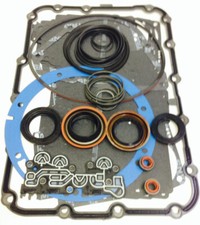
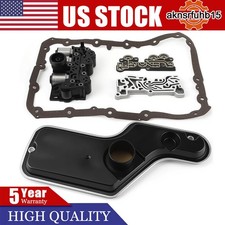

Problem 1: Worn Servo Apply Pin Bores (Lost 2nd, 3rd or 5th)
This is the failure that ends most 5R55S Mustang transmissions. The 5R55 uses three bands, and the overdrive and intermediate band servos push apply pins that ride directly in bores machined into the aluminum case, with no sleeve or bushing [2] [6]. Every apply and release moves the pin, and over the years the bore wears oval.
Sonnax explains exactly why that hurts. Servo apply oil is fed through the center of the case bridge into the pin and acts on the cover side of the piston. As the bore wears, that apply oil leaks into the barrel area of the case, which drops band apply pressure and throws off shift timing. Release oil goes the other way, cross-leaking into the apply circuits and exhausting at the shift valves [6]. Sonnax lists the symptoms as 1-2, 2-3 and 4-5 flares, gear loss, codes 732, 733 and 735, band lining failure and loss of overdrive and intermediate servo control [6].
Ford addressed it on the Mustang in TSB 09-12-12, which covers shift concerns on 2005-2009 Mustangs with the 5R55S: lost 2nd, 3rd and 5th gear caused by overdrive or intermediate band failure from servo pin case bore wear and the resulting low apply pressure. Owners on Mustang forums describe the classic version: shifts fine cold, then starts flaring or drops a gear once the fluid is hot. That fits the mechanism. Thinner hot fluid leaks faster past an oval bore.
How to recognize it on the scan tool:
- Ratio codes with no electrical codes. P0732, P0733 and P0735 are the 2nd, 3rd and 5th gear ratio errors. Ford's chart describes them as RPM higher or lower than expected [2]. If those set and the solenoid circuits are clean, think case, not solenoids.
- Turbine speed flares during the shift. Log turbine shaft speed and output shaft speed. On a good shift, turbine speed drops smoothly to the new ratio. On a worn bore it hangs or climbs before the band catches.
- Delayed reverse. In reverse both servos are charged from the release side, so bore wear also shows up as a slow reverse engagement [6].
- Line pressure that sags in specific ranges. Ford's line pressure test results list low pressure in all forward ranges, in "N" only, or in manual 2 or 3 as overdrive or intermediate servo leakage among the causes [2].
The fix is mechanical. The bores get reamed and sleeved with the Sonnax 56361J-01K kit, which carries an overdrive and an intermediate repair sleeve and installs with the S-56361J-TL tool kit and the SERVO-FIX fixture [6]. Ford's bulletin uses the same ream-and-sleeve approach. New servo pistons and seals in an oval bore will feel better on the test drive and come back. If the bands are already burned, the job is a rebuild with new bands, and a case that has worn too far gets replaced.
5R55S Servo Bore Sleeve Kit, Complete Set (Sonnax)
The full set of Sonnax servo bore sleeves for the 5R55S case. This is the repair Ford's TSB 09-12-12 points at, and the one that keeps a rebuilt Mustang unit from flaring again.
View the 5R55S sleeve kit →Need something else? Browse all 5R55S parts at Core Transmission Parts.
Problem 2: Harsh, Firm or Inconsistent Shifts
The 5R55S has more electronics in the shift than people expect. Ford's description lists four on/off shift solenoids (SSA, SSB, SSC and SSD), a PWM solenoid for the converter clutch, and three pressure control solenoids (PC-A, PC-B and PC-C) that set line pressure and band and clutch apply pressure [2]. That means a harsh shift can be electrical, hydraulic or mechanical, and the order you check them in matters.
Check the inputs first
The PCM uses transmission fluid temperature to set pressure and shift scheduling. Ford's code chart defines P0713 as the TFT sensor reading -40°F, which is an open circuit, and a cold reading makes the PCM run firm shifts [2]. Before anything else, compare the TFT PID with engine coolant temperature on a warm car. If TFT reads -40°F or never climbs, you have a circuit or connector problem, not a valve body problem.
Then the solenoid circuits
With the 16-pin case connector off, Ford's specs are 16-45 ohms for SSA through SSD and 9-16 ohms for the TCC solenoid [2]. Ford defines an open circuit as more than 5 ohms in a harness or connection check and says to clean any connection approaching that [2]. Ford's chart lists PC-A faults (P0745/P1746) with harsh engagement and slipping among the symptoms [2], so a PC-A code plus harsh shifts is a solenoid body job.
Then the hydraulics
If the electrical side checks out, put a gauge on the line pressure tap. Ford's diagnosis lists high line pressure at idle in all ranges as wiring, the boost valve, the PC solenoid or the main regulator valve, and low at idle in all ranges as fluid level, filter or filter seal, loose valve body bolts, pump leakage or a bad valve body or separator plate [2]. Ford's published pressure table in that manual is for the Explorer application, so use it to read the pattern, not as a Mustang calibration number. Ford also warns not to hold WOT on a stall test for more than 5 seconds [2].
One Mustang-specific note from the shop: a lot of these cars have a tune. Raising shift pressure through the PCM makes the car feel crisp, but it also means a harsh shift may be what someone paid for, and higher apply pressure on a pin that is already wearing its bore speeds up the Problem 1 failure. Ask about tuning before you chase a "harsh shift" complaint.
Problem 3: The 2009-2010 Valve Body Is Not the Same Part
ATSG reported in Transmission Digest that beginning with the 2009 model year, Ford vehicles with the 5R55S got a redesigned valve body and bonded spacer plate, with changes to the VFS 1, VFS 2 and line pressure passages. None of the 2009 valve body and spacer plate parts retrofit to earlier applications [4]. ATSG has seen shops put the 2009 plate on an earlier valve body. The extra hole connects a line pressure passage to the VFS 2 circuit and produces a harsh 1-2 upshift and a flared 2-3 upshift [4]. The current Ford bonded spacer plate is 9L2Z-7Z490-B [4].
Sonnax's identification guide makes it easy to tell them apart. Rough forging numbers are RF1L2P 7A101GA or RF5L2P 7A101CA for 2001-2008 and RF9L2P 7A101AA for 2009-up, and the forging number moved location on the casting [5]. Jeff Parlee's Transmission Digest write-up adds that the 2009 casting has a 09 date cast in, revised worm tracks, smaller VFS 1 and VFS 2 separator plate holes, and the same two checkball locations as earlier units, plus a 2009-up bulletin, 09-21-4, for a whistle at hot idle in all gears that is fixed with an updated separator plate identified by two small holes near the servo bore [5].
For a Mustang, that means:
- A 2009 or 2010 car is not a donor for a 2005-2008 car's valve body, and the reverse is also true. Read the forging number before you buy a used or remanufactured unit.
- A car that went harsh 1-2 and flared 2-3 right after valve body work gets its spacer plate checked first.
- A hot whistle in every range on a 2009-up unit is a separator plate question before it is a pump question.
Problem 4: Low or Wrong Fluid on a Transmission With No Dipstick
Ford's 2007 Mustang owner guide says it plainly: the 5R55S transmission does not have a transmission fluid dipstick, and fluid should be checked and added by an authorized dealer [1]. In practice, nobody checks it. A seeping pan gasket or cooler line goes unnoticed until the car flares hot.
| Item | Ford spec, 2007 Mustang |
|---|---|
| Transmission | 5R55S (4.0L V6 and 4.6L GT) |
| Fluid | Motorcraft MERCON V, XT-5-QM |
| Capacity | 11.9 qt (11.2 L), approximate dry, includes cooler and tubes |
| Dipstick | None |
| Additives | Ford says do not use supplemental additives, treatments or cleaning agents |
All of that is from the guide's maintenance chapter and capacity table [1]. Ford also warns that MERCON and MERCON V are not interchangeable and should not be mixed [1]. The level is set at the pan. ATRA Technical Bulletin 746 lays out Ford's method for the 5R55N, S and W: monitor the TFT PID, idle in Park with the car level on a hoist, remove the small center level plug from the larger drain plug with a 3/16-inch Allen key, fill through the 307-437 adapter until fluid runs back out, and finish with fluid between 80 and 120°F [3]. Check it outside that window and the level is wrong.
Sonnax adds a wrinkle that matters on these cars: the 5R55N, W and S are prone to foaming the fluid in the sump from excess exhaust and valve body wear, which puts fluid out the vent and gives false fill readings [6]. A Mustang that "keeps puking fluid out the vent" after a level set may be telling you about internal wear, not overfill.
Flat towing is another fluid-related trap. Ford's guide limits all-wheels-down towing of the automatic car to Neutral, 35 mph and 50 miles, and says to disconnect the driveshaft beyond that, because the transmission is not lubricated when the engine is off [1]. A Mustang that started acting up after being towed behind a motorhome has a reason.
How I Diagnose a 2005-2010 Mustang 5R55S
- Ask the history. Tune, gears, drag passes, flat towing, and when the symptom shows up: cold, hot or always.
- Set the fluid level correctly with the TFT PID in the 80-120°F window [3]. Look at the fluid on the plug. Burned band material says the job is already a rebuild.
- Pull codes and sort them. TFT and solenoid circuit codes point at the connector and solenoid body. Ratio codes (P0732, P0733, P0735) with clean circuits point at the servo bores [2].
- Ohm the solenoids through the case connector: 16-45 ohms shift solenoids, 9-16 ohms TCC [2].
- Gauge the line pressure and read the pattern against Ford's test results table [2].
- Road test with data. Log TFT, turbine speed and output speed and watch for flares on 1-2, 2-3 and 4-5 [6].
- Decide on hard parts. Solenoid body for confirmed electrical faults, the correct-year valve body for 2009-up issues [4], and a sleeved case on any rebuild [6].
Overhaul kits, shift kits, valve bodies and filter kits for the 2005-2010 Mustang 5R55S, with checkout on our site.
Shop 5R55S parts →FAQ
What are the most common 5R55S problems in a 2005-2010 Mustang?
Worn servo apply pin bores in the aluminum case are the big one, showing up as lost or flared 2nd, 3rd or 5th gear and covered by Ford TSB 09-12-12. After that come harsh or erratic shifts traced to the pressure control solenoids, the TFT signal or valve body wear, the 2009 valve body and spacer plate change that does not interchange with earlier parts, and low fluid on a transmission with no dipstick.
Does the 2005-2010 Mustang automatic have a dipstick?
No. Ford's 2007 Mustang owner guide states that the 5R55S transmission does not have a transmission fluid dipstick. The level is set at a small center plug in the pan drain plug, with the engine idling in Park, the car level on a lift, and fluid temperature between 80 and 120 degrees F on the scan tool's TFT PID.
How much transmission fluid does a 5R55S Mustang hold?
Ford lists 11.9 quarts (11.2 L) of Motorcraft MERCON V, part XT-5-QM, as the approximate dry capacity including the cooler and tubes. A pan and filter service takes back far less than that, so the final level is always set at the level plug, not by the quart count.
Why does my Mustang lose 2nd, 3rd or 5th gear when it gets hot?
That pattern points at servo pin bore wear. The overdrive and intermediate servo apply pins ride in bores machined into the case, and as the bores wear, apply oil leaks past the pin and band apply pressure drops. Thinner hot fluid leaks faster, so the flare or lost gear shows up warm. The repair is reaming and sleeving the bores, not a solenoid pack.
Can I put a 2009 5R55S valve body in a 2006 Mustang?
No. ATSG reports that the 2009 5R55S valve body casting and bonded spacer plate changed the VFS 1, VFS 2 and line pressure passages, and none of the 2009 parts retrofit to earlier applications. A 2009 spacer plate on an earlier valve body can cause a harsh 1-2 upshift and a flared 2-3 upshift.
Sources
- Ford Motor Co. — 2007 Mustang Owner Guide, "Maintenance and Specifications" (pp. 239, 244-245) and "Tires, Wheels and Loading" (p. 156), on the 5R55S having no dipstick, Motorcraft MERCON V XT-5-QM, 11.9 qt (11.2 L) approximate dry capacity including cooler and tubes, the MERCON/MERCON V and no-additive warnings, and recreational towing limits. 2007 Mustang Owner Guide (PDF, archive.org)
- Ford Motor Co. service information (Mitchell reprint) — "5R55W/S Diagnosis," on the four shift solenoids, TCC PWM solenoid and PC-A/B/C solenoids, the DTC chart (P0713, P0732/P0733/P0735, P0745/P1746), solenoid resistance (SSA-SSD 16-45 ohms, TCC 9-16 ohms), the 5-ohm open-circuit rule, line pressure test results and stall test limits. 5R55W/S Diagnosis (PDF)
- ATRA — Technical Bulletin 746 (February 2003), "5R55N, 5R55S & 5R55W: New Rotunda Tool for Checking Fluid Level and Filling Transmissions," on the no-dipstick fill plug, the TFT PID 80-120°F window, the 3/16-inch level plug and the 307-437 adapter. ATRA TB 746 (PDF)
- Transmission Digest (ATSG), December 2018 Tech/Talk, "Ford 5R55S: Avoid 1-2 harsh shifts and 2-3 flared shifts," on the 2009 valve body and spacer plate redesign, non-interchangeability, the VFS 2 cross-feed symptom, and spacer plate 9L2Z-7Z490-B. transmissiondigest.com
- Sonnax — "5R55S/W Valve Body Identification," on 2001-2008 vs 2009-up rough forging numbers (RF1L2P/RF5L2P vs RF9L2P 7A101AA) and VFS separator plate changes; and Transmission Digest, Jeff Parlee, "Valve-Body and Plate Changes for the 5R55S" (April 2013), on the 09 date casting, checkball locations and TSB 09-21-4. sonnax.com | transmissiondigest.com
- Sonnax — Overdrive & Intermediate Servo Pin Bore Sleeve Kit 56361J-01K, on how pin bore wear leaks apply and release oil, 1-2/2-3/4-5 flares, 732/733/735 codes, delayed reverse, sump foaming, and the S-56361J-TL and SERVO-FIX tooling. sonnax.com/parts/2207