Ford put the 6R80 behind the Mustang for the 2011 model year, in the V6 and the 5.0L GT, and kept it through the 2017 cars before the 10R80 took over for 2018. That covers the last four years of the S197 body and the first three years of the S550, which got the 3.7L, the 5.0L and the 2.3L EcoBoost with the same six-speed. The F-150 gets most of the attention, and our 6R80 F-150 problems guide covers the truck. The Mustang shares the transmission but not all of the campaigns. It also has two bulletins of its own: a converter whine and a driveshaft clunk that gets blamed on the transmission all the time.
This page is organized the way a Mustang should be checked in: by model year and build date first. Ford split almost every one of these programs by build date at Flat Rock, so a 2012 built in March can be outside a campaign that covers a 2012 built in January. Pull the date off the door tag before you plug in a scan tool. Run the VIN through Ford or NHTSA recall lookup too. Every document below is linked in the Sources section.


Mustang 6R80 recall and bulletin map
| Mustang | Complaint | Ford's stated cause | Document |
|---|---|---|---|
| 2011-2014, built on or before 8-Apr-2013 | Takes off in 5th, speedometer at zero, odometer dashes, wrench light | Molded lead frame | TSB 13-6-8 |
| 2012-2013, built 17-Oct-2011 to 9-Jan-2012 | Intermittent no Reverse, no R in the gear display, no backup lamps or camera | Transmission range sensor, part of the lead frame | Compliance Recall 12C23 |
| 2012, built 19-Aug-2011 to 21-Feb-2012 | MIL or wrench light, sudden downshift into 1st | Intermittent output shaft speed (OSS) signal | Recall 16V-248 (Ford 16S19), program 16N02 |
| 2013 3.7L, built 1-Apr-2012 to 1-Jul-2012 | Whine from the bell housing on acceleration that stops at converter lockup | Torque converter | TSB 13-6-4 |
| 2015-2017 3.7L and 5.0L, built on or before 1-Apr-2017 | Clunk or ping on Park to Reverse, Park to Drive, or Drive to Reverse | Driveshaft NVH | SSM 49083 |
Three of those five rows come back to one part: the molded lead frame bolted to the valve body. GEARS Magazine's David Chalker lists what lives on it in the 2011-and-later unit: the output shaft speed sensor, the turbine shaft speed sensor, the fluid temperature sensor and the range sensor. When any one of those signals goes bad, the PCM is shifting on bad information, and the symptom depends on which signal it lost.
Problem 1: Takes off in 5th gear (2011-2014)
This is the Mustang complaint you will see most on S197 cars. Ford's TSB 13-6-8, published 7 June 2013, covers 2011-2014 Mustangs built on or before 8 April 2013. The car pulls away from a stop in 5th instead of 1st. The wrench light or the seat belt minder may come on, the speedometer reads zero and the odometer shows dashes while the car is moving. Ford notes that the symptoms may clear after a key cycle, and that P0720 and P0722 may or may not be stored.
Read that symptom list as a mechanic. A dead speedometer and dashes in the odometer mean the PCM has lost output speed. With no output speed it cannot calculate a gear ratio, so it falls back to a gear that will not over-rev the engine.
The fix in the bulletin is the molded lead frame, Ford part AL3Z-7G276-A. Ford is specific that the shift solenoids do not need to be replaced. Ford allowed 2.2 hours for the Mustang, a tenth more than the F-150.
How to confirm it before you pull the pan
- Pull codes from the PCM, not just a generic reader. P0720 is the output speed sensor circuit and P0722 is no signal. Stored history codes count even if the car is driving normally today.
- Graph output shaft speed against vehicle speed on a road test. On a healthy car the two track together. When the lead frame drops out, OSS goes to zero or spikes while the car is still moving.
- Wiggle the transmission harness at the case connector with the engine running and the data graphing. A dropout that follows harness movement points to the connector or the external harness, not the lead frame.
- Check the build date. If it is after 8 April 2013, the 13-6-8 fix is not the documented answer and you should treat it as a normal P0720 diagnosis. Our 6R80 P0720 guide walks the circuit.
Problem 2: No Reverse and no backup lights (2012-2013)
Compliance Recall 12C23, dated 1 May 2012, covers certain 2012-2013 Mustangs built at the AutoAlliance plant in Flat Rock from 17 October 2011 through 9 January 2012. It is a compliance recall, not a safety recall, because the cars may not meet two federal standards: FMVSS 102, which requires the gear selected to be displayed, and FMVSS 108, which requires the backup lamps to come on in Reverse.
The cause is a faulty transmission range sensor, which Ford says is integral to the lead frame. With the shifter in Reverse, the owner can get any of these, intermittently:
- The transmission will not engage Reverse.
- The electronic PRNDL display does not show R.
- The backup lamps do not come on.
- The rear camera works on and off, if the car has one.
Ford gave dealers a special tool to test the range sensor and replace the lead frame only if it failed. Before the tool shipped, every car in the population got a lead frame. On a car outside that build window with the same complaint, check range sensor position in the scan tool data while you move the shifter through every position. A range reading that skips, flickers or disagrees with the lever is the lead frame. A no-Reverse with a correct range reading is a hydraulic or clutch problem, and our 6R80 no Reverse guide covers that path.
Problem 3: Sudden downshift into 1st (2012)
This one is a safety recall. NHTSA campaign 16V-248, filed by Ford on 25 April 2016 as recall 16S19, covered 184,000 vehicles across the F-150, Expedition, Navigator and Mustang. The Mustang population is 2012 cars built from 19 August 2011 through 21 February 2012. Ford's Part 573 report describes an intermittent loss of the output speed sensor signal to the PCM that can cause a temporary, unintended downshift into 1st. In some cases the signal recovers while driving. In others the car has to be stopped and restarted. Ford reported three accidents and no injuries tied to the condition across the affected vehicles.
The recall itself reprogrammed the PCM. The hardware side was Customer Satisfaction Program 16N02, dated 16 June 2016. It extended lead frame coverage to 10 years or 150,000 miles from the warranty start date on 2012 Mustangs built at Flat Rock from 9 August 2011 through 24 February 2012. To qualify, the PCM had to have P0720, P0722, P0731 and/or P1500 stored, or the car had to have had a downshift-to-1st event.
Here is the catch for a shop today. Ten years from the warranty start date has passed on every 2012 Mustang, so the free lead frame is gone. The recall reflash is still worth confirming, because a car that never got it will still drop to 1st when the OSS signal drops out. If the software is current and the codes are back, the repair is a customer-paid lead frame.
Problem 4: Whine on acceleration that goes away at lockup (2013 3.7L)
TSB 13-6-4, published 4 June 2013, covers 2013 Mustangs with the 3.7L and the 6R80 built from 1 April 2012 through 1 July 2012. The complaint is a whine from the torque converter housing area during acceleration that goes away once the converter clutch locks.
That last detail is the diagnosis. If the noise stops the moment the converter clutch applies, the noise is coming from something that only turns at different speeds while the converter is unlocked. Ford's fix replaces the torque converter, part BR3Z-7902-C, and the converter pump seal, part 6L2Z-7A248-AA. The parts list calls for MERCON LV (XT-10-QLV) to top off and new cooler line O-rings (7L1Z-7J227-A, four required).
A whine that does not change at lockup, or that follows engine speed in Park, is a different problem. Pump and gear noise need their own diagnosis, which we cover in our 6R80 noise guide.
Problem 5: Clunk shifting into gear (2015-2017)
On S550 Mustangs, the most common "transmission" complaint is not in the transmission. Ford's Special Service Message 49083 covers 2015-2017 Mustangs with the 3.7L and 5.0L and the 6R80 built on or before 1 April 2017. They may make a clunk or ping from the driveshaft on Park to Reverse, Park to Drive, or between Reverse and Drive. Ford released a revised driveshaft with better NVH and lists the driveshaft (4R602) as the causal part.
Before you quote a valve body or a shift kit for a clunk on an S550, get under the car with a helper running it through the range. If the noise comes from the driveshaft and not the transmission case, the SSM applies. Ford's SSM lists the 3.7L and 5.0L only. On a 2.3L EcoBoost car, do the same check, but do not assume the bulletin covers it.
Harsh or flared shifts on any year
Not every Mustang 6R80 complaint has a bulletin. Harsh 1-2 and 2-1 shifts were a known complaint on the early 6R80. Chalker writes that Ford first tried calibration updates, then for 2011 added a one-way clutch to the rear planetary. On 2011-and-later units the D clutch releases at about 3 mph and the one-way clutch holds 1st. The D/E solenoid is a normally-high solenoid that gets about 50 mA to apply the D clutch and about 850 mA to release it. The case, support, planetary, valve body, lead frame and harness all changed with it, and every Mustang 6R80 is a 2011-or-later unit, so order late-design parts.
For flares and bind-ups that remain after the software is current, Sonnax's Jim Dial lists the usual causes: adaptation problems, clutch clearance, a worn valve train leaking in a clutch control circuit, and solenoids that lose their calibration over time. Two of his points save comebacks. First, the PCM has to know the solenoid strategy and the solenoid body ID codes, so they have to be programmed in after a valve body or solenoid replacement. Second, the adapts take about three to five shift cycles to relearn, so do not judge the shift quality on the first trip around the block. Our 6R80 harsh shift guide goes deeper on the hydraulic side.
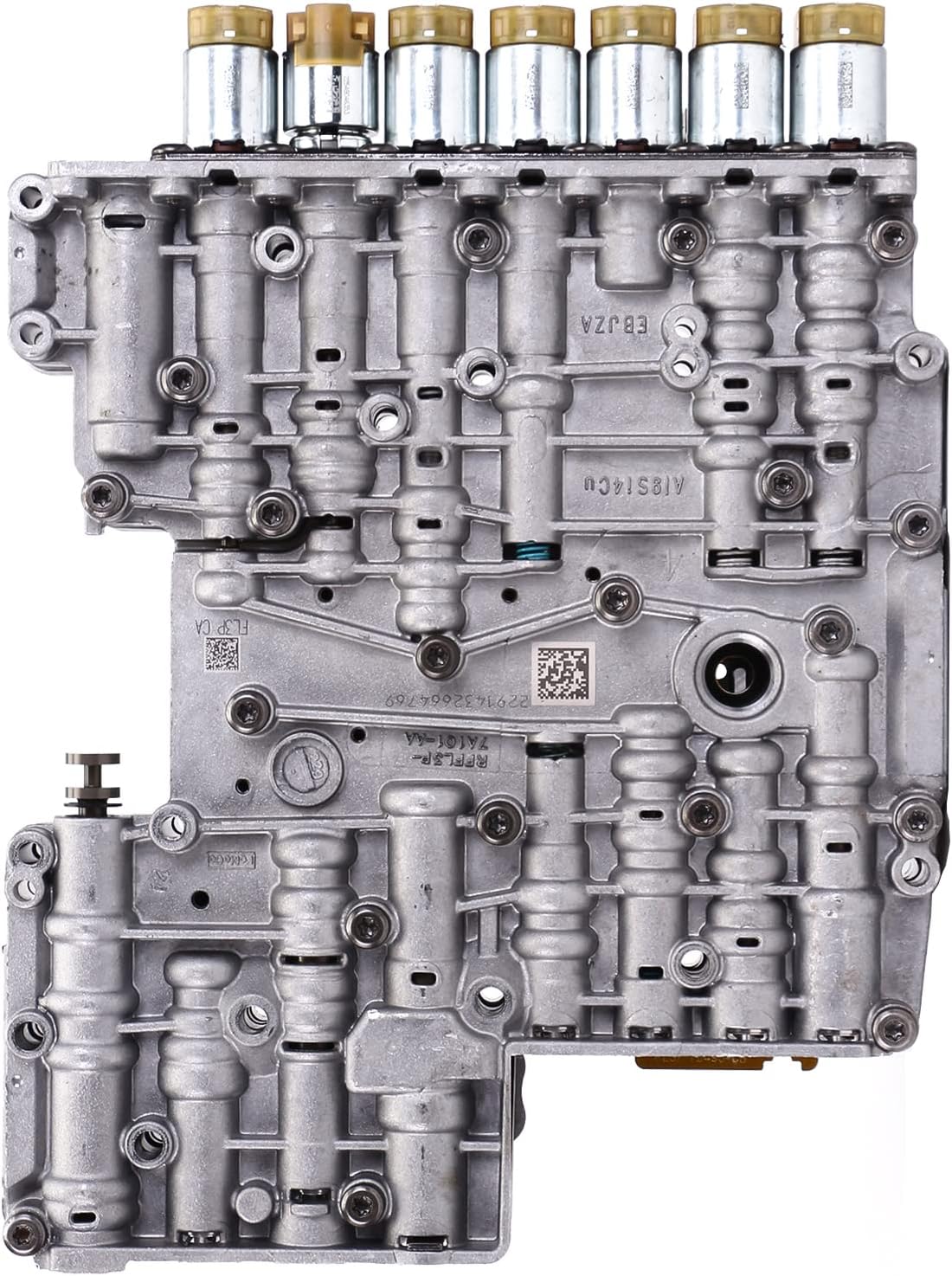
6R80 lead frame and range sensor assembly
The 5th-gear starts, the OSS downshifts and the range sensor no-Reverse on these Mustangs all come back to this assembly once the car is outside Ford's coverage. Sold by our sister store, CoreTransmissionParts.
Shop the part for this fix →Need the rest of the transmission? The rebuild kits collection has 6R80 overhaul and master kits.
Need parts for this job?
Mustang 6R80 lead frame kits, valve bodies with solenoids, master rebuild kits, filter kits and MERCON LV are on our 6R80 parts page, with checkout on site.
FAQ
Why does my Mustang start in 5th gear?
On 2011-2014 Mustangs built on or before 8 April 2013, Ford's TSB 13-6-8 traces it to the molded lead frame losing the output speed signal. The speedometer reads zero, the odometer shows dashes and P0720 or P0722 may be stored. The fix is lead frame AL3Z-7G276-A, and Ford says the shift solenoids do not need to be replaced.
Is there a recall on the Mustang 6R80 transmission?
Yes, two. Recall 16V-248 (Ford 16S19) reprogrammed the PCM on 2012 Mustangs built 19 August 2011 through 21 February 2012 for a sudden downshift into 1st. Compliance Recall 12C23 covered 2012-2013 Mustangs built 17 October 2011 through 9 January 2012 for a range sensor fault that can cause no Reverse and no backup lamps. Check the VIN with a Ford dealer or NHTSA.
Will Ford still replace the lead frame for free on a 2012 Mustang?
Almost certainly not. Program 16N02 covered the lead frame for 10 years or 150,000 miles from the warranty start date, with P0720, P0722, P0731 or P1500 stored. Ten years has passed on every 2012 Mustang, so a lead frame today is usually customer-paid. The recall software update is still worth confirming.
Why does my 2015-2017 Mustang clunk when I shift into Drive or Reverse?
Ford's SSM 49083 says some 2015-2017 Mustangs with the 3.7L or 5.0L and the 6R80, built on or before 1 April 2017, make a clunk or ping from the driveshaft on engagement. Ford released a revised driveshaft. Confirm the noise is coming from the driveshaft and not the transmission before you replace parts.
Related guides
- 6R80 Common Problems and Fixes
- 6R80 F150 Common Problems and Fixes
- 6R80 P0720: Output Speed Sensor Circuit Fix
- 6R80 No Reverse Fix
- 6R80 Noise Diagnosis: Whine and Clunk
Sources
- Ford Motor Company — Technical Service Bulletin 13-6-8, "6R80 Transmission High Gear Engagement From A Stop," 7 June 2013, hosted by NHTSA. Backs the 2011-2014 Mustang coverage, the 8-Apr-2013 build cutoff, the 5th-gear start symptoms, P0720/P0722, lead frame AL3Z-7G276-A, the no-solenoids note and the 2.2-hour Mustang labor. static.nhtsa.gov (PDF)
- Ford Motor Company / NHTSA — Part 573 Safety Recall Report 16V-248 (Ford 16S19), 25 April 2016, and Customer Satisfaction Program 16N02, 16 June 2016. Back the 2012 Mustang build ranges, the 184,000-vehicle population, the OSS signal loss and 1st-gear downshift, the three reported accidents, the 10-year/150,000-mile lead frame coverage and the P0720, P0722, P0731 and P1500 requirement. 16V-248 (PDF) · 16N02 (PDF)
- Ford Motor Company — Compliance Recall 12C23, "Transmission Range Sensor Inspection and/or Replacement," 1 May 2012, hosted by NHTSA. Backs the 2012-2013 Mustang build window at AutoAlliance, the FMVSS 102 and 108 basis, the no-Reverse, PRNDL, backup lamp and camera symptoms and the lead frame replacement. static.nhtsa.gov (PDF)
- Ford Motor Company — TSB 13-6-4, "Whine Noise On Acceleration," June 2013, and Special Service Message 49083, 2015-2017 Mustang clunk or ping on engagement, both hosted by NHTSA. Back the 2013 3.7L build window, the lockup-dependent whine, converter BR3Z-7902-C, seal 6L2Z-7A248-AA, MERCON LV and the cooler line O-rings, plus the S550 driveshaft clunk, the 1-Apr-2017 cutoff and causal part 4R602. TSB 13-6-4 (PDF) · SSM 49083 (PDF)
- GEARS Magazine (ATRA) — David Chalker, "Updates to the Ford 6R80." Backs the sensors on the lead frame (OSS, TSS, TFT, TR), the Mustang application, the 2011 one-way clutch, the D clutch releasing at about 3 mph, the D/E solenoid at about 50 mA apply and 850 mA release, and the parts that changed for 2011. gearsmagazine.com
- Sonnax — Jim Dial, "Troubleshooting Ford 6R80 & 6R140 Timing-Related Shift Issues," August 2022. Backs the causes of flared and harsh shifts, solenoid calibration drift, programming solenoid strategy and body ID codes, and the three-to-five-cycle adapt relearn. sonnax.com