A Lincoln LS that "slips" can mean a flare on the 2-3 up a highway ramp, a flare into 5th at 45 mph, or a soft 3rd once it is hot. Each points at a different part of a 5R55S. And the LS changed transmissions partway through its run, so first make sure you know which one is under it.
Sonnax notes that the 5R55N used in the early LS was replaced by the 5R55S in 2003 in the Lincolns and Thunderbirds [4], and Ford's 2005 LS owner guide lists the 5R55S behind both the 3.0L V6 and the 3.9L V8 [1]. This guide is for the 2003-2006 cars with the S. It is the order I work a slip complaint in, with the Ford and trade numbers behind each step. Where something is my own bench habit rather than a published spec, I say so.
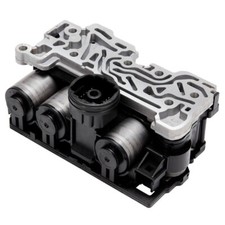
The short version: Set the fluid level first; the LS 5R55S has no dipstick, and Ford tells owners to have the level checked when the transmission slips [1]. Then decide which gear slips. A 2-3 flare on a 2003-2006 LS is often the wrong-design solenoid pack: ATRA lists 1L2Z-7G391-AG for 2003 Lincolns and 9L2Z-7G391-A for 2004-2006 [3]. Slips in 2nd, 3rd and 5th with ratio codes point at worn servo pin bores [5] or worn VFS modulator bores in the valve body [4] [5], and a gauge on the line pressure tap tells you which.

Step 1: Set the Fluid Level the Ford Way
Ford's 2005 LS owner guide is blunt: "The 5R55S transmission does not have a transmission fluid dipstick." The same section says the level should be checked if the transmission slips or shifts slowly, and that the job belongs to a technician [1]. On a twenty-year-old LS that has been through a few quick-lube bays, low fluid is a real cause of slipping, not a formality.
| Item | 2003-2006 Lincoln LS 5R55S |
|---|---|
| Fluid | Motorcraft MERCON V [1] |
| Approximate dry capacity | 11.2 L (11.9 qt), including cooler and tubes [1] |
| Level check point | Small center plug in the pan drain plug, 3/16-inch Allen [2] [6] |
| Fill adapter | Rotunda 307-437 Fluid Level and Fill Plug Adapter [6] |
| Fluid temp at final level | 80-120°F (27-49°C) on the TFT PID [6] |
| Additives | Ford says do not use supplemental additives, treatments or cleaners [1] |
Per ATRA's write-up of the Ford method: watch TFT, idle (about 650 rpm) in Park with the car level on a hoist, hold the large drain plug and pull the small center plug with a 3/16-inch Allen key. Fill through the 307-437 adapter until fluid drains back, then let the excess drain with TFT between 80 and 120°F and reinstall the center plug [6]. Ford also warns that MERCON and MERCON V are not interchangeable and must not be mixed [1].
Two traps: set it outside the temperature window and the level is wrong, and watch for foam. Sonnax points out that worn 5R55N, W and S units can foam the fluid from excess exhaust and valve body wear, pushing fluid out the vent and causing false fill readings [5]. If the fluid coming out of the plug looks like a milkshake, the level reading is not trustworthy and the valve body is part of the conversation.
Dark, burned fluid with band lining in it means the slip already did its damage, and a fluid service will not bring it back. Ford notes that band and clutch material carries into the converter and cooler, so any rebuild needs the cooler replaced or the lines backflushed; its cooler flow test expects about 8 oz in 15 seconds at idle [2].
Step 2: Find Out Which Gear Slips
Every gear in a 5R55S uses a different combination of bands and clutches, so the gear that slips is a diagnosis in itself. Ford's apply chart for the 5R55W/S [2], read for slipping:
| Gear | Holding elements | If only this gear slips, suspect |
|---|---|---|
| 1st | Forward clutch, direct and low one-way clutches | Forward clutch, one-way clutches |
| 2nd | Forward clutch, overdrive band | Overdrive band, servo, pin bore |
| 3rd | Forward clutch, intermediate band | Intermediate band, servo, pin bore |
| 4th | Forward clutch, direct clutch | Direct clutch, PC-C circuit |
| 5th | Forward clutch, overdrive band, direct clutch | Overdrive band or direct clutch |
Read it backwards. Slipping in 2nd and 5th is the overdrive band circuit, the only two gears that hold it. Slipping in 3rd alone is the intermediate band. Slipping in 2nd, 3rd and 5th at once is both band circuits, and that is usually the case or the valve body bores that feed them, not two bands that happened to wear out at once. Slipping in 4th and 5th is the direct clutch side: ATRA notes that PC-C is directly responsible for direct clutch application in 4th and 5th [3]. Slipping in every forward gear while reverse is fine puts the forward clutch first, and slipping everywhere including reverse sends you back to fluid level, filter and pump.
Step 3: The 2-3 Flare and the Solenoid Pack
The most common LS "slip" I hear about is a 2-3 flare. ATRA explains that 2nd is the forward clutch plus the overdrive band, and on the 2-3 the overdrive band releases at the same time the intermediate band applies. That release-and-apply has to be precise; a slight timing variation gives a flare or a harsh shift [3].
Both bands are fed through solenoid-controlled pressures. Per ATRA, PCA drives the VFS1 modulator, and VFS1 pressure applies the intermediate servo in 3rd. PCB drives the VFS2 modulator, which directly applies the overdrive servo and coast clutch [3]. Change how either solenoid responds and the overlap on the 2-3 changes with it.
That is exactly what happens with the wrong solenoid pack. ATRA's application split, which names the Lincoln specifically [3]:
- 2003 Lincoln LS with the 5R55S (early design): Ford P/N 1L2Z-7G391-AG.
- 2004-2006 Lincoln LS with the 5R55S (later design): original 4L2Z-7G391-AA, updated 9L2Z-7G391-A. Ford recommends only the updated design for these.
ATRA's testing found the PCA solenoids from different packs produced a 4 psi difference at the same 0.6 amp command [3]. If a 2-3 flare showed up right after a solenoid pack or a used valve body went in, read the part number on the pack before anything else.
The same ATRA write-up lists two more checks for flare complaints: the pressure regulator valve and sleeve for wear, and the overdrive and intermediate servo control valves and plugs, since worn plugs leak during engagements and shift timing [3]. Sonnax adds that units built after 2002 run an adaptive strategy and need a relearn after solenoid service [4], and Ford's owner guide says the transmission relearns over several shifts after a battery disconnect [1].
Step 4: Codes, PIDs and the Road Test
The 5R55S tells on itself with ratio codes. Ford's chart lists P0732, P0733 and P0735 as no 2nd, 3rd and 5th gear, with engine RPM higher or lower than expected [2]. Sonnax lists the same three codes, written 732, 733 and 735, as symptoms of servo pin bore wear [5]. Pressure control circuit codes are a different job: chase the case connector, harness and solenoid body first.
For soft or slipping shifts Ford runs codes, then Test A (shift and TCC solenoids), Test B (TFT sensor), Test D (PC-A, PC-B, PC-C) and, on the 2-3, Test E (speed sensors) [2]. Ford notes a faulty TFT signal causes incorrect line pressure [2], so a slip that happens only cold or only hot gets a TFT PID check first.
On the road test I log TFT, turbine, intermediate and output shaft speeds and commanded gear. A slip shows turbine speed running away from where output speed says it should be, and a worn bore usually gets worse as the fluid heats up.
Step 5: Gauge the Pressure, Then Decide on Hard Parts
Put a gauge on the line pressure tap before you guess. Ford's published 5R55W/S line pressure table in this document is written for the Explorer and Mountaineer, so I treat it as a ballpark on an LS, not a pass/fail: 80-110 psi at idle in Drive for the 4.0L and 100-135 for the 4.6L, and 228-263 psi at WOT stall in the forward ranges [2]. More useful is Ford's results table, which reads the pattern rather than the number [2]:
- Low at idle in all ranges: low fluid, filter or filter seal, loose valve body bolts, pump or pump gasket leakage, case leakage, valve body or separator plate.
- Low in all forward ranges: forward clutch, valve body, overdrive servo or intermediate servo.
- Low in manual 2 or manual 3: intermediate servo, overdrive servo or forward clutch.
Ford says to run line pressure before any stall test and never hold WOT more than 5 seconds [2]. If you do run a stall test, Ford's results table reads high stall in manual 2 only as the intermediate band or servo, and high stall in all ranges as the forward clutch or direct one-way clutch [2].
Servo pin bores or VFS modulator bores?
This is the decision that separates a valve body job from a case job, and both produce the same 2nd, 3rd and 5th slip with ratio codes.
Servo pin bores. The overdrive and intermediate servo apply pins ride in bare bores in the aluminum case. Sonnax describes severe wear of the case at the pin bore from continuous pin oscillation: apply oil leaks into the case barrel and drops band apply pressure, and release oil cross-leaks into the apply circuits. Its listed symptoms are 1-2, 2-3 and 4-5 flares, gear loss, codes 732, 733 and 735 and band lining failure. The fix is the 56361J-01K overdrive and intermediate sleeve kit, cut with the S-56361J-TL tooling, which pilots from the pin bore centerline rather than the servo piston bore [5]. That means the transmission comes out.
VFS modulator bores. Sonnax's warning is that as these units age, the VFS 1, 2 and 3 modulator bores in the valve body wear and reduce clutch and servo pressure, causing ratio codes and slippage, and that the solenoid or the servo pin bore often gets blamed when the VFS modulator valves simply cannot supply enough pressure [4]. Sonnax's 56947J-19K oversized VFS modulator control valve kit lists flare shifts, pressure control out-of-range codes and low line pressure as symptoms, fits either the VFS1 or VFS2 bore, and installs with the F-56947J-TL19 reamer [5]. That is a valve body job, done in the car.
How I split them (bench practice, not a Ford procedure): low forward-range line pressure plus VFS bores that fail a vacuum test means fix the valve body first. Pressure in range, tight VFS bores and still flaring with ratio codes means servo pin bores. Band material in the fluid means a rebuild, with the case sleeved while it is apart.
5R55S Sonnax Oversized VFS Modulator Control Valve Kit 56947J-19K
The valve-body fix for flare shifts and low line pressure from worn VFS1 or VFS2 modulator bores on the 2003-2006 Lincoln LS 5R55S. Requires the reamer tooling.
View the VFS modulator kit →Case worn instead? Browse all 5R55S parts at Core Transmission Parts, including the Sonnax servo bore sleeve sets and the 2003-2006 rebuild kit.
Preventing the Next Slip
- Keep it full, by the plug. Every fluid service ends at the center plug with TFT in the 80-120°F window, never by quart count [6].
- Right solenoid pack for the year. 1L2Z-7G391-AG for a 2003 LS, 9L2Z-7G391-A for 2004-2006 [3]. A junkyard pack from the wrong year is a flare waiting to happen.
- Sleeve the bores while it is apart. On a high-mileage case, the sleeve kit costs far less than a second removal [5].
Rebuild kits, pressure control solenoids, valve bodies and filter kits for the 2003-2006 Lincoln LS 5R55S, with checkout on our site.
Shop 5R55S parts →FAQ
Why is my Lincoln LS transmission slipping?
On a 2003-2006 LS with the 5R55S, start with the fluid level, because there is no dipstick and Ford says to have the level checked when it slips. After that the usual causes are a wrong-design solenoid pack giving a 2-3 flare, worn servo apply pin bores in the case, and worn VFS modulator bores in the valve body. The gear that slips tells you which one to chase.
How do you check transmission fluid on a Lincoln LS?
The 5R55S has no dipstick. With the engine idling in Park and the car level on a lift, hold the large pan drain plug and remove the small center plug with a 3/16-inch Allen key. Set the level through the 307-437 adapter until fluid drains back, with fluid temperature between 80 and 120 degrees F on the TFT PID.
What causes a 2-3 flare on a Lincoln LS?
On the 2-3 the overdrive band releases while the intermediate band applies, so small pressure changes cause a flare. ATRA traces many 2-3 flares to the wrong solenoid pack: a 2003 LS takes 1L2Z-7G391-AG and a 2004-2006 LS takes the updated 9L2Z-7G391-A. Worn VFS modulator bores and servo pin bores cause the same flare.
What transmission fluid does a Lincoln LS take?
Ford specifies Motorcraft MERCON V for the 5R55S, with an approximate dry capacity of 11.2 L (11.9 qt) including the cooler and tubes. Ford warns that MERCON and MERCON V are not interchangeable and says not to use supplemental additives or cleaners.
Can a slipping 5R55S be fixed without a rebuild?
Sometimes. A low fluid level, a wrong solenoid pack, or worn VFS modulator bores in the valve body can all be corrected with the transmission in the car. Worn servo pin bores in the case and burned bands require removal, and the case should be sleeved during the rebuild.
Sources
- Ford Motor Co. — 2005 Lincoln LS Owner Guide, "Maintenance and Specifications," on the 5R55S having no dipstick, checking level when the transmission slips or shifts slowly, Motorcraft MERCON V, 11.2 L (11.9 qt) approximate dry capacity including cooler and tubes, the no-additive and MERCON/MERCON V warnings, and adaptive relearn after battery disconnect. 2005 Lincoln LS Owner Guide (PDF, archive.org)
- Ford Motor Co. service information (Mitchell reprint) — "5R55W/S Diagnosis," on the clutch and band apply chart, soft/slipping shift test sequences (Tests A, B, D, E), TFT effect on line pressure, DTCs P0732/P0733/P0735, line pressure specifications and results, stall test cautions and results, the 3/16-inch level plug and 307-437 adapter, and the cooler flow test. 5R55W/S Diagnosis (PDF)
- ATRA — 2013 technical seminar manual, "Ford 5R55W/S Erratic Transmission Operation," on the 2-3 flare from the wrong solenoid pack, the 2003 Lincoln (1L2Z-7G391-AG) and 2004-06 Lincoln (4L2Z-7G391-AA / 9L2Z-7G391-A) applications, PCA/PCB/PCC roles, VFS1/VFS2 servo apply, and the 4 psi difference at 0.6 amp. ATRA 2013 seminar, pp. 112-120 (PDF)
- Sonnax — Bob Warnke, "Figuring Out the 5R55 Alphabet," on the 5R55S replacing the 5R55N in 2003 Lincolns and Thunderbirds, VFS 1, 2 and 3 modulator bore wear causing ratio codes and slippage, and relearn after solenoid service on post-2002 units. sonnax.com
- Sonnax — product technical pages for the Overdrive & Intermediate Servo Pin Bore Sleeve Kit 56361J-01K (case pin bore wear, apply and release oil leakage, 1-2/2-3/4-5 flares, codes 732/733/735, band lining failure, fluid foaming and false fill readings, S-56361J-TL tooling) and the Oversized VFS Modulator Control Valve Kit 56947J-19K (VFS1/VFS2 bore wear, flare shifts, pressure control out-of-range codes, low line pressure, F-56947J-TL19 tooling). sonnax.com/parts/2207 | sonnax.com/parts/2233
- ATRA — Technical Bulletin 746 (February 2003), "5R55N, 5R55S & 5R55W: New Rotunda Tool for Checking Fluid Level and Filling Transmissions," on the TFT PID 80-120°F window, 650 rpm idle, level hoist position, the 3/16-inch center plug and the 307-437 adapter. ATRA TB 746 (PDF)