A 2005-2010 Mustang with the 5R55S automatic that "slips" usually shows up one of three ways. The V6 or GT flares between 2nd and 3rd on a warm day. It feels like it drops into neutral for a beat when it grabs 5th on the highway. Or it bangs into 2nd and then goes soft in 3rd until the engine races. Same complaint from the owner, three different jobs on the bench.
The good news is that this transmission tells you where it hurts. Every gear uses a different combination of bands and clutches, so if you know which gear slips, and whether it does it cold or hot, you have the failed component narrowed down before the pan comes off. This is how I work a slipping S197 5R55S, step by step, with the Ford numbers and the trade sources behind each one. Where something is my own shop habit and not a published spec, I say so.
The short version: Check the level first; the Mustang 5R55S has no dipstick and Ford tells owners to check fluid when the transmission slips [1]. Then match the slip to Ford's apply chart: 2nd and 5th share the overdrive band, 3rd uses the intermediate band, 4th adds the direct clutch, and the forward clutch is on in every forward gear [2]. On a Mustang the most common hard cause is worn servo apply pin bores in the case, which flare 1-2, 2-3 and 4-5 and set ratio codes, per Sonnax and Ford TSB 09-12-12 [4] [5]. A 2-3 flare can also be the wrong-design solenoid pack [3].
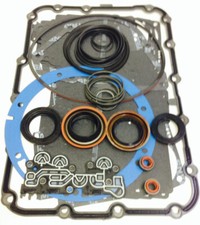
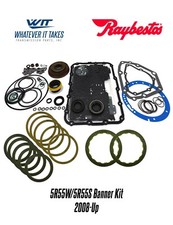

Step 1: Check the Fluid the Way Ford Intended
Ford's 2007 Mustang owner guide says it plainly: "The 5R55S transmission does not have a transmission fluid dipstick." The same page says the level should be checked "if the transmission slips or shifts slowly" [1]. That puts fluid level at the top of the list, and on these cars it is often the whole problem. A lot of S197s have been through quick-lube shops that could not check the level, or had a pan dropped by someone who refilled by the quart count and drove away.
The specs that matter, from Ford's capacity table:
| Item | 2005-2010 Mustang 5R55S |
|---|---|
| Fluid | Motorcraft MERCON V, XT-5-QM [1] |
| Approximate dry capacity | 11.9 qt (11.2 L), including cooler and tubes [1] |
| Dipstick | None; level is set at the pan check plug [1] |
| Additives | Ford says do not use supplemental additives, treatments or cleaners [1] |
Ford also warns that MERCON and MERCON V are not interchangeable and must not be mixed [1]. If the fluid on the plug is dark and smells burned, and especially if you see band lining in it, the slip already did its damage, and a fluid change will not bring it back. Burned band material is the strongest hint you will get that you are about to sleeve servo bores.
Set the level with the car level on a lift, the engine idling in Park and fluid temperature watched on the scan tool's TFT PID.
Step 2: Match the Slip to the Apply Chart
Ford's clutch and band application chart for the 5R55W/S in the Overdrive range is the most useful single piece of paper for this job [2]:
| Gear (OD range) | Elements applied (Ford) |
|---|---|
| 1st | Forward clutch, direct one-way clutch, low one-way clutch |
| 2nd | Forward clutch, overdrive band, low one-way clutch |
| 3rd | Forward clutch, intermediate band, direct one-way clutch |
| 4th | Forward clutch, direct clutch, direct one-way clutch |
| 5th | Forward clutch, overdrive band, direct clutch |
| Reverse | Reverse band, coast clutch, direct clutch, direct one-way clutch |
Now read it backwards:
- Slips in 2nd and 5th: the overdrive band, its servo, or the overdrive servo pin bore. Those are the only two forward gears that hold the overdrive band. Ford's own symptom chart lists "No 2nd & 5th Gears" as its own condition and sends you to the pressure control solenoid test first [2].
- Slips in 3rd, or flares on the 2-3: the intermediate band and servo. Ford's "Soft or Slipping 2-3 Shift" entry lists line pressure, sticking valve body valves, loose valve body bolts, the intermediate band and servo, and the direct one-way clutch [2].
- Slips in 2nd, 3rd and 5th: both band circuits at once. That combination almost always means the case, because the two band servos share one weakness: their apply pins ride in bare aluminum bores. More on that below.
- Slips in 4th and 5th: the direct clutch, or the solenoid that applies it. ATRA notes that pressure control solenoid PCC "is directly responsible for direct clutch application" in 4th and 5th [3], and Ford ties PC-C circuit codes P0795/P0797 to incorrect gear ratio in 4th and 5th [2].
- Slips in every forward gear but reverse is fine: the forward clutch, or a pressure leak in the forward circuit. Ford's line pressure results table lists "Low in all forward ranges" as forward clutch, valve body, overdrive servo or intermediate servo [2].
- Slips everywhere, including reverse: low fluid, a plugged filter or a weak pump before anything else.
Step 3: Pull Codes and Read Them Like a Builder
Ratio codes are the PCM's way of telling you something slipped. Ford's DTC chart for the 5R55W/S lists P0732 (no 2nd gear), P0733 (no 3rd gear) and P0735 (no 5th gear), each described as improper gear selection, shift errors and RPM higher or lower than expected [2]. Sonnax lists those same three codes, written as 732, 733 and 735, as symptoms of servo pin bore wear [4].
That overlap is the tell. If you have P0732, P0733 or P0735 with no solenoid circuit codes and the electrical side checks good, the case is the suspect. If you have PC-A, PC-B or PC-C circuit codes (Ford lists P0745/P1746 for PC-A and P0795/P0796/P0797/P0799 for PC-C), chase the wiring and the solenoid body first [2]. Ford's diagnosis also flags the TFT sensor: a bad TFT signal causes incorrect line pressure, and on a car that slips only cold or only hot, that is worth a look at the PID before you condemn hard parts [2].
On the road test, log TFT, turbine shaft speed (TSS), intermediate shaft speed (ISS) and output shaft speed (OSS), plus commanded gear. A slip shows up as turbine speed climbing away from where output speed and the gear ratio say it should be. Watching it happen on a graph removes the argument about whether "it feels like it slips" means the converter, a band or the driver's right foot.
Step 4: Gauge the Line Pressure
Before you guess at internal parts, put a gauge on the line pressure tap. Ford's published 5R55W/S line pressure table in this service document is written for the Explorer and Mountaineer, so I use it as a ballpark on a Mustang, not a pass/fail spec. For the 4.0L application it lists 80-110 psi at idle and 228-263 psi at WOT stall in the forward ranges, and 145-190 psi idle and 282-350 psi stall in Reverse [2]. A Mustang that is 40 psi short in Drive at idle is not a "slightly soft" car; it has a leak somewhere.
Ford's caution is worth repeating: run the line pressure test before any stall test, because if pressure is low at stall you will hurt the transmission further, and never hold WOT for more than 5 seconds [2]. Ford's line pressure results table then gives you the map [2]:
- Low at idle in all ranges: low fluid, filter or filter seal, loose valve body bolts, pump or pump gasket leakage, case leakage, valve body or separator plate.
- Low in all forward ranges: forward clutch, valve body, overdrive servo or intermediate servo.
- Low in Manual 2 or Manual 3: intermediate servo, overdrive servo or forward clutch.
Notice how often the two band servos show up in that list. That is not an accident.
Step 5: The Usual Mustang Culprit, Worn Servo Pin Bores
The 5R55S holds 2nd, 3rd and 5th with bands, and the overdrive and intermediate servos push apply pins that ride directly in bores machined into the aluminum case. Sonnax explains the mechanism: the servo pins oscillate every time a band applies and releases, the case bore wears, apply oil leaks into the barrel area of the case, and release oil can cross-leak into the apply circuits [4]. Less apply oil means less band holding force, so the band slips, burns and slips worse.
The symptoms Sonnax lists line up with what Mustang owners describe: 1-2, 2-3 and 4-5 flares, gear loss, codes 732, 733 and 735, band lining failure and loss of overdrive and intermediate servo control [4]. It also notes these units can foam fluid in the sump, which pushes fluid out the vent and gives false fill readings [4]. If a Mustang "keeps puking fluid" after you set the level correctly, think internal leakage before you think overfill.
Ford recognized this in TSB 09-12-12, which covers 5R55S/5R55N/5R55W shift concerns and loss of 2nd, 3rd and 5th with incorrect-ratio codes, lists 2005-2009 Mustang, and calls for inspecting and repairing servo pin bore wear with Rotunda tooling. The bulletin notes the condition is generally worse when hot, which matches what I see: thinner hot fluid leaks past a worn bore faster, so the car is fine for the first ten minutes and starts flaring once it is warm. ATRA's Gears magazine gives the same advice for the 5R55W/S family: slipping in 2nd and 5th, or a bind on the 2-3 shift, means check the servo pin bore for wear and repair it with a pin bore kit [5].
The repair is reaming the bores and installing sleeves. Sonnax's kit 56361J-01K includes an overdrive sleeve and an intermediate sleeve in wear-resistant aluminum, installed with tool kit S-56361J-TL, whose pilot and reamer align from the pin bore centerline rather than the servo piston bore [4]. My rule: if the case is out of the car for any reason, it gets sleeved, and new band and servo parts go in with it. Putting fresh bands behind worn bores just burns new bands.
Step 6: The 2-3 Flare That Is Not a Bad Band
Not every 2-3 flare is a worn case. ATRA's 2013 seminar material describes a flare on the 2-3 shift after a rebuild that traced back to the solenoid pack, because Ford changed these solenoids over the years and small pressure differences change how the transmission shifts [3]. ATRA gives the application: 2002-03 units use the early pack, Ford P/N 1L2Z-7G391-AG; 2004-on Ford 5R55W/S use the later pack, original 4L2Z-7G391-AA and updated 9L2Z-7G391-A, and Ford recommends only the updated design for the later transmissions [3]. Every 2005-2010 Mustang falls in the later group.
ATRA also explains why it matters. PCA and PCB raise and lower mainline pressure and run the VFS1 and VFS2 modulator valves; VFS1 pressure applies the intermediate servo in 3rd, and VFS2 directly applies the overdrive servo and coast clutch [3]. So the same solenoids that set line pressure also set band apply feel. ATRA's other checks for flares are a worn pressure regulator valve and sleeve, and worn overdrive and intermediate servo control valves and plugs, which can leak during engagements and shifts [3].
One Mustang-specific wrinkle: Ford changed the 5R55S valve body casting and separator plate in 2009. Jeff Parlee, writing in Transmission Digest, gives the 2009-up rough-forging number as RF9L2P 7A101AA with an 09 date casting, and says the separator plate hole sizes were reduced in the VFS1 and VFS2 circuits [6]. Since those are exactly the circuits that apply the bands, a 2009-2010 Mustang that has had a used or mismatched valve body bolted in can flare or bang in ways no amount of new frictions will fix. Confirm the casting number matches the year before you go deeper. Parlee also notes TSB 09-21-4 for the 2009-up valve body, which addresses a whistle noise when hot at idle with an updated separator plate [6].
Step 7: Decide on the Fix
- Low or wrong fluid, no burned material: correct the level with MERCON V and road test again with data. Sometimes that is the whole repair.
- Flares on 2-3 or harsh/soft shifts with clean fluid and good pressure: confirm the solenoid pack design and the valve body casting for the year [3] [6].
- Ratio codes P0732/P0733/P0735, worse hot, pressure low in forward ranges: servo pin bore wear. Sleeve the bores and replace the servo parts and bands [4] [5].
- Slips in all forward gears, burned fluid: the forward clutch is gone; that is an overhaul with the case sleeved while it is apart.
If the fluid is burned and there are ratio codes, quoting a full overhaul with sleeves usually costs the owner less than doing the bores, then coming back for clutches six months later.
Overhaul kits, rebuild kits with bands, filter kits and hard parts for the 2005-2010 Mustang 5R55S, with checkout on our site.
Shop 5R55S parts →FAQ
Why is my 2005-2010 Mustang automatic slipping?
Start with the fluid level, because the 5R55S has no dipstick and Ford tells owners to check fluid when the transmission slips. If the level is right, the most common hard cause on these cars is worn overdrive and intermediate servo pin bores in the case, which leak band apply oil and cause flares on the 1-2, 2-3 and 4-5 shifts, often with codes P0732, P0733 or P0735.
Why does my Mustang slip only when it is hot?
Hot fluid is thinner and leaks past worn clearances faster. Ford TSB 09-12-12 notes that servo pin bore wear gets worse when hot, which is why many S197 Mustangs shift fine for the first few minutes and start flaring once the transmission warms up. A bad TFT sensor signal can also skew line pressure with temperature, so check the TFT PID too.
What transmission fluid does a 5R55S Mustang take, and how much?
Ford specifies Motorcraft MERCON V, part XT-5-QM, with an approximate dry capacity of 11.9 quarts (11.2 L) including the cooler and tubes. Ford says MERCON and MERCON V are not interchangeable and warns against supplemental additives. The level is set at the pan check plug, not by the quart count.
Can a solenoid pack cause a 5R55S 2-3 flare?
Yes. ATRA documented 2-3 flares caused by the wrong-design solenoid pack. 2004-on 5R55W/S units, which includes every 2005-2010 Mustang, use the later pack, and Ford recommends only the updated 9L2Z-7G391-A design. Check the part number before you condemn the bands.
Can servo pin bore wear be fixed without replacing the case?
Usually, yes. The bores are reamed and sleeved; Sonnax kit 56361J-01K includes overdrive and intermediate sleeves installed with tool kit S-56361J-TL. Install new band and servo parts at the same time, because burned bands behind repaired bores will still slip.
Sources
- Ford Motor Co. — 2007 Mustang Owner Guide, "Maintenance and Specifications," on the 5R55S having no dipstick, checking fluid when the transmission slips, Motorcraft MERCON V XT-5-QM, 11.9 qt (11.2 L) approximate dry capacity including cooler and tubes, and the no-mixing and no-additive warnings. 2007 Mustang Owner Guide (PDF, archive.org)
- Ford Motor Co. service information (Mitchell reprint) — "5R55W/S Diagnosis," on the clutch and band application chart, the soft/slipping shift symptom entries, the DTC chart (P0732, P0733, P0735, PC-A and PC-C codes), TFT effects on line pressure, line pressure specifications and the line pressure test results table. 5R55W/S Diagnosis (PDF)
- ATRA — 2013 Technical Seminar, "Ford 5R55W/S Erratic Transmission Operation," on 2-3 flares from the wrong solenoid pack, pack part numbers 1L2Z-7G391-AG, 4L2Z-7G391-AA and 9L2Z-7G391-A, and the PCA/PCB/PCC and VFS1/VFS2 servo apply functions. ATRA 2013 seminar (PDF)
- Sonnax — Overdrive & Intermediate Servo Pin Bore Sleeve Kit 56361J-01K, on how pin bore wear leaks apply and release oil, 1-2/2-3/4-5 flares, codes 732/733/735, band lining failure, sump foaming, and the S-56361J-TL tooling. sonnax.com/parts/2207
- Gears Magazine (ATRA), Street Smart, March 2017, "5R55N with Wrong Gear Starts and Bindups? Look for a Faulty Servo," on 5R55W/S slipping in 2nd and 5th or binding on the 2-3 shift, and checking and repairing the servo pin bore. gearsmagazine.com
- Transmission Digest — Jeff Parlee, "Body of Evidence: Valve-Body and Plate Changes for the 5R55S" (April 2013), on the 2009-up RF9L2P 7A101AA casting, reduced VFS1/VFS2 separator plate holes, and TSB 09-21-4. transmissiondigest.com