An Avenger comes in with a shift complaint, and the owner usually describes it one of four ways: it bangs into second, it clunks when it slows down to a stop, it flares and then catches, or it will not shift past third at all. All four can come from the same six-speed for very different reasons. Some are software, some are a learn that never finished, some are a worn bore in the valve body, and some are a seal that only leaks cold. The trick is sorting them before you spend the customer's money.
This is the order I work an Avenger 62TE shift complaint. The numbered references point to the Sources list at the bottom.

Step one: make sure it is a six-speed
The Avenger was built with a four-speed and with the 62TE six-speed, and nothing below applies to the four-speed. The 2014 Avenger owner's manual gives you the tells without a build sheet [1]. The four-speed has a transmission dipstick and a "3" range on the shifter. The six-speed has a capped filler tube with no dipstick, and AutoStick below Drive [1]. On the 2012-2013 cars, Chrysler's own bulletin identifies the six-speed by sales code DG2, behind either the 3.6L (ERB) or the 2.4L (ED3 or EOG) [2]. V6 Avengers with the 3.5L had the 62TE from launch; ATRA lists the JS Sebring and Avenger among its first applications [3].
Step two: separate strategy from a real fault
The 62TE does several things on purpose that drivers write up as shift problems. Rule these out first:
- Stuck in third. Third gear is the failsafe. If the TCM sees a condition that could damage the transmission, it holds third no matter which forward gear is selected, while Park, Reverse and Neutral still work [1]. TransGo's clutch chart marks third (2.284 ratio) as the failsafe/limp mode gear [6]. "It will not shift" with a steady third almost always means a stored code.
- Cold mornings. At -16 F (-27 C) or colder, the six-speed may be held briefly in third until it warms [1]. That is normal.
- Hot fluid. When fluid temperature climbs past normal limits, the powertrain controller changes the shift schedule to protect the unit [1]. Shift points that move after a long climb or towing are strategy.
- A fresh learn. The manual says the six-speed's electronics are self-calibrating, and the first few shifts after a new unit, or after the adaptives are reset, may be abrupt [1]. A car that just had a battery, PCM or transmission job will feel worse before it feels better.
Step three: software before parts
On 2012-2013 Avengers with the 62TE built before October 9, 2012, service bulletin 21-013-12 is the first stop. It selectively erases and reprograms the PCM so upshifts are handled with better torque management, and its diagnosis section is one line: if the customer indicates shift quality issues, perform the repair procedure [2]. The procedure needs wiTECH at release 13.01 or higher and a battery charger holding 13.2 to 13.5 volts during the flash, and any codes other modules set during reprogramming have to be cleared afterward [2]. It pays 0.2 hours under labor operation 18-19-06-S9 [2], which tells you how cheap a first step it is compared with pulling a pan.
Look for the "Authorized Modification" label near the VECI label (part 04275086AD) [2]. If it is there, the flash has been done and you are hunting a mechanical or hydraulic cause.
Step four: reset the learn the right way
A lot of comebacks on these are not parts, they are an incomplete reset. TransGo's 62TE instructions say that after every repair you should clear codes and reset the VLP (variable line pressure) counter, found under the special functions in the scan tool [6]. Do that, then run Quick Learn and drive the car through every upshift and downshift at light and moderate throttle so the TCM can rebuild its adaptive values. If you skip the VLP reset after a valve body or solenoid pack swap, the TCM keeps commanding pressure based on the old parts, and the shifts stay harsh or soft no matter what you installed.
Step five: match the complaint to the shift
The 62TE is a 41TE-family four-speed main box with an underdrive compounder on the transfer shaft. The compounder has a low clutch, a direct clutch and a one-way clutch, and it runs in reduction or direct [3][6]. The gear ratios, per TransGo's application chart [6]:
| Gear | Ratio | Note |
|---|---|---|
| 1st | 4.127 | |
| 2nd | 2.842 | 1-2 is a compounder shift |
| 3rd | 2.284 | Failsafe / limp mode |
| 4th prime | 1.573 | Used only on a 6-4 kickdown |
| 4th | 1.452 | |
| 5th | 1.000 | |
| 6th | 0.689 | |
| Reverse | 3.215 |
Harsh or flared 1-2
The 1-2 is the compounder going from reduction to direct. ATRA's 62TE update names ring land wear on the compounder low clutch drum as the most common failure in the unit, with codes P0792 and P0735, no line rise and a slipping 1-2 [3]. TransGo adds the mechanism: the transfer shaft sealing rings shrink and dump lube oil, which lowers line pressure and accelerates ring land wear, and early rotating rings usually destroy the ring grooves on the low clutch housing [6]. A 1-2 that has gone from firm to soft to flared over a few months is usually this, not software.
Bump or shudder on the 2-3, 3-2 or 4-2
These are double-swap shifts, where two elements release while two others apply. ATRA puts the clutch-to-clutch handoff at 40 to 70 milliseconds. If the compounder shifts too early relative to the main box the driver feels a shudder or harsh shift, and if it is too late it is a double bump [3]. Out-of-range clutch volumes or a sticking valve throws that timing off.
Clunk coasting to a stop
Two coast-down clunks are common enough that TransGo's 62TE kit is written to correct them: a 6-5 underdrive apply clunk and a 3-2 low/reverse apply clunk [6]. Those come from the pressure regulator and torque converter regulator bores wearing, which TransGo says destabilizes the main pressure system and drives shift complaints along with converter drainback [6].
Delay into Drive cold, or limp on a 4-3 coast
This one fools people because it is intermittent. TransGo documents wear and a ridge in the underdrive piston where it rubs the seal groove on the input hub. The ridge nibbles the seal, and the result is a cold leak: delayed or no forward when cold, sometimes limp-in on a cold start into Drive until the seal softens [6]. On a long run in fourth the seal relaxes and can fail to reseal on a 4-3 coast downshift between 28 and 19 mph; the computer sees the delayed apply on the speed sensors and puts the unit in limp [6]. If your Avenger drops into third coming off the highway and is fine after a restart, think underdrive seal.
Engine chugs or stalls at a stop
Per TransGo, if the unit chugs or kills the engine at a stop, the TCC solenoid is bad. It often fails and breaks, and the original retainer breaks often enough that the solenoid can back out, causing slipping or a no-move forward [6]. ATRA's hotline fix for a converter that will not release with P2764 was a new TCC solenoid, Mopar 5169313AA [3].
Step six: read the codes and the clutch volumes
Pull current and history codes from the TCM. Codes that point at the valve body rather than the clutches are the switch valve family. Sonnax lists the symptoms of solenoid switch valve plugs cocking in the bore or bore wear at the switch valves as a low/reverse switch code, second gear starts, erratic TCC apply and no lockup [5]. TransGo ties TCC slip and pressure switch rationality codes to a worn solenoid switch valve bore [6]. An Avenger that starts in second and sets a switch code is a valve body job, not a rebuild.
Then look at clutch volume indexes. ATRA explains that the TCM calculates gear ratio by dividing input speed by output speed, and figures each clutch's volume from how long the ratio takes to change after a shift is commanded [4]. As clearance grows, the number climbs. ATRA's preliminary 62TE ranges [4]:
| Clutch | Preliminary CVI range |
|---|---|
| Underdrive (UD) | 26-74 |
| 2/4 | 16-54 |
| Overdrive (OD) | 42-143 |
| Low/Reverse (L/R) | 16-63 |
| Low clutch (LC), compounder | 16-25 |
| Direct clutch (DC), compounder | 26-34 |
A harsh or flared shift with every volume in range and no codes points back at software, an incomplete learn, or a pressure regulator problem. A single volume out of range tells you which clutch to look at. The compounder windows are tight, so an LC or DC reading outside 16-25 or 26-34 on a car with a bad 1-2 is a strong lead.
Step seven: the valve body and solenoid pack checks
If the codes point at the switch valves, pull the valve body and vacuum test the bores. Sonnax uses vacuum test failures at the indicated ports, or visible wear, as the call for repair [5]. For bores that are badly worn, Sonnax's oversized plug kit 92835-18K fits only bores with the OE .420 in. large-spool switch valve, uses guide-stem plugs that keep the two halves from cocking, and needs reamer 92835-RM with tool kit F-92835-TL18; note that Sonnax says that bench reamer is not compatible with the 62TE, so check your fixture before you start [5]. TransGo offers replacement switch valves by diameter: RFE-SV420-WT for a .420 valve and RFE-SV453-WT for a .453 valve [6]. Measure the valve before you order.
When you reinstall the solenoid block, watch the seal. ATRA lists it as the most common builder error on the 62TE: installed upside down, it blocks the 2/4 clutch circuit, and you lose third in limp mode, plus fourth and sixth [3]. "It shifted fine before I touched it, now it will not go into fourth" is almost always that seal.
Step eight: the fix
- 2012-2013 car, no flash label, no codes: the 21-013-12 PCM flash, then a full learn [2].
- Harsh shifts right after other work: clear codes, reset VLP counters, run Quick Learn and drive it through the learn [6].
- Switch codes, second gear starts, no lockup: switch valve bore repair or a reconditioned valve body [5][6].
- Chugging at a stop or P2764: TCC solenoid, with an updated retainer [3][6].
- Coast-down clunks, drainback: pressure regulator and converter regulator valve work [6].
- Cold delay or limp on the 4-3 coast: underdrive piston and seal [6].
- Flared 1-2 with P0792 or P0735: overhaul with an updated low clutch housing [3][6].
If it does come apart, use the published clearances. TransGo lists UD .037-.059 in., OD .042-.128 in., Reverse .035-.054 in., L/R .035-.058 in. and 2/4 .030-.104 in. [6]. ATRA gives the compounder direct clutch at .037-.056 in. and low clutch at .018-.029 in. [3]. TransGo also wants 20-25 psi of regulated air to apply the direct clutch on the bench before the unit goes together [6].
How to keep the shifts right
- ATF+4 only, with no additives other than leak dye, no sealers and no chemical flushes [1]. Wrong fluid shows up as poor shift quality and shudder first.
- Set the level hot, about 180 F (82 C), with the service dipstick, since the six-speed has none of its own [1]. Low fluid makes every clutch-to-clutch shift worse.
- After any battery, module, solenoid or valve body work, reset VLP counters and run the learn before the car leaves [6].
- Keep it under the 1,000 lb trailer rating and on the severe-service schedule if it tows [1].
Shop the part for this fix
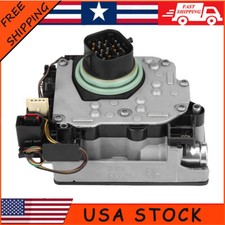
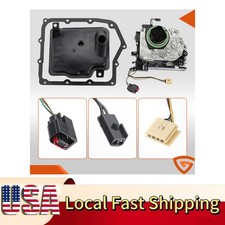
Solenoid code, a dead pressure switch or a pack that has been in and out too many times? CoreTransmissionParts carries the 62TE shift solenoid block pack, Mopar number 68376696AA.
See the 62TE solenoid block pack →Doing the whole unit? Browse all rebuild kits at CoreTransmissionParts.
Need parts for this job?
Solenoid packs, valve bodies, shift kits, TCC solenoids and rebuild kits for the Avenger's 62TE, with checkout right here on Gearbox Insider.
Shop 62TE parts →FAQ
Why does my Dodge Avenger shift hard?
On a six-speed Avenger, start with software and the learn. 2012-2013 cars built before October 9, 2012 have a PCM flash, bulletin 21-013-12, for shift quality. After that, a harsh shift with no codes is often an incomplete adaptive learn or worn pressure regulator bores, and a harsh shift with codes points at the valve body or clutches.
Why is my Avenger stuck in third gear?
Third is the 62TE's limp mode. The TCM holds third when it sees a fault that could damage the transmission, so read the stored codes. In extreme cold, at -16 F (-27 C) or below, it can also hold third briefly until the fluid warms, which is normal.
How do I reset the transmission on a Dodge Avenger?
With a scan tool, clear codes, reset the variable line pressure (VLP) counters and run Quick Learn, then drive the car through all the shifts so the TCM can relearn. Disconnecting the battery alone does not do a proper reset. Expect the first few shifts to be a little abrupt while it relearns.
Why does my Avenger clunk when coming to a stop?
The two common ones are a 6-5 underdrive apply clunk and a 3-2 low/reverse apply clunk on coast-down. Both are tied to wear in the pressure regulator and converter regulator valve bores. Check fluid level and clutch volumes first, then address the valve body.
Can a bad solenoid pack cause shifting problems on a 62TE?
Yes. The solenoid block carries the shift solenoids and pressure switches, and a failing solenoid or switch sets codes and can put the unit in limp. Check that the solenoid block seal is installed right side up, because upside down it blocks the 2/4 circuit and you lose fourth and sixth.
Related guides
Sources
- FCA US LLC (Chrysler Group), 2014 Dodge Avenger Owner's Manual (archived copy). Backs the four-speed dipstick versus the capped six-speed fill tube, the 3 range versus AutoStick, limp home in third, the cold-weather third gear hold, the hot-fluid shift schedule, self-calibrating shifts, ATF+4 only with no additives, sealers or flushes, the 180 F (82 C) hot level check and the 1,000 lb tow rating. archive.org
- Chrysler Group LLC, Service Bulletin 21-013-12, "Transmission Shift Improvements," November 10, 2012, 2012-2013 JS Avenger/200. Backs the 3.6L (ERB) and 2.4L (ED3/EOG) DG2 coverage, the pre-October 9, 2012 build date, the torque management flash, wiTECH 13.01, the 13.2-13.5 V charger requirement, label 04275086AD and labor operation 18-19-06-S9. static.nhtsa.gov (PDF)
- Mike Souza, ATRA Senior Research Technician, "62TE Update" technical webinar. Backs the first 62TE applications including the 3.5L Avenger, the compounder layout and 4th prime, 40-70 ms double-swap timing, low clutch drum ring land wear with P0792/P0735 and a slipping 1-2, P2764 and TCC solenoid 5169313AA, compounder clutch clearances and the upside-down solenoid block seal. atracom (PDF)
- ATRA, Chrysler "CVI (Clutch Volume Indexes)" technical bulletin, 2012. Backs how the TCM calculates gear ratio and clutch volume, and the preliminary 62TE clutch volume ranges. atracom (PDF)
- Sonnax, "Oversized Solenoid Switch Valve Plug Kit" 92835-18K technical page. Backs the switch valve symptoms (low/reverse switch code, second gear starts, erratic TCC apply, no lockup), the cause, the .420 in. large-spool fitment, the required tools and the note that reamer 92835-RM does not fit the 62TE. sonnax.com
- TransGo, SK 62TE-A shift kit instructions and 62TE additional data (2019-2026). Backs the VLP counter reset after every repair, the 6-5 and 3-2 coast clunks, pressure regulator and TC regulator wear, the TCC solenoid and retainer failure, switch valve bore wear and valves RFE-SV420/453, the gear ratio chart, transfer shaft ring and low clutch housing wear, the underdrive piston seal cold leak and 4-3 limp, and the clutch clearances. transgo (PDF)