The 62TE does not fail all at once. It fails in a known order, and most of that order is documented by Chrysler's own service bulletins and by the companies that make the wear parts. What follows is not another fluid-change article. It is the checklist I actually run on a high-mileage 62TE, in the order the unit tends to need it, with the source behind every item so you are not taking my word for it.
This is written for a van, crossover or Ram ProMaster sitting somewhere north of 90,000 to 100,000 miles, whether it is in for an unrelated repair, a pre-purchase inspection, or just showing its first shift complaint. The numbered references point to the Sources list at the bottom.


The checklist, by mileage and trigger
| Trigger | Check | Source |
|---|---|---|
| 60,000 mi (severe duty) / 120,000 mi (normal) | Fluid and filter change, ATF+4 only | Owner's manual [1] |
| Any fluid/filter service | Confirm dipstick reads true; wrong valve body pan is a known cause of a bad reading | GPOP tech tip 9004206 [2] |
| Delayed/no reverse, burnt low/reverse clutch | Vacuum-test the low/reverse and low clutch switch valve bores; 18 in-Hg or better is good | Sonnax [4] |
| Failsafe mode, wrong-gear start, codes 841/868/871/988/1775/1776 | Vacuum-test the solenoid switch valve plug bores | Sonnax [3] |
| Pan or valve body already off | Inspect the shift shaft for a cracked nylon bushing | Sonnax [5] |
| TCC shudder, slip, or no lockup, especially after a water-intrusion event | Check the shift shaft bushing before blaming the converter | Sonnax [5] |
| P0740 or P2764 with jerking/slipping | Test TCC solenoid operation before replacing the torque converter | GPOP tech tip 9004206 [2] |
| Any R&R of the transmission | Verify engine-to-transmission dowel pins are seated; replace bracket-to-case fasteners if removed | GPOP tech tip 9004206 [2] |
| Erratic shift pattern, ratio-error codes, suspect pack | Resistance-check the solenoid pack at roughly 70°F before condemning the TCM | Transmission Digest [6] |
Start with fluid, but check the reading, not just the color
The factory plan is lighter than most people assume. FCA's 2019 Grand Caravan owner's manual calls for a fluid and filter change once, at 120,000 miles, under normal use, moved up to 60,000 and 120,000 miles for police, taxi, fleet use or vehicles that regularly tow for more than 45 minutes continuous [1]. A high-mileage daily-driver minivan in city traffic is closer to the severe line than the normal one, so I work on 60,000 miles once a unit is past 100,000 total.
What belongs on a high-mileage checklist that a routine service does not cover: whether the dipstick is actually telling you the truth. GPOP tech tip 9004206 flags that some in-service 62TE units have an incorrect valve body pan installed, which throws off the fluid-level reading on the dipstick tool even when the ATF was filled to the service library specification. The fix in the bulletin is to install the correct pan, part number 68145886A, rather than chasing a level that will never read right [2]. If you inherit a unit with a persistent "can't get the level right" complaint, check the pan part number before you keep adding or removing fluid. For the full filter, torque and level-check procedure, see our 62TE filter and pan service guide, and for fluid specifics, our 62TE fluid type and capacity guide.
Switch valve bores: the first hydraulic wear point
Past 100,000 miles, the most common hydraulic wear on a 62TE is in the solenoid switch valve bores in the valve body. Sonnax ties wear here to codes 841, 868, 871, 988, 1775 and 1776, along with failsafe mode, wrong-gear starts, a burned overdrive or fourth clutch, and a no-lockup complaint [3]. A separate bore, the low/reverse and low clutch switch valve, wears from what Sonnax describes as heavy side-loading; leakage past the one-way valve there shows up as low apply pressure, a burnt low/reverse clutch, and delayed or missing reverse or first and second gears [4]. Sonnax's own guidance for testing it: vacuum-test each bore by shuttling the valve manually to its worm track, and treat an 18 in-Hg reading or better as acceptable; if one port leaks, the companion port almost certainly does too, so replace both valves in the pair rather than just the one that tested bad [4].
These two wear clusters are the reason an otherwise sound 62TE starts throwing intermittent codes around 100,000 to 150,000 miles with nothing electrically wrong. We cover the full diagnosis and repair kit numbers in Chrysler 62TE valve body and solenoid failures; this checklist is where that inspection fits in the bigger picture.
The shift shaft bushing: check it anytime you are already in there
This one does not get enough attention. Sonnax calls shift shaft bushing failure "a chronic problem" on the 62TE: the shift shaft rides in an OE nylon bushing, and that bushing cracks with age. Once it cracks, water and road dirt get into the case, which Sonnax lists as a leading cause of shudder-related complaints [5]. Two things make this worth a specific line on a high-mileage checklist rather than something you only find by accident. First, an OEM replacement shift shaft uses the same nylon bushing, so a straight swap just restarts the same failure clock. Second, a shop-applied epoxy repair does not hold, because it cannot effectively seal the crack once it has opened [5]. Any time the pan or valve body is already off for another reason, a visual check of the shift shaft bushing costs you two minutes and can explain a shudder complaint that would otherwise send you chasing the torque converter clutch.
Torque converter codes: rule out the solenoid first
P0740 and P2764 get blamed on the torque converter more often than they should. FCA's own tech tip is direct about the order of operations: if the vehicle is jerking or slipping with either code stored, check TCC solenoid operation first. Only if the solenoid tests good does the bulletin call the codes indicative of a torque converter failure and call for replacing the converter [2]. Skipping that solenoid check is the single most common reason a converter swap does not fix the original complaint. For the full diagnostic sequence, including the cooler-flow isolation test, see our 62TE P0741 diagnosis and fix.
If the transmission is coming out for any reason
Two items from the same FCA tech tip belong on every R&R checklist, not just warranty replacements. The engine-to-transmission dowel pins are, in the bulletin's words, critical to the longevity of several components; verify they are seated in the rear face of the engine block before a transmission goes back in [2]. Separately, the transmission bracket-to-case fasteners are one-time-use: if they are removed during service, replace them rather than reusing them. The bulletin even breaks out which service kit applies by build date on ProMaster applications, since the isolator and bracket hardware changed partway through production [2]. Neither of these costs much, and both are easy to skip when a transmission swap is the fourth job of the day.
Bench-check the solenoid pack before you condemn the TCM
When the symptom is an erratic shift pattern or a ratio-error code rather than a clean mechanical bore-wear pattern, pull the pack and check it electrically before replacing a controller. Per Transmission Digest's breakdown of the 62TE solenoid pack, it contains six shift solenoids, one line-pressure solenoid, a temperature sensor and five pressure switches, with the line-pressure sensor and the TCC variable-force solenoid mounted separately on the valve body rather than inside the pack itself [6]. Run resistance checks at roughly room temperature for the readings to be meaningful, and do not assume a pack that reads electrically sound is also hydraulically sound; the switch valve bore wear above happens in the valve body casting, not in the solenoids themselves, so a good ohm reading does not rule out the bore wear covered earlier in this checklist. For a solenoid-by-solenoid symptom guide, see 62TE shift solenoid symptoms and replacement.
Reading the pan, and knowing when the checklist is over
A pan drop at any point on this checklist is free diagnostic information. A fine gray paste on the magnet is normal wear. Visible bright metal flakes mean something is actively chewing, most often a bushing or the pump. Black or brown friction fiber paired with a burned smell means the clutches are already gone. When the checklist above turns up burnt low/reverse material, a cracked shift shaft bushing with water intrusion, and bore wear in the valve body all on the same unit, you are no longer looking at a service interval problem. That combination is what a master rebuild kit is for, not another round of fluid and a hopeful road test.
Shop the part for this checklist: 62TE filter with pan gasket
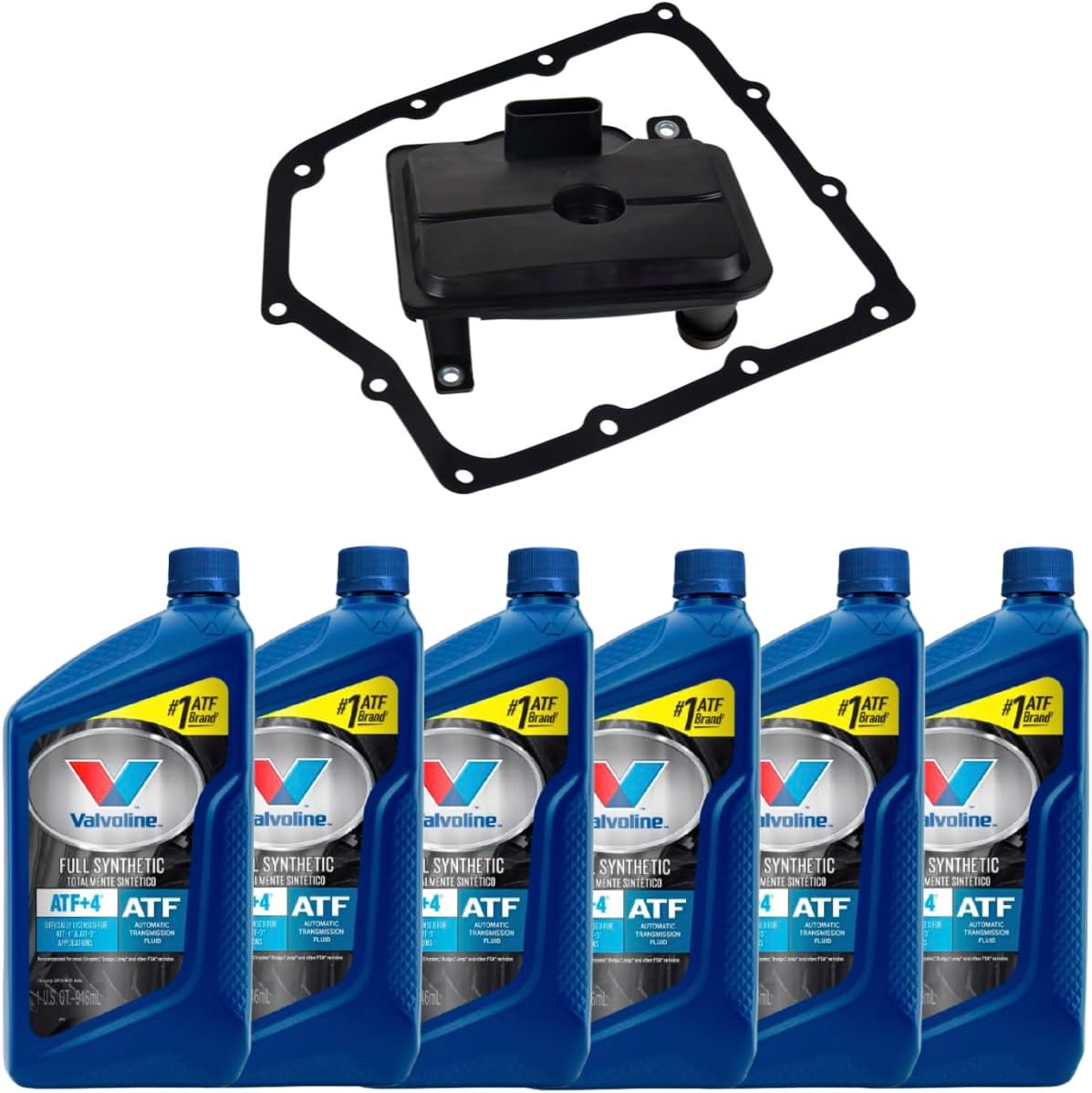
Every item on this checklist starts with the pan off. The CoreTransmissionParts 62TE filter kit replaces Mopar 68018555AA and includes the pan gasket, so you are not waiting on parts to start the inspection.
View the 62TE filter kit at CoreTransmissionPartsOr browse all 62TE parts at CoreTransmissionParts.
Need parts for this job?
Our 62TE parts page has the service kit, the solenoid pack, and the master rebuild kit for whichever stage this checklist puts you at, all on our own checkout. For every OEM fluid spec side by side, see the transmission fluid spec chart.
FAQ
How often should a high-mileage 62TE actually be serviced?
FCA's own owner's manual calls for a fluid and filter change at 120,000 miles under normal use, moved up to 60,000 and 120,000 miles for police, taxi, fleet use or frequent trailer towing over 45 minutes continuous. Past 100,000 miles on a minivan or crossover that sees mostly city driving, treat it as severe duty and work on the 60,000-mile line rather than the normal one.
What codes show up when the 62TE solenoid switch valve bores wear out?
Sonnax ties high-mileage wear in the solenoid switch valve bores to codes 841, 868, 871, 988, 1775 and 1776, along with failsafe mode, wrong-gear starts, a burned overdrive or fourth clutch, and loss of torque converter lockup. These bores take the most cycles of anything in the valve body, so they are usually the first thing to wear on a unit well past 100,000 miles.
Is a cracked shift shaft bushing a big deal on the 62TE?
Yes. Sonnax calls shift shaft bushing failure a chronic problem on the 62TE: the OE nylon bushing cracks, and the crack lets water and road dirt into the case, which Sonnax lists as a leading cause of shudder-related complaints. An OEM shaft replacement only resets the clock on the same nylon bushing, and epoxy cannot seal the crack, so it is worth a visual check any time the pan or valve body is already off.
What should a tech check before buttoning up a 62TE R&R?
Per FCA's GPOP tech tip 9004206, verify the engine-to-transmission dowel pins are seated in the rear face of the block before the transmission goes back in, and treat the transmission bracket-to-case fasteners as one-time-use: if they were removed, replace them rather than reusing them. The bulletin also flags that some units in service have the wrong valve body pan installed, which throws off the dipstick reading even when the fluid level is correct.
Does a P0740 or P2764 code always mean the torque converter is bad?
No, check the TCC solenoid first. FCA's own guidance says that if the vehicle is jerking or slipping with P0740 or P2764 stored, test TCC solenoid operation before condemning the converter. If the solenoid checks out, FCA states the codes point to the torque converter and it should be replaced. Skipping the solenoid check is the most common reason for a converter swap that does not fix the complaint.
Related guides
Sources
- FCA US, 2019 Dodge Grand Caravan Owner's Manual, Servicing and Maintenance (Maintenance Plan, Automatic Transmission) and Trailer Towing. Backs the 120,000-mile normal and 60,000/120,000-mile severe fluid and filter intervals and the 45-minute continuous towing rule. vehicleinfo.mopar.com (PDF)
- FCA US / Stellantis, GPOP Tech Tip 9004206, "Remanufactured Transmission Assembly" (April 7, 2021), covering MY11-13 JS, MY15-22 VF, MY11-20 RT and JC, via NHTSA. Backs the one-time-use bracket fasteners, the engine-to-transmission dowel pin check, the P0740/P2764 TCC-solenoid-first diagnosis, and the incorrect valve body pan causing a bad dipstick reading (correct pan P/N 68145886A). static.nhtsa.gov (PDF)
- Sonnax, "Chrysler 62TE Vacuum Test Guide." Backs the solenoid switch valve plug codes (841, 868, 871, 988, 1775, 1776) and associated failsafe/wrong-gear-start/burned-clutch symptoms. sonnax.com
- Sonnax, "Diagnosing 62TE/68RFE Low/Reverse Switch Valve Issues." Backs the low/reverse and low clutch switch valve bore wear, the burnt low/reverse clutch and delayed/no reverse symptoms, and the 18 in-Hg vacuum test threshold. sonnax.com
- Sonnax, "How to Repair & Prevent 62TE Shift Shaft Bushing Failure." Backs the chronic nylon bushing crack, water/dirt intrusion causing shudder, and why OEM shaft replacement and epoxy repairs do not solve it. sonnax.com
- Transmission Digest, "Solenoid-Pack Information for the Chrysler 62TE." Backs the solenoid pack composition (six shift solenoids, one line-pressure solenoid, temperature sensor, five pressure switches) and that the line-pressure sensor and TCC variable-force solenoid mount separately on the valve body. transmissiondigest.com