"It's making a noise" is the least useful complaint a 62TE will ever generate, because that one sentence covers at least three different failures with three different repairs. A whine that lives at idle is not the same problem as a growl that shows up under load, and neither one is the clunk or shudder some customers report right as the transmission shifts. Treating all three as "probably the pump" is how shops end up replacing the wrong part on a unit where Chrysler's own parent company has already documented the real failure points.
This guide sorts the three complaints by what FCA's own bulletins and a recognized aftermarket supplier actually say is failing, not by guesswork. It is a companion to our 62TE pump failure symptoms guide, which covers the P0944 no-move and slip diagnosis in depth; this one is narrower and focused specifically on what you hear, not just what codes set.


Start with the fluid, not the wrench
Before you chase any of the three noises below, pull the dipstick or check the fluid through the fill plug. FCA's own repair index for 62TE hydraulic complaints opens with exactly this step: inspect the transmission fluid for signs of excessive thermal deterioration, which shows up as a very dark color and a strong, burnt odor. That one check tells you whether you're looking at an early-stage mechanical issue, like a scored pump bushing, or a transmission that has already been cooking itself and needs a heavier repair.
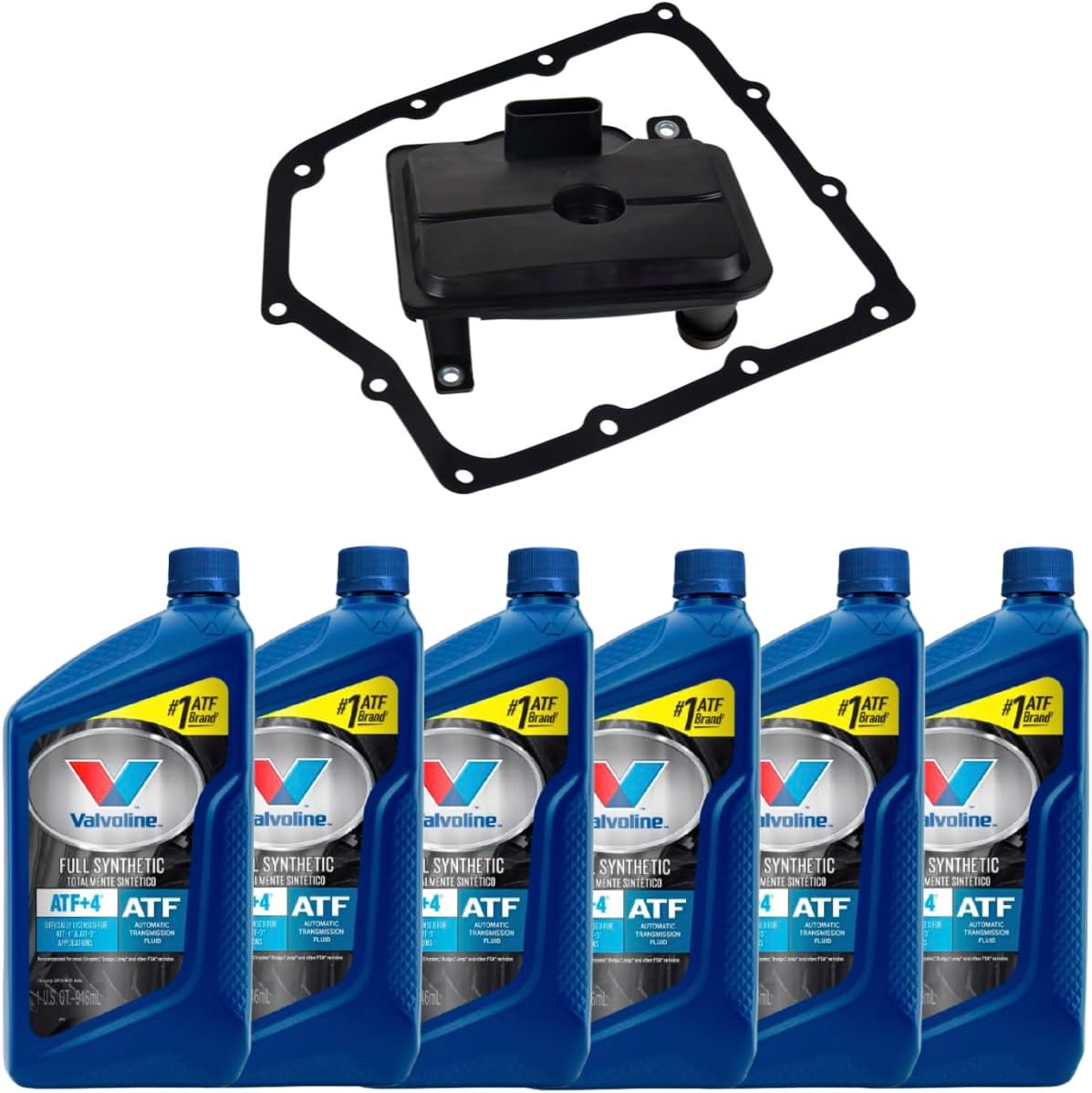
While you're in there, confirm you're using the right fluid and filling to the right level. The 62TE is specified for Mopar ATF+4 only, part number 05013457AA. FCA's published vehicle capacities list a service (pan drop) fill of 5.5 quarts (5.2 liters) and a full overhaul dry fill of 9.0 quarts (8.5 liters), noting that actual refill amounts vary with cooler type and line length. ATF+4 itself is covered by Chrysler Material Standard MS-9602, with a kinematic viscosity around 7.5 cSt at 100°C and 35.0 cSt at 40°C and a pour point near -48°C. Fluid that's low, the wrong type, or thinned out from heat can produce a cold-start whine on its own, from pump cavitation, before you ever get to a hardware failure.
A whine at idle or low speed: the pump bushing
If the noise is a steady whine that's present at idle and doesn't change much with load or converter lockup, the first real suspect is the oil pump bushing. FCA's GPOP tech tip 9004009, last updated March 31, 2021, is direct about this: on 62TE-equipped vehicles, if the pump bushing is scored or damaged and the dowel pin alignment holes are intact, you replace the pump assembly, not the complete transmission. The bulletin also tells you to check something easy to miss first: confirm both dowel pins are present in the engine block and inspect the dowel alignment holes in the transmission case, since damaged or elongated holes mean the transmission itself should be replaced to prevent repeat failure from misalignment during the repair.
This failure mode exists because of how the pump bushing clearance is set at the factory. The bore that houses the torque converter hub is machined in place during pump assembly, so bore diameters vary more than a stamped or ground part would, and a worn or out-of-spec bushing lets the converter hub move around more than it should. That extra clearance is what generates the whine, along with increased front seal leakage and loss of converter prime in more advanced cases.
A growl or whine that gets worse under load: the torque converter
A noise that intensifies with load, or that shows up alongside slipping and erratic shifts, points away from the pump and toward the torque converter. This is a separate, well-documented 62TE condition: FCA's STAR Case S2121000005, released April 1, 2021, covers a batch of torque converters built with an internal piston that can develop a crack over time. Once cracked, the piston scrapes friction material off the front cover, which produces the noise and slip complaint together and can set DTCs P0740 (TCC Out of Range), P0868 (Line Pressure Low), and/or P0944 (Loss of Hydraulic Pump Prime).
That bulletin lists specific suspect transmission and torque converter assembly part numbers and notes that newer remanufactured transmissions and torque converters built after August 2017 should not exhibit the condition, so a build date and part number check is worth doing before you commit to a converter replacement. We cover the full code-by-code decision tree from that bulletin, Service Actions A, B, and C, in the pump failure symptoms guide linked above; the short version for a noise complaint is that a clean fluid and filter with only P0740 present points to a converter-only repair, while contamination and clutch wear escalate the job toward a full assembly replacement.
Sorting TCC solenoid from torque converter: P0740 and P2764
Not every converter-area noise means a new converter. FCA's GPOP 9004009 also addresses the jerking and slipping complaint directly: if the vehicle is jerking or slipping with MIL code P0740 or P2764, check TCC solenoid operation first. If the solenoid tests fine, the bulletin states those codes are indicative of a torque converter failure, and the converter should be replaced. Skipping the solenoid check and going straight to a converter swap is a common way to replace a $300-plus part when the fix was a solenoid.
A clunk or shudder tied to shifting: the shift shaft bushing
The third complaint, a clunk or shudder that shows up around shift events rather than a continuous whine, has a documented source that's easy to overlook because it isn't inside the valve body or pump. Sonnax's technical writeup on the 62TE identifies the factory nylon shift shaft bushing as a chronic failure point: when the bushing cracks, it lets water and dirt into the transmission, which Sonnax calls a leading cause of shudder-related problems. Because the crack itself isn't visible without pulling the shift shaft, this failure commonly gets misdiagnosed as a torque converter clutch shudder, and the converter gets replaced while the actual leak path stays open.
Sonnax's fix is a shift shaft saver kit (their part 262991-04K) that replaces the factory bushing with a sealed design, rather than relying on epoxy repairs, which the company notes don't hold up because they can't reliably seal the crack. If you've already replaced a converter for a shudder complaint and the noise or shudder came back, the shift shaft bushing is worth checking before you condemn the new converter.
Diagnose it in this order
- Check the fluid first. Dark, burnt-smelling fluid moves you toward the heavier repair tier regardless of which noise you're chasing. Confirm it's ATF+4 and filled to spec; low or wrong fluid can cause its own whine.
- Pull codes. P0740, P0868, P2764, and P0944 each narrow the field. No codes at all, with a steady idle whine, leans pump bushing. Codes with load-related slip lean converter.
- Drop the pan and pull the filter. Friction material here confirms clutch-side contamination and pushes you toward Service Action C territory from the FCA bulletin, not a simple pump or converter swap.
- Check TCC solenoid operation before replacing a converter. Per GPOP 9004009, a good solenoid with P0740 or P2764 present means the converter itself has failed; a bad solenoid means it hasn't, yet.
- If the complaint is a clunk or shudder on shift, inspect the shift shaft bushing for cracking before you assume the torque converter clutch is at fault, especially if a converter was already replaced once for this complaint.
- Confirm dowel pins and alignment holes any time you're replacing a pump for bushing scoring, so you don't reinstall onto a transmission case that will just re-damage the new part.
62TE Torque Converter Clutch TCC Solenoid, OEM 926-378
Per FCA's own bulletin, this is the part to rule out before you replace a torque converter for a P0740 or P2764 complaint. Sold by our sister store, CoreTransmissionParts.
Shop the part for this fix →Confirmed it's the converter instead? CoreTransmissionParts also carries a 62TE remanufactured pump assembly if the bushing check above points at the pump instead.
Need parts for this job?
Our 62TE parts page has the oil pump assembly, service kit with fluid and filter, and master rebuild kits for when the noise has turned into clutch damage. Checkout is on site.
FAQ
What causes a whine in a 62TE transmission?
The two most common sources are a scored or damaged oil pump bushing and a torque converter whose internal piston has cracked and is scraping friction material off the front cover. FCA's own GPOP tech tip 9004009 addresses the first directly: if the pump bushing is scored and the dowel pin alignment holes are undamaged, the fix is a pump assembly replacement, not a full transmission. The second condition is documented separately in FCA STAR Case S2121000005 and tends to set P0740, P0868, and/or P0944 as it progresses.
Is a 62TE whine always a pump problem?
No. A whine that fades or changes with converter lockup, or that comes with slipping and MIL codes P0740 or P2764, points at the torque converter rather than the pump, per GPOP 9004009 item 4: check the TCC solenoid first, and if it tests fine, the codes indicate torque converter failure. A whine that is steady regardless of load or lockup state, with no codes, leans toward pump bushing wear or low fluid level.
What causes a clunk or shudder when a 62TE shifts?
One documented and often-missed cause is a cracked shift shaft bushing. Sonnax's technical writeup on the 62TE explains that the factory nylon shift shaft bushing can crack, which lets water and dirt into the transmission and is a leading cause of shudder-related complaints. Because the crack is hard to see without removing the shaft, it commonly gets written off as a torque converter clutch shudder and the wrong part gets replaced first.
Should I check the fluid before diagnosing a 62TE noise complaint?
Yes, before anything else. FCA's cracked-converter-piston repair index treats fluid condition as the first diagnostic step: fluid that is dark and has a strong, burnt odor signals thermal deterioration and points toward a heavier repair tier, while clean fluid with no friction material in the pan or filter narrows the problem toward an earlier-stage issue like pump bushing wear or a TCC solenoid fault. Checking fluid color and smell costs nothing and changes which direction you investigate.
How much fluid does a 62TE take and what type is specified?
FCA's published vehicle capacities and specifications list Mopar ATF+4 as the specified fluid, with a service (pan drop) fill of 5.5 quarts (5.2 liters) and a full overhaul dry fill of 9.0 quarts (8.5 liters), part number 05013457AA. ATF+4 is covered by Chrysler Material Standard MS-9602, with a kinematic viscosity of roughly 7.5 cSt at 100 degrees C and 35.0 cSt at 40 degrees C. Actual refill amounts vary by cooler type and line length, so always confirm the level with the fluid-level check procedure rather than the chart alone.
Related guides
- 62TE Pump Failure Symptoms and Replacement
- 62TE Torque Converter Shudder
- 62TE No Movement Diagnosis
- 62TE Pressure Testing
- 62TE Slipping: Causes and Fix
- 62TE Fluid Type and Capacity
Sources
- FCA US LLC, GPOP Issue Review System Tech Tip 9004009, "Transmission Kit with Torque Converter," updated March 31, 2021. Backs the scored pump bushing diagnosis and pump-assembly-only repair, the dowel pin and alignment hole check, and the TCC solenoid vs. torque converter decision point for P0740/P2764. static.nhtsa.gov (PDF)
- FCA US LLC, STAR Online Case S2121000005, "62TE 6-Speed Transmission Cracked Torque Converter (TC) Piston Repair Index, To Aid In Diagnosis And Repair," Version 4.3, released April 1, 2021. Backs the cracked internal piston defect, the P0740/P0868/P0944 code set, the suspect part numbers, and the fluid-condition-first diagnostic approach. static.nhtsa.gov (PDF)
- Sonnax, "How to Repair & Prevent 62TE Shift Shaft Bushing Failure," published April 21, 2021. Backs the shift shaft bushing cracking, water/dirt intrusion, the resulting shudder-related complaints, and why epoxy repairs fail. sonnax.com
- FCA US LLC, "Vehicle Quick Reference / Capacities and Recommended Fluids / Specifications," Transmission section. Backs the 62TE ATF+4 service fill (5.5 qt / 5.2 L) and overhaul fill (9.0 qt / 8.5 L) figures and fluid part number 05013457AA. static.nhtsa.gov (PDF)
- Amalie Oil Company, "Full Synthetic ATF+4 Automatic Transmission Fluid" technical data sheet, February 2024. Backs the MS-9602/MS-7176E/D specification and the kinematic viscosity, viscosity index, and pour point figures for ATF+4. amalie.com (PDF)