The first time you go looking for a pressure tap on a 62TE, you will think you are losing your mind. No row of plugs down the case, nothing on the bell housing. Look it over twice and you find exactly one: a single main line tap in the lower left pan rail, in among the pan bolts. That is not an oversight. Chrysler deleted every clutch pressure tap on this transaxle on purpose, and understanding why tells you how to test one.
The short version: the 62TE has one pressure tap and it reads main line only. Warm the unit, hang a 0–300 psi gauge on that tap, and watch the gauge and the scan tool side by side. Normal OE line pressure runs a 60 psi minimum and a 150 to 160 psi maximum at stall, with roughly 250 psi in Reverse at the top of the range. Actual and desired should track each other. A flatlined actual reading sitting at 150–160 psi in Park, Neutral and Drive at idle with no duty cycle activity is not a bad pump — it is an open circuit on the pressure control solenoid, and on this unit that is very often inside the PCM.
Why This Transaxle Only Has One Tap
Chrysler documented the 62TE design in SAE technical paper 2007-01-1097, "62TE 6-Speed Transaxle for Chrysler Group," presented at the 2007 SAE World Congress. The engineering case laid out there is straightforward: machined pressure taps cost money, each plug that gets pressed in costs more money, and every one of them is a place the unit can eventually leak. So they deleted them.
The factory still had to verify clutch circuits on the line, so the valve body got a workaround. ATSG's Wayne Colonna took a 62TE valve body apart and counted the checkballs: four normal removable ones, and nine more that do not come out. Those nine sit in tapered ports. A test machine drives a probe in, unseats the ball, and reads clutch pressure through the port; pull the probe and the ball reseats and seals that circuit for the rest of the unit's life.
Two things follow from that, and both matter on the bench:
- Do not try to remove those nine checkballs. They are the seal for their circuits. Do check that they seat and hold pressure, because a ball that no longer seals is a clutch circuit that no longer holds — Sonnax lists drive slip, reverse slip, gear ratio errors and limp mode against exactly that failure.
- You cannot tap-test a 62TE clutch circuit the way you would a 4L80E. There is nowhere to hook up. Line pressure is the only hydraulic number you get, so everything else has to come from scan data, vacuum testing and a clean teardown.
There is one more oddity worth knowing about, and it is a real-world failure, not trivia. The low/reverse clutch circuit is routed out to the pan rail the same way the main line tap is — but that port was never tapped. It is blocked by the pan. Which means every time the vehicle goes into Reverse or first gear, the pan gasket is what holds back low/reverse clutch pressure. Colonna's suggestion, and it is a good one, is to drill and tap that port the way the line tap is tapped. You kill a real leak path and you gain a low/reverse clutch tap you can actually use.
How the 62TE Decides What Pressure to Make
This is a closed-loop system, and you cannot shim your way around it. The Transmission Control System calculates a desired line pressure — Chrysler calls the primary input Torque Based Line Pressure, derived from calculated torque into the transmission — then duty-cycles the pressure control solenoid (PCS) until the line pressure sensor (LPS) reports that it got there. Desired and actual are compared continuously.
Four numbers do most of the diagnostic work:
- The PCS is a normally vented solenoid, and its duty cycle is inverse to pressure. Five percent duty cycle means solenoid off, which is maximum line pressure. Sixty-two percent means solenoid on, which is minimum line pressure. Watching duty cycle climb while pressure falls is normal control, not a fault.
- Line pressure is forced to a preset level during every shift, and in Park and Neutral, so shift quality stays consistent regardless of what the torque math says. A high-looking number in Park is not automatically a high-pressure fault.
- The LPS is a three-wire transducer — 5 volt supply, ground, signal — the same style used in the 45RFE and 42RE. Its signal must stay between 0.35 and 4.75 volts. Low pressure gives low signal voltage; high pressure gives high signal voltage.
- The LPS and the TCC variable force solenoid bolt directly to the valve body and are not part of the solenoid pack. The line pressure solenoid is in the pack, along with six shift solenoids, a temperature sensor and five pressure switches. That distinction decides which part you order.
The Spec Table
| Parameter | Value | Source |
|---|---|---|
| Normal OE line pressure, minimum | 60 psi | Sonnax |
| Normal OE line pressure, maximum at stall | 150–160 psi (unit dependent) | Sonnax |
| Max-pressure fault signature, idle in P / N / D | 150–160 psi flatlined | Sonnax |
| Max-pressure fault signature, Reverse | 250 psi | Sonnax |
| Default desired line pressure with PCS open circuit | 125 psi, no activity | Sonnax |
| PCS duty cycle range | 5% = solenoid off = max pressure; 62% = solenoid on = min pressure | Transmission Digest / GEARS |
| Line pressure sensor operating voltage | 0.35–4.75 V | GEARS (ATRA) |
| PCS ground control circuit current, KOER in Park or Drive | 0.20–1.00 amps | Sonnax |
| Valve body bore vacuum test, pass threshold | 18 in-Hg or better | Sonnax |
| Solenoid resistance test temperature | Approximately 70°F | Sonnax |
| Fluid | ATF+4 (Chrysler MS-9602) only | 62TE installation guide |
| Initial fill before start-up | 5 quarts, then top to level | 62TE installation guide |
One caution on that table: the 150–160 psi figure appears twice for a reason. It is both the legitimate top of the OE range at stall and the signature of a solenoid circuit failure at idle. What separates them is where you see it and whether it moves. Pressure that climbs to 160 psi at stall and comes back down is working. Pressure that sits at 160 psi in Park at idle and never changes is broken.
Tools You Actually Need
- A 0–300 psi gauge with a long hose. Not a 0–100 psi gauge — Reverse alone can put 250 psi on it in a fault condition and bend the needle around the stop.
- Miller 9336A dipstick, for the applications that shipped without one. Level is a real measurement here, not a wipe-and-look.
- A scan tool showing Line Pressure, Desired Line Pressure and transmission oil temperature. Line pressure duty cycle is not available on every scan tool for the 62TE; without it you diagnose from actual-versus-desired and current draw.
- A low-current amp clamp, which is what separates an open PCS circuit from everything else without cutting a wire.
- A vacuum test stand for the valve body work below.
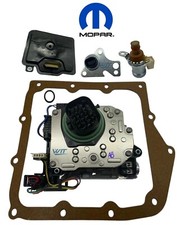
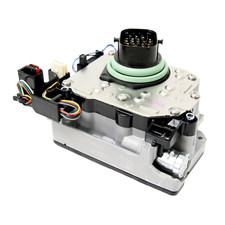
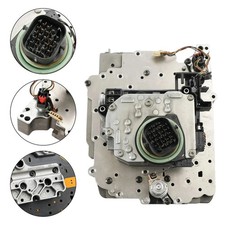
62TE solenoid block pack
When the line pressure solenoid tests open, or the shift solenoid resistances are out at 70°F, the whole pack comes off — six shift solenoids, the line pressure VFS, the temp sensor and five pressure switches in one assembly. Remember that the line pressure sensor and TCC VFS bolt to the valve body separately and are not included in a pack.
View the 62TE solenoid pack →The Procedure
- Set the fluid level properly, at temperature. Vehicle level, cap off the fill tube, foot on the brake, engine idling in Park. Shift through every range a few times stationary, warm it up, wait at least two minutes, then check with the engine running. The 9336A goes into the fill tube roughly 16.7 inches until the tip touches the pan and carries marks every 10 mm; read the height against transmission oil temperature off the scan tool. A low level hands you a low-pressure reading and sends you chasing a pump that is fine.
- Pull and record codes before you clear anything. Which pressure codes set together is most of the diagnosis on this unit.
- Hook up the gauge to the pan rail tap. Lower left rail, alongside the pan bolts. Route the hose away from the exhaust and the axles.
- Read Park and Neutral at idle with the gauge and scan tool together. Log actual, desired, LPS voltage and duty cycle if you have it.
- Read Drive at a stop, brakes applied. Then Reverse. Then a brief stall — brakes hard, throttle up, no more than five seconds, and watch the gauge, not the tach.
- Road test with the gauge taped outside the windshield. Desired and actual should stay close through upshifts and downshifts. Divergence under load that does not show at idle is the pattern for a leaking circuit or a worn regulator bore.
- Compare gauge to scan tool at every step. If the mechanical gauge and the reported line pressure disagree, the sensor or its wiring is the suspect, not the hydraulics.
Three Signatures Worth Memorizing
1. Max line pressure, flatlined
Sonnax describes this one precisely: actual line pressure pinned at 150–160 psi at idle in Park, Neutral and Drive and 250 psi in Reverse, with desired line pressure sitting at its 125 psi default and no activity in the data. That combination points at an open circuit on the PCS line pressure solenoid. Here is the frustrating part — Chrysler never assigned a code to a PCS line pressure circuit fault. What you get instead is P0933, P0869 or P1745, and P0933 in particular will happily send you to the line pressure sensor, which is not the problem.
Confirm it without cutting anything. Put a low-current clamp on the PCS ground control wire back to the PCM, clear codes, and monitor key-on engine-running in Park or Drive. Current flow varies from 0.20 to 1.00 amps on a healthy circuit. See current, and it is not open. See nothing, and it is. And on the 62TE specifically, per Sonnax, that open circuit is commonly inside the PCM itself.
Two footnotes. Aftermarket tuning can mimic max pressure, but tuning usually runs above 160 psi and still shows activity rather than a dead flatline. And after any P1745 repair you have to run Clear Variable Line Pressure (VLP) Counters under miscellaneous functions with a scanner, or the code comes right back.
2. Actual below desired
That is P0868, Line Pressure Low, monitored continuously while driving in all forward gears. Per ATRA's GEARS coverage, it sets when actual line pressure is more than 10 psi below desired. Work the cheap causes first: fluid level, a plugged or cracked primary filter, then the pressure control solenoid circuit and the 5 volt supply, then a sticking main regulator valve. The main filter loading up somewhere in the six-figure mileage range is a well-worn path on this transaxle, and it is a pan gasket and a filter to rule out.
3. Gauge and scan tool disagree
P0934 sets when LPS voltage is at or below 0.35 volts for 0.18 seconds; P0935 sets at or above 4.75 volts for the same 0.18 seconds. Both are circuit codes, not pressure codes. The manufacturer's own cause list is short: 5 volt supply open or shorted to ground, signal wire open or shorted to ground, bad sensor, bad PCM. GEARS also flags the connector itself — faulty solder and crimp joints where the wire meets the terminal pin are one of the most common sources of intermittent pressure codes on these units, and a light tug on the wires usually finds it.
Be careful about stopping at "bad sensor." Transmission Digest documented a 2019 Grand Caravan with a 62TE that set P0934 and did not respond to a new OE sensor. The 5 volt supply and ground checked good. With a gauge on the line tap, the sensor tracked the gauge perfectly when the vehicle behaved — then dropped to 30 psi when it did not. The actual fault turned out to be the accelerator pedal position sensor: APPS 2 circuit voltage went erratic at exactly the same moments the line pressure signal did. New APPS, problem gone. The lesson is not that pedal sensors cause pressure codes. The lesson is that a shared reference or ground can drag a pressure signal down, and it was the gauge on the tap that proved the hydraulics were innocent.
| Code | Description | Set condition |
|---|---|---|
| P0868 | Line Pressure Low | Actual more than 10 psi below desired, continuously in forward gears |
| P0869 | Line Pressure High | Actual higher than the highest desired ever used in the current gear, with PCS duty cycle at or near maximum |
| P0933 | Hydraulic Pressure Sensor Range/Performance | Actual more than 172.4 kPa (25 psi) above desired but below the highest ever used in that gear |
| P0934 | Line Pressure Sensor Circuit Low | LPS voltage 0.35 V or less for 0.18 seconds |
| P0935 | Line Pressure Sensor Circuit High | LPS voltage 4.75 V or more for 0.18 seconds |
| P1745 | Line Pressure Too High for Too Long | 62TE and 42RLE only; requires Clear VLP Counters after repair |
When the Gauge Is Right and the Unit Still Is Not
Line pressure can measure perfectly and the transaxle can still burn a clutch, because on a 62TE the leak is usually downstream of the only place you can measure. Two bores earn a hard look every time this valve body is open.
The low/reverse switch valve and the low clutch switch valve both work as one-way valves for their clutches in Reverse and Drive. Sonnax traced the wear to heavy side loading — the valve diameter is too close to its overall length, so it cocks in the bore. Once the bore is worn, apply oil leaks past the one-way function and exhausts out through the manual valve. The result is low apply pressure, and the symptoms are a burnt low/reverse clutch, delayed Reverse, or no Reverse at all. None of that moves the line pressure gauge much.
Vacuum testing those two bores on a 62TE is genuinely awkward and worth doing anyway. Sonnax's guidance: one of the ports is very long, so cover both the back and the front of the casting — a rubber mat over the back of the valve body makes it manageable — plug the exhaust holes inside the test area, and manually shuttle the valve into whichever worm track you are testing. 18 in-Hg is a pass. Anything below that is worn. They also found that if port #1 leaks badly, port #2 is almost certainly leaking too, so plan on replacing both OE valves rather than one. The repair kits are 92835-43K drop-in and 92835-47K oversized for extreme bore wear.
The pressure regulator valve bore is the other one, and it is the bore that can actually move your gauge. Where the wear sits decides what you see: wear at the inner bore drives high line pressure, harsh shifting and erratic converter apply; wear at the spring end lets line pressure exhaust, giving low pressure, soft shifts and burnt clutches. Sonnax lists 92835-29 as the oversized replacement for variable line pressure units. If line pressure is inside spec but wanders while desired sits still, that bore is where to look — and no code will point you there.
Fill, Level and Relearn
The 62TE takes ATF+4, Chrysler material standard MS-9602, and nothing else. On a reman install, add 5 quarts before start-up, run it, then bring it up to level with the engine running using the procedure above. Cooler and lines get hot flushed or replaced — skipping that is how a fresh unit inherits the debris that killed the last one.
Then run the Quick Learn procedure. It has preconditions, and it aborts if you miss them: brakes applied, engine speed above 500 rpm, throttle angle under 3 degrees, shift lever held in position until prompted, and calculated oil temperature above 60°F and below 200°F. Driving one of these without the relearn done can damage the transmission immediately, which is a costly way to save fifteen minutes.
Solenoid block packs, line pressure sensors, valve bodies, oil pumps, filter and gasket kits, torque converters and master rebuild kits for the 62TE — shipped fast from the USA.
Shop 62TE parts →Related reading: 62TE valve body and solenoid problems goes deeper on the solenoid pack and the codes that come with it, and the general transmission pressure testing guide covers gauge selection and technique that carries across units.
Sources
- SAE International — Technical Paper 2007-01-1097, "62TE 6-Speed Transaxle for Chrysler Group," SAE World Congress, Detroit, April 2007. Backs the design decision to eliminate machined clutch pressure taps on the 62TE valve body on the grounds of tap machining cost, plug insertion cost and the leak paths taps create, and the resulting need for an alternate assembly-line clutch pressure verification method. sae.org/publications/technical-papers/content/2007-01-1097
- Transmission Digest — Wayne Colonna (ATSG, Technical Editor), "62TE Observations." Backs the nine non-removable checkballs sitting in tapered ports and used with a factory test probe for clutch-circuit pressure testing, the warning not to remove them, the location of the single main line pressure tap in the lower left pan rail alongside the pan bolts, and the fact that the low/reverse clutch circuit is routed to the pan rail untapped and sealed only by the pan, along with the recommendation to drill and tap that port. transmissiondigest.com/62te-observations
- Sonnax — Jim Mobley (Sonnax TASC Force), "Diagnosing Chrysler Transmission Max Line Pressure & P0933, P0869, P1745 Codes." Backs the normal OE range of 60 psi minimum and 150–160 psi maximum at stall, the max-pressure fault signature of 150–160 psi at idle in Park, Neutral and Drive with 250 psi in Reverse and desired sitting at the 125 psi default with no activity, the absence of any Chrysler code for a PCS line pressure circuit fault, the P0933 set threshold of 172.4 kPa (25 psi) above desired, the note that P0869 on the 62TE is often a bad PCM, the P1745 requirement to run Clear Variable Line Pressure (VLP) Counters, the 0.20 to 1.00 amp current range on the PCS ground control circuit with the engine running, the way aftermarket tuning differs from a circuit fault, and the caution that line pressure duty cycle is not available on all scan tools for the 62TE. sonnax.com/tech_resources/1205-diagnosing-chrysler-transmission-max-line-pressure-p0933-p0869-p1745-codes
- GEARS Magazine (ATRA) — David Chalker, "Diagnosing Pressure Trouble Codes." Backs the pressure control solenoid duty cycle relationship of low duty cycle for maximum pressure and high duty cycle for minimum pressure, the line pressure sensor 5 volt reference and signal behavior, the 0.35 to 4.75 volt operating window, and the set conditions for P0868 (actual more than 10 psi below desired, monitored continuously in all forward gears), P0869, P0933 (172.4 kPa / 25 psi above desired), P0934 (0.35 V or less for 0.18 seconds) and P0935 (4.75 V or more for 0.18 seconds), plus the finding that faulty solder and crimp joints at the line pressure sensor connector are a common source of intermittent codes. gearsmagazine.com/magazine/diagnosing-pressure-trouble-codes
- Sonnax — Chris Leach (Sonnax TASC Force), "Diagnosing 62TE, 68RFE Low/Reverse Switch Valve Issues." Backs the one-way valve function of the 62TE low/reverse switch valve and low clutch switch valve in Reverse and Drive, side loading as the cause of bore wear because valve diameter is too close to valve length, the leak path past the one-way valve exhausting through the manual valve producing burnt clutches and delayed or no Reverse, the vacuum test technique of covering front and back of the casting and manually shuttling the valve, the 18 in-Hg pass threshold, the observation that leakage at port #1 makes leakage at port #2 near certain, and repair kit part numbers 92835-43K and 92835-47K. sonnax.com/tech_resources/1527-diagnosing-62te-68rfe-low-reverse-switch-valve-issues
- Transmission Digest — Wayne Colonna, "Shift Pointers: A Peculiar Problem Syndrome" (2019 Dodge Grand Caravan 3.6L, 62TE). Backs the manufacturer theory of operation quoted for the 62TE line pressure system: line pressure electronically controlled and measured by the LPS with desired continuously compared to actual, 5% duty cycle equals solenoid off equals maximum line pressure and 62% duty cycle equals solenoid on equals minimum line pressure, Torque Based Line Pressure as the primary input, the preset line pressure level during shifts and in Park and Neutral, the 0.35 to 4.75 volt LPS window with the 0.18 second threshold, the four manufacturer-listed causes for P0934, and the documented case where a failing accelerator pedal position sensor produced the pressure sensor fault. transmissiondigest.com/shift-pointers-a-peculiar-problem-syndrome
- 62TE Chrysler Automatic Transmission Installation Guide (remanufactured unit installation instructions, document 04232018). Backs the ATF+4 fluid requirement, the 5 quart initial fill before start-up, the requirement to hot flush or replace the cooler and lines, the Miller 9336A dipstick fluid check procedure including the approximately 16.7 inch insertion depth and 10 mm indicator marks read against transmission oil temperature, and the Quick Learn preconditions of brakes applied, engine speed above 500 rpm, throttle angle under 3 degrees and calculated oil temperature above 60°F and below 200°F. 62TE installation guide (PDF)