A Corvette owner who says "it shifts funny" is usually right that something changed, and usually wrong about what. On the 2006-2014 cars with the Hydra-Matic 6L80 (RPO MYC), the complaint can be a paddle request the car refused, a 2nd-gear launch, a held gear after a hard corner, a hot-fluid protection shift, or a real hydraulic fault like a cracked clutch housing weld. They feel alike from the seat. They do not look alike on a scan tool.
This post is about shift timing and shift quality on the Corvette 6L80. If the car slips or will not move, start with our 6L80 Corvette slipping guide or the broader 6L80 Corvette common problems post, which covers the first-shift 2-3 flare and the wrong upper valve body trap.
- Rule out designed-in behavior first: paddle-mode 2nd-gear launches, refused shifts outside set speeds, Sport/Track gear holding on the 2014 car, and hot-fluid protection above 270°F (GM owner manuals).
- A harsh 2-3 shift on a 2006-2009 car is a known GM bulletin item (09-07-30-004J): a cracked 1-2-3-4 / 3-5-R housing weld or leaking 1-piece pump cover seal rings.
- Harsh shifts right after a battery, valve body or TEHCM job usually need an adapt reset and relearn, not parts (GM PI1343B method).
- Harsh and soft shifts with solenoid codes point at AFL bore wear (Sonnax). Test line pressure before buying a TEHCM.
Step One: Which Corvette, Which Shifter
Every two-pedal Corvette from 2006 through 2014 is a 6L80. On the C6 it lives at the back of the car as the front half of the rear transaxle, driven through the torque tube, so pan and valve body access are nothing like a truck. The 2015 and later Stingray moved to the 8L90 eight-speed, with its own bulletins. If you are not sure, read MYC off the Service Parts Identification label before ordering anything, and see our 6L80 vs 8L90 guide.
The shifter matters. The 2006-2013 C6 uses D and S (Sport Mode) with steering wheel paddles, and the 2012 manual says S works as an automatic with "more noticeable upshifts" until a paddle is used. The 2014 C7 uses D and M (Manual Mode) plus the Driver Mode Selector (Weather, Eco, Tour, Sport, Track), and the shift calibration changes with the mode.
Shift Behavior GM Designed In
A large share of Corvette "shift problems" are the car doing what GM wrote it to do.
Paddle mode launches in 2nd
Both the 2012 and 2014 manuals say that while paddle shift is active, the transmission downshifts through the gears as the car slows and selects 2nd as it stops. From a stop it starts from and holds 2nd unless the driver picks another gear or goes back to D. A soft, lazy launch in paddle mode is 2nd gear, not a slipping 1st. The driver can select 1st with the paddle.
Paddle mode times out on its own
Tapping a paddle in D puts the car in paddle mode temporarily. On the C6, the 2012 manual says it goes back to automatic after 10 seconds of steady cruising with no manual shifts, or at a stop. On the 2014 car the manual says six seconds, and aggressive cornering keeps it in manual.
Refused shifts show an X
Paddle shifts are speed-limited both ways, and the system will never allow a start from 4th or higher. On the C6, a denied shift puts an X over the gear display and sounds a chime (the HUD does the same). With the 2.56 axle (RPO GM8), upshifts to 4th, 5th and 6th need about 22, 28 and 41 mph, and a paddle downshift into 1st is refused above about 42 mph. With the 2.73 axle (RPO GU2), the upshift points drop to about 19, 24 and 35 mph and the 1st-gear downshift limit to about 40 mph.
2014: Sport and Track hold gears on purpose
The 2014 manual describes two algorithms that run when the driver is not using the paddles. In Sport, Performance Algorithm Liftfoot (PAL) recognizes aggressive throttle and holds lower gears for engine braking. In Track, Performance Algorithm Shift (PAS) recognizes hard cornering, heavy braking and high acceleration and holds lower gears. The cluster shows PERFORMANCE SHIFT ACTIVE when either one has taken over.
The quick test: reproduce it in D, paddles untouched, fluid warm (Tour mode on a 2014). If it goes away, it was the mode.
Hot Fluid Changes the Shifts
Corvettes get driven hard, and heat is the 6L80's real enemy. The 2012 owner manual says the TRANSMISSION HOT IDLE ENGINE message comes on, with four chimes, when fluid temperature passes 132°C (270°F) or rises fast, and that the transmission "may shift gears or apply the torque converter clutch" to bring the temperature down. GM says to drive slower and let it cool to at least 110°C (230°F), and that seeing the message on flat roads in normal driving means the car may need service.
Odd shift points after a track session or a long hot climb may be that protection strategy, so get the fluid temperature history before blaming hardware.
Harsh 2-3 on a 2006-2009 Car: GM 09-07-30-004J
This is the Corvette 6L80 shift bulletin most shops never look up. GM Service Bulletin 09-07-30-004J (February 2014) lists the 2006-2009 Corvette with the 6L80 (MYC) for slips in Reverse or 3rd, delayed Reverse or Drive engagement, DTCs P0776, P2715 or P2723, and harsh 2-3 shifts. It gives two different causes depending on the year.
2006-2008: cracked 1-2-3-4 / 3-5-R housing weld
On 2006-2008 units, GM lists a cracked 1-2-3-4 / 3-5-R clutch housing as a cause of a no-Reverse or slipping Reverse, delayed Reverse, a harsh 2-3 shift, a harsh 4-5 or a slip in 5th, and a slip on acceleration when passing. The test is simple and can be done with the housing assembled or apart:
- Apply soap compound to the weld area of the housing.
- Hold your thumb over the air bleed passage.
- On an assembled housing, blow compressed air into the 3-5-R clutch feed hole.
- Bubbles at the weld mean the housing must be replaced.
Two warnings from the same bulletin save comebacks. GM changed the 1-2-3-4 piston, the 1-2-3-4 piston housing and the 3-5-R piston for the 2008 model year, and putting a complete 2008 housing into a 2007 or older 6L80 can cause a 2-3 flare or 3-5-R clutch distress. And when a new housing goes into a 2007 or older unit, all three inner seals must be installed, or the result can be no Reverse, no forward or burnt clutches.
2006-2009: leaking 1-piece pump cover seal rings
The second cause covers all four model years. A harsh 2-3 can come from leaking 1-2-3-4 and 3-5-R clutch fluid seal rings on the pump cover. Units from 2006, 2007, 2008 and early 2009 used a 1-piece seal ring, and GM switched to a 2-piece design starting in December 2008. GM calls the 1-piece leak "typically a low mileage issue." The fix is new 1-piece rings, not a new pump cover, installed in the correct orientation or the harsh 2-3 comes back. Never put a 1-piece ring on a 2-piece cover, identified by a notch in the ring grooves.
On the bench, a drum leak tester on the 3-5-R and 1-2-3-4 circuits helps find both problems before the unit goes back in the car.
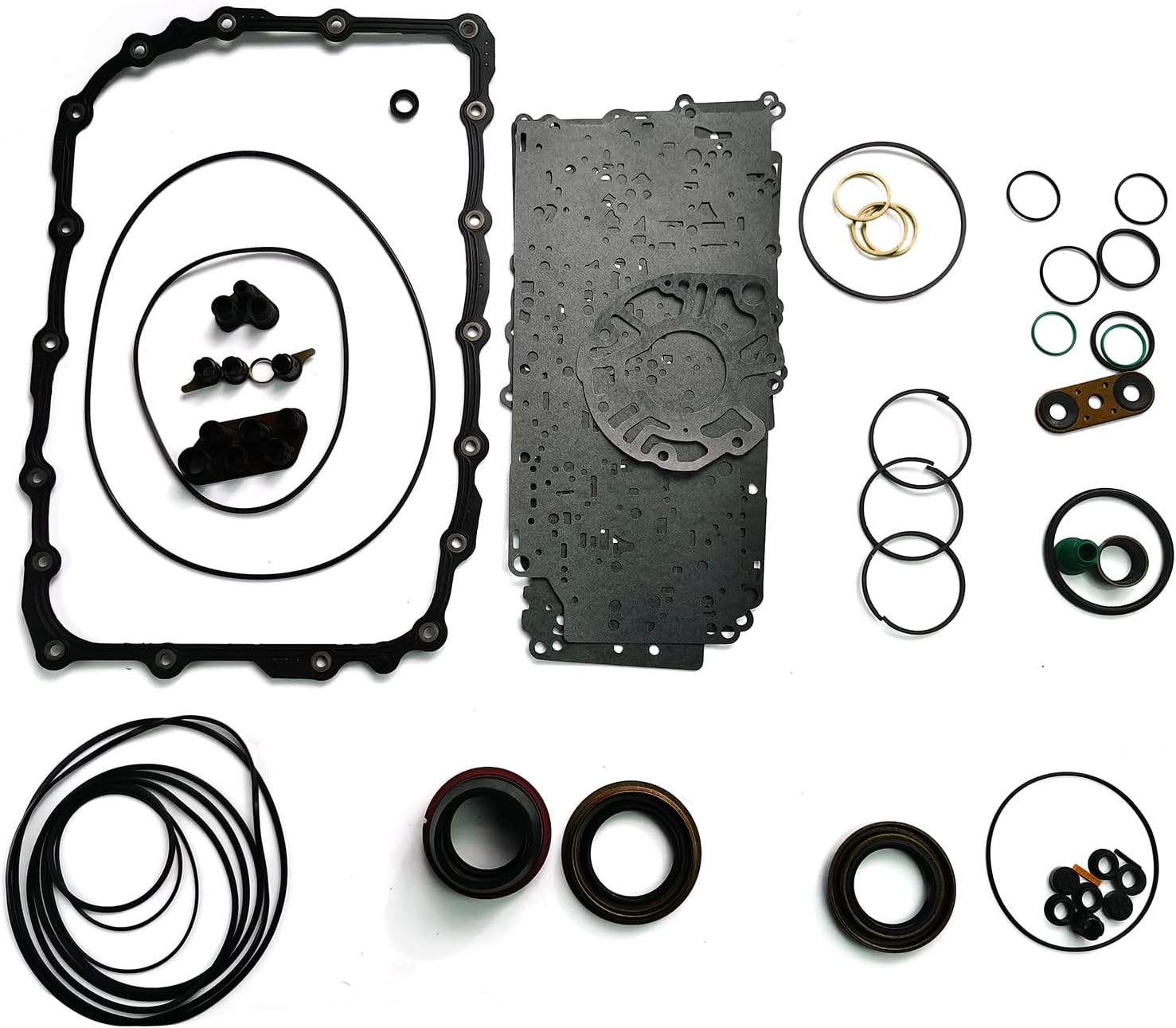
6L80 Complete Teflon Sealing Ring Kit
For the leaking clutch fluid seal rings behind a harsh 2-3: a full set of 6L80 sealing rings, so every circuit gets fresh rings while it is apart.
Shop the 6L80 sealing ring kit →Need a different part? Browse the full 6L80 parts collection.
Harsh Shifts After a Battery, TEHCM or Valve Body Job
The 6L80 is clutch-to-clutch. Every shift is one clutch releasing while another applies, and the TCM times that overlap from learned values (adapts). When the learned values no longer match the hardware, shifts bind up or flare. That is why a Corvette can come back banging into gears after a TEHCM swap, valve body repair or reflash.
GM's process for this is shown in Preliminary Information PI1343B, written for a harsh 6-4 downshift on 2012 6L80 (MYC) trucks: perform Reset Transmission Adapts, then road test. If that fixes it, the reset was the repair. If not, the bulletin is not the cause and diagnosis continues. The Corvette is not listed, but the order applies to any 6L80: reset, relearn, re-test, then condemn parts.
The relearn only works if the fluid gets to operating temperature. Gears Magazine (Keith Clark, October 2023) notes 6L80 and 6L90 units whose cooler bypass valve keeps them from ever warming up, so they never adapt their shifts, and recommends an updated thermostatic bypass valve for those cases.
Harsh, Soft or Wrong-Gear Starts With Codes: The AFL Valve
If adapts will not hold, or the car swings between harsh and soft shifts and stores solenoid performance codes, look at the actuator feed limit (AFL) valve in the valve body. The AFL valve regulates the oil that feeds the shift solenoids. Sonnax states that AFL bore wear causes erratic supply pressure to the control solenoids, and lists solenoid performance codes, clutch failure, wrong gear starts, harsh shifts and soft shifts as the symptoms on the 6L45, 6L50, 6L80 and 6L90.
Unstable feed oil makes every solenoid-controlled clutch misbehave, which is why a worn AFL bore gets mistaken for a bad TEHCM. Sonnax's repair is the oversized AFL valve 104740-12, installed with the F-104740-TL12 tool kit, when the bore fails a vacuum test at the specified ports or shows visible wear. Because the AFL works off line pressure, Sonnax also points to its pressure regulator and boost valve kit when line pressure is the problem.
Before You Buy a TEHCM: Test Line Pressure
Gears Magazine notes this unit cannot be back-probed electrically, so the key hard test is line pressure against command:
- Put a gauge on the mainline pressure port on the passenger side of the case.
- Use the scan tool's bi-directional controls to sweep pressure control (EPC) solenoid current up and down, and compare the gauge to the commanded value at each step.
- If pressure reads low, pull the TCM fuse. With no power, the pressure control solenoid goes to high pressure, so the gauge should climb. Low pressure that rises with engine speed points at pump output.
- A shaky needle at idle and hot delayed engagement also point at the pump. The article gives a slide-to-rotor clearance of 0.0008 to 0.002 in. (Plastigage).
High line pressure is a harsh-shift cause on its own. Either way, the TEHCM belongs at the end of the list, not the start.
A Working Diagnostic Order for a Corvette Shift Complaint
- Confirm MYC on the SPID label and note the build year.
- Ask what mode the car was in and reproduce the complaint in D, warm, paddles untouched. Check fluid temperature history.
- Pull codes and freeze frame before clearing. P0776, P2715 or P2723 on a 2006-2009 car points at 09-07-30-004J.
- Set the fluid level by GM's procedure with DEXRON-VI (no dipstick).
- Road test logging fluid temp, input and output speed, commanded gear, throttle and TCC slip. Bookmark each bad shift.
- Harsh shifts after any repair, reflash or battery work: reset adapts, relearn at full operating temperature, re-test.
- Harsh 2-3 on a 2006-2009 car: air-test the 1-2-3-4 / 3-5-R housing weld and inspect the pump cover seal rings.
- Harsh and soft shifts that will not adapt, or solenoid codes: line pressure against command, then vacuum test the AFL bore.
- Only after pressure, the clutch housing and the valve body check out, look at the TEHCM.
FAQ
Why does my Corvette start in second gear?
If paddle shift is active, GM's owner manuals say the transmission downshifts to 2nd as the car stops and launches in 2nd until the driver picks another gear or returns to D. Select 1st with the paddle, or move back to D, and it will launch in 1st. A soft launch in D with no paddle input is not this and should be diagnosed.
What does the X over the gear display mean on a C6 Corvette?
It means the transmission refused a paddle shift because vehicle speed was outside the allowed range, and the car also sounds a chime. The 2012 owner manual lists the limits, for example no paddle downshift into 1st above about 42 mph with the 2.56 axle. The system also never allows a start from 4th or higher.
What causes a harsh 2-3 shift on a 6L80 Corvette?
On 2006-2009 cars, GM bulletin 09-07-30-004J lists two causes: a cracked 1-2-3-4 / 3-5-R clutch housing weld on 2006-2008 units, and leaking 1-piece clutch fluid seal rings on the pump cover. Harsh shifts after a repair are more often an adapt problem, and harsh shifts with solenoid codes point at AFL valve bore wear.
Sources
- General Motors — Service Bulletin 09-07-30-004J, "Slips in Reverse or Third, Delayed Reverse or Drive Engagement, DTC P0776, P2715, P2723, Harsh 2-3 Shifts," February 2014 (hosted by NHTSA). Backs: 2006-2009 Corvette MYC coverage, cracked 1-2-3-4 / 3-5-R housing symptoms and soap-and-air weld test, 2008 piston design change, three inner seals on 2007 and older, 1-piece vs 2-piece pump cover seal rings (December 2008 change) and orientation warning. GM 09-07-30-004J (PDF)
- General Motors — Preliminary Information PI1343B, "Harsh or Tie-Up Feeling from 6-4 Downshift," January 2016 (hosted by NHTSA). Backs: Reset Transmission Adapts then road test as the first step on a 6L80 (MYC) shift-quality complaint. GM PI1343B (PDF)
- General Motors — 2012 Chevrolet Corvette Owner Manual, Automatic Transmission, Manual Mode and DIC messages. Backs: S (Sport Mode) behavior, paddle mode 2nd-gear launch, 10-second return to automatic, X over gear display and chime, upshift and downshift speed limits by axle ratio (GM8, GU2), TRANSMISSION HOT IDLE ENGINE at 270°F and cool-down to 230°F. 2012 Corvette Owner Manual (PDF)
- General Motors — 2014 Chevrolet Corvette Owner Manual, Driver Mode Control and Manual Mode. Backs: D and M lever positions, six-second paddle timeout, Performance Algorithm Liftfoot (Sport) and Performance Algorithm Shift (Track), PERFORMANCE SHIFT ACTIVE message. 2014 Corvette Owner Manual (PDF)
- Sonnax — Oversized Actuator Feed Limit Valve, 104740-12 (6L45/6L50/6L80/6L90). Backs: AFL bore wear causing erratic solenoid supply pressure, symptom list (solenoid performance codes, clutch failure, wrong gear starts, harsh and soft shifts), vacuum test indication, F-104740-TL12 tool kit, pressure regulator and boost valve kit for line pressure problems. Sonnax 104740-12
- Gears Magazine (ATRA) — Keith Clark, "6L80/6L90: Issues That Could Drive You Crazy," October 2023. Backs: line pressure test against EPC command, TCM fuse failsafe high-pressure check, pump slide-to-rotor clearance 0.0008-0.002 in., units that never warm up and fail to adapt, thermostatic bypass valve update. Gears Magazine article