

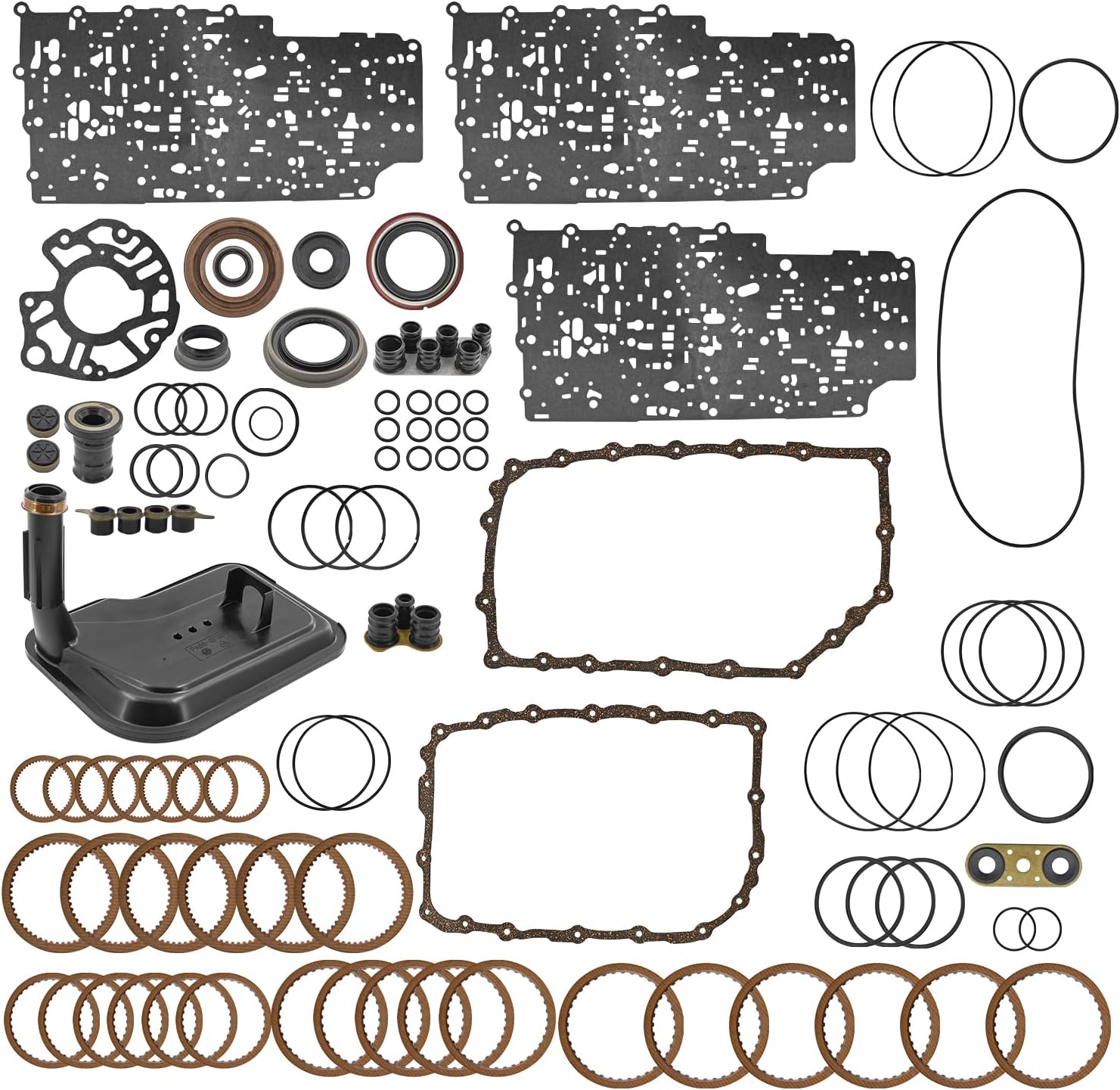
A harsh shift on a 6L80 is not one failure. It is four or five different failures that all land on the driver the same way, and the only thing they have in common is that the oncoming clutch grabs faster than the calibration intended. Treating it as a single complaint is how a shop ends up selling a valve body to a truck that needed a fast learn, or selling a fast learn to a truck with a worn pressure regulator bore that will be back in three weeks.
What is actually happening during the shift
The 6L80 uses six torque-transmitting devices: the 1-2-3-4 clutch, the 2-6 clutch, the 3-5-Reverse clutch, the 4-5-6 clutch, the low and reverse clutch, and the low roller clutch. First gear runs the 1-2-3-4 clutch with the low sprag holding. The 1-2 shift is the 2-6 clutch applying while the 1-2-3-4 clutch stays on. Nothing releases. That is why a harsh 1-2 has a different fingerprint than a harsh 2-3, where the 2-6 clutch comes off as the 3-5-R goes on and clutch timing overlap is in play.
Shift feel is not fixed in the calibration. GM's bulletin on adaptive functions spells out the loop: the transmission control module watches the input speed sensor and the output speed sensor during every commanded shift, decides whether the shift happened too fast (harsh) or too slow (soft), and trims the signal to the matching pressure control solenoid to bring shift time back to the originally calibrated number. That loop runs continuously for the life of the unit. So a harsh shift means one of three things has gone wrong: the adapt table is wrong, the pressure the solenoid commands is not the pressure that reaches the clutch, or something mechanical is applying before it should.
Cause 1: the adapts are wrong, not the hardware
If the unit is under roughly 5,000 miles — new vehicle, or new to you after a valve body, clutch job, or replacement transmission — the adapt table is the first suspect, not the last. Per GM bulletin 16-NA-019, low mileage is defined as approximately 8,050 km (5,000 mi) or less, or that same window since a valve body, clutch repair, or transmission replacement. In that window, firm shifts, slips, and flares are expected while the module learns.
The reset is the Transmission Service Fast Learn, run in the stall with no driving required. In GDS2 the path is Module diagnostics → Transmission Control Module → Configuration / Reset Function → Transmission Service Fast Learn. Two rules matter here and both get broken constantly:
- Fluid temperature must be in the learn window. GM specifies 35 C (95 F) to 95 C (203 F) for the adaptive learn drive. Outside that range the clutches will not learn, and the technician drives twenty miles and concludes the reset did not work.
- Do not Fast Learn a high-mileage unit to chase a complaint. GM is blunt about it: performing the adapt procedure on a high-mileage vehicle may improve shift quality for a limited amount of time, but the vehicle will most likely return with the same symptoms. On a 140,000-mile truck a fast learn is a diagnostic tool, not a repair. If the shift goes normal for a week and comes back, you have just proven the hardware is worn.
Check the calibration before you learn anything. If a TCM software update is available and relevant to the complaint, install it first — completing the update clears the clutch adapts on its own, which means any learn you did beforehand is gone.
There is one documented case where the adapt reset is the whole repair. GM Preliminary Information PI1343C covers a harsh (detent) 6-4 downshift, often felt as a tie-up after heavy throttle is released, on 2012-2014 Silverado, Suburban, Tahoe, Sierra and Yukon with the 6L80 (RPO MYC). GM says to reset adapts and road test; if that corrects it, the reset is the fix, except on a 2012-2014 Tahoe with the police package (RPO PPV), which also gets a revised TCM calibration. If the reset does not correct it, GM says the bulletin is not the cause and to keep diagnosing. Note that the 2014 original of this bulletin called for a 2-6 waved plate and 1-2-3-4 clutches; GM pulled that parts list in the 2016 revisions, so do not tear a unit down on the old version.
Cause 2: line pressure is higher than commanded
This is the one that gets written off as "it just shifts firm." The 6L80 pressure regulator valve lives in the pump cover, and its position is set by a pressure control solenoid in the TEHCM. It does not only regulate pressure, it controls pump slide position, so it sets pump volume too.
Sonnax documents the exact wear pattern: the balance end of the pressure regulator valve wears into the casting, and the result is high line pressure, harsh shifts, and overheating due to insufficient cooler and converter lube flow. Wear at the outboard spool does the opposite — converter feed pressure drops and line pressure goes low — and on a high-mileage unit you can have both conditions at once in the same bore.
The tell is the combination: harsh shifts across the board, a unit that runs hot, and often a converter complaint riding along with it. When the customer says it bangs into gear and the temperature climbed on the trailer, stop looking at solenoids.
How to confirm it on the vehicle
You cannot back probe the electrical circuits on this unit, so the mainline gauge is the tool. ATRA's technique, published in GEARS:
- Hook a mainline pressure gauge to the port on the passenger side of the case.
- Using bidirectional controls, command EPC and compare commanded pressure against the actual gauge reading. The spread between the two is the whole diagnosis.
- With no bidirectional control available, pull the TCM fuse. That drops the EPC solenoid into maximum pressure demand and gives you a known worst-case reference.
- If line pressure reads relatively low but rises when you increase engine speed, you are looking at pump output, not the solenoid.
The repair on a worn bore is a valve, not a valve body. Sonnax's drop-in pressure regulator valve kit 104520-15K and the oversized pressure regulator and boost valve kit 104520-16K both install without drilling the pump. The older 104520-14K required drilling a 45-degree hole through the adjacent channel so balance oil could reach the valve in the regulating position; the current kits removed that step. If the bore is too far gone to hold a standard valve, the oversized kit with its reamer is the correct path.
Cause 3: actuator feed limit valve bore wear
The actuator feed limit valve regulates the oil supplied to the control solenoids. When that bore wears, the solenoids are no longer being fed a properly regulated pressure, and every shift they control drifts. Sonnax lists the symptom set as solenoid performance codes, clutch failure, wrong gear starts, harsh shifts, and soft shifts — and the mixed signature is the giveaway. If one shift is harsh, another is soft, and the truck occasionally starts off in the wrong gear, you are not chasing a single clutch. You are chasing the feed circuit behind all of them.
The repair is the oversized actuator feed limit valve 104740-12 with tool kit F-104740-TL12 to recondition the bore, or the complete actuator feed limit valve kit 104740-47K. Reaming the bore and fitting the oversized valve renews the hydraulic integrity of that circuit, and normal shift feel comes back with it.
Cause 4: clutch timing and the compensator feed circuit
On shifts where one clutch releases as another applies, feel depends on timing, and timing depends on the compensator feed circuit holding the right balance pressure behind each piston. Sonnax's wear list for the compensator feed regulator valve is specific: harsh shifts, downshift clunk, 3-4 bump, flare shifts, and burnt clutches, repaired with kit 104740-09K. Two other bores in this valve body produce shift-feel complaints worth knowing by name:
- Clutch boost valve (104740-01) — burnt clutches, delayed engagement, harsh shifts, slide shifts, and slip codes. It fits three separate locations in the valve body, so inspect all three.
- TCC regulator valve kit (104740-46K) — overheated fluid, failsafe mode, harsh shifts, and harsh TCC apply. A harsh shift that is actually the converter slamming on is a common misread; watch TCC slip RPM in the data before you condemn a clutch pack.
Vacuum-test the bores before you buy parts. A vacuum test plate on the valve body tells you which bores leak in seconds, and it is the only way to know whether you are replacing a valve because it is worn or because it was next on a list.
Cause 5: heat and cooler flow
GM bulletin 22-NA-182 (March 2024, version 4, which replaced PIP5792E) covers 6L80, 6L90, 8L90, 10L80, 10L90, and 10L1000 equipped vehicles with harsh shifting, shudder, surging, stalling, neutral/flare, transmission overheating, or above-normal transmission fluid temperature — before or after an overhaul. The cause GM calls out on low-mileage vehicles is a twisted transmission cooler line, and the inspection may require removing underbody panels to see it clearly. A twisted line can also set P27EC in the TCM on ETRS units.
If the lines are straight and undamaged, the same bulletin points at the thermal bypass valve. The opening temperatures GM lists are worth writing on the wall:
- 6-speed (6L80, 6L90): 158 F (70 C) — TBV is external to the transmission.
- 8-speed (8L90): 194 F (90 C), external to the transmission.
- 10-speed (10L80, 10L90, 10L1000): 143 F (61 C), inside the valve body on most applications.
A 6L80 that never routes fluid to the cooler runs the clutch packs and the converter hot, and hot fluid changes friction behavior before it changes anything you can see in the pan. On a truck that tows, verify cooler flow physically. Do not assume it.
Cause 6: it is already mechanical
Sometimes the harsh shift is the unit telling you the damage is done. ATRA's teardown work on the 6L80 and 6L90 identifies the failure paths worth ruling out before you spend money on hydraulics:
- Stator support gasket leaks. Hot and cold cycling etches the gasket on high-mileage units, and once it leaks, clutch failure is imminent. Which clutches burn depends on where the leak is. Vacuum-test or air-test the stator support to isolate it.
- 1-2-3-4 clutch piston cracking. Early pistons are prone to cracking and GM released an updated design. The housing can also crack at the inside diameter and separate completely.
- 3-5-R drum weld cracks on early applications. Updated drums are identifiable by a dot-matrix QR label. A cracked 3-5-R weld reads as no Reverse or slipping Reverse along with 3rd and 5th gear problems.
- 4-5-6 clutch dampener failure, where engine firing pulses fracture the shaft; severe cases snap the shaft off the drum. The 4-5-6 typically fails from overheating, which points straight back at the cooler bypass valve.
- Low sprag degradation, which makes the vehicle feel like it drops into neutral around 2 mph. It is routinely misdiagnosed as a 1-2-3-4 clutch failure.
- Converter TCC lining wear migrating metal into the pump. Regulator valve lands worn to look like camshaft lobes came from somewhere, and that somewhere is usually the converter.
Bench specs worth having in front of you
When the unit is apart and you are deciding whether a pump is reusable, these are the numbers ATRA publishes for the 6L family:
- Pump slide spring clearance: at least 0.020" between the spring and a straightedge laid across the slide. Less than that and the spring coil binds and the slide sticks, which produces erratic pressure and erratic shift feel. Inspect the spring bore for wear and dress it if needed.
- Rotor and slide end clearance: 0.0008" to 0.002" (0.0203 to 0.0508 mm) between the bellhousing machined surface and the slide and rotor, checked with Plastigage in multiple positions with the cover bolted and torqued to spec.
- Nominal rotor and slide thickness: approximately 0.707".
- Input endplay: 0.004" to 0.006". The 6L family is a net-build unit with no factory endplay adjustment, so aftermarket selective shims are how you get there.
Working order that keeps you out of trouble
ATRA's road-test discipline applies here more than anywhere: do not change anything before you diagnose. Do not clear codes, do not top off fluid, do not reset adapts. Any change you make can move the complaint and cost you the data. Drive it first at light, half, and full throttle and note whether the harshness follows throttle, follows temperature, or is there cold and gone warm.
- Road test at three throttle levels. Record which shift, at what throttle, at what fluid temperature.
- Scan for current and history codes plus freeze frame. Note ISS, OSS, TFT, and commanded versus actual line pressure.
- Check fluid level at the specified temperature and inspect condition. Metal or clutch material in the pan ends the hydraulic conversation.
- Mainline gauge on the passenger-side port. Compare commanded to actual. Pull the TCM fuse for a maximum-demand reference.
- If mileage is low or the unit was just repaired, run Service Fast Learn and re-drive inside the 95 F to 203 F window.
- If pressure is high or erratic and mileage is high, the pump cover and valve body come off. Vacuum-test the bores.
- Inspect the cooler lines and verify thermal bypass valve function before you close it up, or you will do this job twice.
Preventing the repeat
DEXRON-VI only, on a real interval, especially on anything that tows. The friction behavior of the fluid is part of the shift calibration, and a fluid that has sheared down changes shift feel before it changes anything measurable in the pan. Keep the cooler flowing, replace a cooler you cannot prove is clean after a converter failure, and never put a reconditioned valve body onto a system still circulating metal.
The part most of these end at
On a high-mileage 6L80 with harsh shifts and heat, the pressure regulator bore is the usual answer. The Sonnax drop-in PR valve kit reconditions that circuit without replacing the pump cover, and the actuator feed limit kit covers the mixed harsh-and-soft signature. Both are at CoreTransmissionParts, along with the full 6L80 catalog.
Sonnax 6L80 Pressure Regulator Valve Kit 104520-15K →FAQ
Why does my 6L80 shift hard after a rebuild or valve body job?
Because the transmission control module lost its clutch adapt table and has to relearn it. GM bulletin 16-NA-019 treats firm shifts, slips and flares as normal behavior for roughly 5,000 miles after a valve body, clutch repair or transmission replacement. Run the Transmission Service Fast Learn in GDS2, then drive it with fluid temperature between 95 F and 203 F so the clutches can actually learn. If it is still harsh after a correct learn, the complaint is hydraulic or mechanical, not adaptive.
Can high line pressure cause a harsh shift on a 6L80?
Yes, and it is one of the most common causes on a high-mileage unit. Sonnax documents the balance end of the pressure regulator valve wearing into the casting, which produces high line pressure, harsh shifts and overheating from insufficient cooler and converter lube flow. The fix is reconditioning that bore with a pressure regulator valve kit such as 104520-15K or the oversized 104520-16K, not replacing the whole valve body. Confirm it first with a mainline gauge on the passenger-side port, comparing commanded EPC pressure against the actual reading.
Will resetting the transmission adapts fix a harsh 6L80 shift?
Only if the adapts are the problem. GM states directly that performing the adapt procedure on a high-mileage vehicle may improve shift quality for a limited amount of time, but the vehicle will most likely return with the same symptoms. On a worn unit, treat a fast learn as a test: if the shift cleans up and then degrades again within a few hundred miles, you have confirmed worn hardware rather than fixed anything.
Can a bad transmission cooler line cause a harsh 6L80 shift?
It can. GM bulletin 22-NA-182 lists harsh shifting, shudder, surging, stalling, neutral/flare and overheating on 6L80 and 6L90 vehicles, with a twisted transmission cooler line named as the cause on low-mileage units. A twisted line may also set P27EC in the TCM on ETRS transmissions. If the lines are straight, check the thermal bypass valve, which on the 6L80 and 6L90 is external and opens at 158 F (70 C).
How do I tell a harsh shift from a harsh converter apply on a 6L80?
Watch TCC slip RPM in the scan data and note where in the drive the bump happens. A converter that slams on will feel like a shift but will not be accompanied by a gear-ratio change. Sonnax ties TCC regulator valve bore wear to overheated fluid, failsafe mode, harsh shifts and harsh TCC apply, repaired with kit 104740-46K. Sorting this out before teardown saves you from condemning a clutch pack that is fine.