Two questions get asked about 6L80 fluid, and only one of them has a single answer. The fluid type is settled: GM says DEXRON-VI and puts a part number on it. The capacity is not one number at all, and every shop that treats it as one ends up either short a quart at the end of a rebuild or overfilled on a pan drop.
What follows is pulled from GM's own published documents: the Chevrolet Performance instruction sheet that ships with the crate 6L80, the owner literature for the trucks these units live in, and the preliminary information bulletin GM wrote for 6L80 overheat complaints. Where a physical property is quoted, it comes off a fluid maker's data sheet, not off a jug label.


The Fluid: DEXRON-VI, With a Part Number Attached
The Chevrolet Performance instruction sheet for the 6L80 does not hedge. It carries a caution that reads: use DEXRON-VI transmission fluid only, P/N 88861037 in the US and 19264717 in Canada, and that failure to use the proper fluid may result in transmission internal damage. That is the same fill the production trucks get. GM's owner literature lists DEXRON-VI Automatic Transmission Fluid against the automatic transmission entry in Recommended Fluids and Lubricants, with its own caution that use of the incorrect automatic transmission fluid may damage the vehicle and the damage may not be covered by the vehicle warranty.
The trap in 2026 is DEXRON-HP. It is what the 8L and 10L units take, it sits on the same shelf, and the label looks close enough at a glance. In the same owner manual table you will find the 6-speed and the 8-speed listed as separate line items with separate fluids. A 6L80 is not a candidate for HP, and a truck can leave a bay with the wrong fluid in it without anyone noticing until the first torque converter clutch complaint shows up.
What is actually in a licensed DEXRON-VI
DEXRON-VI is a viscosity and durability specification, not a color. Mobil publishes the numbers for its licensed DEXRON-VI on its product data sheet: kinematic viscosity of 29.5 mm2/s at 40 C and 5.83 mm2/s at 100 C, with a Brookfield viscosity of 11,500 mPa.s at -40 C. That thin, shear-stable profile is the point. The 6L80 does clutch-to-clutch shifting through solenoids inside the TEHCM, and every apply and release is a timed pressure event through small passages. A fluid that shears out of grade, or that thickens too much cold, changes the fill and release rates of those clutches before it changes anything you can see on a dipstick.
That is also why "compatible with DEXRON-VI" on a multi-vehicle jug is not the same claim as a licensed fluid. The licensed product carries GM's approval and, per Mobil's own page, warranty protection for 2006 and newer GM vehicles. The compatible product carries a marketing sentence.
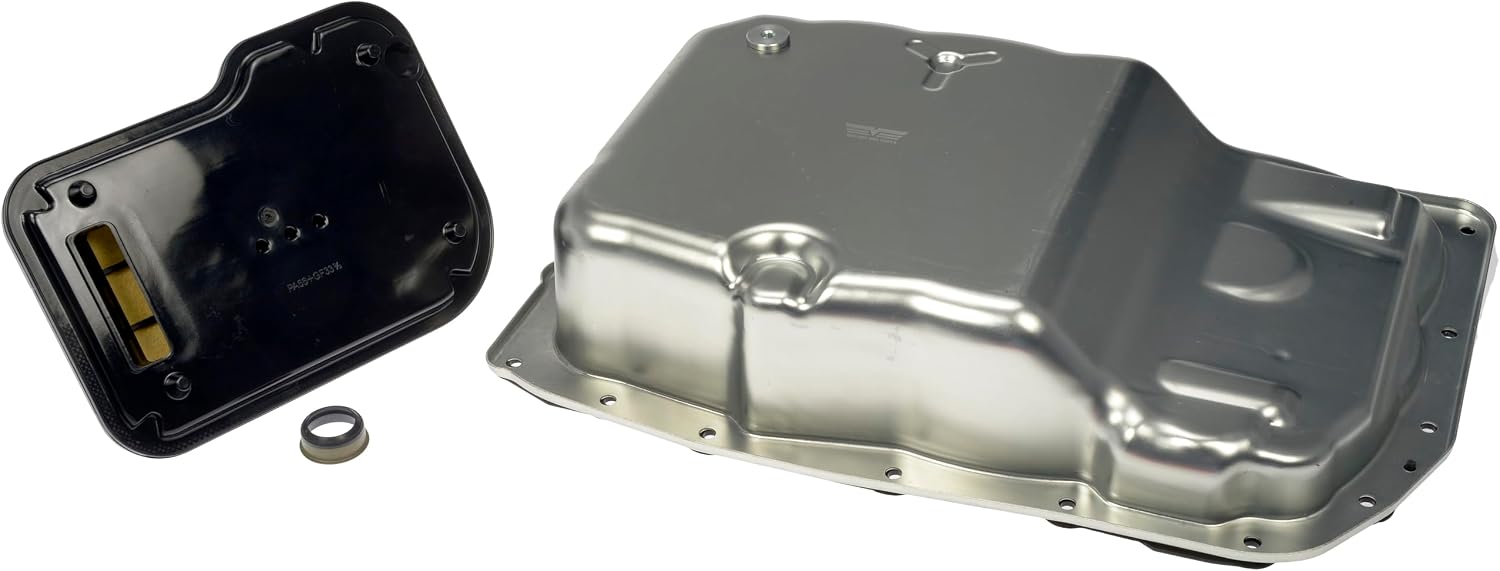
Get the filter and gasket kit →
The Capacity Numbers, By Job
Chevrolet Performance publishes an Approximate Fluid Capacities table for the 6L80 with three separate figures, because three different jobs empty three different amounts of the unit.
| Service | Metric | English |
|---|---|---|
| Pan removal and filter replacement | 5.7 liters | 6.0 quarts |
| Overhaul, transmission volume only | 9.9 liters | 10.5 quarts |
| Complete transmission system, including cooler volume | 11.5 liters | 12.2 quarts |
The gap between 10.5 and 12.2 quarts is the cooler, the cooler lines and what the system carries outside the case. The gap between 6.0 and 10.5 is mostly the torque converter plus whatever is held up in the valve body and the clutch feed circuits. None of that drains when you pull a pan.
Practical consequence: on a pan drop, measure what came out and put that much back before you touch a level plug or a dipstick. If you dropped 5 quarts because the converter did not drain back, pouring in 6 is an overfill you have to chase back out. For a rebuild, plan on 12 quarts in the building and do not start the job with 10 on the shelf, because the converter will take its share the first time it spins up.
Why GM Fills to a Level, Not to a Number
Fluid expands with heat. That is the whole reason GM writes the procedure around a temperature window instead of a quart count. The published windows are specific: the cold check is valid when transmission fluid temperature is between 27 C and 32 C (80 F and 90 F), and the hot check is valid between 71 C and 93 C (160 F and 200 F). GM is explicit that the cold check exists only as a reference to confirm the transmission has enough fluid to be operated safely until a hot check can be made, and that the hot check is the accurate one.
The preparation sequence matters as much as the window, and it is short enough that there is no excuse for skipping it. Park on a level surface with the engine running. Set the park brake and put the shifter in Park. With your foot on the brake, move the shift lever through every range, pausing about three seconds in each, then back to Park. Let it idle at 500-800 rpm for at least one minute. Then read the temperature and check the level. That range sweep is what fills the clutch feed circuits and the accumulators; check a level without it and you are reading a unit with fluid still sitting in the pan that belongs somewhere else.
Two rules from the same page that get ignored constantly. Add less than 0.5 L (1 pint) at a time, because it does not take much fluid to move the level a long way. And check twice, not once. If the two readings do not agree, GM's instruction is to inspect the vent assembly to be sure it is clean and unclogged before you trust either number.
The Thermal Bypass Valve Decides When "Hot" Happens
Here is the part most write-ups leave out, and it changes how you get a 6L80 into the hot-check window. These units run a thermal bypass valve that holds fluid away from the cooler until the fluid is warm. Per GM bulletin PIP5882, covering 2014 through 2021 6L80 MYC and 6L90 MYD units, the original TBV starts to open between 180 and 187 F (82 to 86 C) and is fully open at 194 F (90 C). If the valve has been replaced with the revised part identified in TSB 21-NA-199, it starts to open between 138 and 145 F (59 to 63 C) and is fully open at 158 F (70 C).
So the cooler circuit on an original-valve truck is barely participating at the bottom of the 160-200 F hot-check window and fully in play at the top of it. Get the unit to a stable temperature by driving it, not by letting it idle in the bay, and read the level in the same thermal state you intend to repeat next time.
PIP5882 also gives the cleanest overheat diagnosis anyone has published for this unit, and you can run it with an infrared thermometer. Drive the vehicle until fluid temperature reaches about 190 F so the valve is open. Shoot the pan surface, the TBV, and both cooler lines about six inches from the valve. Pan temperature and the scan tool reading should be close. The line heading to the cooler runs hotter than the pan; the return line should come back cooler. If both cooler lines read lower than the pan and the TBV itself reads higher than the pan, the valve is not opening. If pan temperature runs 10 to 15 F above the cooler line, GM calls the bypass valve bad and says replace it. And if the displayed transmission temperature sits more than 15 degrees above the measured pan temperature, suspect the temperature sensor, which lives inside the TEHCM.
Dipstick Trucks and No-Dipstick Trucks
Whether you get a dipstick depends on the platform, not on the transmission. Heavy-duty trucks and crate installs use a fill tube and an indicator with COLD and HOT crosshatch bands, and the cold and hot windows above apply directly to it. A large share of later light-duty applications have no dipstick at all. GM's own owner literature, writing about its dipstick-free automatics, tells the owner plainly that there is a special procedure for checking and changing the fluid, that it is difficult, and that it should be done at the dealer.
On those units you fill through the level-set plug with an adapter and a pump, then set the level with the engine idling in Park inside the temperature window. Fluid arriving at the plug as a fast drip is right. Fluid leaving in a steady stream means the unit is overfull and you let it run down to a drip. Both jobs need a fill adapter, which is the single tool that turns this from a two-hour mess into a twenty-minute service.
What the Wrong Level Actually Does
Overfilled, the rotating assembly beats air into the fluid. The Chevrolet Performance sheet warns that an overfilled transmission may result in foaming or fluid expelled out the vent tube. Aerated fluid is compressible, and a pump moving foam cannot hold a stable line pressure, so clutches that should apply firmly start to slip and burn. The fluid you see blown out the vent is the symptom people notice; the pressure instability is the damage.
Underfilled, the pickup uncovers on grades and in corners. You get an intermittent pressure drop under exactly the conditions that load the unit hardest, which is a fast route to a glazed 3-5-R pack.
But do not let a fluid level chase cover a hydraulic fault. Transmission Digest documented a low line pressure condition on 2006-2015 GM vehicles with 6L80 or 6L90 (RPO MYC or MYD) after a service pump cover, P/N 24248573, has been installed: rust inhibitor in the cover, described as a thick waxy substance, can stick the pressure regulator valve (#233) or the isolator valve (#236), or plug the small orifice (#5) in the isolator valve sleeve (#237). If it is not identified and corrected, clutches may be damaged during operation. That failure reads exactly like low fluid on a scan tool and will not be fixed by another quart. Sonnax publishes a vacuum test guide for the 6L45, 6L50, 6L80 and 6L90 valve body for the same reason: worn bores are diagnosed by vacuum testing the valve body at defined locations, not by inference from a pressure reading.
How Often GM Says to Change It
Look at the two maintenance charts in the truck owner manual side by side. On Additional Required Services - Normal, running all the way out to 240 000 km / 150,000 miles, there is no automatic transmission fluid and filter row. On Additional Required Services - Severe, the row is there. That is GM's answer: under normal duty they do not schedule it, and under severe duty they do.
Now consider what a 6L80 actually lives under. Trailer towing, hot-weather stop and go, mountain grades, fleet duty. Most of these trucks are severe-service vehicles wearing a normal-service sticker. Service the fluid on the severe schedule and you are following GM, not second-guessing it.
Filter and pan gasket kits, drain-plug pans, fill adapters, thermal bypass valve upgrades, pressure regulator valve kits and master rebuild kits for 6L80 and 6L90 units.
Shop 6L80 parts →The Short Version for the Bench
- Fluid: licensed DEXRON-VI, GM P/N 88861037 US / 19264717 Canada. Never DEXRON-HP.
- Pan and filter: about 5.7 L / 6.0 qt. Measure what came out, put that back.
- Overhaul: 9.9 L / 10.5 qt transmission only; 11.5 L / 12.2 qt with the cooler. Stock 12 quarts.
- Setting level: hot check at 71-93 C (160-200 F). Cold check at 27-32 C (80-90 F) is a safety reference only.
- Prep: level ground, three seconds in each range, idle 500-800 rpm one minute, then read.
- Add small: less than 0.5 L at a time, and verify with a second reading.
- Get it hot by driving it, because the thermal bypass valve is not fully open until 194 F on the original part.
FAQ
What transmission fluid does a 6L80 take?
Licensed DEXRON-VI. Chevrolet Performance's own 6L80 instruction sheet names GM P/N 88861037 in the US and 19264717 in Canada and carries a caution that failure to use the proper fluid may result in internal damage. DEXRON-HP is the fill for GM's 8L and 10L units, not the 6L80, and GM's owner literature warns that damage from the wrong automatic transmission fluid may not be covered by the vehicle warranty.
How many quarts of fluid does a 6L80 hold?
Three different numbers for three different jobs. Chevrolet Performance lists a pan removal and filter replacement at 5.7 liters (6.0 quarts), an overhaul at 9.9 liters (10.5 quarts) for the transmission volume alone, and 11.5 liters (12.2 quarts) for the complete system including cooler volume. Buy against the job you are doing, not against a single headline figure.
Why does my 6L80 pan drop only give back about five quarts?
Because the converter, the cooler, the cooler lines and the valve body passages never drain during a pan drop. The 6.0 quart figure is an approximate capacity for that service, and what actually comes out depends on how long the vehicle sat and whether the converter drained back. Measure what you removed and put that much back, then set the level by temperature.
What temperature should a 6L80 be when I set the fluid level?
The accurate check is the hot check, with transmission fluid temperature between 71 C and 93 C (160 F and 200 F). The cold check at 27 C to 32 C (80 F to 90 F) is only a reference to confirm the unit has enough fluid to be driven safely until you can get it hot. Fluid level rises with temperature, so a level set outside the window is wrong in a predictable direction.
Does the thermal bypass valve affect the fluid level I set?
It affects when the cooler circuit is actually carrying fluid. GM bulletin PIP5882 states the original thermal bypass valve starts to open between 82 and 86 C (180 to 187 F) and is fully open at 90 C (194 F), while the revised valve covered by 21-NA-199 starts to open at 59 to 63 C (138 to 145 F) and is fully open at 70 C (158 F). Set the level on a unit that has been driven, not on one idling in the bay from cold.
Related 6L80 guides
Sources
- Chevrolet Performance — Supermatic 6L80 Transmission Controller Kit for LS Crate Engines, Installation Instructions, P/N 19366636 (PDF). Backs the Approximate Fluid Capacities table (pan removal and filter replacement 5.7 liters / 6.0 quarts; overhaul, transmission volume only, 9.9 liters / 10.5 quarts; complete transmission system including cooler volume 11.5 liters / 12.2 quarts), the DEXRON-VI requirement with GM P/N 88861037 US and 19264717 Canada, the overfill warning about foaming and fluid expelled from the vent tube, and the cold check window of 80-90 F (27-32 C) versus the hot check window of 160-200 F (71-93 C). www.chevrolet.com
- General Motors — 2015 Chevrolet Silverado 2500HD / 3500HD Owner Manual (PDF). Backs the DEXRON-VI service fill listed for the automatic transmission in Recommended Fluids and Lubricants and the caution that use of the incorrect automatic transmission fluid may damage the vehicle and may not be covered by the vehicle warranty; the level check preparation sequence (level surface, park brake, three seconds in each range, idle 500-800 rpm for at least one minute); the instruction to add less than 0.5 L (1 pt) at a time; the instruction to check the level at least twice and inspect the vent if readings are inconsistent; the statement that vehicles without a dipstick require a special procedure that should be done at the dealer; and the appearance of the automatic transmission fluid and filter change in the Additional Required Services - Severe schedule but not in the Normal schedule. experience.gm.com
- General Motors — Preliminary Information PIP5882, "Diagnostic Tips - 2014 through 2021 6L80 MYC and 6L90 MYD Transmissions with an Overheat Concern," published 10/3/2022 (NHTSA-hosted PDF). Backs the thermal bypass valve opening temperatures (original valve starts to open at 180-187 F / 82-86 C and is fully open at 194 F / 90 C; the revised valve identified in TSB 21-NA-199 starts to open at 138-145 F / 59-63 C and is fully open at 158 F / 70 C), the infrared comparison of pan, valve and both cooler lines, the rule that a displayed transmission temperature more than 15 degrees above pan temperature points at the temperature sensor inside the TEHCM, and the 10-15 F pan-to-cooler-line delta that indicates a bypass valve not working correctly. static.nhtsa.gov
- ExxonMobil — Mobil DEXRON-VI ATF product data sheet and typical properties table. Backs the physical properties quoted for a licensed DEXRON-VI fluid: kinematic viscosity of 29.5 mm2/s at 40 C and 5.83 mm2/s at 100 C, Brookfield viscosity of 11,500 mPa.s at -40 C, and the statement that the fluid meets or exceeds GM's DEXRON-VI specification with warranty protection for 2006 and newer GM vehicles. www.mobil.com
- Sonnax — GM 6L45, 6L50, 6L80, 6L90 Vacuum Test Guide. Backs the point that valve bore wear in these units is diagnosed by vacuum testing the valve body at published test locations, which is how you separate a genuine hydraulic fault from a fluid level complaint. www.sonnax.com
- Transmission Digest — "Tech Tip: GM 6L80, 6L90 Low Line Pressure Repair," September 9, 2020. Backs the low line pressure condition on 2006-2015 GM vehicles with 6L80 or 6L90 (RPO MYC or MYD) after installing service pump cover P/N 24248573, caused by rust inhibitor sticking the pressure regulator valve (#233) or isolator valve (#236) or plugging the small orifice (#5) in the isolator valve sleeve (#237), and the warning that clutches may be damaged if it is not corrected. www.transmissiondigest.com