P0894 reads out of most scanners as Transmission Component Slipping. That is a vague name for a code that is actually telling you something precise: the control module did the ratio math, and the number it got back was not the number it commanded.
It is not a solenoid circuit code. It is not a sensor code. It is the module reporting that a holding element inside the transmission let go while it was supposed to be holding. On a 6L80 that narrows down fast, because the unit only has five apply components and a sprag, and each gear uses a specific pair. Read the pairs correctly and the code tells you which clutch is burnt before the pan ever comes off.
Related reading: our 6L80 slipping under load write-up and the 3-5-R clutch failure teardown, which is where most P0894 jobs end up.
How the module decides something is slipping
The TCM has two speed signals to work with: input shaft speed from the ISS and output shaft speed from the OSS. Divide one by the other and you have the ratio the transmission is actually running. The module already knows the ratio it commanded. If actual and commanded disagree by more than the calibration allows, for long enough, and it happens enough times, the code sets.
So you need the ratios in your head. The 6L80 runs 4.027 in first, 2.364 in second, 1.532 in third, 1.152 in fourth, 0.852 in fifth, 0.667 in sixth, and 3.064 in reverse. Note that nothing is 1.00 to 1 - there is no direct gear on this unit, which means every forward gear is a live ratio you can verify with math.
That gives you a road test you can run before touching anything. Put the scanner on ISS and OSS in graphing mode, drive it through all six, and divide. If the truck is commanded into third and you are reading 1.9 instead of 1.532, something in the third gear apply path is slipping. If the ratio is dead-on in third but garbage in fifth, that tells you something different. Write the numbers down for each gear. That list is the whole diagnosis.
The clutch application chart, which is the actual answer
Sonnax publishes the 6L45/6L50/6L80/6L90 clutch and solenoid application chart in its vacuum test guide, and it is the single most useful page of paper for this code. Here is what applies where:
| Range | Applied clutches |
|---|---|
| Reverse | 3-5-R + Low/Reverse |
| 1st (braking) | 1-2-3-4 + Low/Reverse, low sprag holding |
| 1st | 1-2-3-4, low sprag holding |
| 2nd | 1-2-3-4 + 2-6 |
| 3rd | 1-2-3-4 + 3-5-R |
| 4th | 1-2-3-4 + 4-5-6 |
| 5th | 3-5-R + 4-5-6 |
| 6th | 2-6 + 4-5-6 |
Now overlay your ratio notes on that chart and find the common element:
- Slips in 3rd, 5th and Reverse. Only one clutch is in all three. It is the 3-5-R. This is the classic 6L80 P0894 and it is where most of these end up.
- Slips in 2nd and 6th. 2-6 clutch.
- Slips in 4th, 5th and 6th. 4-5-6 clutch.
- Slips in 1st through 4th but 5th and 6th are clean. 1-2-3-4 clutch.
- Feels like it drops into neutral off the line, but 2nd through 6th are fine. Look at the low sprag before you condemn the 1-2-3-4. More on that below.
Two gears sharing a symptom is a clutch. One gear alone is usually a control problem, not a clutch problem.
Check the two things that make a good clutch slip first
A healthy clutch pack will slip if it is not getting clamp load. Rule that out before you pull the unit, because both causes are cheap and both are common.
Fluid level, done to spec
The 6L80 has no dipstick. Level is set at the check plug with the fluid temperature between 35 and 45 C (95 to 113 F), read off the scan tool, not guessed at. Outside that window the level will be wrong in a predictable direction: check it hot and you leave it underfilled, check it cold and you overfill it. Underfilled is what sets slip codes, because the pump starts pulling air and clamp pressure collapses under load. It is DEXRON VI, and only DEXRON VI, in this unit.
GM makes the low-fluid connection explicit. In preliminary information bulletin PIP4379J, GM lists P0894 alongside P0776, P0873, P0877, P2723 and a stack of ratio codes and says outright that any of them could possibly indicate no or excessively low pump pressure. That bulletin covers the Allison LCT1000 rather than the 6L80, so do not take its procedure to a 6L80 job - but it is a clean statement of how GM's own engineers read this code family: low pressure first, parts later.
Line pressure, on a real gauge
Hook a mechanical gauge to the mainline port and watch it against engine speed. Sonnax documents two signatures worth memorizing:
- Stuck around 60 to 68 psi with no RPM rise at all means the TEHCM line pressure solenoid is stuck in exhaust mode. Sonnax adds the detail that makes this test tricky - unplugged reads no different. A dead circuit and a stuck solenoid give the same number.
- Below 30 psi at idle points at a missing pressure regulator boost valve retaining roll pin. There may still be some movement with this fault, but nothing normal.
If pressure is low across the board, every clutch in the unit is being asked to hold without enough squeeze, and P0894 is a symptom rather than the problem.
Read the companion codes
P0894 rarely shows up alone, and its neighbors point at circuits:
- P0776, P2714, P2715, P2723 - pressure control solenoid performance codes. On the 6L80, P0776 is the one that rides along with 3-5-R trouble. GM's own bulletin for this family lists P0776, P2715 and P2723 together with a complaint set of slip when reverse is selected or no reverse, delayed engagement into reverse, harsh shifts from second to third, harsh shifts from fourth to fifth or slips in fifth, and slips on acceleration when passing.
- P0716 or P0717 - input speed sensor codes. These can be a genuine sensor fault, or they can be metal debris from a failed clutch sticking to the sensor. If you have a slip code and an ISS code together, assume debris until you prove otherwise.
Capture the freeze frame before you clear anything. Which gear, what fluid temperature, what load - that context is the difference between chasing a cold-only leak and chasing a burnt pack.
What actually breaks, in the order you should suspect it
1. Cracked 1-2-3-4 / 3-5-R clutch housing weld
This is the headline failure and GM wrote a bulletin on it. Per GM bulletin 09-07-30-004J, a cracked 1-2-3-4 / 3-5-R clutch housing causes slip or no reverse, delayed reverse engagement, harsh 2-3 shifts, harsh 4-5 or slipping fifth, and slips on acceleration when passing. Look at that list against the application chart above: 3rd, 5th and Reverse. Same clutch, same story.
The bulletin gives you a bench test that costs nothing:
- Apply soap compound to the weld area of the housing.
- Hold your thumb over the air bleed passage.
- On a fully assembled housing, spray compressed air into the 3-5-R clutch feed hole and watch the weld for bubbles. Disassembled, spray air into the housing itself.
- Bubbles mean a new housing. There is no repair.
Two traps in that same bulletin that will earn you a comeback. First, the 6L80 changed the 1-2-3-4 piston, the 1-2-3-4 piston housing and the 3-5-R piston for the 2008 model year, and installing a 2008 complete housing assembly into a 2007 or older 6L80 can produce a 2-3 shift flare or 3-5-R clutch distress. Second, when installing a new housing into a 2007 or older unit, all three inner seals must go in - leave them out and you get no reverse, no forward, or distressed clutches.
2. Broken 3-5-R waved plate
The waved cushion plate behind the 3-5-R pack fatigues at the tooth corners. When it lets go, the apply piston over-travels and the debris takes the drum with it. Sonnax lists a broken or cracked 3-5-R drum weld as producing exactly the pattern you are chasing - a no-reverse or slipping-reverse condition along with third and fifth gear issues, with line pressure reading normal the whole time. Normal line pressure alongside a slipping clutch is the signature of a mechanical failure rather than a hydraulic one.
3. Stator support sealing rings
ATRA's GEARS coverage of 6L80 clutch failure puts this one clearly: the back of the stator support carries the sealing rings that seal the feed oil circuits for the 3-5-R and 1-2-3-4 clutches, and early units had a ring design that leaked, especially cold. The customer complaint is a delayed or slipping engagement, usually going into reverse. GM updated the rings, but the updated design will not fit the earlier pumps, so it becomes a pump replacement or a machining job.
The related item is the pump cover seal ring update in bulletin 09-07-30-004J. Transmissions built in 2006 through early 2009 used a one-piece seal ring on the pump cover; a two-piece design came in starting December 2008. One-piece rings can leak and cause a harsh 2-3 shift, typically at low mileage. Do not mix them - the two-piece cover is identified by a notch in the seal ring groove that accepts the tab on the two-piece ring, and one-piece rings do not belong in it.
4. 1-2-3-4 piston, and the pressure regulator behind it
The 1-2-3-4 apply piston cracks. Sonnax puts it bluntly - the OE piston has such a high failure rate that most shops replace it on every repair regardless. The housing inner diameter can crack too, though less often. Both are updated parts now.
Behind that, pressure regulator valve wear is a common cause of clutch damage on this family. GEARS describes worn regulator valve lands that look more like camshaft lobes. And the reason the pump is usually damaged in the first place is the converter: TCC lining wear leads to metal-to-metal contact between the apply piston and the converter cover, or the stator clutch outer race splines fail, and either way that metal migrates straight into the pump. Replace the converter and flush or replace the cooler, or you will do this job twice. The pump slide and rotor are selective in this application, so clearances get checked even with factory parts.
5. Low sprag, wearing a 1-2-3-4 costume
The 6L uses the low sprag to hold the output carrier at launch, with the Low/Reverse clutch assisting until roughly 2 MPH, at which point the L/R releases. If the sprag will not hold after that handoff, the vehicle feels like it drops into neutral - and every instinct says the 1-2-3-4 clutch failed. Inspect the elements and races closely before you order clutches you do not need.
6. Checkballs and the valve body
On early units, checkball wear is a real problem: as they wear they migrate through the valve body and cause slipping and clutch damage. Updated balls are in most quality overhaul kits. While the valve body is out, vacuum test it. Sonnax's guide flags the 3-5 reverse clutch regulator valve specifically for burnt 3-5-R clutch, delayed or no reverse, and third and fifth gear shift concerns, and flags the 1-2-3-4, 3-5 and 4-5-6 clutch boost valves for slip codes, burnt clutches, and slips and flares. A worn bore feeding a clutch will burn a brand new pack.
One more from Sonnax that is worth knowing before you blame anything: a Type 2 separator plate on a Type 1 valve body causes a no-forward condition, and the Type 1 plate (#24245720) on a Type 2 body causes no third and no reverse. Line pressure reads normal both ways. If the unit came to you already opened once, check the plate.
Fixing it
If the ratio math and the air check say the housing is cracked, the unit comes out. GM released complete assembled 1-2-3-4 / 3-5-R clutch housings so the job does not require building one on the bench: 24238694 covers the 2008 6L80 (RPO MYC) and 24238695 the 2007-2008 6L90 (MYD), both complete with pistons, seals, clutches, bearing and internal parts. The one-piece pump cover seal ring kit is 24248581. For 2006-2007 MYC there is no complete assembly - individual parts only. The warranty labor operation is 8466450, 3-5-Reverse Clutch Plate Replacement.
While you are in there: update the 1-2-3-4 piston, replace the waved plate, check the drum weld with soap and air even if it looks fine, verify clutch pack clearances rather than assuming, and address the converter and cooler. Bulletin 09-07-30-004J also notes that on full-size trucks with the 6L80, any time the transmission is out, a revised fluid fill tube (24260606) with a damper near the top should be installed if it is not already present - it prevents resonance-related damage.
Keeping it from coming back
- Clean out the debris completely. A failed 3-5-R pack fills the unit with friction material and metal. Replace the pump filter and the control solenoid filter, flush or replace the cooler, and check the ISS for metal on the tip.
- Set the level by temperature, not by quarts. 35 to 45 C at the check plug. Every clutch in the box depends on it.
- Service the fluid on a real interval. DEXRON VI. Clean fluid keeps valve bores and solenoid screens working, which keeps clamp pressure where it belongs.
- Watch converter health. Most pump damage on this unit starts in the converter. A TCC shudder you ignore this year is a pump and a clutch pack next year.
Need the parts for this one
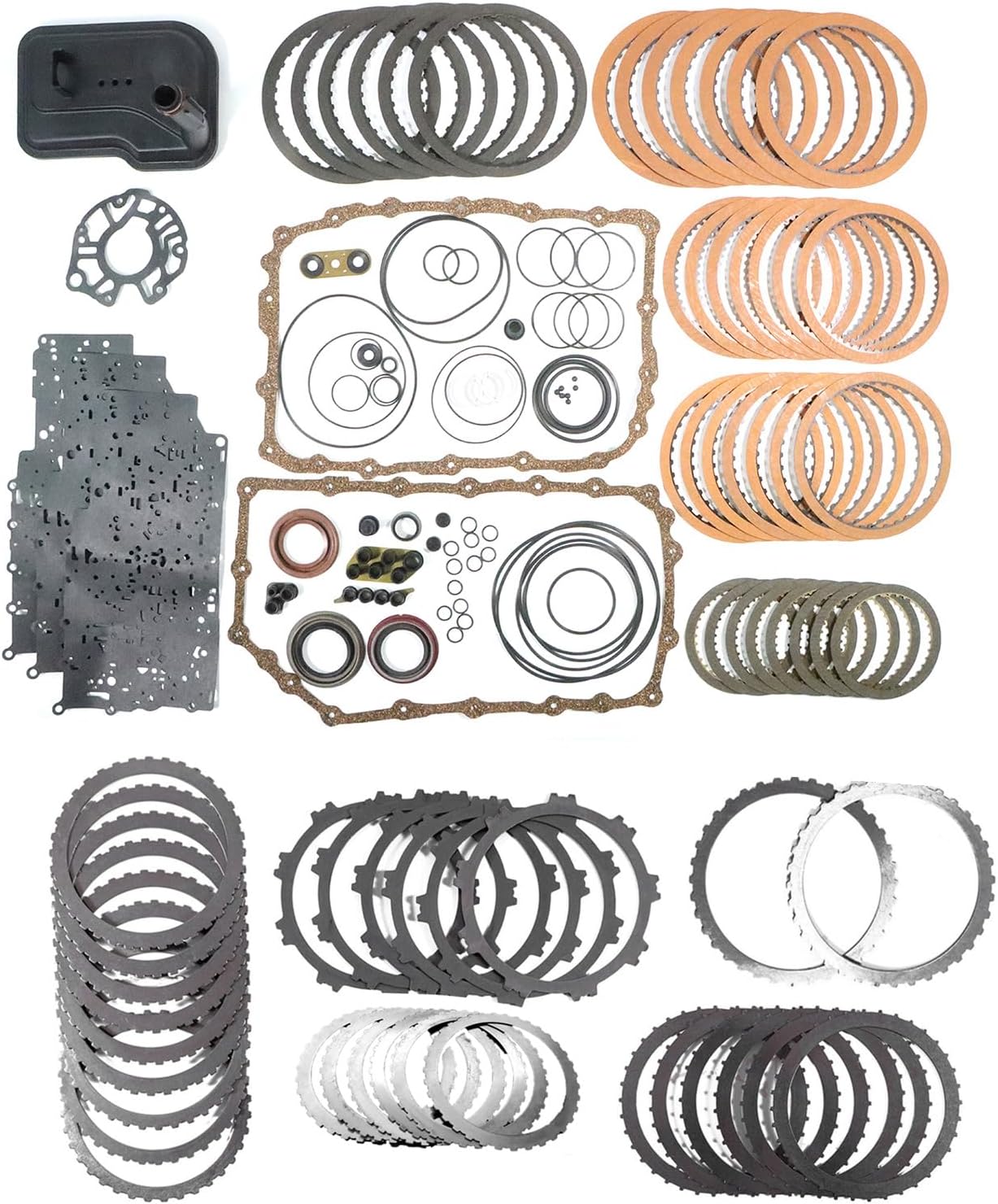
A P0894 that traces to a burnt 3-5-R pack is a teardown, and a teardown wants a kit with the frictions and steels in the box rather than a parts list you chase for three days. The 6L80 master rebuild kit with clutches at CoreTransmissionParts covers the pack, and the full 6L80 catalog has the pistons, seal rings, filters and valve body parts this job touches.
6L80 master rebuild kit with clutches →FAQ
What does P0894 mean on a 6L80?
P0894 is Transmission Component Slipping. The TCM compares input shaft speed against output shaft speed to work out the ratio the transmission is actually running, then compares that to the ratio it commanded. When the two disagree by more than the calibration allows, it sets the code. It is not a circuit fault or a sensor fault - it means an apply component let go while it was supposed to be holding.
Which clutch is slipping when a 6L80 sets P0894?
Work it out from the clutch application chart. The 3-5-R clutch is applied in 3rd, 5th and Reverse, so slipping in all three points there - and that is the most common answer on this unit. Slipping in 2nd and 6th is the 2-6 clutch, 4th through 6th is the 4-5-6, and 1st through 4th with clean 5th and 6th is the 1-2-3-4. Two gears sharing a symptom is a clutch; one gear alone is usually a control problem.
Can low fluid alone set P0894 on a 6L80?
Yes, and it should be ruled out first. An underfilled transmission lets the pump pull air, clamp pressure collapses under load, and a perfectly good clutch pack slips. The 6L80 has no dipstick - level is set at the check plug with fluid temperature between 35 and 45 C (95 to 113 F), read off the scan tool. GM's own preliminary information on this code family points at low pump pressure before parts.
How do I check the 6L80 clutch drum for a cracked weld?
GM bulletin 09-07-30-004J gives the procedure. Apply soap compound to the weld area of the housing, hold your thumb over the air bleed passage, then spray compressed air into the 3-5-R clutch feed hole on an assembled housing (or into the housing itself if it is apart) and watch the weld for bubbles. Bubbles mean the housing is cracked and must be replaced. There is no acceptable repair.
Is it safe to drive a 6L80 with P0894 set?
Not for long. A slipping clutch is generating heat with every mile, and that heat cooks the friction material, the seals and the fluid. What starts as one distressed pack turns into a contaminated unit that needs a full rebuild instead of a clutch job. If the truck is also throwing an input speed sensor code, assume metal is already circulating and stop driving it.