The 6L80 is a stout unit. It is not fragile, it is not underbuilt, and clutch capacity behind a half-ton tow load is not what kills it. What kills it is fluid temperature, and on this transmission family the largest single contributor to fluid temperature is not the cooler you bolted on. It is a thermostatic valve on the cooler block that GM itself went back and revised, plus a rubber cooler line that GM documents as twisting on low mileage trucks.
Both of those are in published GM bulletins. Neither costs much to fix. And both will make more difference on tow day than a deep pan and a tune combined. Here is the whole picture, in the order a builder would work it.


Where the heat actually comes from
Almost all of it comes out of the torque converter, and specifically out of converter clutch slip. Sonnax vice president of technical development Bob Warnke puts the principle about as plainly as it can be put in his converter clutch control article: work creates heat, so circulation or flow is required to reduce heat. Slip multiplied by torque is work. There is no third variable.
The 6L80 controls its converter clutch with a solenoid feeding a regulator valve, not with a simple on-off switch. Warnke describes the arrangement generally: two-path clutch control typically takes three to four valves to regulate slip rate and turbine shaft RPM, and the regulator continuously adjusts apply pressure in response to what the controller commands. Most of these valves limit apply pressure at the converter clutch piston to somewhere around 130 psi.
There is a second, less obvious consequence of that design, and it matters for towing. Per the same article, when the clutch fully locks, flow from the converter clutch control valve goes to the cooler instead of into the converter, and flow typically increases significantly at full lockup because apply pressure is now dead-headed. Read that the other way around and you have the towing problem in one sentence: the condition that makes the most heat, a partially applied converter clutch under load, is also the condition that sends the least fluid to the cooler. Heat production goes up exactly when heat removal goes down.
That is why a truck can pull a grade at 1,800 RPM with the clutch cycling and climb 30 degrees in three minutes. It is not the cooler failing. It is the converter making heat faster than a reduced flow rate can carry it out.
The thermal bypass valve: 194F versus 158F
On the 6L80 and 6L90 the thermal bypass valve, or TBV, is external to the transmission and it decides whether fluid reaches the cooler at all. Until the fluid hits the valve's opening temperature, the cooler is largely out of the circuit so the transmission warms up quickly.
The original valve did not open fully until 194F. GM revised it. Per GM bulletin 21-NA-199, released September 2021 and revised through December 2021, the revised TBV has a full open temperature of 158F (70C), where the previous TBV had a full open temperature of 194F (90C). The new valve carries a 70 stamped into the bottom of the valve, and the bulletin notes that the 70 stamp is visible on the valve while it is installed on the transmission, which means you can identify what a customer's truck has without removing anything. GM also warns that the 70 can be hard to read if a dot print landed over it.
That is a 36 degree change in when the transmission starts getting full cooler flow, and it lands right in the temperature band a loaded truck lives in. GM's instruction is direct: the cooler-operating TBV should be installed when any transmission repair is performed, including a Customer Concern Not Duplicated, and once the new valve is in it does not need to be replaced again unless it fails.
The condition list GM attaches to that bulletin is worth reading, because most of it does not sound like a cooling complaint: MIL illuminated, harsh shifts, slip, surge, shudder, harsh garage shifts, harsh range shifts, noise, whine, growl, shake, vibration and delayed shifts. Hot fluid does all of that.
Part numbers from 21-NA-199
| Part | Number | Application |
|---|---|---|
| Transmission Cooler Bypass Valve (TBV) | 86774933 | 2016-2018 Silverado / Sierra, 2019 Silverado LD / Sierra Limited (steel lines) |
| Transmission Cooler Bypass Valve (TBV) | 85547828 | Silverado / Sierra 2500HD and 3500HD |
| Transmission Cooler Bypass Valve (TBV) | 85563685 | 2019-2021 Silverado / Sierra (aluminum lines), Express / Savana |
| Seal | 23135703 | All, qty 1 |
| Trans fluid cooler pipe fitting o-ring | 12650609 (aluminum lines) / 23277649 (steel lines) | All, qty 2 |
| DEXRON VI transmission fluid | 88865601 (US) | All |
GM's own labor guide shows how small a job this is: 0.2 hour to install the TBV during a repair that already requires the transmission to come out, and 0.6 hour when the transmission stays in the truck. Half an hour of labor and a hundred-dollar part is the cheapest degree-per-dollar on the whole vehicle.
The twisted cooler line GM documents in 22-NA-182
Before you spend anything on cooling hardware, go look at the rubber cooler line. This one surprises people.
GM bulletin 22-NA-182, most recently revised February 2024, covers 6L80, 6L90, 8L90, 10L80, 10L90 and 10L1000 equipped vehicles with harsh shift, shudder, surge, stall, neutral or flare, transmission overheating and above-normal transmission fluid temperature. The cause GM gives is that the condition may be caused by a twisted cooler line on low mileage vehicles.
The service instruction is to inspect for a twisted cooler line, removing underbody panels if needed to see it clearly. If it is twisted, disconnect it from the transmission auxiliary cooler, untwist it, and reconnect. If the line stays misshaped after untwisting, replace it. Either way, check the fluid level afterward and add if needed. On ETRS transmissions (RPO MHS and MQC) GM notes that a twisted cooler line may set DTC P27EC in the TCM.
A twist in a soft line is a restriction, and a restriction in this circuit does the same thing a too-small cooler does. It shows up as high fluid temperature under load and clears up completely for ten minutes of work. I would rule that out before quoting anybody a cooler.
That same bulletin is also the cleanest published reference for bypass valve opening temperatures across the current GM automatics, which is handy when a customer asks why the neighbor's truck runs cooler:
| Transmission | TBV full open | Location |
|---|---|---|
| 6L80, 6L90 | 158F (70C) | External to the transmission |
| 8L90 | 194F (90C) | External to the transmission |
| 10L80, 10L90, 10L1000 | 143F (61C) | Within the valve body |
| 10L80 / 10L90 with 3.0L LM2 or LZ0 diesel | 194F (90C) | On the frame rail, external |
Full-time cooler flow, and what that buys you
Once you understand that the bypass valve is a gate, the aftermarket approach makes sense: take the gate out of the picture. Superior Transmission Parts' STL010 Sure Cool kit replaces the thermostatic element with a design that allows full time cooler flow and lube to parts, and it is built to reuse the existing GM block and lines on the units listed in bulletin 21-NA-199. Coverage spans 2014-up 6L45, 6L50, 6L80 and 6L90 along with 2015-up 8L45, 8L50 and 8L90. Superior claims reduced average operating temperatures by as much as 30 percent along with immediate cooler fill. That 30 percent is a manufacturer figure, not an independent test, but the mechanism behind it is not controversial: a circuit that is always open flows more than one waiting on a wax element.
There is a real tradeoff, and anybody selling you one of these should say it out loud. Full-time flow means slower warmup in cold weather, and cold ATF is thick ATF. On a truck that lives in a northern winter and rarely tows, the factory thermostatic behavior has value. On a truck that pulls a trailer for a living in summer, the warmup penalty is a few minutes and the heat benefit is every mile after that. Match the part to how the truck actually gets used.
One side benefit worth knowing: with a full-flow block the cooler fills right away, so a fluid level check is not skewed by a cooler circuit that has not filled yet. Superior specifically calls out an immediate accurate fluid level check without a warm-up cycle. On a transmission with no dipstick, where you set level at the control plug, that matters more than it sounds.
Why an older 6L80 runs hotter than a new one
Everything above is bolt-on. This part is internal, and it is the reason a 180,000-mile 6L80 with a clean cooler still cooks fluid.
Two bores in this unit directly control how much fluid reaches the converter and the cooler, and both of them wear.
The TCC regulator valve. Per Sonnax, bore wear at the TCC regulator valve reduces TCC apply and converter charge pressure, and the symptom list they publish for the repair reads like a tow-day complaint sheet: TCC slip with high RPM, transmission overheating, harsh shifting and TCC engagement, reduced fuel economy, failsafe, and codes P0741 and P0742. Reduced apply pressure means the clutch that was supposed to lock solid now slips under load, and we already established what slip under load does. Their fix, kit 104740-46K, is a drop-in repair with no machining: the valve lands are lengthened significantly so the valves operate in unworn portions of the casting bore, and the kit includes the regulator valve, shuttle valve, end plug and spring.
The pressure regulator valve. This one hits the cooler circuit directly. Sonnax describes the mechanism as continuous oscillation of the pressure regulator valve producing excess bore wear, which causes erratic line pressure and restricts cooler and lube flow. The published complaint list for their oversized pressure regulator and boost valve kit, 104520-16K, includes erratic, high and low line pressure, clutch slippage, harsh shifts, low cooler flow, no cooler flow, overheated transmission, burnt clutches and converter concerns. Wear at the boost sleeve shows up separately as Reverse issues. This repair is not casual: the pump has to come off, and unless the stator support shaft is removed from the pump body it takes a reaming fixture and the matching tool kit, though no pump drilling is required.
The diagnostic value here is in the pattern. A cooling complaint that appears only under load, on a high-mileage unit, with line pressure that wanders and no external restriction anywhere, is a valve body and pump story rather than a cooler story. Bolting a bigger cooler onto that truck buys a few degrees and leaves the cause in place.
Choosing and plumbing the auxiliary cooler
When you do add cooling, the TASC Force Tips article Wayne Russell wrote for Transmission Digest on cooler sizing is still the reference worth reading, and it corrects several common assumptions.
- The GVW rating on the box assumes you kept the OE cooler. As the article states, the GVW rating on most coolers is the total rating when it is used in addition to the OE cooler, not as a replacement for it. If you deleted the in-radiator cooler, what you bought is smaller than the number on the box.
- Target under 200F, and understand why that is hard. Most transmission people want fluid under 200F, which the article notes is difficult when engine coolant is at 210F or more. That is the argument for an oil-to-air cooler in the airstream rather than leaning entirely on the oil-to-water cooler in the radiator.
- The worst case is a grade, and it is worse than it looks. The converter generates the greatest amount of heat when the vehicle is climbing a steep incline with a big load, and that is exactly when vehicle speed is lowest and the least air is reaching the cooler. Size for that condition, not for 70 mph on flat interstate.
- Turbulators decide fin-and-tube performance. A bare tube with fins transfers heat only from the outer layer of fluid; most of the fluid passes through with little cooling. Internal turbulators fix that, but the article warns that a cheap flat twisted-aluminum turbulator and a superior extruded design look identical from the outside.
- Stacked-plate designs suit stand-alone and heavy-duty use, largely because of how they handle flow.
- Plumb in series, after the factory cooling. Let the in-radiator cooler bring fluid up to temperature and carry the baseline, and let the air cooler take the peak.
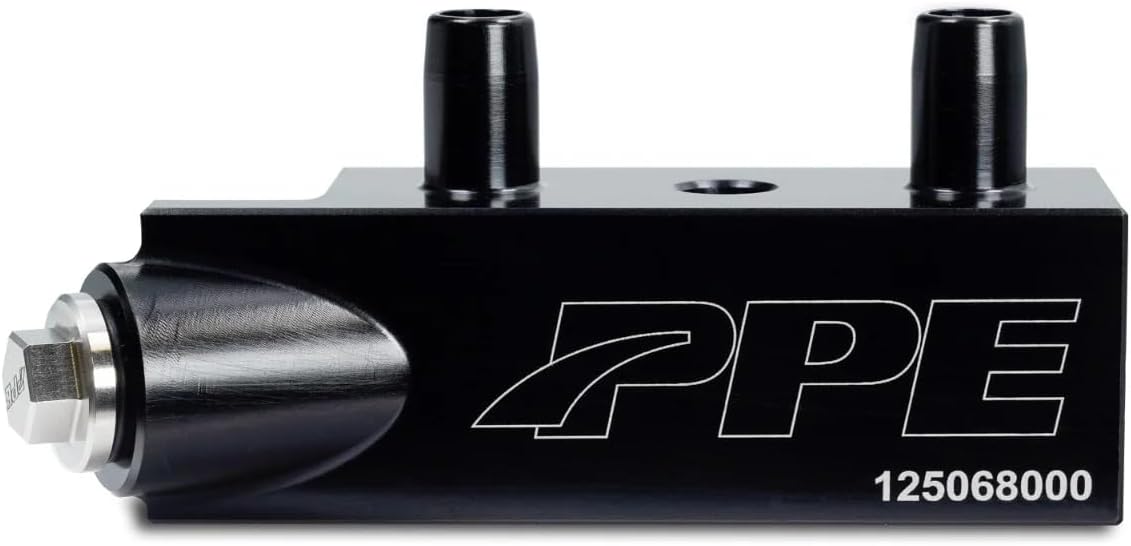
One practical note on the plumbing itself. On the 6L80 the factory lines land on a block at the case, and the cleanest way to run an auxiliary cooler without fighting quick-connect fittings is an adapter plate that converts that block to AN fittings. It also removes a set of aging snap-in connections from the circuit, which after reading 22-NA-182 you may decide is the real point.
A tow-duty checklist, in order of payoff
- Inspect the rubber cooler line for a twist per 22-NA-182. Free, ten minutes, and a documented cause of overheating.
- Check for the 70 stamp on the TBV. No stamp means the 194F valve. Replace it with the correct part number for the application per 21-NA-199, along with seal 23135703 and the cooler pipe o-rings.
- Watch converter clutch slip under load rather than watching temperature alone. Temperature is the result; slip is the cause.
- Set fluid level correctly at the control plug. Level on these units is temperature dependent, so checking outside the specified fluid temperature window gives a wrong answer in both directions.
- Add an auxiliary oil-to-air cooler in series if the fluid will not recover after grades.
- On a high-mileage unit with wandering line pressure, plan on the TCC regulator and pressure regulator bores at rebuild time rather than hoping a cooler covers it.
- Use DEXRON VI. It is what GM lists in the bulletin parts table for this work, and it is what the unit was designed around.
Need parts for this job?
Thermal bypass valves, cooler bypass kits, coolers, valve body kits, solenoids, pans and filters, and rebuild kits for the 6L80 and 6L90, shipped from the USA on our own checkout.
Shop 6L80 parts →FAQ
What temperature does the 6L80 thermal bypass valve open at?
It depends on which valve is on the truck. GM bulletin 22-NA-182 states that on the 6L80 and 6L90 the thermal bypass valve is external to the transmission and opens at 158F (70C). That is the revised valve. Bulletin 21-NA-199 documents the change: the previous TBV had a full open temperature of 194F (90C), and the new one, stamped with the number 70 on the bottom of the valve, opens fully at 158F (70C). The stamp is visible with the valve installed, so you can check which one a truck has without taking anything apart.
Is the updated GM thermal bypass valve worth installing on a tow truck?
Yes, and GM says to install it during any transmission repair, including a Customer Concern Not Duplicated. Bulletin 21-NA-199 lists the part numbers by application: 86774933 for 2016-2018 Silverado and Sierra plus 2019 Silverado LD and Sierra Limited with steel lines, 85547828 for Silverado and Sierra 2500HD and 3500HD, and 85563685 for 2019-2021 Silverado and Sierra with aluminum lines and the Express and Savana vans. The bulletin also calls for seal 23135703 and the cooler pipe fitting o-rings, and it says the valve only needs to be replaced once.
Why does my 6L80 overheat when the fluid is full and the cooler is clean?
Check the rubber cooler line for a twist before you chase anything internal. GM bulletin 22-NA-182 covers 6L80, 6L90, 8L90, 10L80, 10L90 and 10L1000 vehicles with harsh shifting, shudder, surge, stall, neutral or flare and transmission overheating, and names a twisted cooler line on low mileage vehicles as the cause. On ETRS trucks that twist can also set DTC P27EC. The fix is to disconnect the line at the auxiliary cooler, untwist it and reconnect, or replace the line if it stays misshaped, then recheck fluid level.
Does a 6L80 need an auxiliary transmission cooler for towing?
If the truck already has the factory auxiliary cooler and a working 158F bypass valve, that is a reasonable baseline for most trailers. Add capacity when the fluid will not settle back down after a grade. The important thing when you buy is what the Transmission Digest TASC Force article on cooler sizing says: the GVW rating printed on most coolers is the rating when the cooler is used in addition to the OE cooler, not as a replacement for it. Plumb the extra cooler in series after the factory cooling, not instead of it.
What transmission temperature is too hot for a 6L80?
Most transmission people want the fluid under 200F, which the TASC Force cooler article points out is difficult when engine coolant is sitting at 210F or more. Short spikes while pulling a grade with the converter unlocked are normal. What matters is recovery: if the fluid will not come back down into the 180s on level road after the grade, the cooling system is out of capacity or something upstream, like a slipping converter clutch or a restricted cooler circuit, is adding heat faster than the cooler can remove it.
Sources
- General Motors — Service Bulletin 21-NA-199, "Information on Installation of a New Thermal Bypass Valve (TBV)," December 2021 (via NHTSA). Backs the revised TBV full open temperature of 158F (70C) versus the previous 194F (90C), the 70 stamp on the bottom of the valve and its visibility when installed, the instruction to install the valve during any transmission repair including CCND and only once, the condition list (MIL, harsh shifts, slip, surge, shudder, harsh garage and range shifts, noise, whine, growl, shake, vibration, delayed shifts), part numbers 86774933 / 85547828 / 85563685, seal 23135703, o-rings 12650609 and 23277649, DEXRON VI 88865601, and the 0.2 and 0.6 hour labor times. static.nhtsa.gov (PDF)
- General Motors — Service Bulletin 22-NA-182, "Information on 6L80 6L90 8L90 10L80 10L90 10L1000 Equipped Vehicles With A Harsh Shift, Shudder, Surge, Stall, Neutral/Flare, Transmission Overheating and/or High Transmission Fluid Temperature," revised March 2024 (via NHTSA). Backs the twisted cooler line as a documented cause of overheating on low mileage vehicles, the untwist-or-replace procedure and fluid level recheck, DTC P27EC on ETRS transmissions (RPO MHS, MQC), and the bypass valve temperature table: 6L80/6L90 at 158F (70C) external, 8L90 at 194F (90C) external, 10L80/10L90/10L1000 at 143F (61C) within the valve body, and 194F (90C) frame-rail external on the 3.0L LM2 and LZ0 diesel. static.nhtsa.gov (PDF)
- Sonnax — "Hydraulics Fundamentals Part IV: Converter Clutch Control," by Bob Warnke, VP of technical development. Backs the heat mechanism: work creates heat so circulation or flow is required to reduce it, two-path clutch control typically requiring three to four valves to regulate slip rate and turbine shaft RPM, the roughly 130 psi limit on apply pressure at the converter clutch piston, and the behavior at lockup where flow from the converter clutch control valve goes to the cooler instead of the converter and increases significantly once apply pressure is dead-headed. sonnax.com
- Sonnax — TCC Regulator Valve Kit 104740-46K product data (GM 6L45, 6L50, 6L80, 6L90). Backs the internal wear mechanism and its symptoms: bore wear at the TCC regulator valve reduces TCC apply and converter charge pressure, producing TCC slip with high RPM, transmission overheating, harsh shifting and TCC engagement, reduced fuel economy, failsafe and DTCs P0741 and P0742, plus the drop-in repair with lengthened valve lands that operate in unworn portions of the bore and the kit contents. sonnax.com
- Sonnax — Oversized Pressure Regulator & Boost Valve Kit 104520-16K product data (GM 6L45, 6L50, 6L80, 6L90). Backs the cooler-flow side of valve wear: continuous oscillation of the pressure regulator valve causing excess bore wear, resulting in erratic line pressure and restricted cooler and lube flow, with published complaints including low cooler flow, no cooler flow, overheated transmission, burnt clutches and converter concerns, wear at the boost sleeve causing Reverse issues, and the installation requirement that the pump be removed with reaming tooling unless the stator support shaft is removed. sonnax.com
- Transmission Digest — "Transmission Coolers, Part 2," TASC Force Tips by Wayne Russell, November 2003. Backs the cooler selection guidance: the GVW rating on most coolers applies when the cooler is used in addition to the OE cooler rather than as a replacement, the under-200F fluid target against engine coolant at 210F or more, the worst-case condition of a converter working hardest on a steep grade with a big load at low vehicle speed and reduced airflow, how internal turbulators determine fin-and-tube performance and why cheap and superior designs look alike from the outside, and that stacked-plate designs are better suited to stand-alone applications. transmissiondigest.com
- Superior Transmission Parts — STL010 Sure Cool kit product information. Backs the full-time cooler flow approach: the kit allows full time cooler flow and lube to parts with immediate cooler fill and an immediate accurate fluid level check without a warm-up cycle, reuses the existing GM block and lines on units listed in TSB 21-NA-199, and covers 2014-up 6L45/6L50 and 6L80/6L90 plus 2015-up 8L45/8L50 and 8L90. The 30 percent average operating temperature reduction is the manufacturer's own claim. superiortransmission.com
6L80 6AN cooler line adapter plate → or browse all 6L80 parts →