On a 6R80 F-150, the fluid itself is simple. It takes MERCON LV (Motorcraft XT-10-QLVC), Ford lists roughly 12-13 quarts dry fill depending on engine, and the full specs are in our 6R80 fluid type and capacity guide. This post is about the job: which trucks actually have a 6R80, how much old fluid each service method really replaces, what it costs, and the steps after the refill that most quick-lube services skip. That last part is where a fluid change turns into a shift complaint.
I do these on F-150s often enough to have opinions. Where a number comes from Ford or a technical source, it is cited at the bottom.


First, confirm the truck has a 6R80
The 6R80 went into the F-150 for 2009 and stayed through the 2017 model year on most trucks. Ford's Motorcraft fluid chart (by vehicle, revised 9/2026) shows the 6R80 rows for the newer trucks: the 5.0L for 2017-2018, the 3.5L for 2017, the 2.7L EcoBoost for 2017-2018, and the 3.3L V6 for 2018-2020, all MERCON LV. Everything else from 2017 on, including the 3.5L EcoBoost, Raptor and Hybrid, got the 10R80 and takes MERCON ULV (XT-12-QULV).
That 2017-2020 overlap is why I check before I pour. A 2018 F-150 can be either transmission depending on engine. The easy tells: the window sticker or build sheet, the transmission code on the door jamb label, or just counting gears on a scan tool. A 3.3L 2019 work truck is a 6R80. A 3.5L EcoBoost 2019 is a 10R80. Putting LV in a 10R80 or ULV in a 6R80 is not a "close enough" mistake.
Most 2009-2010 F-150s with the 4.6L two-valve still used a four-speed, so do not assume every truck of that age is a 6R80 either.
What you are buying
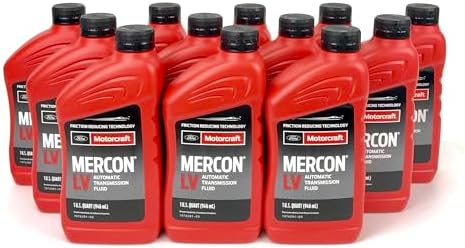
- Fluid: Motorcraft MERCON LV, XT-10-QLVC by the quart or XT-10-5Q3LV in a 5-quart jug, per Ford's chart. Any aftermarket bottle should carry an actual MERCON LV license number on the label. Motorcraft's own license is MLV070701.
- Filter and gasket: the Motorcraft FT-188 filter is the common F-150 6R80 part, and it comes as a kit with a pan gasket from most suppliers. Check fitment against the VIN; Mustang and Expedition 6R80s use different pans and filter pickups on some years.
- Nothing in a bottle: Ford's transmission fluid chart says, in capital letters, not to use supplemental transmission fluid additives, treatments or cleaning agents. On a 6R80 those products do not fix worn valve body bores. They just mask what the scan tool would have shown you.
Buy more fluid than you think. If the old fluid comes out dark, you will want a second drain and fill a few hundred miles later, and running out at the level-check stage with the truck on the lift is a waste of an hour.
How much old fluid each method actually replaces
This is the part most F-150 owners get wrong. A 6R80 holds about 13 quarts total, but a big share of that lives in the torque converter, the cooler and the lines, and none of it comes out when the pan drops. The stock F-150 pan has no drain plug, so a standard service means loosening the pan bolts and letting it pour over the edge. In my bay that gives up roughly five to six quarts.
Here is the math, assuming a 13-quart system and fresh fluid mixing fully with what stayed in:
| Services in a row | 5 qt out each time | 6 qt out each time |
|---|---|---|
| 1 drain and fill | about 38% new | about 46% new |
| 2 drain and fills | about 62% new | about 71% new |
| 3 drain and fills | about 77% new | about 84% new |
Each row is 1 minus (fluid left behind / 13) raised to the number of services. It is simple dilution, but it explains a lot. One pan service on a truck with 120,000 miles of original fluid leaves the majority of that old fluid in the unit. That is not a reason to skip it. It is a reason to plan for two services if the fluid is dark, and to stop expecting a single pan drop to change how a worn unit shifts.
The other options:
- Aftermarket pan with a drain plug. It does not change how much comes out per service, but it makes the second and third drain and fill a 20-minute job without touching the filter or gasket again.
- Cooler-line exchange. A machine on the cooler lines pushes new fluid in as old fluid comes out, and can get close to a full replacement in one visit. In my experience it uses more fluid, usually 16-20 quarts to do it well, and it does nothing for the filter. On a healthy unit with a known history, it is a reasonable way to get to mostly-new fluid. On a high-mileage truck that has never been serviced and already slips, I do not want a sudden full swap with no filter change.
- Flushing with solvents or "cleaner" additives. Not on this transmission. See Ford's additive warning above.
The level check is not optional
There is no dipstick tube on a 6R80. The level indicator is a short plastic stick that sits inside the fill plug on the right front of the case. Sonnax's write-up of a 2009 F-150 leak case describes it exactly that way: a short dipstick plug in the hole where the tube would normally be.
The Ford workshop procedure, as reproduced in Camerota's 6R80 installation guide, is:
- Truck level on a hoist, scan tool connected and reading transmission fluid temperature (TFT).
- Engine running, move the selector through each gear position and hold about 5 seconds in each, then back to PARK.
- Remove the fill plug and take the level indicator off the plug.
- Confirm TFT is 96.7-102°C (206-215°F). Read the dotted (B) area of the indicator, not the crosshatched (A) area. Correct level is the upper edge of the dotted area.
- Add or remove fluid as needed and reinstall the fill plug to 26 lb-ft (35 Nm).
Ford adds two warnings. If the truck was just run hard on the highway, in heavy traffic, in hot weather or towing, let the fluid cool before reading it. And do not overfill. An overfilled 6R80 aerates, and foamy oil gives the solenoids soft, inconsistent pressure that looks like a valve body problem.
Refill goes in through the fill plug hole. A hand pump works. Ford recommends a pressurized dispenser (8-12 gallon units such as the Mityvac MITMV6412) for an overhauled unit, which takes an 8-quart initial fill before start-up. For a service, put back roughly what came out, then set the level hot with the procedure above.
Listen when you pull the fill plug
If you hear a loud rush of air when the fill plug comes out, stop and check the vent before you go any further. In the Sonnax case, a 2009 F-150 5.4L had an intermittent leak that sometimes left a puddle more than a foot across. The shop had already done the case connector per Ford TSB 11-2-25 (later revised to TSB 14-0069) and ATRA bulletin 1495, and it still leaked. The cause was a red rubber check valve inside the vent at the top front of the case. It held enough pressure in the sump to push fluid past several seals at once.
The fix was to pick the check valve out of the vent. If the whole vent comes out, Sonnax notes a plastic GM TH350 vent works in its place. A fluid service is the natural time to find this, because you are already pulling the plug.
After the refill: clear adapts and run the drive cycle
The 6R80 controls every shift by learned clutch-fill values. Those adapts were learned on old, sheared fluid. New fluid fills the clutches a little differently, and on some trucks the first few days after a service feel harsher or softer than before. That is the most common "you broke my truck" call after a fluid change, and it is avoidable.
With a scan tool that can do it, record and clear DTCs, reset the transmission adaptive tables, then run Ford's Adaptive Learning Drive Cycle. Per the workshop procedure in the Camerota guide:
- Level road, engine and transmission at normal operating temperature, correct fluid level, and no active check-engine lights in any module (an active fault stops the learn).
- In Drive, accelerate moderately from a stop to 50 mph (80 km/h) so it shifts into 6th. Hold steady speed and throttle at least 15 seconds.
- Still in 6th at steady speed, lightly tap the brake to light the brake lamps, and hold speed and throttle at least 5 more seconds.
- Brake to a stop and stay stopped at least 20 seconds.
- Repeat steps 2 through 4 five times.
If a code sets during that drive, Ford's instruction is to fix it before driving the truck further. I agree. A fluid service on a truck that already has P0751-type solenoid codes or a 3-4 clutch complaint does not fix those problems. It just changes the symptoms.
What it costs
Parts for a pan-drop service at our prices: a 12-quart case of Motorcraft MERCON LV at $181.99 and the FT-188 filter and pan gasket kit at $38.99, so about $221 before tax. You will use roughly half the case on the first service and the rest on the level check, top-off and a second drain and fill. If you plan to do repeat drain and fills, a pan with a factory-style drain plug is $103.99 and pays for itself in time on the second service.
Labor on a pan drop with the level check done properly is about an hour to an hour and a half in my bay, most of it waiting for the fluid to reach 206-215°F so the level reading means something. A shop quoting a 6R80 fluid service that does not include a scan tool level check at temperature is guessing at the level.
How often on an F-150
Ford's 2014 and 2015 F-150 owner's manual schedules put the transmission fluid and filter change at 150,000 miles (the manual details are in our capacity guide). Haynes, writing for 2004-2014 F-150s, lists automatic fluid replacement at 100,000 miles and every 15,000 miles for trucks that tow often, run in heavy city traffic over 90°F, work hilly or mountainous terrain, or go off road.
My shop practice sits between those: around 60,000 miles for a truck that tows or idles a lot, and sooner if the fluid is dark or smells burnt. The 6R80's valve body and solenoid complaints get worse on oxidized fluid, and a case of fluid costs less than a valve body.
6R80 transmission dipstick kit, 2010-2017 (OEM 22200)
If you service your own F-150 and are tired of pulling the fill plug to guess at the level, this dipstick kit fits 2010-2017 6R80 units. Sold by our sister store, CoreTransmissionParts.
Shop the part for this fix →Want a drain plug for repeat services? The transmission pans collection has 6R80 pans and pan kits with filters.
Need parts for this job?
Our 6R80 parts page has MERCON LV by the case, the FT-188 filter and gasket kit, drain-plug pans, and the solenoid kits and valve bodies for when the old fluid tells you the problem is bigger than a service. Checkout is on site.
FAQ
What transmission fluid does a 6R80 F-150 take?
MERCON LV, Motorcraft XT-10-QLVC by the quart or XT-10-5Q3LV in a 5-quart jug. Ford's fluid chart lists MERCON LV for the 6R80 in the 2017-2018 5.0L, 2017 3.5L, 2017-2018 2.7L EcoBoost and 2018-2020 3.3L F-150. The 10R80 trucks take MERCON ULV instead, so confirm which transmission the truck has before you pour.
How many quarts does a 6R80 F-150 fluid change take?
A pan-drop service on the stock pan usually gives up about five to six quarts, not the 12-13 quart dry-fill capacity, because the torque converter, cooler and lines stay full. Put back roughly what came out, then set the final level hot with the fill-plug indicator. Buy a 12-quart case so you have enough for the level check and a second drain and fill.
Does one drain and fill change all the fluid in a 6R80?
No. If about 5 quarts come out of a 13-quart system, one service replaces roughly 38 percent of the fluid, two services about 62 percent and three about 77 percent. If the old fluid is dark, plan on two or three drain and fills a few hundred miles apart.
Do you need to reset the transmission after a 6R80 fluid change?
It is a good idea. Clear the adaptive tables with a scan tool and run Ford's Adaptive Learning Drive Cycle: accelerate to 50 mph in 6th, hold 15 seconds, tap the brake and hold 5 seconds, stop for 20 seconds, and repeat five times on a level road with the fluid at operating temperature and no active codes.
How much does a 6R80 F-150 fluid change cost?
At our prices the parts are about $221: a 12-quart case of Motorcraft MERCON LV at $181.99 and the FT-188 filter and pan gasket kit at $38.99. Expect about an hour to an hour and a half of labor for a pan drop with a proper scan-tool level check at 206-215F.
Related guides
- 6R80 Fluid Type and Capacity
- 6R80 Filter and Pan Service Guide
- 6R80 F-150 Common Problems
- 6R80 F-150 Shift Problems
- Ford 6R80 vs. 10R80 F-150 Comparison
Sources
- Ford Customer Service Division, Motorcraft Automatic Transmission Fluid Chart by vehicle. Backs the 6R80 F-150 applications (5.0L 2017-2018, 3.5L 2017, 2.7L EcoBoost 2017-2018, 3.3L 2018-2020) on MERCON LV, the 10R80 trucks on MERCON ULV, and part numbers XT-10-QLVC, XT-10-5Q3LV and XT-12-QULV. fcsdchemicalsandlubricants.com
- Ford Customer Service Division, Motorcraft Automatic Transmission Fluid Chart by transmission. Backs MERCON LV for the 6R80 and the caution against supplemental transmission fluid additives, treatments or cleaning agents. fcsdchemicalsandlubricants.com
- Motorcraft, MERCON LV Automatic Transmission Fluid Product Data Sheet. Backs MERCON LV license number MLV070701. fcsdchemicalsandlubricants.com
- Camerota, 6R80 Transmission Installation Guide, reproducing Ford workshop manual section 307-01 procedures. Backs the level check steps, the 96.7-102°C (206-215°F) check temperature, the dotted (B) zone, 26 lb-ft (35 Nm) fill plug torque, the 8 qt initial fill and pressurized dispenser recommendation, and the Adaptive Learning Drive Cycle steps. camerota.com
- Sonnax, Ed Lee, "6R80 Transmission: Solving a Leak Mystery" (November 2017). Backs the plug-mounted level indicator, the 2009 F-150 5.4L leak case, Ford TSB 11-2-25 and 14-0069, ATRA bulletin 1495, the red rubber check valve in the vent and the TH350 vent substitute. sonnax.com
- Haynes, 2004-2014 Ford F-150 Pickup Truck Routine Maintenance FAQ. Backs the 100,000-mile automatic fluid replacement and the 15,000-mile interval under towing, hot city traffic, hilly terrain or off-road use. haynes.com