An F-150 that will not move is a different job from one that slips. Slipping means something is holding, just not well enough. No movement means the transmission never got a clutch applied, never got the pressure to apply one, or never got told what range it was in. On a 6R80 F-150 those three causes look the same from the driver's seat, and they cost wildly different amounts to fix. I have seen trucks towed in on a quote for a reman unit that left on a lead frame, and I have seen the opposite: a fresh lead frame installed into a transmission with a broken pump.
This covers the 2009-2017 F-150 with the 6R80, in the order I work it: fluid, range signal, line pressure, then the missing clutch. Sources are linked at the bottom.


Sort the complaint before you touch it
Get the exact symptom from the driver, then confirm it yourself with a scan tool connected. Four questions narrow it down: does it move in Drive, in Reverse, in neither? Does the engine load down when you select a range? Does the gear indicator in the cluster show the correct letter or dashes? Did it fail suddenly, or right after a repair?
| What you see | What it usually is | First check |
|---|---|---|
| No Drive, no Reverse, PRNDL shows dashes or wrong letter, may not crank | Range signal fault: lead frame, connector or harness | TR PID while moving the shifter through each position |
| No Drive, no Reverse, engine does not load at all, may whine | No line pressure: fluid gone, pump, or valve body leak | Fluid level, then line pressure in every range |
| Right after an overhaul or valve body job | Mismatched spacer plate or valve body parts | Line pressure in Park/Neutral vs Drive/Reverse |
| Reverse works, no Drive | A clutch, the clutch common to 1st through 4th | Try manual 1, compare TSS and OSS |
| Drive works, no Reverse | B clutch or its circuit | See our 6R80 no reverse guide |
| Engine loads, OSS shows output speed, truck still sits | Not the transmission: driveshaft, axle or parking pawl linkage | Watch OSS with the brake released |
| Feels like it will not pull from a stop, speedometer at zero | Starting in 5th gear (TSB 13-6-8) | Commanded gear at launch |
Step 1: fluid level, and where it went
Before anything electrical, confirm there is fluid in it. A 6R80 that lost a cooler line or a pan gasket on the highway will drive until the pump starts pulling air, then stop. The F-150 has no conventional dipstick tube; the level is checked at the case check plug with the truck level, the engine idling, the shifter run through each range and returned to Park, and fluid temperature read on the scan tool. Do not overfill it to make up for a leak you have not found.
The fluid is MERCON LV, Motorcraft XT-10-QLVC, in every 6R80 F-150 per Ford's fluid chart. That same chart warns against supplemental additives, treatments and cleaners. A truck that pumped its fluid out through a cooler line needs several quarts before you can judge anything. If it comes up to level and drives, find the leak. If it still will not move, keep going. Our 6R80 fluid type and capacity guide covers the full check procedure.
Step 2: does the truck know what range it is in?
On the 6R80, the transmission range sensor is not a switch bolted to the side of the case. GEARS Magazine describes the control assembly as a valve body with an integrated unit that carries the output shaft speed sensor (OSS), turbine shaft speed sensor (TSS), fluid temperature sensor (TFT) and the transmission range sensor (TR). On F-150s, those sensors live on the molded lead frame bolted to the valve body inside the pan. When the TR signal is missing or implausible, the PCM may not crank the engine, may show dashes in the gear display, and may not command a range at all. The truck sits there with the shifter in Drive.
Plug in and watch the TR PID as you move the shifter slowly through P, R, N, D and M. Every position should read cleanly and match the lever. A reading that drops out, flickers between two ranges, or shows an in-between value is a range input problem, and no amount of hydraulic work will fix it. Check the shift cable adjustment and the case connector first. Then the lead frame.
2009-2010 trucks vs 2011 and later
This matters when you order parts. Per GEARS Magazine's second article on the 6R80 updates, the earlier units carried an internal TCM on the conductor plate. With the one-way clutch update, the PCM took over control of pressure and shifting, and the conductor plate changed with it. A 2009-2010 lead frame and a 2011-2017 lead frame are not interchangeable, and after replacing either one you need to program the solenoid strategy and clear adaptive tables, or the truck can shift badly even when it moves.
The lead frame bulletin and the recall
Two Ford documents explain why lead frames have such a reputation on these trucks. Ford TSB 13-6-8 covers 2011-2013 F-150s with the 6R80 built on or before April 8, 2013 that engage 5th gear from a stop. The symptoms listed are a wrench light, a speedometer reading zero and dashes in the odometer, with P0720 and P0722 that may or may not be stored. The fix is molded lead frame AL3Z-7G276-A. The bulletin notes the shift solenoids do not need to be replaced. A truck launching in 5th with a load on the hitch can feel exactly like a truck that will not move.
Separately, NHTSA Recall 19V-075 (Ford 19S07) covers 2011-2013 F-150s where an intermittent output shaft speed sensor failure can cause an unintended downshift to first gear. The remedy is a PCM reprogram that prevents the downshift if the OSS signal drops. If an OSS fault is part of your story, run the VIN for open recalls before you quote the job.
Step 3: line pressure in every range
If the range input is good and the fluid is full, put a gauge on the line pressure port and record pressure in Park, Reverse, Neutral and Drive at idle. Compare with the line pressure desired PID on the scan tool. The pattern of the readings tells you where to look.
- Zero or near zero in every range: the pump is not producing. Check whether the converter is fully engaged in the pump drive after any recent R&R. A converter that was not seated when the transmission was bolted up will break the pump drive. A pump with scored gears or a cracked housing goes the same way.
- Normal in Park and Neutral, gone in Drive and Reverse: pressure is being lost once the manual valve opens the apply circuits. That points to the valve body, the spacer plate, or a large leak at a clutch seal or tube seal.
- Normal in every range, still no movement: the pressure is there but the clutch is not applying or holding. That is a mechanical failure inside, covered in Step 4.
No movement after an overhaul: check the spacer plate
Transmission Digest ran a case that every 6R80 builder should read. A 2010 F-150 came back after an overhaul with no movement. Line pressure was 40 psi in Park and Neutral and fell to zero in Drive or Reverse. The builder had mixed parts from two different valve body improvement kits and installed a new spacer plate. When the valve body came off, the cause was obvious: the valve body used only two solenoid dampers, but the new spacer plate was made for a valve body with all six. Pressure was dumping through the four orifices that had no damper behind them. The original spacer plate went back in and the truck moved forward and backward with normal pressure.
The part numbers from that article: the 2006-2008 six-orifice plate is 6L2P-7Z490-FB, the 2008-2010 two-orifice plate is 6L2P-7Z490-FD, and the solenoid damper is BL3Z-7J191-A. The article adds that Ford went back to six dampers on 2010 and later units, with a bonded six-orifice plate. GEARS adds another layer for 2011 and later: the D2 passage and D2 regulator valve were removed with the one-way clutch update, and the plate for those units is stamped AL3P-7Z490-BA. Read the stamp on the plate you pull out and match it. Do not trust the box.
Solenoids changed too. Per GEARS, the SSE on/off solenoid reads about 10.5 ohms on units built before November 4, 2010 and about 18 ohms after. A wrong-year solenoid set is another way to build a 6R80 that leaves the bench and does not drive.
Step 4: good pressure, no movement, which clutch is missing
The 6R80 uses five clutches: A, B and E drive, C and D hold. Every gear needs two. Per the 6R80 clutch application, A is applied in 1st through 4th, B in 3rd, 5th and Reverse, and E in 4th, 5th and 6th. Reverse is B plus D. First gear launch is A plus D, and that is where the 2011 change matters.
For 2011, Ford added a one-way clutch to the rear planetary. Per GEARS, on those trucks the D clutch applies only until about 3 mph, then releases and the one-way clutch holds 1st. The SSD (VFS4) solenoid that controls it is normally high: about 50 mA applies the D clutch and about 850 mA releases it. That gives you a few useful tests.
- No Drive, Reverse fine: Reverse proves the D clutch and the pump. The A clutch is the common element in 1st through 4th, so a burned A pack or a blown A piston seal is the lead suspect. Manual 1 will not move either, since it also uses A.
- No Reverse, Drive fine: B clutch or its feed. Covered in our no reverse guide.
- No Drive and no Reverse with good pressure: look for what both share. That is the D clutch on a pre-2011 unit, or a broken input or output component on any year. Watch TSS and OSS: if turbine speed is at zero with the engine running, nothing is turning the input. If OSS shows output speed and the truck still sits, the transmission is doing its job and the problem is behind it.
A truck that moves cold and quits hot usually has a worn clutch seal or a tired pump. Drop the pan: friction lining or metal chunks in the filter mean the unit is coming out.
The fix, by what you found
- Low fluid, unit drives once full: fix the leak, refill with MERCON LV, recheck at temperature.
- TR reading wrong or dropping out: cable adjustment and connector first, then the lead frame for the correct year, then program and relearn.
- Starts in 5th, speedometer at zero, 2011-2013: lead frame per TSB 13-6-8. The solenoids stay.
- No pressure in any range: converter engagement and pump. Pull the unit.
- Pressure in P/N only, after a valve body job: spacer plate, dampers and solenoids matched by year, or a remanufactured valve body.
- Good pressure, clutch missing, debris in the pan: full overhaul with a master kit, a cooler flush and solenoid strategy programming.
- OSS shows output turning: stop working on the transmission and inspect the driveline.
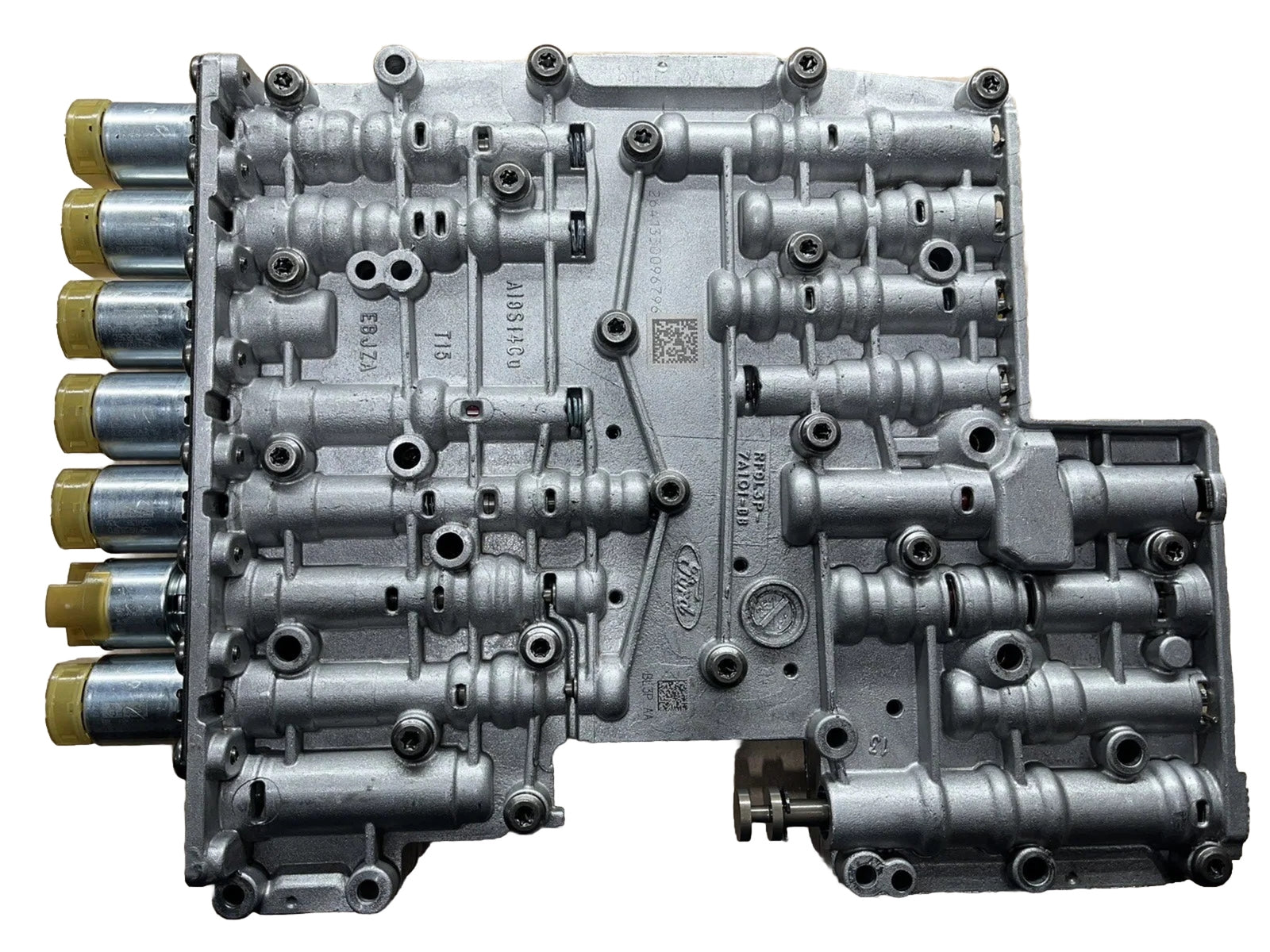
6R80 lead frame with temperature and range sensor
When the TR signal is the reason the truck will not go into gear, this is the assembly that carries the range sensor, the speed sensors and the temperature sensor. Sold by our sister store, CoreTransmissionParts.
Shop the part for this fix →Found a burned clutch instead? The rebuild kits collection has 6R80 master kits for 2009-2014 and 2011-2017.
Need parts for this job?
F-150 6R80 lead frame kits, remanufactured valve bodies by year, pumps, master rebuild kits and MERCON LV are on our 6R80 parts page, with checkout on site.
FAQ
Why won't my F-150 move in Drive or Reverse?
On a 6R80 F-150 the common causes are low fluid from a leak, a transmission range signal the PCM cannot read because of the lead frame or its connector, no line pressure from a failed pump, and a burned clutch. Check the fluid level first, then watch the TR PID while moving the shifter, then gauge line pressure in every range. Each step rules out a whole group of parts.
Can a bad lead frame make a 6R80 not move?
Yes. The molded lead frame carries the range sensor and the speed sensors, so a bad one can leave the PCM unsure what range is selected, show dashes in the gear display, or start the truck in 5th gear. Ford TSB 13-6-8 covers 2011-2013 F-150s built on or before April 8, 2013 that start in 5th, fixed with lead frame AL3Z-7G276-A.
Why does my 6R80 have no movement after a rebuild?
Mismatched valve body parts are a known cause. Transmission Digest documented a 2010 F-150 with 40 psi in Park and Neutral and zero in Drive and Reverse because a six-orifice spacer plate was installed on a valve body with only two solenoid dampers. Match the spacer plate stamp, dampers and solenoids to the model year.
It moves in Reverse but not Drive. What failed?
Reverse working proves the pump and the D clutch are doing their job. The A clutch is applied in 1st through 4th, so a burned A clutch pack or a leaking A piston seal is the most likely cause. Manual 1 will not move either, because it also uses the A clutch.
Related guides
- 6R80 F150 Slipping: Causes and Fix
- 6R80 F150 Common Problems and Fixes
- 6R80 Delayed Engagement Fix
- 6R80 No Reverse Fix
- 6R80 Pump Failure Symptoms
Sources
- Transmission Digest — Wayne Colonna, "Ford 6R80 No Movement After Overhaul," Transmission Tech/Talk, April 2026. Backs the 2010 F-150 case, 40 psi in Park/Neutral dropping to zero in Drive/Reverse, the two-damper valve body with a six-orifice spacer plate, and part numbers 6L2P-7Z490-FB, 6L2P-7Z490-FD and BL3Z-7J191-A. transmissiondigest.com
- GEARS Magazine (ATRA) — David Chalker, "Updates to the Ford 6R80." Backs the five-clutch layout, the control assembly carrying OSS, TSS, TFT and TR, the 2011 one-way clutch addition, the D clutch releasing at about 3 mph and the SSD/VFS4 50 mA apply and 850 mA release values. gearsmagazine.com
- GEARS Magazine (ATRA) — David Chalker, "Updates to the Ford 6R80 Part 2." Backs the deleted D2 passage and D2 regulator valve, spacer plate AL3P-7Z490-BA, solenoid snout colors, the SSE 10.5 vs 18 ohm change around November 2010, and the move from an internal TCM to PCM control. gearsmagazine.com
- Ford Motor Company — Technical Service Bulletin 13-6-8, "6R80 Transmission High Gear Engagement From A Stop," June 2013, hosted by NHTSA. Backs the 2011-2013 F-150 coverage, the April 8, 2013 build cutoff, the 5th-gear start symptoms, P0720/P0722 and lead frame AL3Z-7G276-A without solenoid replacement. static.nhtsa.gov (PDF)
- NHTSA / Ford — Safety Recall Notice 19S07, NHTSA Recall 19V-075. Backs the intermittent OSS failure on 2011-2013 F-150s causing an unintended downshift to first gear and the PCM reprogramming remedy. static.nhtsa.gov (PDF)
- Ford Customer Service Division — Motorcraft Automatic Transmission Fluid Chart by vehicle. Backs MERCON LV (XT-10-QLVC) for the 6R80 F-150 and the warning against supplemental additives, treatments or cleaners. fcsdchemicalsandlubricants.com (PDF)