Most people look up 6R80 gear ratios for one of two reasons. Either they are running the numbers on a gear swap, a tire change or a towing setup, or they have a scan tool on the truck and a gear ratio code on the screen and want to know what the transmission is supposed to be doing. This page is written for both. The ratio chart is at the top. Below it is the part that actually helps on a repair: which clutches make each ratio, which solenoids command them, and how to use that to find the failed clutch before the pan comes off.
The 6R80 is Ford's version of the ZF 6HP26, and it kept the ZF gear set. The ratios below match the ZF 6HP26 data sheet exactly [1], and the clutch apply logic comes from ATRA's apply chart for the 2011-up 6R80 [2].
The short version: 1st 4.17, 2nd 2.34, 3rd 1.52, 4th 1.14, 5th 0.87, 6th 0.69, Reverse 3.40. Total spread 6.04 [1]. Two overdrive gears, 5th and 6th. Every forward gear uses exactly two shifting elements out of five (A, B, C, D, E), and every upshift swaps one clutch for another. Fluid is MERCON LV only, with Ford listing 12.1 qt (3.7L) and 13.1 qt (5.0L, 6.2L, 3.5L EcoBoost) approximate dry fill in the 2014 F-150 [5].


6R80 Gear Ratio Chart
Here is the full ratio set, the step between each gear, and the two elements that are applied to make each one. The step column is simply one ratio divided by the next; it tells you how far engine RPM drops on each upshift at a given road speed.
| Gear | Ratio | Step to next gear | Elements applied |
|---|---|---|---|
| 1st | 4.17:1 | 1.78 | A (forward) + D (low/reverse) or low one-way clutch |
| 2nd | 2.34:1 | 1.54 | A + C (intermediate) |
| 3rd | 1.52:1 | 1.33 | A + B (direct) |
| 4th | 1.14:1 | 1.31 | A + E (overdrive) |
| 5th | 0.87:1 | 1.26 | B + E |
| 6th | 0.69:1 | — | C + E |
| Reverse | 3.40:1 | — | B + D |
Ratios are from the ZF 6HP26 type sheet [1]; applied elements are from ATRA Technical Bulletin 1861 [2]. The steps are tight at the top and wide at the bottom, which is what you want in a truck: a deep first gear to get a load moving, then closely spaced upper gears so the engine stays near its torque peak on the highway. That 1-2 step of 1.78 is the biggest RPM drop in the box and the shift that gets the most attention in calibration.
Where the Ratios Come From: the Lepelletier Gear Set
The 6R80 does not have six separate gear sets. It has two. ZF's own data sheet describes the 6HP26 as based on the Lepelletier gear set concept [1]: a simple planetary in front and a Ravigneaux (compound) planetary behind it. GEARS Magazine's David Chalker breaks the 6R60/75/80 down the same way: a four-element torque converter with a multi-disc lockup clutch, three driving clutches (A, B and E) and two brake clutches (C and D) [3].
The front planetary is a fixed reduction. Input drives it, and its output turns slower than engine speed all the time. The A and B clutches take that reduced speed into the rear gear set. The E clutch takes full input speed straight into the rear gear set. C and D are brakes that hold members of the rear set to the case. Pick two of those five and you get a gear:
- 3rd gear shows the trick most clearly. With A and B both applied, both sun gears of the rear set turn at the same reduced speed, the Ravigneaux set locks up and turns as one piece, and the output runs at the front planetary's reduction. That is why 3rd is 1.52:1: it is the front gear set's ratio passed straight through.
- 4th through 6th all use E, which means the rear set's carrier is being driven at engine speed. Pair it with A (4th), B (5th) or the C brake (6th) and the output speeds up relative to 3rd, until 5th and 6th turn the output faster than the input. Those are the two overdrive gears.
- Reverse uses B and D. B drives the rear set at reduced speed while D holds the carrier, and the output turns backward at 3.40:1.
Ford names most of these clutches by the gears they work in, and you will see both naming systems in service information. Sonnax's 6R80 shift-quality article uses the Ford names: the 1-2-3-4 clutch is on in 1st, the 2-6 clutch comes on in 2nd, and on the 2-3 shift the 3-5-R clutch applies as the 2-6 releases [4]. Map them over and A is 1-2-3-4, B is 3-5-R, C is 2-6, D is low/reverse and E is 4-5-6. Every letter lines up with the chart above.
The 2011 One-Way Clutch Changed First Gear
First gear is the one ratio that is made two different ways depending on the year. In 2011 Ford added a one-way clutch to the rear planetary assembly. Chalker writes that it was designed to provide smoother 1-2 and 2-1 transitions, quicker downshifts and better fuel economy [3]. ATRA's bulletin spells out the apply change [2]:
- 2009-2010 units: the D clutch applies throughout first gear.
- 2011-later units: the D clutch applies only until about 3 mph, then releases, and the low one-way clutch holds for the rest of first gear.
- Manual 1st (all years): A and D are both applied, which gives you engine braking in first. The one-way clutch alone cannot do that because it freewheels on decel.
That split is a useful diagnostic. On a 2011-up truck, a slip or no-move in Drive first gear that goes away when you select manual 1st points hard at the one-way clutch, because manual 1st brings D back in to do the holding. The 1-2 shift on these units is also no longer a clutch-to-clutch swap; the one-way clutch overruns as C applies, which is exactly why Ford added it.
6R80 Solenoid Apply Chart
The ratios only happen if the solenoids put pressure on the right clutches. ATRA's chart for the 2011-up 6R80 lists five shift solenoids, the pressure control solenoid and the TCC solenoid, each marked normally low (NL) or normally high (NH) [2]. An "X" means the solenoid is at high duty cycle, about 850 mA; no X means low duty cycle, about 50 mA [2].
| Range | SSE (on/off) | SSA (A) NL | SSB (B) NH | SSC (C) NL | SSD (D/E) NH |
|---|---|---|---|---|---|
| P, R, N | |||||
| D-1st | X | X | 50 mA, then X above 3 mph | ||
| D-2nd | X | X | X | X | |
| D-3rd | X | X | |||
| D-4th | ON | X | X | ||
| D-5th | ON | ||||
| D-6th | ON | X | X |
The pressure control solenoid (NH) is modulated by load in every range, and the TCC solenoid (NL) is modulated in 2nd through 6th [2]. Reading this chart takes one rule that ATRA prints right under it: a normally low solenoid is proportional, so high current applies its clutch; a normally high solenoid is inversely proportional, so high current exhausts its clutch [2]. Look at 3rd gear: SSB has no X, it sits at 50 mA, and because it is normally high that means the B clutch is fully applied. In 4th SSB goes back to 850 mA and B releases. If you watch commanded solenoid current on a scan tool, this is the chart you check it against.
Two more things matter when you are replacing solenoids to fix a ratio problem. Sonnax's identification guide notes that 2010-later Ford solenoids are cream-colored and carry a flow band number from 1 to 5 [6], and the PCM's solenoid body strategy is written around those bands. We cover band matching in detail in the 6R80 pressure control solenoid guide.
What the Ratios Mean on the Road
The transmission ratio times the axle ratio gives you the overall ratio at the tire. A few worked numbers with a 3.55 axle, which is a common F-150 choice:
- 1st: 4.17 x 3.55 = 14.80:1 overall
- Reverse: 3.40 x 3.55 = 12.07:1 overall
- 6th: 0.69 x 3.55 = 2.45:1 overall
For cruise RPM, a 31.5-inch tall tire turns about 640 times per mile (63,360 inches in a mile divided by the tire's 99 inch circumference). At 70 mph that is about 747 tire RPM. Multiply by the 3.55 axle and the 0.69 sixth gear and you get roughly 1,830 engine RPM with the converter clutch locked. Drop to 5th and the same speed is about 2,310 RPM. That difference is why a truck towing in 5th on the highway runs noticeably hotter fluid and louder than one that can hold 6th, and it is the math to run before you put taller tires on a truck and wonder why it will not stay in 6th.
If you change tire size, the speedometer and the PCM's idea of road speed change with it. The transmission ratios do not, but shift points that the PCM schedules by vehicle speed will land in different places until the tire size is reprogrammed.
Using the Ratios to Find a Failed Clutch
The PCM checks gear ratio by comparing input (turbine) shaft speed to output shaft speed. If the measured ratio does not match the commanded gear, it sets an incorrect ratio code: P0731 (1st), P0732 (2nd), P0733 (3rd), P0734 (4th), P0735 (5th), P0729 (6th), P0736 (reverse), or the general P0730. You can do the same math yourself: divide the ISS reading by the OSS reading in each gear and compare it to the chart. A slipping clutch shows up as a measured ratio higher than the commanded one, because the input is turning faster than the output says it should.
The real value of the apply chart is that most clutches work in more than one gear. Line up the gears that slip, find the clutch they share, and you have your suspect before you tear anything down:
| Slips or flares in | Common element | First suspect |
|---|---|---|
| 1st, 2nd, 3rd, 4th (5th and 6th OK) | A (1-2-3-4) | Forward clutch pack, piston seals, input shaft sealing rings |
| 3rd, 5th and Reverse | B (3-5-R) | Direct clutch, B clutch bushing and feed; SSB command |
| 2nd and 6th | C (2-6) | Intermediate brake clutch; SSC command |
| 4th, 5th and 6th | E (4-5-6) | Overdrive clutch, E clutch feed; SSE and SSD |
| Reverse and manual 1st | D (low/reverse) | Low/reverse brake clutch |
| Drive 1st only (2011-up), manual 1st OK | Low one-way clutch | One-way clutch in the rear planetary |
A pattern that does not follow one element, such as slips in every gear, points away from a single clutch and back toward line pressure, fluid level, the pump or the converter. The standard rule in 6R80 diagnosis is to fix non-transmission codes first; a torque-reporting fault changes commanded line pressure and can make healthy clutches slip. For the full P0730 procedure, see our 6R80 P0730 guide.
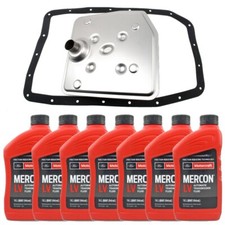
6R80 Overhaul Rebuild Kit with Gaskets
When the ratio math points at a burned clutch pack, the fix is an overhaul, not a solenoid. This kit covers the gaskets and seals for a 6R80 teardown. Available at Core Transmission Parts, our sister store.
Shop the part for this fix →Other 6R80 Specs Worth Knowing
| Spec | Value |
|---|---|
| Type | 6-speed, rear-wheel-drive, Lepelletier gear set (front simple planetary + rear Ravigneaux) [1][3] |
| Shifting elements | 3 driving clutches (A, B, E), 2 brake clutches (C, D); low one-way clutch added 2011 [3] |
| Torque converter | Four-element with multi-disc lockup clutch; TCC available in 2nd-6th [2][3] |
| Fluid | Motorcraft MERCON LV only (XT-10-QLVC) [5][7] |
| Capacity, 2014 F-150 | 12.1 qt (11.7 L) 3.7L; 13.1 qt (12.4 L) 5.0L, 6.2L, 3.5L EcoBoost; approximate dry fill, varies with cooler size [5] |
| ZF 6HP26 baseline | Max input torque 440 or 600 Nm depending on version; weight 84 or 89 kg with oil; about 10 L oil [1] |
| Family | 6R60, then 6R75, then 6R80; later 6R100 and 6R140 [6][8] |
A word on that ZF row: those are ZF's published numbers for the 6HP26, not a Ford rating for the 6R80, and they are listed so you can see where the design started. Ford changed a lot after 2006. Transmission Digest's Mike Riley notes the 6R60 came first, then the 6R75, and the 6R80 was built to handle higher torque, with pump, stator support and forward clutch piston changes along the way [8]. Sonnax counts four separate 6R80 design levels between 2009 and 2017 [6]. The ratios stayed the same through all of it; the hard parts did not. Always identify the unit before you order parts. Our 6R80 identification guide walks through the casting numbers and tag.
6R80 master rebuild kits, clutch modules, solenoid sets, valve bodies and MERCON LV. Shipped fast from the USA.
Shop 6R80 parts →FAQ
What are the gear ratios of the Ford 6R80?
The 6R80 uses the ZF 6HP26 ratio set: 1st 4.17, 2nd 2.34, 3rd 1.52, 4th 1.14, 5th 0.87, 6th 0.69 and reverse 3.40. That is a total spread of 6.04, with 5th and 6th both overdrive gears.
Which clutches are applied in each 6R80 gear?
1st uses A plus D (or the low one-way clutch on 2011-up units), 2nd uses A and C, 3rd uses A and B, 4th uses A and E, 5th uses B and E, 6th uses C and E, and reverse uses B and D. Each upshift releases one element and applies another.
Is the 6R80 the same as the ZF 6HP26?
It is Ford's version of the 6HP26 and uses the same Lepelletier gear set and the same ratios. Ford went on to change the pump, stator support, clutch pistons, valve body and solenoids over the years, so hard parts do not always interchange with a ZF unit or between 6R80 design levels.
How much fluid does a 6R80 hold?
Ford's 2014 F-150 owner's manual lists 12.1 quarts for the 3.7L and 13.1 quarts for the 5.0L, 6.2L and 3.5L EcoBoost as approximate dry fill. A pan and filter service takes far less, and the level must be set hot at the check plug using MERCON LV only.
What does a 6R80 gear ratio code mean?
The PCM compares input shaft speed to output shaft speed and sets P0731 through P0735, P0729 or P0736 when the measured ratio does not match the commanded gear. Compare which gears slip against the apply chart to find the clutch they share, and fix any engine or torque codes first.
Sources
- ZF Friedrichshafen AG — 6HP26 6-speed automatic transmission type sheet (1068 757 703a, 2011). Backs the standard ratios 4.17, 2.34, 1.52, 1.14, 0.87, 0.69 and R 3.40, the 6.04 spread, the Lepelletier gear set concept, 440/600 Nm max input torque, 84/89 kg weight and about 10 L oil. ZF 6HP26 data sheet (PDF)
- ATRA — Technical Bulletin #1861, "6R80 Clutch and Solenoid Apply Charts," 2011-up 6R80, July 2018. Backs the clutch applied in each range, the low one-way clutch holding in D-1st, D releasing above about 3 mph, TCC in 2nd through 6th, the solenoid apply chart with NL/NH designations, the 850 mA and 50 mA duty levels, and the NL-applies/NH-exhausts rule. ATRA bulletin 1861 (PDF)
- GEARS Magazine (ATRA) — "Updates to the Ford 6R80," David Chalker. Backs the four-element converter with multi-disc lockup clutch, driving clutches A, B and E and brake clutches C and D, the Lepelletier arrangement, and the 2011 one-way clutch and its purpose. gearsmagazine.com
- Sonnax — "Troubleshooting Ford 6R80 & 6R140 2-3 Shift Quality Issues," Jim Dial. Backs the Ford clutch names (1-2-3-4, 2-6, 3-5-R) and the 2-3 shift as 3-5-R applying while 2-6 releases. sonnax.com
- Ford Motor Company — 2014 F-150 Owner's Manual, Capacities and Specifications (page 301). Backs 12.1 qt (11.7 L) for the 3.7L and 13.1 qt (12.4 L) for the 5.0L, 6.2L and 3.5L EcoBoost, the approximate dry-fill and cooler-size note, and the warning that transmissions requiring MERCON LV should only use MERCON LV. Ford's own fordservicecontent.com host now blocks direct PDF access (403), so this links the Internet Archive's complete copy of the same first-print manual. 2014 F-150 Owner's Manual (PDF, archived)
- Sonnax — "How to Identify Similar Ford & ZF6 Transmissions: Four Features to Check Before You Begin a Rebuild," Maura Stafford. Backs the 6R60/6R75/6R80/6R100 family, the four 6R80 design levels from 2009 to 2017, and the cream-colored 2010-later solenoids with band numbers 1 to 5. sonnax.com
- Ford Customer Service Division — Motorcraft Automatic Transmission Fluid Application Chart. Backs MERCON LV as the specified fluid for the 6R80. Ford ATF chart (PDF)
- Transmission Digest — "Ford 6R60/6R80 Component Upgrades, Part 1," Mike Riley, August 1, 2016. Backs the 6R60, 6R75, 6R80 production order, the 6R80 built for higher torque, and the pump, stator support and forward clutch piston changes. transmissiondigest.com