Guys who grew up on the 4R70W and 5R55 still call it the EPC solenoid. On the 6R80, Ford calls it the Line Pressure Control solenoid, LPC for short, and it does the same basic job: it tells the main pressure regulator how much line pressure the transmission should run. Every clutch apply in the box is built on top of that number, so when the LPC goes wrong, every shift feels it.
The catch is that the LPC is one of the least common parts in the 6R80 to actually fail, and one of the most commonly blamed. Harsh shifts on this unit come from a long list of things, and a new solenoid bolted onto a worn valve body, or onto a PCM that was never told what solenoid body it has, will not fix any of them. This guide covers what the LPC does, what it looks like when it fails, how to prove it, and what to check before you buy one.
The short version: The 6R80 LPC is a normally high variable force solenoid. Low current means high line pressure. An open circuit, an unplugged connector or failsafe all give you maximum line pressure: hard engagements and firm, banging shifts. A sticky or worn solenoid, or a worn solenoid pressure regulator or main regulator bore, gives you erratic pressure: flares, slips, delayed engagement and solenoid performance codes. Replacement solenoids must match the original's band number and NH/NL type, and the PCM must carry the correct solenoid body strategy, or shift quality will be wrong no matter what you replaced.

What the LPC Solenoid Actually Does
The 6R80 carries seven solenoids on its solenoid body (Ford's name for the valve body): five clutch control solenoids lettered A through E, a torque converter clutch solenoid, and the LPC. The LPC does not apply any clutch directly. Its output signal goes to the main pressure regulator valve, and that valve sets line pressure for the whole unit. The PCM raises line pressure when torque goes up so the clutches hold, and lowers it at light throttle so the shifts stay soft.
Sonnax's solenoid identification for the 2010-later 6R family lists the LPC as a normally high (NH) solenoid [2]. That label is the key to reading every symptom that follows. A normally high variable force solenoid puts out its maximum pressure with little or no current, and the PCM adds current to pull pressure down. You can see the same behavior on the other NH solenoid in the box: in a Sonnax case study by Jim Dial, the 6R80's NH "B" solenoid showed about 14.6 psi at 0.564 A and close to 50 psi at 0.073 A [3]. Less current, more pressure.
The solenoids themselves are fed by the solenoid pressure regulator valve (Ford and ZF also call this the solenoid modulator or AFL valve). Sonnax puts typical solenoid feed from this type of valve in the 80 to 115 psi range across modern units [5]. If feed drops, the LPC cannot produce its commanded output no matter how healthy it is. Keep that in mind; it is the most common trap in this diagnosis.
Symptoms of a Bad LPC Solenoid
Stuck high or no control: harsh everything
Because the LPC is normally high, an open circuit, a broken wire in the lead frame, a connector that is not seated, or a PCM driver that stops commanding current all do the same thing: they leave line pressure at maximum. Ford designed it that way on purpose. GEARS Magazine's Lance Wiggins describes 6R80 failsafe: in the default 3rd gear failsafe all solenoids are off, and the pressure control solenoid provides maximum solenoid pressure to the main regulator valve for maximum line pressure [1]. Maximum pressure keeps the clutches from burning while the truck limps home. What the driver feels:
- Hard, clunky engagement into Drive and Reverse, even at idle
- Firm to harsh upshifts at light throttle, the kind that chirp tires on a 1-2
- If the PCM has also dropped into failsafe, a wrench light or check engine light and the truck stuck in 3rd (or 5th if it failed while in 5th or 6th) [1]
Erratic or low control: flares, slips, delays
A solenoid that is contaminated, sticking or electrically weak does not fail clean. It regulates, just not accurately. Sonnax lists the symptoms of lost solenoid feed pressure as harsh or soft shifts, slips and flares, delayed engagements, wrong gear starts, missing gears, TCC slip and solenoid performance codes [5]. The same list applies when the LPC's output drifts:
- Shift quality that changes with temperature: fine cold, flaring hot, or the reverse
- Delayed engagement into Drive or Reverse
- Flare on upshifts under load, where RPM jumps before the next gear takes
- Gear ratio or solenoid performance codes without an obvious circuit fault
Temperature sensitivity is worth a second look. Sonnax's Eric Streed points out that heat changes coil resistance, resistance changes amperage, and amperage is what sets the output pressure [3]. The PCM compensates within limits using fluid temperature, but a coil that has gone out of spec will show its problem as a unit warms up.
Codes
Electrical faults on the line pressure solenoid show up in the pressure control solenoid "A" group of codes: P0960 (control circuit open), P0962 (circuit low) and P0963 (circuit high), with P0961 for range/performance. Always read the code description your scan tool gives for your exact calibration. A mechanical LPC problem often sets no circuit code at all and shows up instead as a shift-error or gear-ratio code. Wiggins notes that the 6R80 needs four consecutive failures to set a shift error code and five for continuous TCC codes, so an intermittent complaint may take several drive cycles to show up [1].
How to Test It Before You Buy Parts
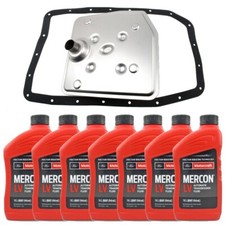
- Check the fluid first. Correct level at operating temperature and MERCON LV only. Low fluid gives the same flares and delays as low pressure. See 6R80 fluid type and capacity.
- Pull all codes, including non-transmission codes. Wiggins's procedure is explicit: repair all non-transmission DTCs first, since they can directly affect transmission operation [1]. A throttle, MAF or torque-reporting fault will change commanded line pressure.
- Watch the solenoid on the scan tool. Most capable scan tools show commanded LPC pressure and actual LPC current (names vary by tool). Current should move smoothly and inversely with commanded pressure: current goes down as commanded pressure goes up with throttle. Current stuck at zero or stuck at one value while the command moves points at the circuit or the PCM driver. Current tracking the command while the shift is still harsh or flared points at the hydraulics.
- Check the circuit. The LPC is fed through the lead frame inside the case. Check the external connector for pushed-back pins and fluid wicking, then compare resistance measured through the case connector with the reading taken directly at the solenoid during a pan drop. A difference between the two points at the lead frame, not the solenoid.
- Check the programming. Compare the 13-digit solenoid body strategy and 12-digit solenoid body identification on the tag on the case (and the strategy etched on the valve body casing) against what the scan tool shows in the PCM. Wiggins warns that if these do not match, you will get harsh shifts [1]. This is the number one cause I see of "the new valve body shifts worse than the old one."
Why a New Solenoid Did Not Fix It
Band number and NH/NL mismatch
Every 6R80 solenoid is tested at the factory and marked with a band number from 1 to 5 next to the barcode [1]. Streed explains that the bands are tolerance windows of roughly 20 mA each, measured at a 31 psi reference, and that on the 6R family the pressure order is reversed between the two types: on normally low (brown) solenoids band 5 has the highest pressure output, while on normally high (black) solenoids band 1 is the highest [3]. The PCM's solenoid body strategy is written around the band of each solenoid that was installed at the factory. Put a band 3 in a hole that the PCM thinks has a band 1 and the output is off by two windows on every shift.
That is why Sonnax's replacement NH solenoid for 2010-later 6R80s (OE BC3Z-7G383-J) comes with a hard rule: check the band on the OE LPC, B or E solenoid first, and install it only if the original is marked band 1. The band number and the NH/NL calibration must both match, or shift calibration concerns will result [2]. The same logic applies to any single-solenoid swap.
The bore behind the solenoid is worn
Two valves sit between a good LPC and good line pressure, and both wear. Sonnax's 6R80 Zip Kit booklet lists the complaints for each [4]:
- Solenoid pressure regulator valve: flare or harsh shifts, wrong gear starts, TCC slip, harsh upshifts and downshifts, delayed Forward and Reverse, solenoid performance codes, gear ratio codes. Sonnax's repair is the 95740-17K oversized valve kit.
- Main pressure regulator valve: poor shift quality, flare or harsh shifts, erratic line pressure, delayed or no Reverse.
Read those lists next to the LPC symptoms above: they are nearly identical. That is the whole problem with this diagnosis. A vacuum test of these bores during a pan-off inspection is what separates a solenoid problem from a bore problem, and Sonnax calls vacuum testing great insurance against a comeback [5].
The PCM was never told
Even with the right part and a good bore, the adaptive tables still hold what the PCM learned from the old part. Sonnax's instructions call for resetting keep-alive memory and shift adaptations after a solenoid replacement [2]. Ford's own bulletin 20-2060 for 2015-2017 F-150 6R80s tells technicians to warn the customer that after the adaptive strategy is reset, the relearning process may give firmer than normal upshifts and downshifts for several days, and to run the Adaptive Learning Drive Cycle in Workshop Manual section 307-01 [6]. A truck that shifts firm for the first couple of days after a repair is not always a failed repair.
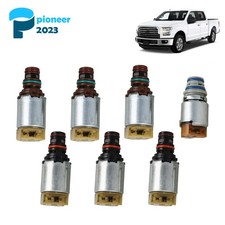
6R80 7-Piece Transmission Solenoid Kit, 2007-2014
If testing points at the solenoids and the originals are too worn to band-match one at a time, a complete set replaces all seven, LPC included. Available at Core Transmission Parts, our sister store.
Shop the part for this fix →Doing the Repair Right
- Record the tag before anything comes apart. The 13-digit strategy and 12-digit ID are what the PCM needs if the solenoid body is replaced.
- One solenoid or all of them. A single LPC swap is fine if you can read the band on the original and match it. OE band numbers are printed very lightly; Sonnax suggests holding the solenoid in direct sunlight to read it [2]. If the originals are contaminated or you cannot read them, a full matched set or a complete solenoid body with its own tag is the cleaner fix.
- Inspect the bores while you are in there. Vacuum-test the solenoid pressure regulator and main regulator at minimum. A new solenoid on a leaking bore is a comeback.
- Torque it correctly. Sonnax's 2015-later 6R80 booklet specifies 8 Nm (71 in-lb) for the valve body to case and valve body half bolts, and 14 Nm (10 ft-lb) for a metal pan to the case [4]. Aluminum threads and a flat separator plate do not forgive guesswork.
- Program and relearn. If the solenoid body was replaced, enter the new tag values through module programming and put the new tag over the old one [1]. Reset adaptives, then run the drive cycle. Wiggins's version: warm the unit, accelerate moderately from a stop to 50 mph in 6th, hold steady for 15 seconds, lightly tap the brake while holding speed for 5 more, stop for 20 seconds, and repeat five times [1].
My opinion as a rebuilder: on a 6R80 with over 150,000 miles and a pressure complaint, I would not replace just the LPC unless it has a hard circuit fault that follows the solenoid. The same wear that makes the LPC suspect has usually reached the regulator bores, and that is where the valve body testing pays for itself.
6R80 pressure control solenoids, complete solenoid sets, valve bodies, lead frames and Sonnax bore repair kits. Shipped fast from the USA.
Shop 6R80 parts →FAQ
What are the symptoms of a bad 6R80 pressure control solenoid?
Because the 6R80 line pressure control (LPC) solenoid is normally high, an open circuit or loss of control leaves line pressure at maximum, which gives hard engagements and firm, banging shifts. A sticking or worn solenoid gives erratic pressure instead: flares, slips, delayed engagement into Drive or Reverse, and solenoid performance or gear ratio codes.
Where is the pressure control solenoid on a 6R80?
It is one of the seven solenoids mounted on the solenoid body (valve body) inside the pan, alongside the A through E clutch solenoids and the TCC solenoid. It is wired through the lead frame to the case connector, so replacing it means dropping the pan and working on the valve body.
What codes does a bad 6R80 line pressure solenoid set?
Electrical faults usually set the pressure control solenoid A codes: P0960 for an open circuit, P0962 for circuit low, P0963 for circuit high and P0961 for range or performance. A mechanically sticking solenoid often sets no circuit code and shows up as shift error or gear ratio codes instead.
Can I replace just the LPC solenoid on a 6R80?
Yes, if the replacement matches the original's band number and normally high calibration. Each solenoid carries a band number from 1 to 5, and Sonnax's NH replacement can only be used where the original is band 1. After the swap, reset keep-alive memory and adaptives and run the drive cycle; Ford notes shifts may be firmer than normal for several days while it relearns.
Why does my 6R80 still shift hard after replacing the solenoid?
The three usual reasons are a band number mismatch, a PCM that does not carry the correct 13-digit solenoid body strategy, and worn solenoid pressure regulator or main regulator bores in the valve body. Those bores cause the same flare and harsh shift symptoms as a bad solenoid and need a vacuum test to rule out.
Sources
- GEARS Magazine (ATRA) — "Controlling the 6R80," Lance Wiggins, July 2015. Backs the seven-solenoid solenoid body, 3rd and 5th gear failsafe with the pressure control solenoid giving maximum line pressure, the 13-digit strategy and 12-digit ID tag and the harsh shifts from a mismatch, band numbers 1 to 5, the four and five consecutive failure code thresholds, repairing non-transmission DTCs first, and the drive cycle. GEARS July 2015 (PDF)
- Sonnax — Installation instructions, Part No. 126421-NHJ Ford 6R80/6R100/6R140 Solenoid (NH), OE BC3Z-7G383-J. Backs the LPC as a normally high solenoid, its use in the LPC, B or E position on 2010-later 6R80s only when the OE band is 1, band and NH/NL matching, reading the band in sunlight, and resetting KAM and shift adaptations. 126421-NHJ instructions (PDF)
- Sonnax — "Breaking Down the Basics of Banded Solenoids," Eric Streed, and "Troubleshooting Ford 6R80, 6R140 2-3 Shift Quality Issues," Jim Dial. Backs the roughly 20 mA band windows at a 31 psi reference, band 1 highest on NH and band 5 highest on NL solenoids, temperature changing coil resistance and output, and the NH "B" solenoid current and pressure readings. Banded solenoids · 6R80 2-3 shift quality
- Sonnax — Ford 6R80 (2015-Later)/6R100 Zip Kit Installation and Testing Booklet. Backs the solenoid pressure regulator and main pressure regulator valve wear symptoms, the 95740-17K kit, and the 8 Nm (71 in-lb) valve body and 14 Nm (10 ft-lb) metal pan torque specifications. Zip Kit booklet (PDF)
- Sonnax — "Uncovering the Root Cause of Pressure Complaints: The Critical Role of Solenoid Modulator/AFL Valves." Backs the 80 to 115 psi typical solenoid feed range, the symptom list for lost solenoid feed, and vacuum testing as insurance against comebacks. sonnax.com
- Ford Motor Company — Technical Service Bulletin 20-2060, 2015-2017 F-150 6R80 (via NHTSA). Backs the note that an adaptive strategy reset may give firmer than normal upshifts and downshifts for several days, and the Adaptive Learning Drive Cycle in WSM section 307-01. TSB 20-2060 (PDF)