Most shops treat "the TCC" as one part: lock, unlock, done. On a 6T70 it is a small hydraulic control loop running constantly in the background, and the TCM is watching it closely enough to set five different fault codes depending on exactly how it fails. If you do not know what the system is supposed to be doing, P0741, P0742, P2762, P2763 and P2764 all just look like "converter problem" and you end up guessing between a solenoid, a valve body and a new torque converter.
This guide covers what is actually happening inside the transaxle when the converter clutch applies, what the TCM measures to decide the lockup is working, and how each of those five codes maps to a specific point of failure in that loop. For the shudder complaint specifically (degraded slip control that feels like a rumble strip), see our 6T70 torque converter shudder guide — this article is the mechanism and the code logic behind it.


What "lockup" actually means on this unit
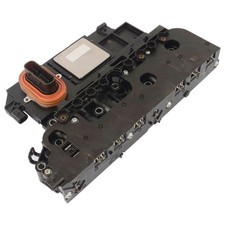
The 6T70 converter carries an electronically controlled capacity clutch, which is GM's term for a converter clutch that is not simply on or off. The TCM commands a torque converter clutch pressure control solenoid, a variable-bleed solenoid built into the control solenoid valve assembly (GM calls this assembly Q8; it also houses the TCM itself, the shift solenoids, the other pressure control solenoids and the transmission fluid pressure switch). That solenoid feeds the TCC regulator valve and TCC control valve in the upper valve body, and those valves set how hard the converter clutch piston clamps against the cover.
Because it is pressure-modulated rather than switched, the TCM does not just slam the clutch shut. In most cruise conditions it holds a small amount of controlled slip — a few RPM of difference between engine speed and turbine speed — which smooths out torque pulses without the fuel economy loss of running the converter fully open. The TCM can command this starting in 2nd gear on the 6T70, not just top gear, so a car cruising gently in 3rd or 4th may already be locked or slipping in a controlled way.
What the TCM is watching, in real time
The two inputs that make the whole system work are the input speed sensor (turbine speed) and the output speed sensor. Their difference, scaled for gear ratio, is TCC slip speed, and it is the single most important parameter when you are diagnosing this system. The TCM also tracks the commanded TCC pressure and the duty cycle it is sending to the solenoid. When you pull up a scan tool snapshot on a lockup complaint, these are the parameters that actually tell you something: engine speed, ISS, OSS, TCC pressure command, and TCC slip speed, logged across a full drive cycle in every forward gear.
The five codes, and what each one actually isolates
These codes split cleanly into two groups: hydraulic codes that watch what the clutch is actually doing (P0741, P0742), and electrical codes that watch the solenoid circuit itself (P2762, P2763, P2764). Knowing which group you are in saves a lot of wasted valve body time.
P0741 — TCC system stuck off
Per GM's 6T70/6T75 service data, this sets when TCC pressure command exceeds 800 kPa (116 psi) for 2 seconds, or when the TCM detects 50 RPM or more of TCC slip for 5 seconds while the clutch is commanded on, and that condition repeats 3 times. It only runs with TCC commanded on and the gear ratio inside a specific window for the current gear (for example 1.32-1.51 in 4th, 0.69-0.79 in 6th). When it sets, the TCM inhibits 6th gear and TCC entirely and forces the hot-mode shift pattern until the fault clears. GM's own component fault table for this code lists a stuck or damaged TCC control valve or TCC regulator valve, a solenoid stuck off or leaking internally, converter clutch delamination or worn lining, a damaged support seal, a case cover release blow-off not seating, a plugged release exhaust orifice, or a cut turbine shaft O-ring — in roughly that order of likelihood.
P0742 — TCC system stuck on
This is the opposite failure: the TCM commands the clutch off but keeps seeing almost no slip. GM's threshold is a slip window of -20 to +30 RPM lasting 2.5 seconds or more, repeated 6 times, with TCC commanded off, vehicle speed at least 16 km/h (10 mph) and gear ratio between 0.69 and 3.07. Setting this code freezes the TCM's adaptive learning and forces the hot-mode pattern. The fault table is almost identical to P0741 — a stuck valve, a stuck or leaking solenoid, a blow-off valve that will not seat — which is why GM's own diagnostic tree for both codes starts the same way: pull the Q8 assembly and bench-test each solenoid for a pressure change before replacing anything.
P2762, P2763 and P2764 — the solenoid circuit itself
These three do not look at hydraulic behavior at all. They watch the electrical circuit between the TCM and the TCC pressure control solenoid. P2762 is a performance fault: the TCM commands a specific current and the measured current does not match for 5 seconds, which points at an internal solenoid winding problem rather than wiring. P2763 is a control circuit high voltage fault, set by an open circuit, high resistance, or a short to voltage, for 5 seconds. P2764 is the low voltage version, set by a short to ground. None of the three requires a road test to confirm; the TCM is watching circuit electrical characteristics continuously whenever the high side driver is enabled and engine speed is above 400 RPM for 5 seconds with ignition voltage at or above 8.6 V.
P2763 forces 6th gear off, TCC off, the hot-mode pattern, and locks out manual tap shifting. P2764 is more severe: TCC is inhibited outright, adaptive functions freeze, line pressure goes to maximum, and the transmission is limited to only Reverse and 5th until the fault is addressed.
| Code | What it watches | Points toward |
|---|---|---|
| P0741 | TCC commanded on, slip too high | Stuck/worn control or regulator valve, weak solenoid, worn converter clutch |
| P0742 | TCC commanded off, slip too low | Stuck valve or solenoid holding apply pressure, blow-off not seating |
| P2762 | Commanded vs. measured solenoid current | Internal solenoid winding fault |
| P2763 | Control circuit voltage too high | Open circuit, high resistance, short to voltage |
| P2764 | Control circuit voltage too low | Short to ground |
Bench-testing before you condemn anything
GM's own procedure for P0741/P0742 is explicit about not replacing parts on a single code read: drive under the DTC's run conditions, pull the snapshot, and confirm the fault actually returns before touching anything. If it does not repeat, treat it as an intermittent connector or wiring issue, not a hydraulic failure. If it does repeat, the sequence is: run the line pressure check, then pull the Q8 control solenoid valve assembly with the key off, and bench-test each solenoid individually for a pressure change. Only a solenoid that fails that test gets replaced on the test bench, not on a guess.
For the circuit codes (P2762-P2764), GM's procedure runs the transmission in 2nd gear until the TCM warms at least 3°C (5°F) above ambient, commands TCC on for a full minute in Drive, and reads three scan tool test parameters directly off the solenoid: Status, High Voltage Test and Low Voltage Test. If the code does not reset under those conditions, the next step uses adapter harness DT-47825-20 connected between the vehicle's 20-way transmission connector and the removed Q8 assembly, with ignition on, to isolate whether the fault lives in the solenoid itself or in the case connector and harness.
When it is not a worn valve: the stuck-solenoid stall
One specific 6T70/6T75 failure mode is worth calling out on its own because it does not look like a lockup problem at first: an engine that stalls as the vehicle coasts to a stop. GM bulletin PI0999 covers 2013 Buick Enclave, Cadillac SRX and XTS, Chevrolet Equinox, Malibu and Traverse, and GMC Acadia and Terrain built with the 6T70 (RPO M7U, M7V, M7W or M7X), plus the 2014 Chevrolet Impala. The bulletin describes the TCC solenoid inside the TEHCM sticking from debris in the transmission. At the very end of a coast-down, the stuck solenoid fails to release the converter clutch, which keeps the engine mechanically tied to the wheels as the car slows. Engine speed gets pulled down below idle and the engine can stall, though GM notes it restarts and drives normally afterward. The fix in that bulletin is not a reflash: it calls for replacing the entire control solenoid valve assembly (TEHCM), GM part 24264346, along with control valve body kit 24264343.
Clearing up afterward
Any time the valve body, Q8 assembly or converter is disturbed on a 6T70, reset the transmission adaptive learning before road testing. The TCM is internal to the unit, so a replacement control solenoid valve assembly also needs to be programmed to the vehicle before it will run correctly. Verify the repair by driving under the same conditions that originally set the code and pulling a fresh snapshot, rather than clearing the code and hoping.
Order of attack
- Confirm which group of code you have: P0741/P0742 are hydraulic, P2762-P2764 are electrical.
- Log ISS, OSS, TCC pressure command and TCC slip across a full drive cycle before touching anything.
- Drive under the code's specific run conditions and confirm it actually resets. If it doesn't, suspect a connector, not a part.
- For P0741/P0742: run the line pressure check, then pull Q8 and bench-test each solenoid for a pressure change.
- For P2762-P2764: run the warm-up and one-minute TCC-on test, read the three scan tool test parameters off the solenoid, then isolate harness vs. solenoid with the DT-47825-20 adapter if needed.
- Stall-at-a-stop on a 2013-2014 6T70/6T75 in the PI0999 vehicle list: check for the stuck TCC solenoid and replace the TEHCM and valve body kit per that bulletin.
- After any repair: reset transmission adaptations, program a replacement TCM, and re-verify with a fresh snapshot.
Sonnax 124740-31K TCC regulator valve kit for the 6T70
When a worn TCC regulator or control valve bore is behind a P0741/P0742 pattern, this oversized valve kit restores clamping pressure without a full valve body swap.
View at Core Transmission Parts →Browse 6T70 parts at Core Transmission Parts →
Need parts for this job?
6T70/6T75 TEHCMs, valve bodies, solenoid kits and master rebuild kits, shipped from the USA.
Shop 6T70 parts →FAQ
At what gear does the 6T70 torque converter lock up?
The TCM can command TCC apply from 2nd through 6th gear on a 6T70, not just top gear. GM's own enabling table for P0741 lists gear ratio windows for 2nd (2.67-3.07), 3rd (1.71-1.97), 4th (1.32-1.51), 5th (0.93-1.07) and 6th (0.69-0.79), so a light-throttle cruise in 3rd or 4th can be running locked or in controlled slip well before top gear.
What is the difference between P0741 and P0742 on a 6T70?
P0741 means the converter clutch is commanded on but the TCM still sees slip, so it is stuck off or not applying hard enough. P0742 means the opposite: the clutch is commanded off but the TCM sees almost no slip, so it is stuck on and will not release. GM's 6T70 thresholds call P0741 at 50 RPM or more of slip for 5 seconds (3 times) with TCC commanded on, and P0742 at a slip window of -20 to +30 RPM for 2.5 seconds or longer (6 times) with TCC commanded off.
What do P2762, P2763 and P2764 mean on a 6T70?
These are electrical codes for the TCC pressure control solenoid, not hydraulic codes. P2762 is a performance fault where the TCM sees a mismatch between commanded and measured solenoid current. P2763 is a control circuit high voltage fault from an open, high resistance or short to voltage. P2764 is a control circuit low voltage fault from a short to ground. None of the three by itself proves the valve body or converter is bad; they point at the solenoid circuit in the Q8 control solenoid valve assembly first.
Why does my 6T70 stall when coasting to a stop?
GM bulletin PI0999 describes the TCC solenoid inside the TEHCM sticking from debris in the transmission. As the vehicle coasts to a stop, the stuck solenoid fails to release the converter clutch, which keeps the engine mechanically tied to the wheels. Engine speed gets pulled below idle and the engine can stall, though it restarts and drives normally afterward. GM's fix in that bulletin is replacing the control solenoid valve assembly (TEHCM), part 24264346, plus the control valve body kit, part 24264343.
Can I just unplug the TCC solenoid to stop a shudder or stall?
No. The TCC pressure control solenoid on the 6T70 is a variable-bleed solenoid inside the Q8 control solenoid valve assembly, not a simple on/off relay you can disable from outside the transaxle. Disconnecting wiring at the case connector affects the whole solenoid harness, will set multiple DTCs, and does not isolate or fix a hydraulic or electrical TCC fault. Diagnose with the scan tool parameters and the control circuit test steps instead.
Sources
- GM Service Information, DTC P0741 or P0742 (6T70/6T75), via SAAB WIS Online shared service platform. Backs the P0741 and P0742 setting thresholds (800 kPa/116 psi command, 50 RPM slip for 5 seconds x3; -20 to +30 RPM slip for 2.5 seconds x6), the per-gear ratio enabling windows, the TCM actions on each code (6th gear/TCC inhibit, hot-mode pattern, frozen adaptives), and the component fault table (control valve, regulator valve, Q8 solenoid, converter clutch, case cover blow-off, turbine shaft seal). saabwisonline.com
- GM Service Information, DTC P2762, P2763 or P2764 (6T70/6T75), via SAAB WIS Online shared service platform. Backs the three code definitions (performance, high voltage, low voltage), the enabling conditions (400 RPM for 5 seconds, 8.6V ignition, high side driver enabled), the setting logic for each, the TCM actions (gear/TCC inhibits, max line pressure, Reverse/5th-only limp mode on P2764), and the bench-test procedure using the DT-47825-20 adapter harness. saabwisonline.com
- General Motors — Preliminary Information Bulletin PI0999, "Malfunction Indicator Lamp (MIL) On, Torque Converter Clutch Sticking, Engine Shudder When Stopping, DTC P0742 Set," June 2013 (via NHTSA). Backs the covered 2013 Enclave, SRX, XTS, Equinox, Malibu, Traverse, Acadia and Terrain, the 2014 Impala, the TCC solenoid sticking from debris at coast-down, the engine-stall symptom, and the TEHCM (24264346) and control valve body kit (24264343) replacement. static.nhtsa.gov (PDF)
- Sonnax — "Beyond 1870: GM Converter Codes P0741, P0742 and 1887." Backs the general PWM TCC control concept (commanded duty cycle vs. measured slip), the role of the TCC apply/PWM solenoid, and the diagnostic habit of confirming electrical/connector causes before condemning internal transmission components on these code families. sonnax.com
- SAE International — "General Motors DEXRON-VI Global Service-Fill Specification," 2006-01-3242. Backs GM's move to DEXRON-VI as the controlling fluid specification for 6T70-era transmissions, cited here for the fluid context behind converter clutch friction behavior. saemobilus.sae.org