The Buick Enclave is the luxury member of GM's Lambda three-row crossovers. Every first-generation Enclave, 2008 through 2017, has the 3.6L V6 and a 6T75 six-speed transaxle. That makes it the same transmission family as the Acadia and Traverse. What is different is the customer. Enclave owners tend to keep the truck a long time, tow a camper with it, and notice a shudder that a Traverse owner would drive around. So the failures that show up on the bench follow the model year closely, and GM's bulletins name the Enclave in almost every one of them. This guide goes year by year through what breaks, the bulletin behind each failure, and the check that confirms it before you pull the unit.

Which Enclave you have, and why the year matters
Split the run in two. The 2008-2012 trucks carry the first-generation 6T75. The 2013-2017 trucks carry the second-generation unit with the updated controls. GM's 2014-2017 Enclave shudder bulletin lists those later trucks under RPO M7V and M7X [4]. The early wave plate bulletins list RPO MH2, MH4, MH6 and MY9 for the earlier units [1][2]. The redesigned 2018-up Enclave went to a nine-speed, so nothing here applies to it.
Before you order a single part, read the RPO codes off the Service Parts Identification label in the glove box. The owner manual points owners to the same label [6]. Gen 1 and Gen 2 valve bodies, wave plates and kits do not interchange blindly, and the year on the registration does not always match the build.
1. 2008-2009: no reverse, no 3rd, no 5th (the wave plate)
This is the Enclave failure everybody has heard about. GM bulletin 09-07-30-012F lists the 2008-2009 Enclave. The complaint is a check engine light with no reverse, often with a slip, flare or harsh shift into 3rd and/or 5th. The usual code is P0776, Clutch Pressure Control Solenoid 2 Stuck Off. Any of P0777, P2723, P0717, P0716, P2715 or P2714 can set on its own from the same failure [1].
The mechanism is simple once you have seen one apart. The 3-5-Reverse clutch uses a waved cushion plate. When it cracks, the apply piston over-strokes, the piston seal leaks, and the clutch loses apply [1]. Reverse, 3rd and 5th all use that clutch, so all three drop out together. GM says it normally does not happen before about 20,000 miles. The debris it throws can upset the speed sensors and the other clutches [1]. That is why the code list often looks like three separate faults when it is really one broken plate.
The coverage has run out
GM Special Coverage 14404B named the 2007-2009 Enclave. It covered the wave plate for 10 years or 120,000 miles from the original in-service date, whichever came first, regardless of ownership [2]. Every eligible Enclave is now past ten years, so this job comes to the independent shop at full price. Do not promise the customer a dealer freebie.
Doing it so it does not come back
Do not sell a control solenoid body on a P0776 alone. GM states that the control solenoid valve assembly, which includes the solenoid body and the TCM, should not be replaced for any DTC unless the SI diagnostics call for it. It should never be washed in a parts cleaner either [1]. On these trucks the TCM lives inside that assembly, so a wrong call costs real money.
The bulletin's repair is a full clean-out: separate the case halves, clean the debris out of the entire transmission, and replace both the pump fluid filter and the control solenoid filter plate. GM warns that skipping those steps can lead to repeat damage. The updated 3-5-R waved plate is P/N 24254103, and GM recommends installing it any time the transmission is apart for any reason [1]. On a heavy, high-mileage Enclave I inspect every clutch pack while I am in there, because the debris has already been through all of them.
2. 2013: engine shudders or stalls coming to a stop (P0742)
2013 was the first year of the Gen 2 unit, and it has its own problem. GM's Preliminary Information for the 2013 Enclave describes two complaints. The first is an engine shudder as the truck rolls to a stop, which GM likens to braking a manual-transmission car to a stop without pushing in the clutch. The second is a check engine light with DTC P0742 stored as active or history [3].
The cause is debris sticking the torque converter clutch solenoid inside the TEHCM. At the end of a coast-down the stuck solenoid does not release the converter clutch. The engine stays tied to the wheels, gets pulled below idle as the truck stops, and may stall. It restarts and drives normally right away [3], which is why customers describe it as "it died at a light" and not as a transmission problem.
GM's fix is the TEHCM, the control solenoid valve and TCM assembly, P/N 24264346, with body kit 24264343 [3]. Before you install it, confirm the diagnosis on the scan tool. Watch TCC commanded state against actual TCC slip on a coast-down. A clutch that stays at near-zero slip after the command drops is the stuck solenoid. And remember where the debris came from. Pull the pan and look at the magnet before you hang a new TEHCM on a unit that is still making metal.
3. 2014-2017: launch shudder, 4th-gear shudder and the 2-3 shift
GM bulletin 18-NA-358 covers the 2014-2017 Enclave with RPO M7V or M7X. The complaint is a severe shudder launching in 1st, a shudder cruising in 4th, or a shudder on the 2-3 upshift or 3-2 downshift. It can come with flare, slide/bump, slip or harsh shifts [4]. GM traces it to debris in the upper and/or lower valve bodies, or to valves that are scratched or scored and do not move freely [4].
Work it in the bulletin's order:
- Rule out an engine misfire or driveability problem first.
- Rule out converter clutch shudder by watching TCC slip on the scan tool while the TCC is applied during the event.
- Try to reproduce the launch shudder with a power brake in 1st, for 5 seconds or less, so you do not distress the 1-2-3-4 clutch [4].
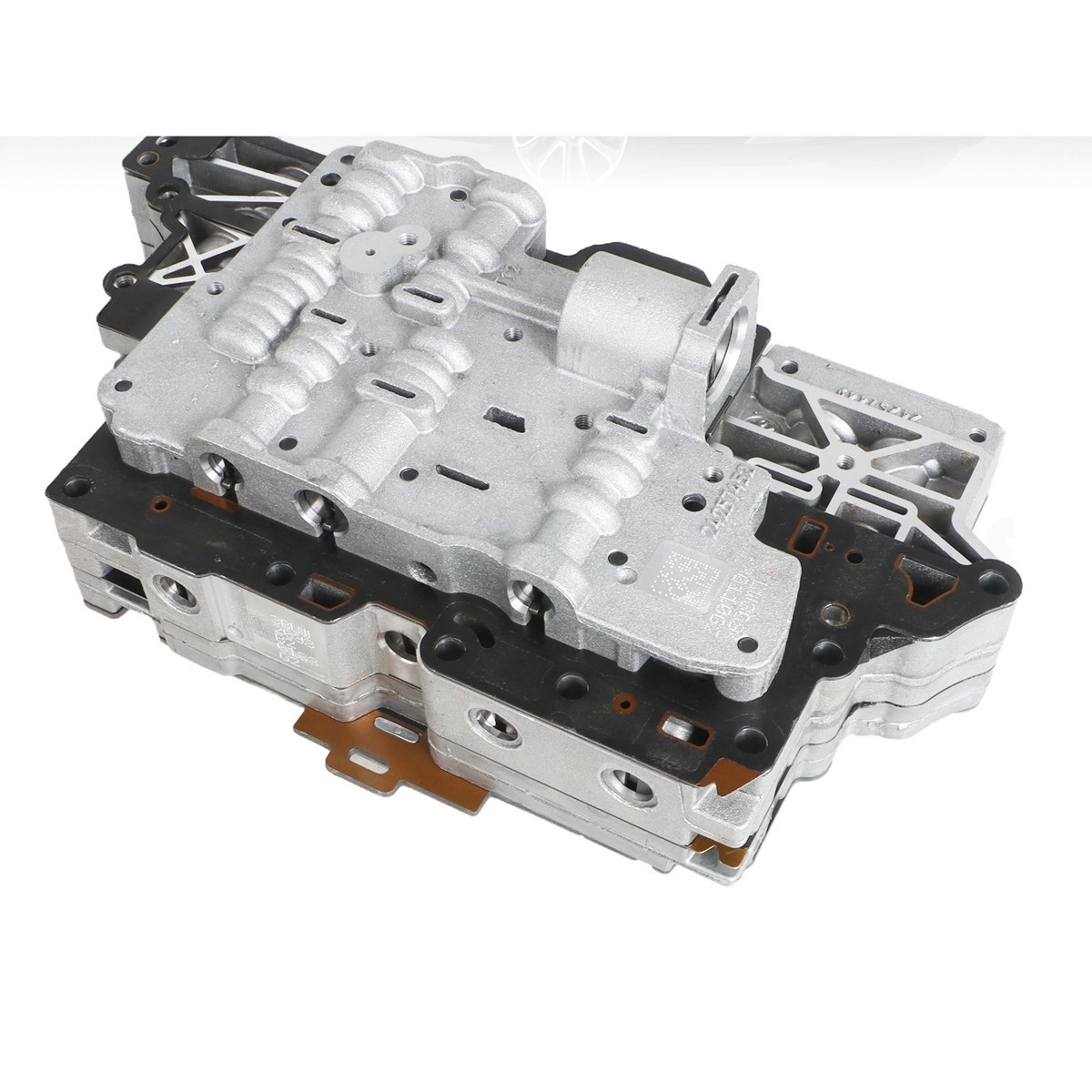
If the power brake reproduces it, GM replaces the upper and lower valve bodies together: upper 24281084, lower 24257450, plus body kit 24264343 [4]. Two notes in the bulletin save real money. First, TEHCM replacement has not been an effective repair for this shudder, so do not replace it for this concern. Second, check the input and output speed sensors for collected debris. Debris on the sensors means an internal part is failing. Clean sensors with scratched valves or bores means you go check the final drive bearing [4]. A new valve body on top of a failing final drive bearing just gets scratched again.
4. 2015-2017: harsh 1-2 shift with no codes
This one costs nothing but a road test, and it gets misdiagnosed constantly. GM's Preliminary Information for the 2015-2017 Enclave, Traverse and Acadia covers a harsh 1-2 shift, mostly at light throttle, with no DTCs. In rare cases the 2-3 is harsh too. GM's explanation is that the shift adapts have not learned [5].
The drive-learn procedure for the 2-6 clutch adapts is specific [5]:
- Select M5 so the transmission is held in 5th gear.
- Hold 38 mph or above with transmission fluid temperature above 86 F (30 C).
- Drive about 5 miles on flat, level ground at a steady throttle. Cruise control helps hold a constant speed.
- Stop and try some light-throttle 1-2 shifts. Drive another 5 miles if needed.
If it needs a second learn drive, let the TEHCM power down before you try again. If nothing changes after the learn, move on to normal harsh-shift diagnosis [5]. Do this after every battery disconnect, TEHCM replacement or valve body job on a late Enclave, before the customer drives it and decides your repair made it worse.
5. Heat and towing
A lot of Enclaves pull a camper or a boat. The owner manual rates the Enclave at 4,500 lb with the V92 trailer towing package and 2,000 lb without it, on both front-wheel and all-wheel drive. The GCWR is 9,500 lb on FWD and 9,700 lb on AWD with the package [6]. A truck towing near the top of that rating in summer heat is the duty cycle that wears the 3-5-R and 1-2-3-4 frictions.
The cluster or DIC will show TRANSMISSION HOT IDLE ENGINE when the fluid overheats, and GM's manual warns that driving on overheated fluid can damage the transmission and that the repair may not be covered by the warranty [6]. When a customer mentions that message, ask about towing before you quote anything. Then check the trailer weight, whether the truck has the V92 package, and whether they were using Tow/Haul.
6. The red leak that is not the transmission
Here is an Enclave detail that catches people. The 2014 owner manual lists DEXRON-VI as the fluid for both the automatic transmission and the hydraulic power steering system [6]. The 2012 manual lists GM power steering fluid, P/N 89021184, for the steering [6]. So on a later Enclave, red ATF dripping near the front subframe can be a steering rack or hose leak. Check the power steering reservoir level before you condemn a cooler line or a pan gasket.
Service specs that keep an Enclave 6T75 alive
- Fluid: DEXRON-VI only. The manual warns that the wrong ATF can damage the transmission and that the damage may not be covered [6].
- Capacity: 5.0 L (5.3 qt) for a drain-and-refill per the 2012 manual [6]. A full overhaul takes far more fluid than that.
- Level check: The manual tells owners there is no need to check the level, and that the fluid will not reach the end of the dipstick unless the transmission is at operating temperature [6]. Check it hot, on level ground, or not at all.
- Interval: The 2014 schedule calls for a fluid change (and filter, if serviceable) at 97,500 miles in normal service, and every 45,000 miles under the severe schedule [6]. Towing puts a truck on the severe schedule. Treat it that way.
Quick reference
| Enclave symptom | Typical codes | Likely cause | Model years |
|---|---|---|---|
| No reverse, 3rd or 5th; slip or flare 3rd/5th | P0776, plus P0777, P2723, P0717, P0716, P2715, P2714 | Broken 3-5-R wave plate [1] | 2008-2009 |
| Engine shudder or stall coming to a stop | P0742 | TCC solenoid in TEHCM stuck by debris [3] | 2013 |
| Launch, 4th-gear or 2-3 / 3-2 shudder | Often none | Valve body debris or scored valves [4] | 2014-2017 (M7V, M7X) |
| Harsh light-throttle 1-2 shift | None | 2-6 clutch adapts not learned [5] | 2015-2017 |
| TRANSMISSION HOT IDLE ENGINE | Varies | Overheated fluid, often towing [6] | All |
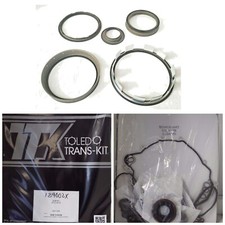
Shop the part for this fix: 6T75 master rebuild kit
When an Enclave unit comes apart for wave plate or debris damage, this CoreTransmissionParts master kit covers the frictions, steels, gaskets and seals for the 6T75 in one box. Confirm your RPO before ordering.
View the 6T75 master rebuild kit at CoreTransmissionPartsLooking for something else? Browse all 6T75 parts at CoreTransmissionParts.
Need parts for this job?
Our 6T75 parts page has overhaul and rebuild kits, valve bodies, pumps, clutch drums and solenoid kits for the Enclave, all on our own checkout. For fluid specs across every unit, see the transmission fluid spec chart.
FAQ
What transmission is in a Buick Enclave?
Every 2008-2017 Buick Enclave uses the 3.6L V6 with GM's 6T75 six-speed transaxle. The 2008-2012 trucks have the first-generation unit and the 2013-2017 trucks have the second-generation unit, which GM lists under RPO M7V and M7X. Read the RPO codes off the Service Parts Identification label in the glove box before ordering parts.
Why does my Enclave have no reverse?
On a 2008-2009 Enclave the usual cause is a broken 3-5-Reverse clutch wave plate, covered by GM bulletin 09-07-30-012F. Reverse, 3rd and 5th all use that clutch, so they drop out together, usually with code P0776. The repair is a new waved plate, P/N 24254103, plus a full debris clean-out with a new pump fluid filter and control solenoid filter plate.
Why does my 2013 Enclave shudder or stall when coming to a stop?
GM traces it to debris sticking the torque converter clutch solenoid inside the TEHCM, so the converter clutch does not release at the end of a coast-down and the engine gets pulled below idle. It often sets P0742. GM's fix is the control solenoid valve and TCM assembly, P/N 24264346, after confirming the stuck TCC on the scan tool.
How much transmission fluid does a Buick Enclave take?
The 2012 Enclave owner manual lists 5.0 L (5.3 qt) of DEXRON-VI for a drain-and-refill. A complete overhaul takes considerably more. Check the level only with the transmission at operating temperature, because the fluid will not reach the end of the dipstick when it is cold.
How often should Enclave transmission fluid be changed?
The 2014 Enclave maintenance schedule calls for a transmission fluid change, and filter if serviceable, at 97,500 miles in normal service and every 45,000 miles under the severe schedule. A truck that tows belongs on the severe schedule.
Related guides
Sources
- General Motors, Service Bulletin 09-07-30-012F, "No Reverse, 3rd or 5th, Check Engine Light Illuminated, DTC P0776," October 2012 (2008-2009 Buick Enclave and other 6T70/75 models, RPO MH2/MH4/MH6/MY9). Backs the symptoms, P0776 and companion codes, the broken 3-5-R wave plate mechanism, the 20,000-mile note, the case-split clean-out with new pump fluid filter and control solenoid filter plate, plate P/N 24254103, and the no-parts-cleaner and no-replacement cautions. static.nhtsa.gov (PDF)
- General Motors, Special Coverage 14404B, "Transmission Clutch Wave Plate," August 2016. Backs the 2007-2009 Enclave listing, the 6T70/6T75 application, and the 10-year/120,000-mile coverage from the in-service date. static.nhtsa.gov (PDF)
- General Motors, Preliminary Information, "MIL On, Torque Converter Clutch Sticking, Engine Shudder When Stopping, DTC P0742 Set" (2013 Buick Enclave and other models). Backs the shudder-at-stop and P0742 complaints, the debris-stuck TCC solenoid in the TEHCM, the below-idle stall and immediate restart, and parts 24264346 and 24264343. static.nhtsa.gov (PDF)
- General Motors, Service Bulletin 18-NA-358, "Shudder, 2-3 Upshift or 3-2 Downshift Concern," August 2022 revision. Backs the 2014-2017 Enclave listing under RPO M7V and M7X, the shudder and flare symptoms, the valve body debris cause, the 5-second power brake test, the TCC slip check, the TEHCM caution, the speed sensor debris and final drive bearing check, and parts 24281084, 24257450 and 24264343. static.nhtsa.gov (PDF)
- General Motors, Preliminary Information, "6T70/75 Transmission Assembly With Harsh 1-2 Shift With No DTCs" (2015-2017 Buick Enclave, Chevrolet Traverse, GMC Acadia). Backs the light-throttle harsh 1-2 complaint, the unlearned adapts cause, and the M5 / 38 mph / 86 F / 5-mile drive-learn procedure with TEHCM power-down between attempts. static.nhtsa.gov (PDF)
- Buick, 2012 and 2014 Enclave Owner Manuals. Back the Service Parts Identification label, the 4,500 lb V92 and 2,000 lb base tow ratings and GCWR, the TRANSMISSION HOT IDLE ENGINE message, DEXRON-VI, the 5.0 L (5.3 qt) drain-and-refill, the hot dipstick note, the 97,500-mile normal and 45,000-mile severe fluid intervals, and the power steering fluid change from GM fluid 89021184 (2012) to DEXRON-VI (2014). 2012 manual, assets.gm.com (PDF); 2014 manual, assets.gm.com (PDF)