An Enclave that slips is almost never a mystery transmission. The 6T75 in the 2008-2017 Buick Enclave has five clutches, a short list of documented failures, and a scan tool that will tell you which clutch is letting go if you know which numbers to watch. The trick is to stop thinking "it slips" and start thinking "which clutch is applied when it slips." Once you know that, the 2008-2009 wave plate, the Gen 2 piston mix-up, valve body debris and plain old low or burnt fluid each point at a different gear. This guide walks the diagnosis in the order I work it on the bench, with the GM bulletin or industry source behind each step.
Start with which gear slips
The 6T75 is a clutch-to-clutch transaxle. Every gear is two clutches applied together, and every shift is one clutch releasing while another applies under TCM control. That makes the slip itself a diagnostic tool. Here is the apply chart I keep taped to the bench:
| Range | Clutches applied | Nominal ratio |
|---|---|---|
| 1st | 1-2-3-4 + low one-way clutch (Low/Reverse in manual low) | 4.48 |
| 2nd | 1-2-3-4 + 2-6 | 2.87 |
| 3rd | 1-2-3-4 + 3-5-R | 1.84 |
| 4th | 1-2-3-4 + 4-5-6 | 1.41 |
| 5th | 3-5-R + 4-5-6 | 1.00 |
| 6th | 2-6 + 4-5-6 | 0.74 |
| Reverse | 3-5-R + Low/Reverse | 2.88 |
Read it like this. Slips in 1st through 4th but 5th and 6th are fine: look at the 1-2-3-4 clutch. Slips in reverse, 3rd and 5th: that is the 3-5-R clutch, every time. Slips only in 2nd and 6th: the 2-6 clutch or its regulator valve. Slips in 4th, 5th and 6th: the 4-5-6 clutch. Slips everywhere, worse when hot: fluid level, line pressure or the pump, before you blame any one clutch.
Step 1: Check the fluid the right way
Half the slipping Enclaves I see have never had the fluid looked at, because the owner manual tells owners it is not necessary to check it. GM's wording is that a leak is the only reason for fluid loss, and that the fluid will not reach the end of the dipstick unless the transmission is at operating temperature [6]. So a cold check that reads empty is not proof of anything, and a hot unit that reads low is a real finding.
ATRA's 6T70/75 procedure is: level ground, park brake set, engine running, run the selector through the ranges, idle one minute, and read the dipstick with transmission fluid temperature (TFT) between 180 and 200 F on the scan tool [4]. The fluid is DEXRON-VI only [6]. The 2012 manual lists 5.0 L (5.3 qt) for a drain-and-refill [6], which is well short of total capacity, so one drain does not fix burnt fluid.
While the pan or plug is out, look at what comes with it. Fine gray paste on the magnet is normal wear. Friction material, brass or steel slivers mean a clutch has already been slipping long enough to cook itself, and a fluid service will not bring it back. On a high-mileage Enclave with burnt, varnished fluid and friction debris, a fluid change is a diagnosis, not a repair.
Step 2: Put numbers on the slip
Do not road test by feel alone. Log these PIDs on a GM-capable scan tool: Input Shaft Speed (ISS), Output Shaft Speed (OSS), Commanded Gear, TFT, TCC Slip Speed, and any shift-time or clutch adapt values the tool exposes. Divide ISS by OSS in each gear and compare it to the ratio chart above. A healthy 3rd reads close to 1.84 and stays there. A 3rd that drifts upward under throttle while TCC Slip Speed stays flat is a clutch slip inside the transmission, not the converter.
That last check matters. GM's shudder bulletin makes the same point: confirm the problem is not torque converter clutch slip by monitoring TCC slip with the TCC engaged during the event [2]. Converter slip shows up as a rising TCC Slip Speed with a steady gear ratio. Clutch slip shows up as a ratio that will not hold. If the ratio drifts far enough, the TCM sets one of the incorrect-ratio codes (P0729, P0731 through P0736), which gives you the gear on a plate.
Before you condemn hard parts on a late truck, check the learned values. The TCM learns clutch fill volume during steady driving: the 4-5-6 clutch learns in 3rd, the 1-2-3-4 and 2-6 clutches in 5th, and the 3-5-R clutch in 6th, and a rough road aborts the learn [4]. After any valve body, TEHCM or battery work, run the scan tool's Service Fast Learn Adapts, then shut the engine off and let the TCM power down to finish it [4]. On a 2015-2017 Enclave with a harsh or slipping light-throttle 1-2 and no codes, GM's own fix is a drive learn: M5, 38 mph or above, TFT above 86 F, about 5 miles of steady throttle on level ground, repeated after a TEHCM power-down if needed [3]. It costs nothing and it catches a lot of trucks that would otherwise get a valve body.
Step 3: Match the slip to the known failures
Slip or flare in 3rd and 5th, no reverse (2008-2009 and other Gen 1 units)
This is the classic. GM bulletin 09-07-30-012F lists the 2008-2009 Enclave with a check engine light, no reverse, and a slip, flare or harsh shift in 3rd and/or 5th. The usual code is P0776 (Clutch Pressure Control Solenoid 2 Stuck Off), and P0777, P2723, P0717, P0716, P2715 or P2714 can set on their own from the same failure [1]. The cause is a broken 3-5-R clutch wave plate that lets the apply piston over-stroke, the piston seal leaks, and the clutch loses apply [1].
ATRA's quick screen before teardown: unplug the transmission and see whether reverse comes back. If reverse engages fine unplugged, the problem is electrical or control-side; if it still will not hold, the clutch is the problem [4]. When it comes apart, GM's repair is a full clean-out with the case halves separated, a new pump fluid filter and control solenoid filter plate, and the updated 3-5-R wave plate, P/N 24254103 [1]. ATRA adds that the debris from a broken plate damages the planetary, and recommends the new-design wave plates in all four clutches: 1-2-3-4 P/N 24259063, 2-6 P/N 24259816, 3-5-R P/N 24254103 and Low/Reverse P/N 24259817 [4]. If you are in there for a slip, do all four. A cheap plate today beats a comeback with a broken planetary next spring.
GM is also clear that the control solenoid valve assembly, which carries the TCM, should not be replaced for these codes unless the service information diagnostics call for it, and should never go in a parts washer [1].
Delayed engagement and slip in 1st (Gen 2 units, often after a rebuild)
Transmission Digest documented a 6T75 with a delayed engagement into drive and a slip in 1st. The cause was a Gen 1 1-2-3-4 clutch apply piston installed in a Gen 2 transmission. The Gen 2 piston's apply fingers measure .785 in. against .638 in. on Gen 1, a .147 in. difference, and the Gen 2 1-2-3-4 frictions are thinner at .058 in. versus .061 in. Mix them and the clutch pack has too much clearance to hold [5]. Gen 2 parts came in selectively during 2013 and every 2014-up unit should have them [5].
This one matters on the Enclave because the trucks split right at 2013. The later Enclave units are RPO M7V or M7X [2], and ATRA notes those RPO codes got the controls update for 2013 while some other 6T70/75 applications did not [4]. If an Enclave slips in 1st after somebody else rebuilt it, pull the 1-2-3-4 piston and measure the fingers before anything else. Then order kits by RPO from the glove box label, not by the year on the title.
Slip, flare or shudder on 2-3, 3-2, launch or 4th (2014-2017)
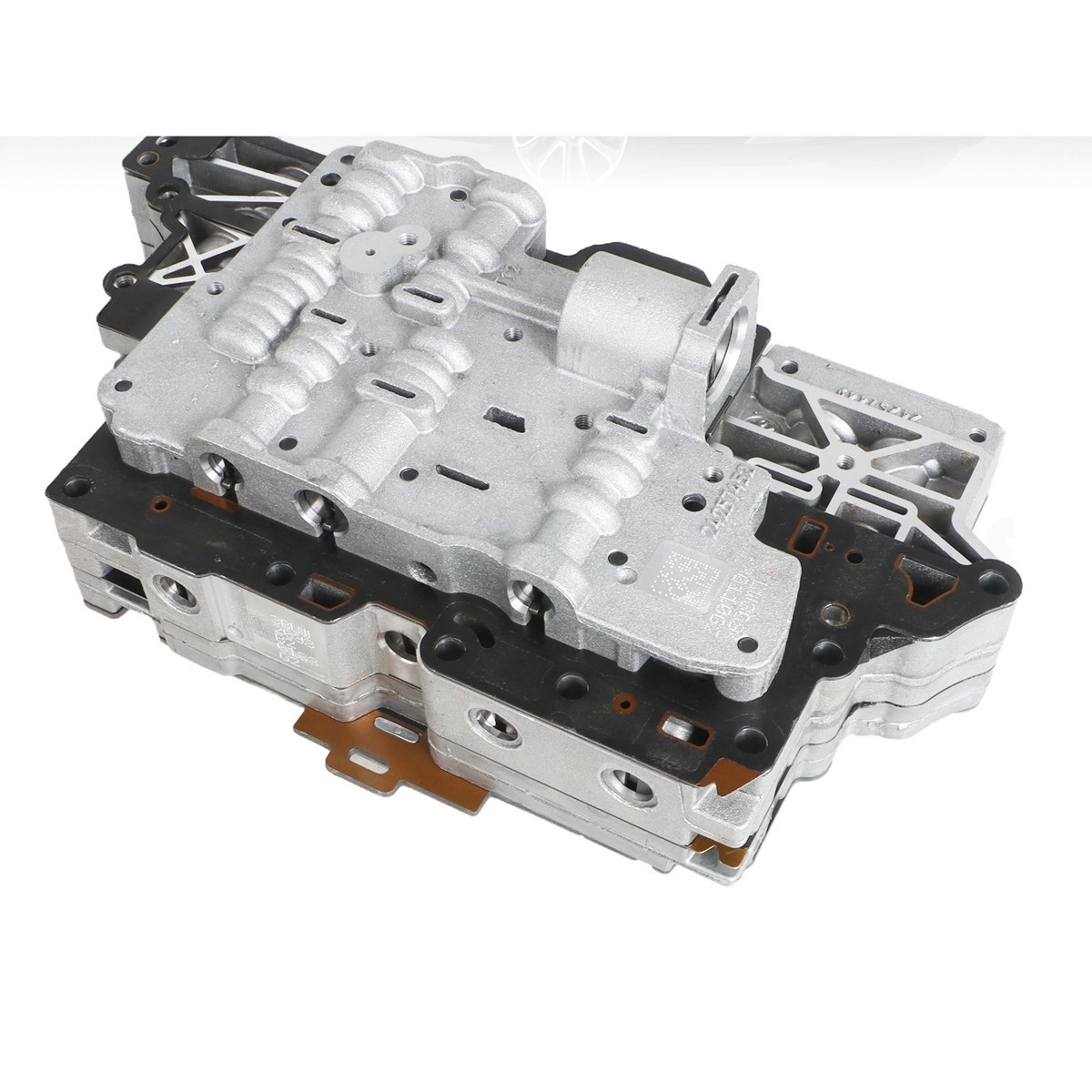
GM bulletin 18-NA-358 covers the 2014-2017 Enclave (RPO M7V, M7X) with a severe launch shudder in 1st, shudder in 4th, or a shudder on the 2-3 upshift or 3-2 downshift, which can come with flare, slide/bump, slip or a harsh shift [2]. The cause is debris in the upper and/or lower valve bodies, or valves scratched or scored so they stick [2]. If a power brake in 1st reproduces it, held for 5 seconds or less to protect the 1-2-3-4 clutch, GM replaces both valve bodies together and states that TEHCM replacement has not been an effective repair for this concern [2].
The bulletin's best line is about root cause. Inspect the input and output speed sensors for debris. Debris on the sensors means an internal part is failing. Clean sensors with scratched valves or bores sends you to the final drive bearing [2]. A valve body hung on a unit with a failing bearing will be scratched again inside a few thousand miles.
Slip with a bind on the 3-4 or 4-3 shift
If the slip comes with a tie-up on the 3-4 or 4-3 shift, sometimes with P0797, look at the case cover hub. ATRA describes a worn ring groove on the case cover hub sleeve that cross-leaks the 3-5-R and 4-5-6 clutch circuits. Measure the gap between the ring and the groove with a feeler gauge; maximum clearance is .007 in., and past that the case cover gets replaced [4]. A new set of frictions on a leaking hub burns up exactly the same way.
Slips in every gear, worse hot
When nothing points at one clutch, check line pressure at idle. ATRA's note for a 6T70/75 with low line pressure at idle is to inspect the pump outlet seal for damage [4]. Pair that with the fluid level check from Step 1, because a unit that is a quart or two low will act exactly like a weak pump once the fluid gets hot and thins out.
Heat and towing: why Enclaves cook clutches
Plenty of Enclaves tow. The owner manual rates them at 4,500 lb with the V92 towing package and 2,000 lb without it [6]. When the fluid overheats, the cluster shows TRANSMISSION HOT IDLE ENGINE, and GM warns that driving on overheated fluid can damage the transmission [6]. If the customer mentions that message, ask about the trailer before you quote. A slip that started on a summer camping trip is usually a cooked 3-5-R or 1-2-3-4 pack, and the fix has to include a cooler that works and a fluid that is not already burnt.
Doing the repair so it stays fixed
- Identify the build first. Read the RPO from the Service Parts Identification label [6]. Gen 1 and Gen 2 pistons, frictions and valve bodies do not interchange blindly [5].
- Clean all of it. A slip that made debris has sent that debris through the valve body, the sensors and the other clutches. GM's wave plate repair calls for a full clean-out with new filters for that reason [1].
- Install the updated wave plates in every clutch while the unit is apart [4].
- Program and learn. The TCM is internal to the transaxle, so a replacement unit needs programming, and any repair needs Service Fast Learn Adapts [4].
- Refill with DEXRON-VI and check it hot, at 180-200 F TFT [4][6].
Shop the part for this fix: 6T75 master rebuild kit
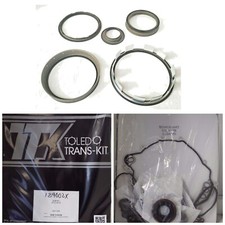
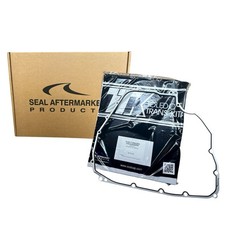
When a slipping Enclave unit comes apart, this CoreTransmissionParts master kit puts the frictions, steels, seals and gaskets for the 6T75 in one box. Match it to your RPO before ordering.
View the 6T75 master rebuild kit at CoreTransmissionPartsLooking for something else? Browse all 6T75 parts at CoreTransmissionParts.
Need parts for this job?
Our 6T75 parts page has overhaul and master kits, valve bodies, pumps, clutch drums and solenoid kits for the Enclave, all on our own checkout. For fluid specs across every unit, see the transmission fluid spec chart.
FAQ
Why is my Buick Enclave transmission slipping?
The most common causes are low or burnt DEXRON-VI, a broken 3-5-R clutch wave plate on 2008-2009 and other Gen 1 units, valve body debris on 2014-2017 trucks under GM bulletin 18-NA-358, and worn clutch packs from towing heat. Which gear slips tells you which clutch to look at, so log the slip on a scan tool before you replace anything.
Can a fluid change fix a slipping Enclave transmission?
Only if the fluid was low or the shift adapts needed relearning. If the pan shows friction material or metal, the clutch is already damaged and fresh fluid will not restore it. Check the level hot, with transmission fluid temperature between 180 and 200 F, before deciding.
What does it mean if my Enclave slips in 3rd and 5th and has no reverse?
Reverse, 3rd and 5th all use the 3-5-R clutch, so losing all three points straight at it. On 2008-2009 Enclaves GM bulletin 09-07-30-012F traces this to a broken 3-5-R wave plate, usually with code P0776. The fix is the updated wave plate, P/N 24254103, plus a full debris clean-out.
Why does my Enclave slip in first gear after a transmission rebuild?
Check for a Gen 1 1-2-3-4 clutch piston installed in a Gen 2 unit. The Gen 2 piston fingers are .147 in. taller and its frictions are thinner, so the wrong piston leaves too much clearance for the clutch to hold. Gen 2 parts started during 2013, and all 2014-up units use them.
Related guides
Sources
- General Motors, Service Bulletin 09-07-30-012F, "No Reverse, 3rd or 5th, Check Engine Light Illuminated, DTC P0776" (2008-2009 Buick Enclave and other 6T70/75 models). Backs the slip/flare in 3rd and 5th with no reverse, P0776 and companion codes, the broken 3-5-R wave plate and over-stroked piston, the case-split clean-out with new filters, P/N 24254103, and the control solenoid valve assembly cautions. static.nhtsa.gov (PDF)
- General Motors, Service Bulletin 18-NA-358, "Shudder, 2-3 Upshift or 3-2 Downshift Concern," August 2022. Backs the 2014-2017 Enclave RPO M7V/M7X listing, the flare/slip/shudder symptoms, valve body debris cause, TCC slip check, 5-second power brake test, TEHCM caution, and the speed sensor and final drive bearing checks. static.nhtsa.gov (PDF)
- General Motors, Preliminary Information PIP5363B, "6T70/75 Transmission Assembly With Harsh 1-2 Shift With No DTCs," January 2017 (2015-2017 Enclave, Traverse, Acadia). Backs the M5 / 38 mph / 86 F / 5-mile drive-learn procedure and the TEHCM power-down between attempts. static.nhtsa.gov (PDF)
- ATRA (Automatic Transmission Rebuilders Association), Steve Garrett, "6T70 Product Issues and Updates" webinar. Backs the 180-200 F fluid check procedure, Service Fast Learn Adapts and TCM programming, the unplug test for reverse, wave plate part numbers for all four clutches, the case cover hub ring groove .007 in. limit, the pump outlet seal check for low idle line pressure, the clutch fill learn gears, and the 2013 Gen II controls update by RPO. atracom.blob.core.windows.net (PDF)
- Transmission Digest, Wayne Colonna, "GM 6T70/75 slips and delays in first," November 1, 2023. Backs the Gen 1 piston in a Gen 2 unit cause, the .638 in. and .785 in. apply finger heights, the .061 in. and .058 in. friction thicknesses, and the 2013 selective / 2014-up Gen 2 phase-in. transmissiondigest.com
- Buick, 2012 and 2014 Enclave Owner Manuals. Back DEXRON-VI, the hot dipstick note, the 5.0 L (5.3 qt) drain-and-refill, the Service Parts Identification label, the 4,500 lb / 2,000 lb tow ratings and the TRANSMISSION HOT IDLE ENGINE warning. 2012 manual, assets.gm.com (PDF); 2014 manual, assets.gm.com (PDF)