A failing front pump on a 722.6 rarely announces itself with one clean symptom. It shows up as a whine that follows engine rpm, engagement that gets lazy once the oil is hot, a front seal that won't stop weeping, or a unit that runs hot for no obvious reason. Most of those complaints also have a valve body or converter explanation, and the 722.6 has no line pressure taps to settle the argument with a gauge. So the job is to separate a true pump failure from the things that imitate it before the unit comes out.
This guide uses Mercedes-Benz's own fluid bulletin and level-check procedure, Sonnax's 722.6 pump and converter-hub bushing documentation, and three Transmission Digest technical articles on this unit's converter and pressure circuits. Everything here applies to the Chrysler NAG1 (W5A580) as well, since it is the same transmission. Sources are listed at the end.
How the 722.6 Pump Works, and Where It Wears
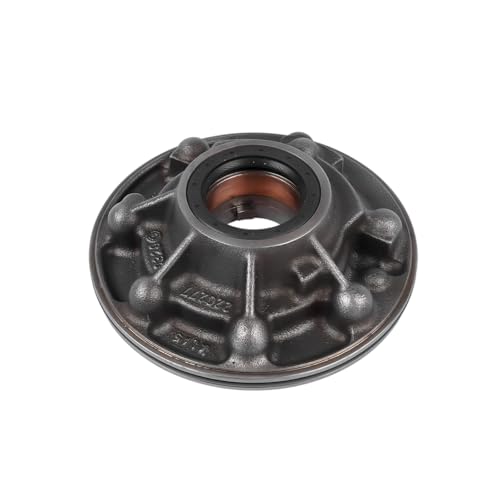
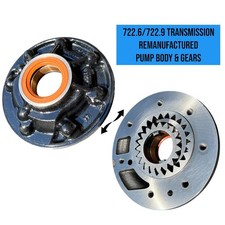
The 722.6 front pump is a gear pump driven directly by the torque converter hub. Every time the engine turns, the pump turns, so it produces flow in Park, Neutral and every gear. That is why a pump problem shows up in all ranges, and why a pump noise follows engine speed rather than road speed. The pump housing carries a bushing that supports the converter hub, and the stator support carries a rear bushing that supports the input shaft side.
Those bushings are the first wear point. Sonnax makes a direct replacement for the '96-and-later 722.6 pump bushing, part 68004-01, a steel-backed bushing with a copper-alloy bearing surface. Its listed dimensions are a 1.810" housing bore, a 1.692" shaft diameter and a 0.550" width. Sonnax notes the bushing is not available on its own from the OE, which is one reason worn pumps get replaced rather than re-bushed. The matching rear pump stator bushing, 68915-01, is listed at a 1.358" bore, 1.239" shaft and 0.420" width.
When the pump bushing wears, the converter hub runs off center. Three things follow:
- The front seal leaks. A seal can only hold a hub that runs true. Excess bushing clearance pushes the hub around the seal lip and lets more oil reach it than it was built to hold back.
- The gears wear the housing. An off-center drive gear rubs the pump pocket and crescent, opening the internal clearances. Once oil can slip back from the outlet side to the inlet side, output drops, and it drops most when the oil is hot and thin.
- The bushing can spin. Sonnax's oversized finish-in-place bushing, 68004-02, exists specifically to salvage 722.6 pump housings where the bushing has spun in its bore. Sonnax lists it to help cure "bushing spins in housing," pump leaks and damaged pumps. It has a 2.000" housing bore and is machined to fit the shaft after installation. It also fits the older 722.3 and 722.5.
Symptoms of a Failing 722.6 Pump
Here is what a tired pump actually does on the road, roughly in the order it tends to appear:
- Whine that follows engine rpm. Rev it in Park and in Neutral. If the pitch tracks the tach with the car sitting still, the noise is in something driven by the converter, and the pump is first in line. A noise that changes with road speed and not engine speed is not the pump.
- Delayed engagement, worse hot. Less flow means the clutch circuits fill slower. Expect it to engage normally on a cold start and get lazier after a long drive or in traffic.
- Slip or flare in every gear under load. A pump problem doesn't single out one shift. If only the 2-3 or 4-5 flares, look at the valve body first (more on that below).
- Front seal leak that comes back. A new seal that leaks again within a few months is a strong sign of hub runout from a worn pump bushing or a scored converter hub.
- Running hot. Low pump output means low converter charge and low cooler flow, so the oil does not get cooled well.
- No movement in any range. The end stage. A scored gear set, a cracked housing or a converter that no longer drives the pump means no pressure at all.
Check the pan sample too. Fine ferrous material that sticks to the magnet points toward gear wear. Aluminum glitter can come from a scored pump housing, but also from other aluminum parts, so treat it as a clue to confirm at teardown, not a diagnosis.
Rule Out the Things That Imitate a Bad Pump
1. Fluid level and type, done the Mercedes way
Low fluid starves the pump and produces nearly every symptom above, including the whine. Mercedes WIS procedure AR27.00-P-0100AC requires the car to be level on its wheels, gives a 25 C range and an 80 C range on the dipstick, and states that a precise check is only possible above 80 C. It also warns that both too little and too much oil can cause malfunctions and damage. The correct oil is MB sheet 236.14, which Mercedes star bulletin S-B-00.40/89d lists as red ATF 134, part number A001 989 68 03 10, and which must not be mixed with the 236.15 or 236.16 oils used in later units. Chrysler NAG1 units other than the Sprinter and Crossfire use ATF+4.
2. Software on 2012 Chrysler NAG1 vehicles
On 2012 Wrangler, Challenger, Charger, 300, Durango, Grand Cherokee and Liberty models with the W5A580, Chrysler bulletin 21-033-14 covers an erroneous P0730 (incorrect gear ratio) and a TCM reflash. Among the listed shift complaints are intermittent delayed engagement from Reverse to Drive and hanging in gear when hot and loaded. Make sure the TCM software is current before you blame the pump on one of these.
3. Valve body pressure regulation
This is the most common pump imitator on a 722.6. Mio Cundl's Transmission Digest article, republished by Sonnax, traces flares on the 2-3 and 4-5 upshifts (and neutral flare on the 5-4 and 3-2 downshifts) to wear in the outer bore of the working pressure regulator valve. Modulated solenoid signal oil leaks past the boost end of the valve, and working pressure stops rising with engine load. The pump is making plenty of oil; the valve body just isn't holding it. Sonnax's 722.6/NAG1 vacuum test guide shows where to vacuum test each critical bore. A bore that fails vacuum is your answer, and a new pump would not have fixed it.
The lubrication pressure regulator valve is the other one to check. Wayne Colonna's Transmission Digest article on the 722.6/NAG1 explains that when its inboard land wears the bore, unregulated line pressure gets into the converter charge circuit. That shows up as judder on lockup or a harsh engagement, symptoms that are easy to blame on the front of the unit.
4. The converter, not the pump
Low cooler flow and overheating are classic pump complaints, but on the 722.6 the converter is a common cause. Ed Lee, writing in Transmission Digest, explains that the 722.6 converter uses a three-path circuit, and the only thing separating the converter in/out oil from the lockup apply circuit is an interference fit between the input shaft and an aluminum sleeve in the converter cover. As that fit wears, oil escapes into the apply circuit, which is open to exhaust whenever lockup is released. Lee reports that on dyno tests some converters showed cooler flow as low as zero, against a Sprinter pass/fail window of 2.5 to 3.5 gallons per minute. The giveaway: cooler flow was close to normal with lockup applied and fell off when lockup was released. A new pump will not cure that. The same worn fit causes shudder on lockup apply.
The converter hub can also cause front leaks. Sonnax's MB-B-1 bushing restores worn 722.6 and 722.9 front cover hub bores, which Sonnax says can cause leakage and clearance problems. Repairing that bore requires machining and Sonnax tool MB-B-1T, which makes it a converter rebuilder's job.
Diagnosing It Without Pressure Taps
Transmission Digest's pressure-gauge diagnostics article points out that the 722.6 is one of the units with no pressure taps, so you can't simply tee in a gauge and read line pressure on a road test. You have to work by elimination:
- Codes and data first. Pull codes with Star/Xentry or a scan tool that reads Mercedes or Chrysler transmission data. Ratio and slip codes stored across several gears point toward pressure supply. A code tied to one gear points toward that clutch or its shift valve.
- Hot level check per AR27.00-P-0100AC, with the oil temperature confirmed on the scan tool.
- Noise test. Rev in Park and Neutral, then compare with a road test at the same engine rpm. A pump noise follows the tach.
- Engagement timing, cold and hot. Time Neutral to Drive and Neutral to Reverse cold, then again after 20 minutes of driving. A pump gets clearly worse hot. A sticking valve can be erratic at any temperature.
- Cooler flow. Measure flow at the return line. Low flow that recovers with lockup applied points at the converter seal, per Lee. Low flow in every state points toward the pump or lube regulator.
- Valve body vacuum test. If the pan is coming off anyway, vacuum test the working pressure regulator and lube regulator bores. Clean bores plus all of the above makes the pump the leading suspect.
The Fix: Pump Replacement Done Right
A pump job on the 722.6 means the transmission and converter come out. Once you are in there, do the whole front of the unit:
- Inspect the converter hub for scoring, bluing or a wear groove where the seal rides. A damaged hub will wear out a new bushing and seal fast. Send the converter out if the hub is marked or if you had low cooler flow or lockup shudder.
- Re-bush or replace the pump. If the housing pocket and gears are clean and within spec, a re-bush with Sonnax 68004-01 (pump) and 68915-01 (rear stator) is a sound repair. If the bushing spun or the pocket is scored, either machine in the 68004-02 finish-in-place bushing or install a complete replacement pump. Most shops find the complete pump faster.
- New front seal and pump O-ring. Never reuse them. Check the drive tangs on the converter and the pump gear for wear.
- Torque to the factory spec. Use the pump bolt torque and tightening sequence from WIS for your exact 722.6xx code. Center the pump so the gear does not bind; spin it by hand after torquing.
- Flush the cooler and lines. Material from a failed pump goes straight to the cooler and will come back into the new pump if you skip this.
- Fill and check. WIS has you put in about 5 liters before starting the engine, then top up with 236.14 oil (ATF+4 on most Chrysler NAG1 applications) and do the final check above 80 C.
If the pan sample showed burned friction material along with pump wear, the clutches were already slipping on low pressure. Rebuild the whole unit with an overhaul kit instead of replacing only the pump and sending it back out.
Preventing a Repeat
- Keep the level right with the correct oil. Most 722.6 pumps that fail early were run low or on the wrong fluid.
- Fix front seal leaks quickly, and find out why the seal failed. A leak that comes back means hub runout.
- Check cooler flow after any rebuild or converter swap. Lee's 2.5 to 3.5 GPM Sprinter dyno window is a useful reference for how much flow a healthy unit makes.
- On high-mileage units, vacuum test the valve body when you service it. A worn regulator bore makes the pump work harder and cooks the oil.
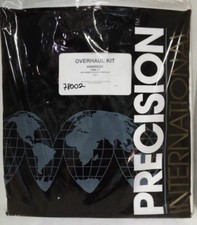
722.6 Overhaul Gasket & Seal Kit 1996-Up
All the gaskets, O-rings, lip seals and sealing rings for the reseal that goes with any 722.6/NAG1 pump job.
View the 722.6 gasket and seal kit →Shop 722.6 parts →
Frequently Asked Questions
What are the symptoms of a bad 722.6 transmission pump?
A whine that follows engine rpm in Park and Neutral, delayed engagement that gets worse once the oil is hot, slip or flare in every gear under load, a front seal leak that keeps coming back, and running hot. In the end stage the car will not move in any range. Symptoms that hit only one shift, like a 2-3 flare, usually point at the valve body instead.
Can a 722.6 pump be replaced without a full rebuild?
Yes, if the clutches are healthy. The transmission and converter have to come out, then the pump is re-bushed or replaced, the front seal and pump O-ring are renewed, and the cooler is flushed. If the pan sample shows burned friction material, the clutches already slipped on low pressure and a full overhaul is the better repair.
How do you check line pressure on a 722.6 with no pressure taps?
You can't tee in a gauge the way you can on most units, because the 722.6 has no pressure taps. Instead, work by elimination: scan for codes across several gears, do the hot level check above 80 C, time engagements cold and hot, measure cooler flow, and vacuum test the valve body regulator bores. Clean bores and good fluid with all-gear symptoms make the pump the leading suspect.
What fluid goes in a 722.6 after a pump replacement?
Mercedes 722.6 units take MB sheet 236.14 oil, red ATF 134, part number A001 989 68 03 10, per star bulletin S-B-00.40/89d, and it must not be mixed with 236.15 or 236.16 oils. Chrysler NAG1 units other than the Sprinter and Crossfire use ATF+4. Mercedes has you add about 5 liters before starting the engine, then finish the level check above 80 C.
Sources
- Sonnax — 722.6 Pump Bushing 68004-01. Backs the '96-later fitment, bimetal steel-backed construction with a copper-alloy bearing surface, the 1.810" housing bore, 1.692" shaft diameter and 0.550" width, the companion rear pump stator bushing 68915-01, and that the bushing is unavailable from the OE. sonnax.com
- Sonnax — 722.6 Pump Bushing 68004-02 (finish-in-place). Backs the oversized salvage bushing for damaged pump housings (2.000" housing bore, 1.678" shaft), the "helps cure" list of bushing spinning in the housing, pump leaks and damaged pumps, and 722.3/722.5 fitment. sonnax.com
- Sonnax — Bushing MB-B-1, Mercedes 722.6/722.9 front cover hub. Backs the converter front cover hub bore wear causing leakage and clearance problems, and the repair requiring machining and tool MB-B-1T. sonnax.com
- Transmission Digest — Ed Lee, "The Importance of a Positive Seal: 722.6 Issues" (July 1, 2018). Backs the three-path converter circuit, the input shaft interference-fit leak, lockup shudder and low or zero cooler flow, the 2.5-3.5 GPM Sprinter cooler-flow pass/fail window, and flow dropping when lockup is released. transmissiondigest.com
- Sonnax / Transmission Digest — Mio Cundl, "Mercedes 722.6, Daimler W5, Porsche W5, Jaguar 722.6." Backs the working pressure regulator valve bore wear, 2-3/4-5 upshift flare and 5-4/3-2 neutral flare, working pressure not rising with load, and the NAG1 fluid split (Sprinter/Crossfire vs ATF+4). sonnax.com
- Transmission Digest — Wayne Colonna (ATSG), "722.6/NAG 1" (January 1, 2010). Backs the lubrication pressure regulator bore wear that lets line pressure into the converter charge circuit, and the resulting judder and harsh engagement. transmissiondigest.com
- Mercedes-Benz USA — Star Bulletin S-B-00.40/89d, "Operating Fluid Specification Changes for Automatic Transmission" (November 6, 2013). Backs the 722.6 fluid: sheet 236.14, red ATF 134, part number A001 989 68 03 10, and the no-mixing rule. static.nhtsa.gov (PDF)
- Mercedes-Benz (Daimler AG) — WIS AR27.00-P-0100AC, "Check oil level in automatic transmission," 722.6. Backs the level-on-wheels requirement, the 25 C and 80 C dipstick ranges, the over-80 C precise check, the roughly 5-liter pre-start fill, and the warning on over- and under-filling. Factory document, PDF copy hosted by mbclub.ru
- Chrysler Group — Service Bulletin 21-033-14 (October 22, 2014), W5A580 TCM flash. Backs the 2012 model list, erroneous P0730, and the delayed-engagement and hot hang-in-gear complaints addressed by software. static.nhtsa.gov (PDF)
- Sonnax — "Mercedes 722.6/NAG 1 Vacuum Test Guide." Backs the critical valve body wear areas and vacuum test locations. sonnax.com
- Transmission Digest — "Diagnosis with Pressure Gauges." Backs that the 722.6 has no pressure taps. transmissiondigest.com
Shop 722.x pumps, overhaul kits and rebuild kits on our own secure checkout.
Shop 722.x parts →