A core shows up with the tag half rubbed off, or a customer reads you numbers off a sticker through the phone, and you need to know what is actually sitting on the bench before you quote fluid, a filter or a rebuild. The 722.9 is an easy transmission to misidentify because the case stamping, the fluid spec, and even the AMG badge all carry their own numbers, and none of it lines up neatly with the model year painted on the window sticker.
This is the identification pass worth running before you order anything: name and generation, production-number break, AMG variant, and known hard-part changes. Skip any one of those and there is a real chance the fluid or filter that shows up is wrong for the unit in front of you.


The short version
722.9 is the Mercedes-Benz factory type number for the transmission Mercedes marketed as 7G-TRONIC starting in September 2003, and the shop-floor shorthand for it is NAG2, short for the German term for new automatic gearbox, generation two, distinguishing it from the five-speed 722.6/NAG1 that came before it. Per the SAE technical paper covering the transmission's introduction, it was the fifth generation of Mercedes' own in-house automatic transmission development dating back to 1960, and it launched as the world's first 7-speed automatic, fitted initially to V8-gasoline S-Class, SL-Class, CL-Class and E-Class models before Mercedes rolled it out across the rest of its 8-cylinder lineup, including the C-Class and G-Class, per Professional Motor Mechanic's technical breakdown of the unit.
Mechanically, the same PMM breakdown describes the 722.9 as running three planetary gear sets plus a Ravigneaux gear set to produce seven forward speeds and two reverse, with the mechatronic assembly, the transmission control unit, hydraulic valve body and eight solenoid control valves, built directly onto the unit rather than mounted externally the way it was on the 722.6. The case itself is magnesium, which the same source credits as a first for any manufacturer on a production transmission, done specifically to cut weight. Torque capacity tops out at 735 Nm, which is the reason Mercedes kept the older 722.6-based 5G-Tronic, rated to 1,079 Nm, in its highest-output V12 applications instead of moving them to the 7-speed.
Where the identification stamp sits
Like the 722.6 before it, the 722.9's build stamp sits low on the case, between the bellhousing and the pan rail, facing down toward the floor rather than out toward the fender, which is why it so often arrives caked in grime and road film on a core. Wipe that area down before you do anything else. The stamp is the only place that reliably carries the production number, and that number, not the car's model year, is what decides which fluid spec the unit was built around.
Early 722.9 vs. the "Plus": the fluid-critical split
This is the identification step that actually changes what you buy. Per Mercedes-Benz USA's Star Bulletin S-B-00.40/89d, issued November 6, 2013 to cover operating fluid specification changes across the 722.6, 722.9, 724.2 and 725.0 families, the 722.9 has a hard production break at transmission production number 23834526:
- Before production number 23834526: the transmission runs MB-Approval 236.14 fluid only, documented under WIS reference BB.00.40-p-0236-14a, with Mercedes part number A001 989 68 03 10. This is the red oil.
- After production number 23834526, on engines 113, 152, 156, 157, 275 or 279: the bulletin specifies 236.15 fluid (WIS reference BB.00.40-p-0236-15a, part number A001 989 78 03 09). This is the blue oil, and it is the generation most of the trade calls the 722.9 "Plus."
- After production number 23834526, on other engines: the bulletin allows either 236.15 or the newer 236.16 (WIS reference BB.00.40-p-0236-16a, part number A 001 989 92 03), the gold oil used on the newest production.
The bulletin is blunt about the stakes: separate filling units have to be used for 236.14, 236.15 and 236.16 because, in its words, "these oils must never be mixed with other oils." Color-coding the fluid in your shop by spec, and keeping a dedicated fill rig for each, is cheaper than explaining a comeback caused by cross-contamination. The official MB-Approval 236.15 technical data sheet, published by Motul as one of the licensed suppliers, confirms the same application: a fully synthetic fluid built specifically for Mercedes' 7-speed transmissions in production since 2010, carrying forward compatibility with the earlier 236.14 approval but not the other way around.
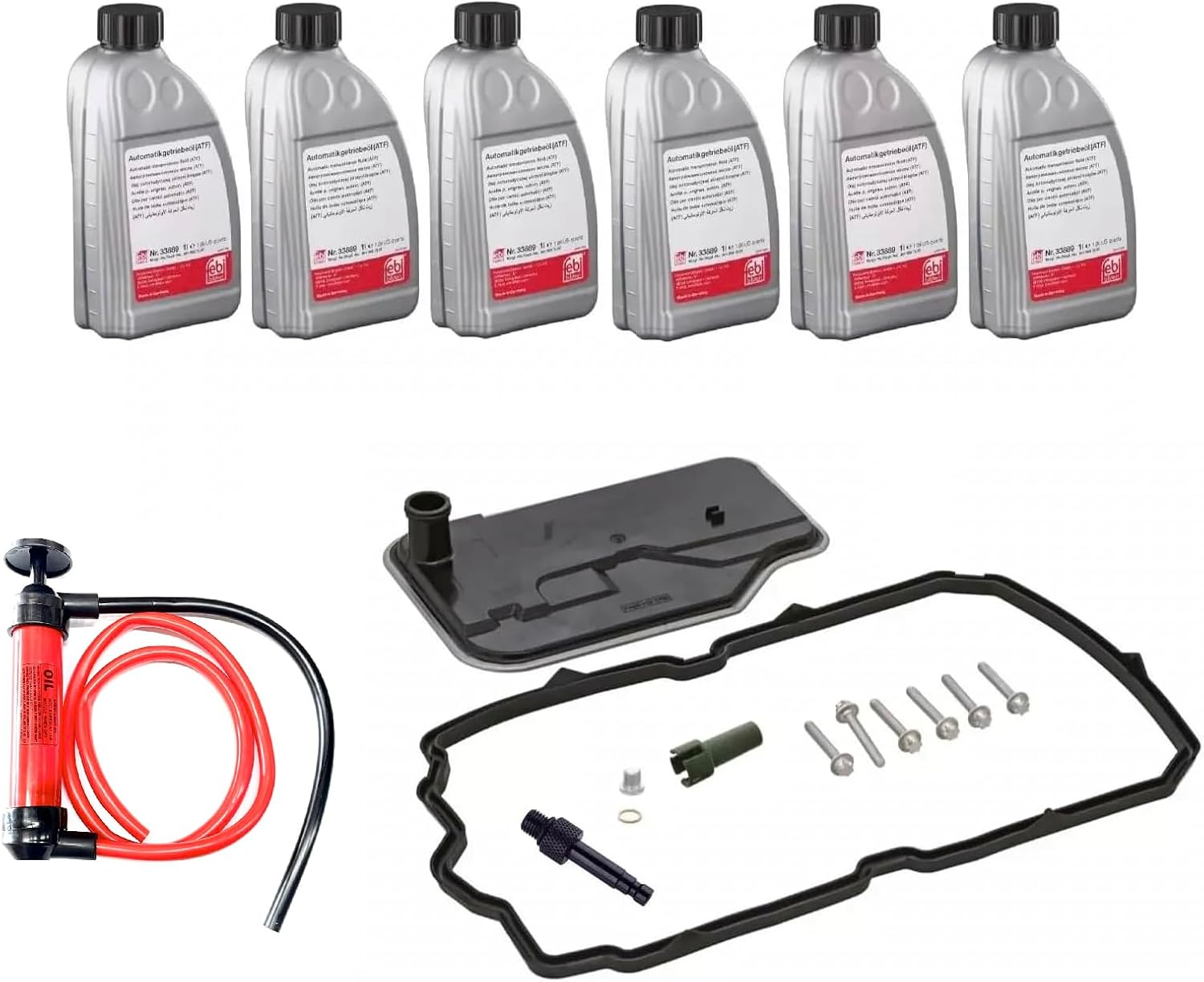
Filter kits, ATF in the correct 236.14 or 236.15 spec, valve bodies and master rebuild kits for the 722.9 7G-Tronic, once you've confirmed which generation you're holding.
Shop 722 parts →AMG units carry their own type numbers
A plain "722.9" stamp is not the whole story on an AMG car. Per a Daimler AG technical bulletin addressing minor oil-trace complaints on the transmission, AMG applications are built under their own model designations: 722.905, 722.907, 722.909, 722.930, 722.931, 722.932 and 722.971. The same bulletin is specific that those designations are not just a labeling quirk; it instructs the technician to skip the standard diagnosis tree entirely on an AMG unit and open a PTSS case with photos of the leak, the EEPROM, and a quicktest readout instead. If the number on the stamp starts with one of those AMG codes, the escalation path and the paperwork both change, regardless of how the complaint looks on the lift.
Check for the pump redesign before you blame the rebuild
One running change is worth knowing before you tear into a 722.9 core. Per ATSG technical editor Wayne Colonna, writing in Transmission Digest, a common and well-documented 722.9 failure is the pump bushing seizing to the converter neck. When that happens, the pump drive gear can walk off-center, catch the crescent, and take the converter housing out along with it, which is exactly the kind of failure that gets blamed on a bad rebuild when the root cause is upstream of it. The article traces the cause to an incompatible material pairing between the original bushing and the converter neck, and notes that Mercedes answered it with a redesigned pump that uses a needle bearing in place of the bushing, cataloged under part number 722 270 0197. If a core on your bench already carries that part number stamped on the pump, the updated design is already in it; if it does not, budget for the upgraded pump on the rebuild rather than reusing the original.
A five-point checklist before you order anything
- Wipe down and read the stamp between the bellhousing and the pan before you do anything else. The production number there, not the car's model year, decides the fluid spec.
- Find your side of the production number 23834526 break. Before it: 236.14, red, part A001 989 68 03 10. After it: 236.15 (blue) or, on current production, 236.16 (gold), with their own distinct part numbers. Never mix them and never guess from the model year alone.
- Check for an AMG type number. A stamp reading 722.905, 722.907, 722.909, 722.930, 722.931, 722.932 or 722.971 means an AMG-spec unit with its own documentation and escalation path.
- Look for part number 722 270 0197 on the pump. That is the needle-bearing redesign that replaced the original bushing after the known pump-to-converter-neck seizure failure.
- Confirm torque class before swapping in a 722.6. The 722.9's 735 Nm ceiling is why some V12 applications kept the older 722.6-based 5G-Tronic instead; don't assume the two are interchangeable across those platforms.
FAQ
What does "722.9" mean, and is it the same thing as 7G-Tronic or NAG2?
Yes, all three names point at the same transmission. 722.9 is the Mercedes-Benz factory type number, 7G-TRONIC is the marketing name Mercedes used starting in September 2003, and NAG2 (New Automatic Gearbox, generation two) is the shop-floor shorthand that distinguishes it from the earlier 722.6/NAG1 five-speed. Per the SAE technical paper on the transmission, it was the fifth generation of Mercedes' in-house automatic transmission development since 1960, and it launched as the world's first 7-speed automatic, fitted first to V8-gasoline S-Class, SL, CL and E-Class models before spreading across the rest of the 8-cylinder lineup.
How do I tell an early 722.9 from the 722.9 "Plus" before I add fluid?
Check the production number stamped on the case, not the model year on the title. Per Mercedes-Benz USA's Star Bulletin S-B-00.40/89d, the hard break is transmission production number 23834526: units built before that number run MB-Approval 236.14 fluid (red, part number A001 989 68 03 10), and units built after it move to 236.15 (blue) or, on the newest production, 236.16 (gold), with their own distinct part numbers. The bulletin is explicit that these oils must never be mixed and that separate filling equipment is required for each, so the production number is the only reliable way to know which one you are looking at.
What type numbers show up on AMG-spec 722.9 units?
AMG applications carry their own sub-variant type numbers rather than a plain 722.9 stamp. Per a Daimler AG technical bulletin covering minor oil-trace complaints on the transmission, AMG vehicles are built with transmission model designations 722.905, 722.907, 722.909, 722.930, 722.931, 722.932 or 722.971, and the bulletin specifically instructs techs to skip the standard diagnosis tree on those units and open a PTSS case with photos instead. If the stamp reads one of those numbers, treat the paperwork and the escalation path differently from a standard 722.9 core.
Is there a known hard-part redesign I should check for on a used 722.9?
Yes, on the oil pump. Per ATSG technical editor Wayne Colonna writing in Transmission Digest, a common and well-known 722.9 failure is the pump bushing seizing to the converter neck, which lets the pump drive gear walk off-center and take out the converter housing with it. The root cause traced to a bad bushing-to-converter-neck material pairing, and Mercedes released a redesigned pump using a needle bearing in place of the original bushing, under part number 722 270 0197. A core stamped with that part number has the updated pump already installed.
What's the maximum input torque the 722.9 is rated for, and why do some V12 Mercedes models not use it?
Per Professional Motor Mechanic's technical breakdown of the transmission, the 722.9 is rated to a maximum of 735 Nm of input torque. That ceiling is why Mercedes kept the older 722.6-based 5G-Tronic in its highest-torque V12 applications, which needed to handle up to 1,079 Nm, well beyond what the 7-speed case and internals were designed to absorb. If you are quoting a rebuild on a high-torque V12 car and find a 722.6 instead of a 722.9, that torque ceiling is the engineering reason why.
Related guides
- 722.6 vs 722.9: Differences, Interchange and Which Is Stronger
- 722.6 Identification Guide: NAG1, W5A580, and How to Tell Them Apart
- 722.9 Fluid Type and Capacity
- 722.9 Common Problems and Fixes
- 722.9 Rebuild Cost
722.9 master rebuild kit → or browse the 722.9 filter
Sources
- Mercedes-Benz USA, LLC / Mercedes-Benz Canada, Inc. — Dealer Star Bulletin S-B-00.40/89d, "Operating Fluid Specification Changes for Automatic Transmission," Revision d, November 6, 2013. Backs the hard production break at transmission production number 23834526; the pre-break requirement for MB-Approval 236.14 (part A001 989 68 03 10); the post-break requirement for 236.15 or 236.16 depending on engine code (parts A001 989 78 03 09 and A 001 989 92 03); the WIS document references for each spec sheet; and the instruction that the oils must never be mixed and require separate filling equipment. static.nhtsa.gov (NHTSA-hosted OEM bulletin)
- Daimler AG — Technical bulletin LI27.55-P-0589, "Procedure in Case of Slight Oil Traces on Transmission 722.9," August 14, 2014. Backs the AMG-specific transmission model designations 722.905, 722.907, 722.909, 722.930, 722.931, 722.932 and 722.971, and the instruction to open a PTSS case with photos rather than process the standard diagnosis tree on those units. static.nhtsa.gov (NHTSA-hosted OEM bulletin)
- Transmission Digest — Wayne Colonna (ATSG), "722.9 Pump Failure," Technically Speaking, April 1, 2012. Backs the well-documented pump bushing-to-converter-neck seizure failure, the material-incompatibility root cause, and the redesigned needle-bearing pump under part number 722 270 0197. transmissiondigest.com
- SAE International — Technical Paper 2004-01-0649, "The New 7G-TRONIC of Mercedes-Benz: Innovative Transmission Technology for Better Driving Performance, Comfort and Fuel Economy," March 8, 2004. Backs the September 2003 introduction on V8-gasoline S-Class, SL-Class, CL-Class and E-Class models, and the transmission's standing as the fifth generation of Mercedes' in-house automatic transmission development since 1960. saemobilus.sae.org
- Motul — Official Technical Data Sheet, ATF 236.15, MB-Approval 236.15. Fluid-maker specification sheet; backs the 236.15 fluid's formulation for Mercedes 7-speed ("7G-Tronic") transmissions in production since 2010 and its forward-compatible approval over the earlier 236.14 specification. motul.com
- Professional Motor Mechanic — "Inside the 7G-Tronic TCU," technical feature. Trade-magazine technical breakdown; backs the 2003 introduction across Mercedes' 8-cylinder lineup including C-Class, E-Class, S-Class and G-Class chassis, the three-planetary-plus-Ravigneaux gearset architecture, the magnesium transmission case described as a first for any manufacturer, the integrated mechatronic TCU/valve body assembly with eight solenoids, and the 735 Nm torque ceiling versus the 5G-Tronic's 1,079 Nm rating. Not a primary authoritative source; cited for architectural and historical detail only. pmmonline.co.uk