A Mercedes-Benz 722.9 (7G-Tronic, NAG2) that will not move in Drive or Reverse usually shows up on a flatbed, and the owner has already been told it needs a transmission. Sometimes it does. But on this unit a no-movement complaint has at least four very different root causes, and two of them are not inside the case at all: a low battery that has locked the car in Park through the Intelligent Servo Module, and a driveline fault behind the transmission. This guide works the problem in the order that gets you to the real failure fastest, using Mercedes-Benz service information and documented shop cases from Transmission Digest and Gears Magazine.
Diagnostics
722.9 No Movement in Any Gear: Diagnosis
Recommended 722.9 parts
In stock, ships same day from the USA. Secure checkout.

First Question: Is It Really "No Movement," or Is It Stuck in Park?
Those are two different complaints and they get mixed up on the phone and on the tow sheet. A true no-movement unit lets you pull the selector into D or R, the cluster shows the range, the engine revs, and the car sits there or creeps with no power. A Park-locked car will not leave P at all, or it drops back into P on its own, and the cluster may be showing "Drive To Workshop Without Changing Gear." On a 722.9 behind a DIRECT SELECT shifter (the column stalk or the Park button), that second complaint is almost always electrical and has nothing to do with the hydraulics inside the case.
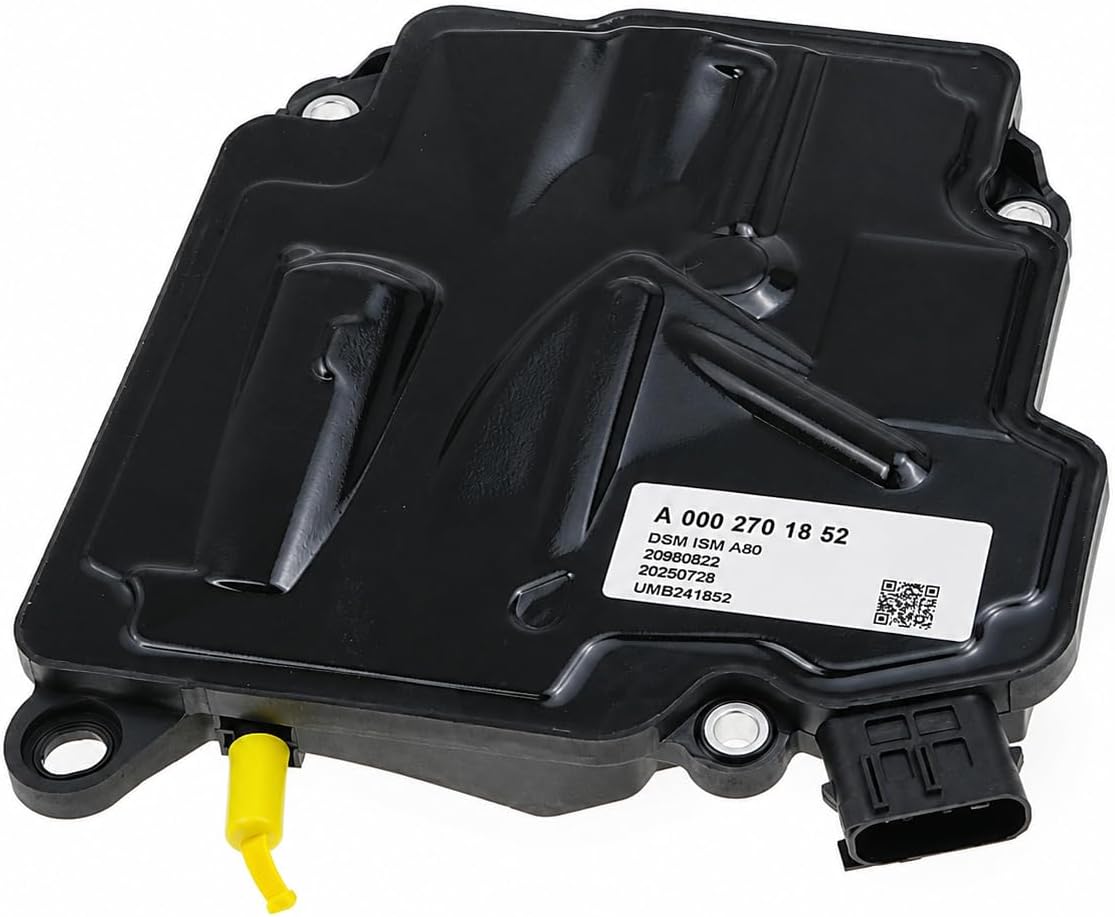
The difference matters because a DIRECT SELECT car has no cable between the driver and the manual valve. Per Mercedes-Benz StarTuned, the Intelligent Servo Module (ISM, component A80) bolted to the transmission physically moves the selector shaft to the requested range with a motor-driven screw and slide nut, and it reports the position back through a sensor. It is also part of the Drive Authorization System, so it will not move anything until the key, the electronic ignition switch (N73), the engine controller and the transmission controller (Y3/8) all agree. If that handshake breaks, the transmission is not "failing to engage" a range. It was never asked to.
Cause 1: Undervoltage and the Emergency-P Function
This is the cheapest fix on the list and the one most often missed. The ISM has an Emergency-P function: when the electronic ignition switch sees a fault, it powers a separate emergency motor that lets spring pressure force the selector into Park. StarTuned is blunt that the emergency motor cannot be reversed from outside. The car stays in P until the underlying cause is fixed. Their most common cause: a dead or nearly dead battery. Some models carry a small 1.2 Ah Emergency-P battery just for this job, newer ones use the main battery, and ECO Start/Stop cars use the secondary battery.
Mercedes-Benz work instruction LI27.60-N-071845 (version 2, dated October 28, 2021, filed with NHTSA) covers this exact complaint on Metris (model 447) and Sprinter (906 and 907) vans with the 722.9. It lists four causes in order: undervoltage of the main on-board battery (G1), with communication faults stored in the control units on the chassis CAN bus; undervoltage of the Emergency-P battery (G1/13); a power supply fault to the ISM control unit; and only last, an internal ISM fault, which the bulletin limits to cases where fault code P179Cxx is current or stored. The remedy runs in that same order: quick test, battery test and replacement if needed, re-check the complaint, then test the Emergency-P or auxiliary battery, re-check again, and only then move on to the ISM itself.
When it is the wiring or the CAN bus
If voltage is good and the ISM still will not respond, StarTuned's procedure is to check the engine CAN bus (CAN-C) that the ISM talks on. Each wire should read roughly 2.4 to 2.6 volts DC to ground. About 0 volts on a wire points to a short to ground, about 12 volts to a short to power, two identical readings to the wires shorted together, and two readings of 0 volts to an unplugged connector. Split the bus at the voltage distributor to isolate a branch, then check supply voltage at the ISM connector both unloaded and with the ISM plugged in. StarTuned notes the ISM itself is rarely the failed part, so do every test before you condemn it.
If the ISM really is bad
A replacement ISM is a theft-relevant part. It is programmed to one VIN, so a used module off a salvage car will not work. StarTuned lists what the install takes: XENTRY with "Initial start-up of already installed control unit" on the A80 adaptations tab, followed by the calibration routine so the module learns each selector position, plus a software check through XENTRY Flash with a battery maintainer on the car. Replace the aluminum mounting bolts and the vent hose every time. If you do not have the online access to personalize the part, plan on a dealer visit for that step. If the car has to move before then, XENTRY can command Neutral for towing.
Cause 2: Zero Line Pressure from a Seized Pump Bushing
If the car shows D or R, the engine revs, and nothing happens, the next stop is a pressure gauge. Transmission Digest's November 2014 Tech/Talk case is the textbook example: a 2006 CLK500 with 85,000 miles made a noise on the highway, the engine flared, and the car coasted to the shoulder with no movement. The shop checked fluid and codes, put a gauge on it, and found no line pressure and debris in the pan. With the converter pulled the cause was obvious: the pump bushing had welded itself to the converter hub and spun.
This is a well-documented 722.9 failure. Wayne Colonna of ATSG described it in Transmission Digest back in April 2012: the bushing seizes to the converter neck, the pump drive gear moves off center, catches the corner of the crescent, and can chew into the converter housing too. The explanation he passed on from an import specialist was a bad pairing of bushing material with converter neck material. Mercedes answered with a redesigned pump that uses a needle bearing in place of the bushing, part number 722 270 0197, and that bearing pump is the only design Mercedes now supplies.
Two rebuild details come out of the 2014 article that save comebacks. First, the 722.9 pump gears run directly against the bellhousing with no steel plate in between, so a failed pump often grooves the bell. Light marks can be machined out. Deep ones mean a new housing, or a drop-in steel pump plate if the surface is flat enough to take one. Second, a bearing pump needs a converter hub hard enough to act as a bearing journal. Gears Magazine (ATRA) adds that when the later bearing pump ran on the early, unhardened hub, the hub or bearing tended to pit and whine. Tell your converter builder it is going behind a bearing pump and ask for the later hardened neck.
Cause 3: Internal Apply Problems (K1 Piston, Rebuild Errors)
Some no-move complaints are partial: the car moves in some ranges and not others, or drops to neutral at one shift. Gears Magazine's 722.9 rundown says molded pistons fail on this unit like any other, with the K1 drum piston the most common. When it goes, the transmission usually falls into neutral heading into third. The same article covers bearing failures between the K1 drum and stator support on early units, which Mercedes fixed with an updated stator and drum. Gears recommends installing the later parts on any rebuild rather than risking a warranty job.
The comeback version is worse because everyone assumes a brand-new part failed. Transmission Digest (Wayne Colonna, August 2023) documented a 2007 CLS550 with no forward movement after overhaul. The B2 brake inner apply piston had gone in upside down. B2 applies in first through fourth gear and holds the rear sun gear, so with that piston backward the unit had no way to start off. Flipping the piston restored forward movement. If a fresh rebuild will not move, air-check B2 and the other packs before you order a second valve body.
Cause 4: It Is Not the Transmission at All
Transmission Digest's May 2025 "Bushwhacked" case belongs on every 722.9 diagnostic sheet. A 2005 E500 with a no-move condition was rebuilt, then kept losing drive on road tests. The shop pulled the unit three times and checked splines and air-checked everything. They even changed and programmed the valve body. Under heavy throttle it kept dropping to neutral. Finally someone watched from underneath: the driveshaft was turning. On the hoist they saw the rear differential pull down to the right under torque and pull the right axle partly out of the diff. The root cause was a missing differential support bushing. A new bushing ended it.
The lesson costs nothing to apply. Before you pull a 722.9 for a no-move, put the car on a lift, run it in gear, and look at whether the output and driveshaft are turning. If they are, your problem is behind the transmission.
Do Not Skip the Fluid Check
Low fluid can produce a no-move on any automatic, and on a 722.9 there is the extra trap of the wrong fluid. Mercedes-Benz bulletin S-B-00.40/89d (archived by NHTSA) sets a production break on June 21, 2010 at transmission serial number 23834526. Units built before it take red ATF134 to MB 236.14 (A001 989 68 03 10). Most units built after it take blue FE-ATF134 to MB 236.15 (A001 989 78 03 09), except behind engines 113, 152, 156, 157, 275 and 279, which stay on 236.14. The bulletin says the two must never be mixed. On a unit that is already marginal, the wrong fluid is one more thing working against you.
The Diagnostic Order That Works
- Pin down the complaint. Stuck in P, or in gear with no drive? Note the cluster message and whether the car has DIRECT SELECT.
- Quick test every module. Multiple U-codes on the chassis CAN, or a stuck-in-Park complaint, sends you to voltage. P179Cxx points at the ISM itself.
- Test the batteries. Main battery, then the Emergency-P or auxiliary battery. Fix charging problems and re-check the complaint after each step, the same way LI27.60-N-071845 does it.
- Check the CAN-C wiring and ISM power if voltage is good: about 2.4 to 2.6 V per bus wire, then supply voltage at the ISM connector, unloaded and loaded.
- Check fluid level and spec against the production date.
- Put it on a lift in gear. If the driveshaft turns, look at the axles, the differential and its mounts.
- Hook up a pressure gauge. Zero line pressure with debris in the pan is the pump bushing pattern. Plan on the bearing pump and a hardened-neck converter.
- Partial no-move or neutral into third: suspect the K1 piston. After a rebuild, air-check every pack and confirm B2 piston orientation.
FAQ
Why is my Mercedes 722.9 stuck in Park and showing Drive To Workshop Without Changing Gear?
On cars with DIRECT SELECT, the Intelligent Servo Module moves the transmission's selector shaft, and when it sees a fault it uses its Emergency-P function to force the transmission into Park. Mercedes-Benz work instruction LI27.60-N-071845 lists undervoltage of the main battery as the first cause, then undervoltage of the Emergency-P battery, then ISM power supply, and only last an internal ISM fault with code P179Cxx. Test both batteries and the charging system before replacing anything.
Can a bad battery really make a 722.9 not move?
Yes, on DIRECT SELECT cars. Mercedes-Benz StarTuned says a dead or nearly dead battery is the most common trigger for Emergency-P, and once Emergency-P engages the emergency motor cannot be reversed from outside, so the car stays in Park until voltage is restored. Communication codes stored across several modules on the chassis CAN bus are the usual clue that voltage dropped.
What causes a 722.9 to lose all movement while driving?
The best documented mechanical cause is the pump bushing seizing to the torque converter hub. Transmission Digest covered a 2006 CLK500 at 85,000 miles that lost drive on the highway with zero line pressure, and teardown found the bushing welded to the converter hub. Mercedes replaced the bushing pump with a needle-bearing pump, part number 722 270 0197.
Can I install a used ISM from a salvage 722.9?
No. The ISM is a theft-relevant part programmed to one VIN, so a used module will not work in another car. A new one has to be initialized and calibrated in XENTRY with online access, and Mercedes-Benz StarTuned also calls for new aluminum mounting bolts and a new vent hose on every replacement.
My 722.9 was just rebuilt and will not move forward. What should I check?
Check piston orientation before you suspect a new part. Transmission Digest documented a 2007 CLS550 with no forward movement after overhaul caused by the B2 brake inner apply piston installed upside down. B2 applies in first through fourth gear, so a backward piston leaves the unit unable to launch. Also put the car on a lift in gear and confirm the driveshaft is not turning, since a missing differential bushing caused a repeat no-move on a rebuilt E500.
Found the real cause of your 722.9 no-movement complaint?
ISM modules, bearing-style pumps, and complete master rebuild kits, shipped fast from the USA.
Shop 722.9 parts →Shop the part for this fix: 722.9 bonded piston set
If teardown turns up a failed K1 piston or a damaged B2 apply piston, CoreTransmissionParts stocks the complete 722.9 bonded piston set so you replace them all at once.
Shop the 722.9 piston set at CTP →Need the full kit instead? Browse CTP rebuild kits.
Sources
- Mercedes-Benz AG — Work instruction LI27.60-N-071845, version 2, October 28, 2021, "Display message Drive To Workshop Without Changing Gear is shown and/or the transmission does not shift out of P" (models 447, 906 with ISM, 907 with 722.9; filed with NHTSA). Backs the four listed causes (main battery undervoltage, Emergency-P battery undervoltage, ISM power supply, internal ISM fault only with P179Cxx) and the step-by-step remedy order. static.nhtsa.gov
- Mercedes-Benz StarTuned — "The Intelligent Servo Module," December 2016. Backs how the ISM (A80) moves the selector shaft, its role in the Drive Authorization System, the Emergency-P function and 1.2 Ah battery, CAN-C voltage checks (about 2.4 to 2.6 V per wire), and the theft-relevant replacement, initialization and calibration requirements. automotivetechinfo.com
- Transmission Digest — Tech/Talk, "Mercedes 722.9 failure," November 2014 issue. Backs the 2006 CLK500 no-movement case at 85,000 miles with zero line pressure, the bushing welded to the converter hub, the bearing pump 722 270 0197, pump gears running on the bellhousing, and the converter hub hardness concern. transmissiondigest.com
- Transmission Digest — Wayne Colonna (ATSG), "722.9 Pump Failure," April 1, 2012. Backs the pump bushing seizing to the converter neck, the drive gear moving off center into the crescent, and the needle-bearing replacement pump. transmissiondigest.com
- Transmission Digest — Wayne Colonna, "Mercedes-Benz 722.9 no forward movement after overhaul," August 1, 2023, and "Bushwhacked: The case of the missing bushing," May 8, 2025. Back the B2 inner apply piston installed upside down and the E500 repeat no-move caused by a missing differential support bushing. transmissiondigest.com (B2 piston) · transmissiondigest.com (missing bushing)
- Gears Magazine (ATRA) — Rob Faucett, "Common Mercedes 722.9 Problems," September 2018. Backs the K1 molded piston failure that drops the unit into neutral going into third, the early K1 drum and stator support bearing update, and pitting of early converter hubs behind the bearing pump. gearsmagazine.com
- Mercedes-Benz USA — Star Bulletin S-B-00.40/89d, "Operating Fluid Specification Changes for Automatic Transmission," November 2013 (archived via NHTSA). Backs the June 21, 2010 production break at serial 23834526, the 236.14 and 236.15 fluid part numbers, the engine exceptions, and the never-mix rule. static.nhtsa.gov
Need parts for this job?
Shop 722.9 ISM modules, pumps, and master rebuild kits — shipped fast from the USA.
Shop 722.9 parts →